
- Bluebook SAT Practice Test Study Plan for November 2026
- Why the domain breakdown matters more than the top-line score
- How to use a Bluebook practice test for SAT practice test score analysis
- Picking the two or three domains worth targeting first
- Turning weak domains into a digital SAT study plan
- Two sample timelines: three weeks versus ten days before test day
- Checking progress and repeating Bluebook SAT practice tests
- What to verify before the November 2026 SAT
- What to do next
Bluebook SAT Practice Test Study Plan for November 2026
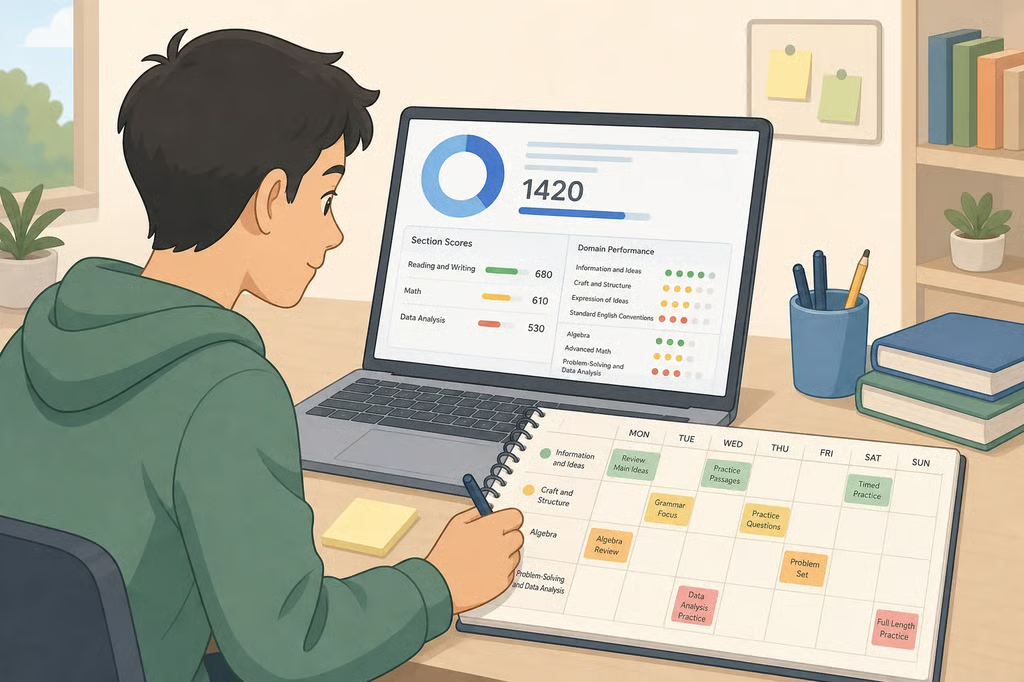
A single full-length Bluebook practice test can do more than hand back a score. Read correctly, it works as a diagnostic that shows exactly where to spend study time before test day. The score itself gives a broad performance reference; the domain-by-domain breakdown underneath it is what helps decide what to study next, and building a Bluebook SAT practice test study plan around that breakdown is the point of this guide.
College Board describes a Bluebook practice test as the best and most accurate way to measure the same skills tested on the actual exam, and notes that practicing in Bluebook also familiarizes students with the testing app they will use on test day, according to College Board's study plan guide. After a student finishes a test, the My Practice dashboard reports performance by content domain instead of a single raw score, according to College Board.
That domain data is the starting point whether test day is three weeks away or ten days away. This guide covers how to read the report, sort out what's actually causing each missed question, match that cause to a specific practice tool, and build a short calendar around it. Some of the guidance behind this comes from sources a year or two old at this point, so a few specifics, registration deadlines and device requirements especially, are flagged below for a direct check on College Board's current site rather than treated as settled facts.
Why the domain breakdown matters more than the top-line score
The SAT uses a multistage adaptive design: each section splits into two modules, and the questions a student sees in the second module depend on performance in the first, according to College Board's scoring explanation. One effect of that design is that two students who answer the same number of questions correctly in a section can still earn different section scores, since scores may differ based on the characteristics of the questions answered, including difficulty, per the same source.
That's the reason to treat a practice score as a broad reference point rather than a locked-in preview of an official result, and it's the reason the rest of this guide works from the domain breakdown instead of the overall number.
How to use a Bluebook practice test for SAT practice test score analysis
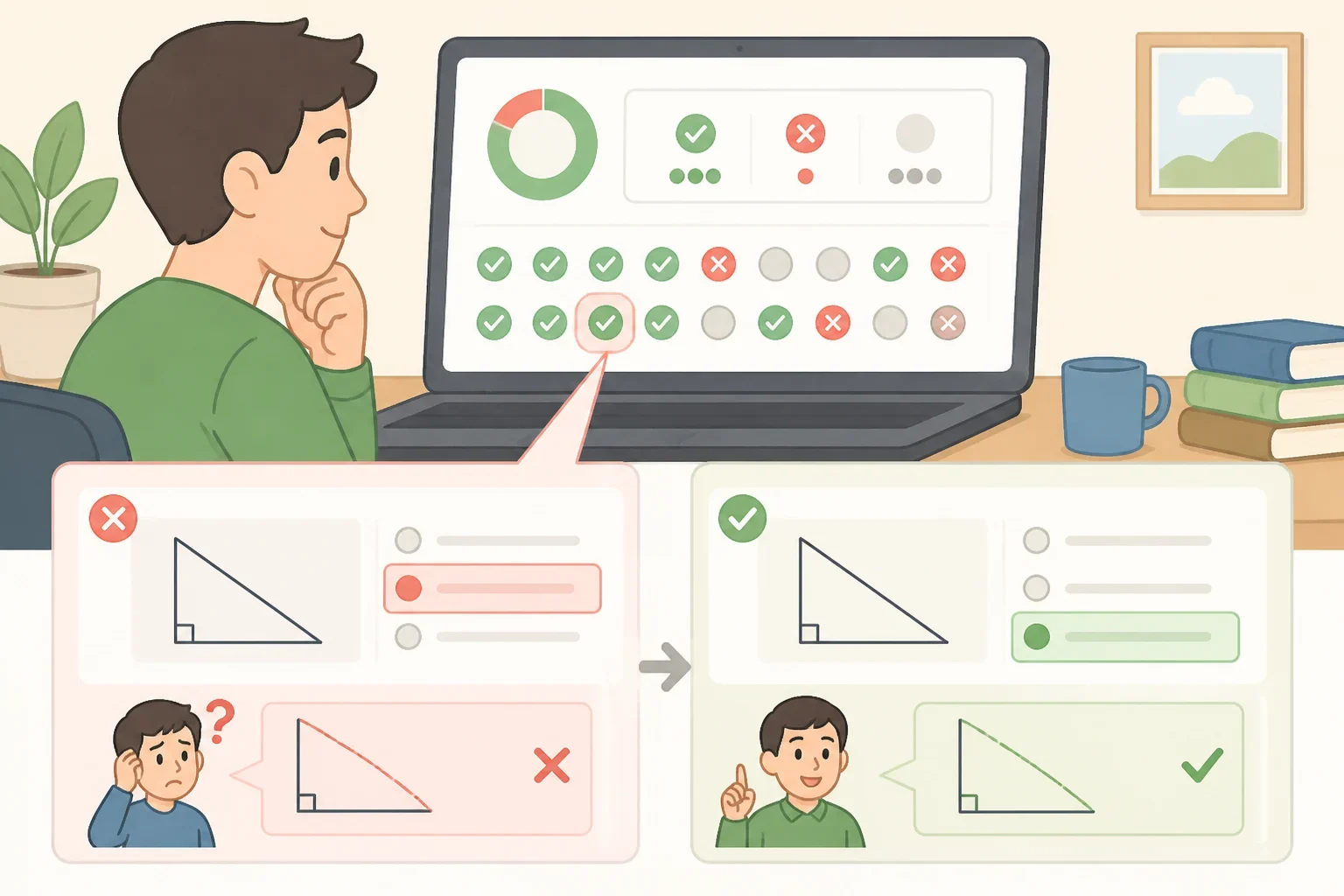
Every practice test includes a Score Details page listing each question, the student's answer, the correct answer, and a breakdown of every answer choice, including the ones the student didn't pick, according to College Board. College Board recommends reading the entire explanation rather than skimming just the correct-answer justification, since understanding why the wrong options are wrong helps prepare for similar questions later.
That review step is where a study plan actually starts. For each missed question inside a weak domain, sort the cause into one of four buckets:
- Content gap: the underlying rule or skill wasn't known
- Misread: the question or passage was misunderstood, even though the skill itself was familiar
- Timing: the question was rushed or guessed near the end of a module
- Careless slip: a mistake on something the student actually knows
This sorting isn't a College Board feature. It's a habit that turns a vague "weak in this domain" into something specific enough to act on.
Consider two students who both miss Command of Evidence questions. One consistently picks an answer that sounds plausible but ignores what the passage actually supports; that's a misread, and slower, more careful re-reading is one way to work on it. The other doesn't yet understand how to trace a claim back to supporting text; that's a content gap, and a lesson on the underlying skill matters more than extra timed drilling. Same domain, same number of wrong answers, two different next steps.
Picking the two or three domains worth targeting first
Not every weak domain deserves equal attention with limited time before test day. A practical way to narrow the list: look for domains that combine a low progress-bar position with at least two missed questions sharing the same error type. This isn't a College Board rule, just a way to prioritize.
A domain sitting in the first few progress-bar boxes with three misreads in a row is a stronger candidate for focused practice than a domain with a slightly higher bar and one careless slip. When the signals conflict, say a low bar caused mostly by careless slips rather than a content gap, that domain may call for a different fix, like slowing down and double-checking answers, rather than new instruction. Bar position plus error pattern is one reasonable way to settle on two or three domains instead of trying to fix everything at once.
Turning weak domains into a digital SAT study plan
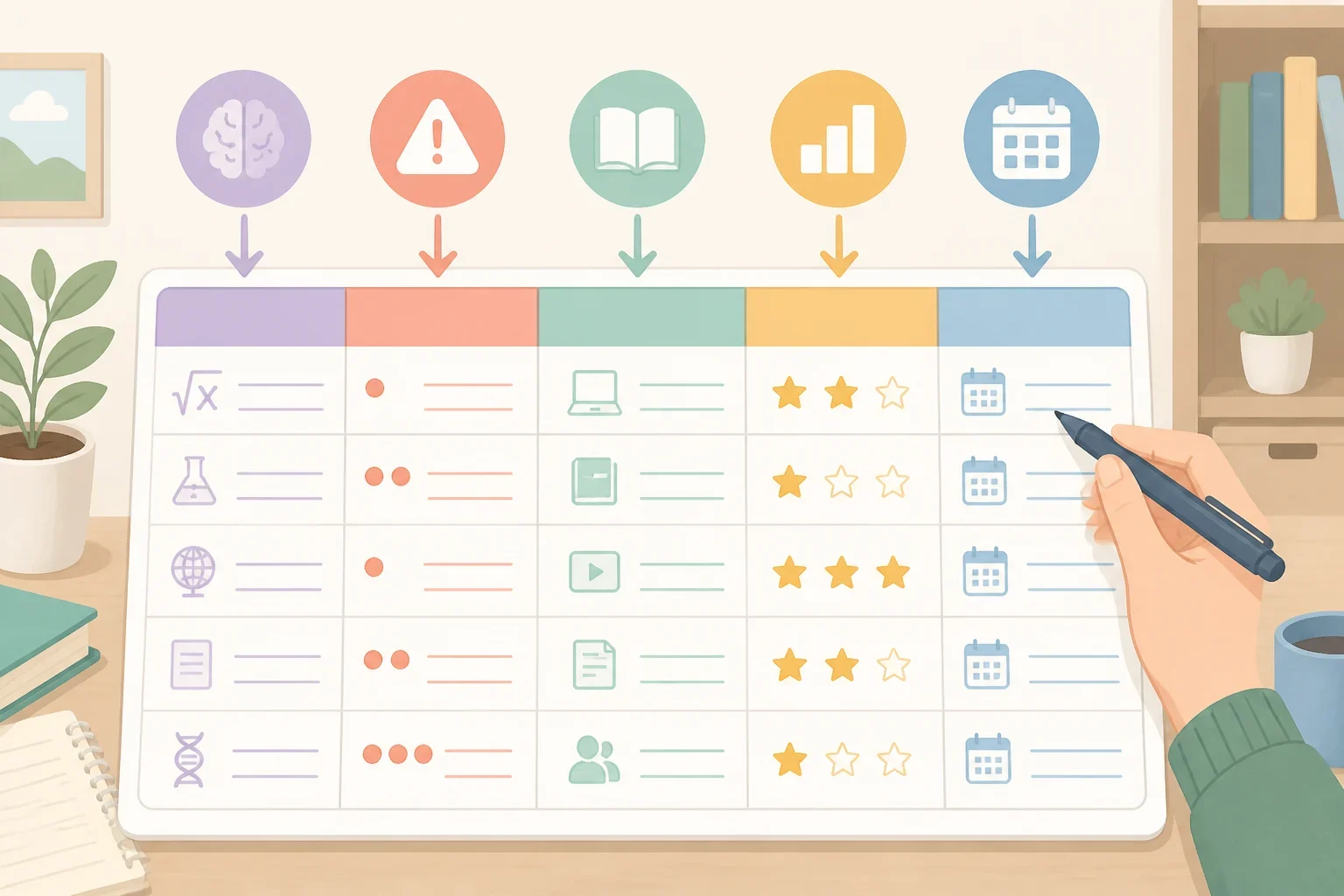
A workable plan follows one sequence: weakest domain, then error type, then practice resource, then difficulty level, then how often to practice, then when to check back in. Two tools inside the SAT Suite handle most of this.
The automated option is My Practice's "Get Tailored Practice" link, which pulls a set of Student Question Bank questions based on how the student performed on the practice test, according to College Board. It takes almost no setup, which makes it a reasonable way to start practicing right after reviewing results.
The manual option is the Student Question Bank itself, filterable by test section, domain, skill, and difficulty to build a custom quiz, according to College Board's study plan guide. Manual filtering suits a specific error type better, since it lets a student drill one narrow skill instead of a random mix.
Difficulty settings can track where a domain's progress bar lands. For a domain in the first three boxes, Easy questions are a starting point; for the fourth or fifth box, Medium questions make sense; and for the sixth or seventh box, Hard questions fit, with an occasional Easy or Medium question mixed in to keep basics sharp, according to College Board's Student Question Bank tips.
For content-gap errors specifically, every official practice test has a matching Khan Academy review course, and answer explanations link directly to lessons covering the underlying skill, according to College Board. That's a better fit for a weak concept than for a timing problem, which calls for repetition rather than new instruction.
Session length can flex around a student's schedule, from activities of 15 minutes or less up to study blocks longer than an hour, according to College Board's study plan guide. As a matter of practice rather than official guidance, short and frequent sets may suit timing errors, while a content-gap lesson that needs time to sink in may fit a longer, less frequent block, though that will vary by student.
Here's a blank template for turning two or three weak domains into an actual plan:
Domain Error type Resource Difficulty Session length/frequency Review date
A filled-in example row, built as a sample rather than official guidance: Command of Evidence, misread passage, manual Student Question Bank filter, Medium difficulty, three 15-minute sets per week, review after one week.
Two sample timelines: three weeks versus ten days before test day

How that table turns into an actual calendar depends on how much time is left. Both sequences below are sample plans, not College Board recommendations, and should flex around a student's real schedule.
- Three weeks out: diagnostic test and full review in week one, two or three targeted practice sessions per weak domain through week two, one reassessment of progress bars and error patterns midway, a second full-length practice test if the schedule allows, then light review in the final days.
- Ten days out: diagnostic review in the first day or two, focused practice on the two error patterns showing up most often across domains for most of the remaining week, short daily sets rather than long sessions, then light review only, with no new content, in the final two or three days. There isn't room in this version for a second full-length test, so the follow-up leans on the error log from the first one.
Checking progress and repeating Bluebook SAT practice tests
Unfinished Bluebook practice tests are stored for up to 90 days and can be paused and resumed later, according to guidance from College Board. That makes it realistic to fit a full diagnostic into a crowded week even close to a November test date, though it's worth confirming that storage window still applies before relying on it, since this detail comes from guidance published in 2024.
College Board recommends spacing practice tests at least two weeks apart and sitting for a full-length test at least two weeks before test day when the schedule allows, per the same source. Not every student working toward a November test date has that much runway, which is one reason the ten-day sequence above compresses the same goal into a shorter window rather than skipping it.
As an optional checkpoint, revisiting a domain's progress bar after some practice is one way to decide whether to raise the difficulty setting or shift focus to the next-weakest domain. College Board's guidance explains what the boxes represent and how to pick a difficulty level; it doesn't specify how much movement counts as enough progress to move on, so treat that call as a personal judgment rather than a fixed rule, according to College Board's Student Question Bank tips.
What to verify before the November 2026 SAT
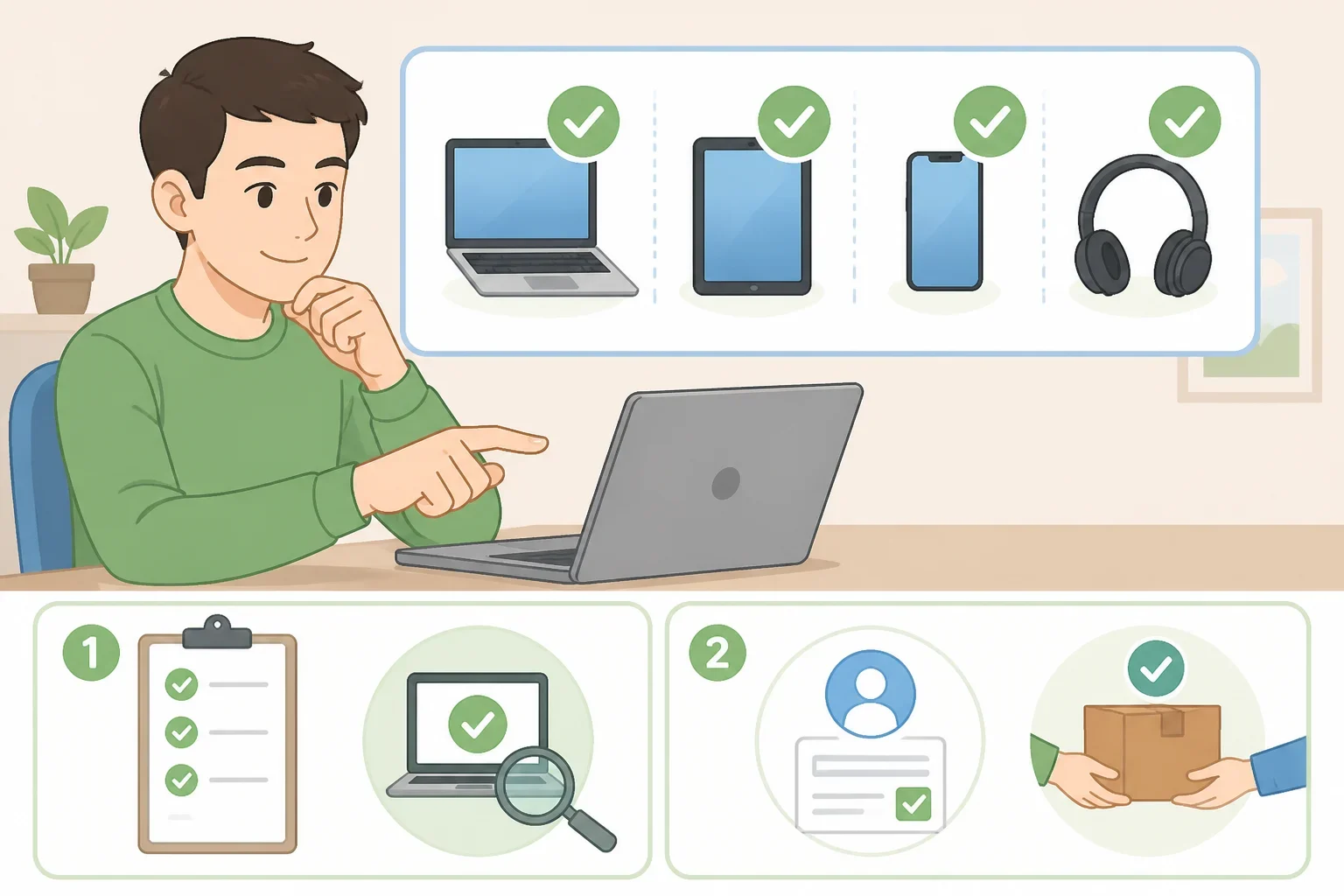
Bluebook has to be installed and set up on an approved device before test day, according to College Board, which lists Mac and Windows computers, iPads, and school-managed Chromebooks as supported devices. That guidance is a couple of years old at this point, so it's worth confirming the current approved-device list rather than assuming nothing has changed.
Students without a personal device should look into College Board's device-borrowing process as early as possible rather than waiting until test week, according to the same source. The exact borrowing deadline for the current cycle isn't something this guidance can confirm, so check it directly on College Board's site.
Before test day, confirm three things directly on College Board's official SAT pages, since registration windows, approved-device lists, and borrowing deadlines can change between administrations:
- the current registration deadline for the specific November 2026 test date
- the current approved-device and operating-system requirements
- any device-borrowing deadline, if one is needed
What to do next
A practice-test error log is a study-planning tool, not a guarantee of a higher score on test day. What it offers more reliably is a clearer sense of where to spend limited study time. A Bluebook practice test turns into that kind of plan through five steps:
- Open the My Practice dashboard and note the two or three weakest domains, combining the lowest progress-bar positions with error types that show up more than once.
- Review every missed question in Score Details and label the cause: content gap, misread, timing, or careless slip.
- Match each weak domain to a tool: automated tailored practice, a manual Student Question Bank filter, or a Khan Academy lesson for content gaps.
- Schedule the first practice session this week and set a date to check progress.
- Confirm the current November 2026 registration deadline, approved devices, and any borrowing timeline on College Board's official SAT pages before test day.
Working through that list once, even with only a week or two left, gives a single Bluebook test a second job: pointing to exactly what to study next.