
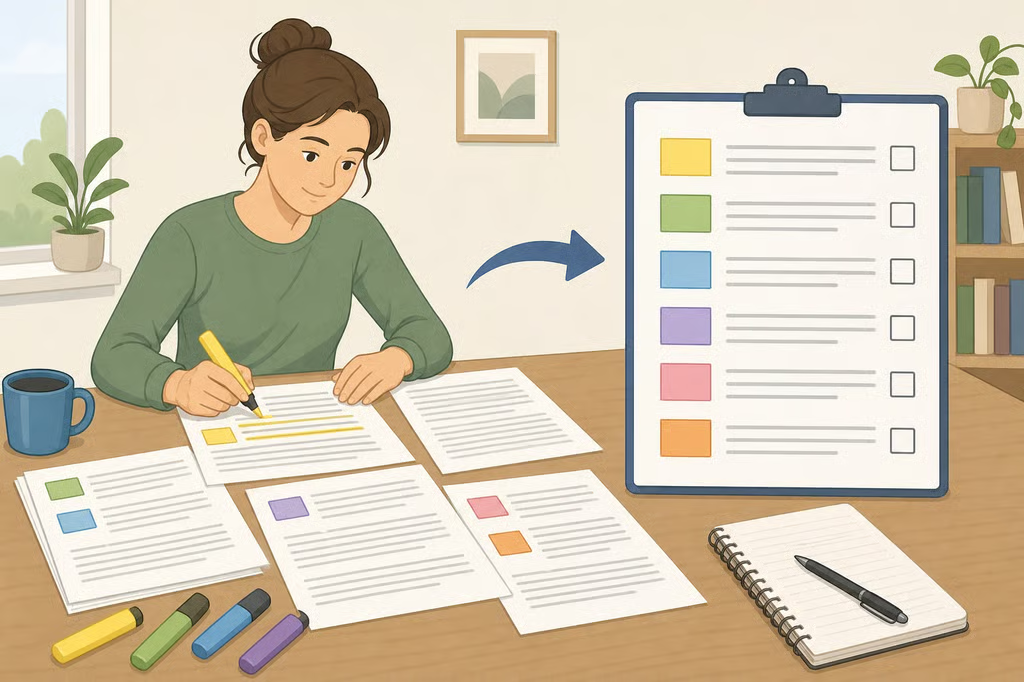
How to reverse outline an essay: step-by-step guide
A finished draft can look complete and still hide real problems: a paragraph that doesn't belong near the ones around it, a thesis that quietly drifted by paragraph four, or a counterargument the assignment required but the essay never actually delivers. Learning how to reverse outline an essay gives a writer a faster way to spot problems like that, scanning a short list of paragraph labels instead of rereading the whole draft from the top every time something feels off. Reverse outlining means writing the outline after the draft already exists, not before it, then checking that list against what the writer actually meant to say (George Mason University Writing Center; Oregon State University Writing Center).
This guide walks through how to make a reverse outline step by step, works through a full example that shows a label getting revised, not just diagnosed, and lays out which pattern in the resulting list points to which fix: cut, combine, split, move, expand, or reconnect to the thesis. It's built for students revising a draft for class, tutors coaching someone through revision, and anyone staring at a paper that feels off without being able to say exactly why.
What reverse outlining actually does for revision
A forward outline is a plan, mapping out what a writer intends to write before drafting starts. A reverse outline is an audit: it records what actually ended up on the page, which may differ from the original plan. GMU's writing center treats reverse outlining as a natural next step once a first draft exists and revision is about to begin.
The mechanics stay simple on purpose: condense the draft into a short list of one-line summaries, one per paragraph, each naming that paragraph's main idea (Oregon State). The list matters because it makes the essay's structure easier to inspect.
The Baylor Graduate Writing Center frames the exercise deliberately: writing a paragraph's label without rereading it first is meant to reveal what's actually on the page, not what the writer intended to argue. That gap, between the plan in a writer's head and the paragraph that actually got written, is what the rest of this guide walks through finding and fixing.
How to reverse outline an essay step by step
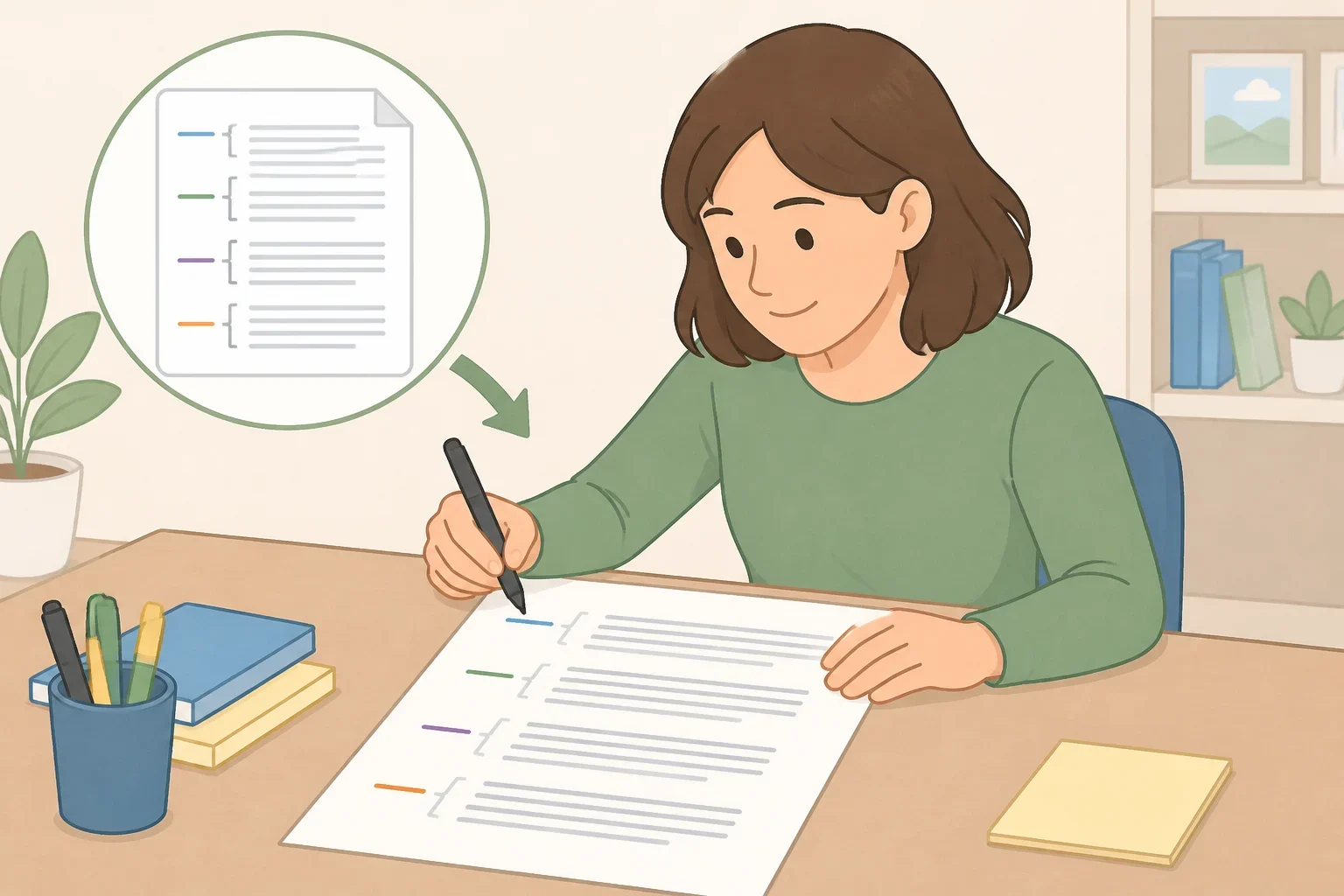
Reverse outlining paragraphs one at a time keeps the process manageable. The method breaks down into four moves, from identifying the thesis to checking the finished list against the assignment itself.
- Identify the thesis or guiding claim first. Write it at the top of a page, and expect it might shift once the rest of the outline is finished (Oregon State).
- Read one paragraph at a time and label it. Write a short phrase, roughly four to ten words, capturing that paragraph's main point, either in the margin or on a separate page (GMU; Oregon State).
- Compare the full list against the thesis. Once every paragraph has a label, read down the list and check whether each one still supports the claim at the top of the page (Oregon State).
- Check the list against the assignment prompt and rubric. A reverse outline shows what's on the page, not what an instructor expects to find there. Before cutting or restructuring anything, confirm the label list covers any required element the prompt or rubric names, such as a counterargument. Check any instructions a teacher gave separately from the written prompt too, since structural expectations sometimes surface there instead.
Two signals tend to show up fast once the list exists. If a paragraph's main idea is hard to pin down in one short label, it's probably carrying too many competing ideas at once. If a label feels thin or repeats something already on the list, that paragraph may need to merge with a neighbor (Oregon State).
None of the four steps has to happen in strict order while labeling. Baylor's writing center notes that working through a draft chronologically is common, but a writer short on time can start with the paragraph that already feels like trouble. A complete reverse outline should still cover every paragraph in the draft before the comparison step, even if labeling doesn't start at paragraph one.
A reverse outline example: reading the pattern of labels
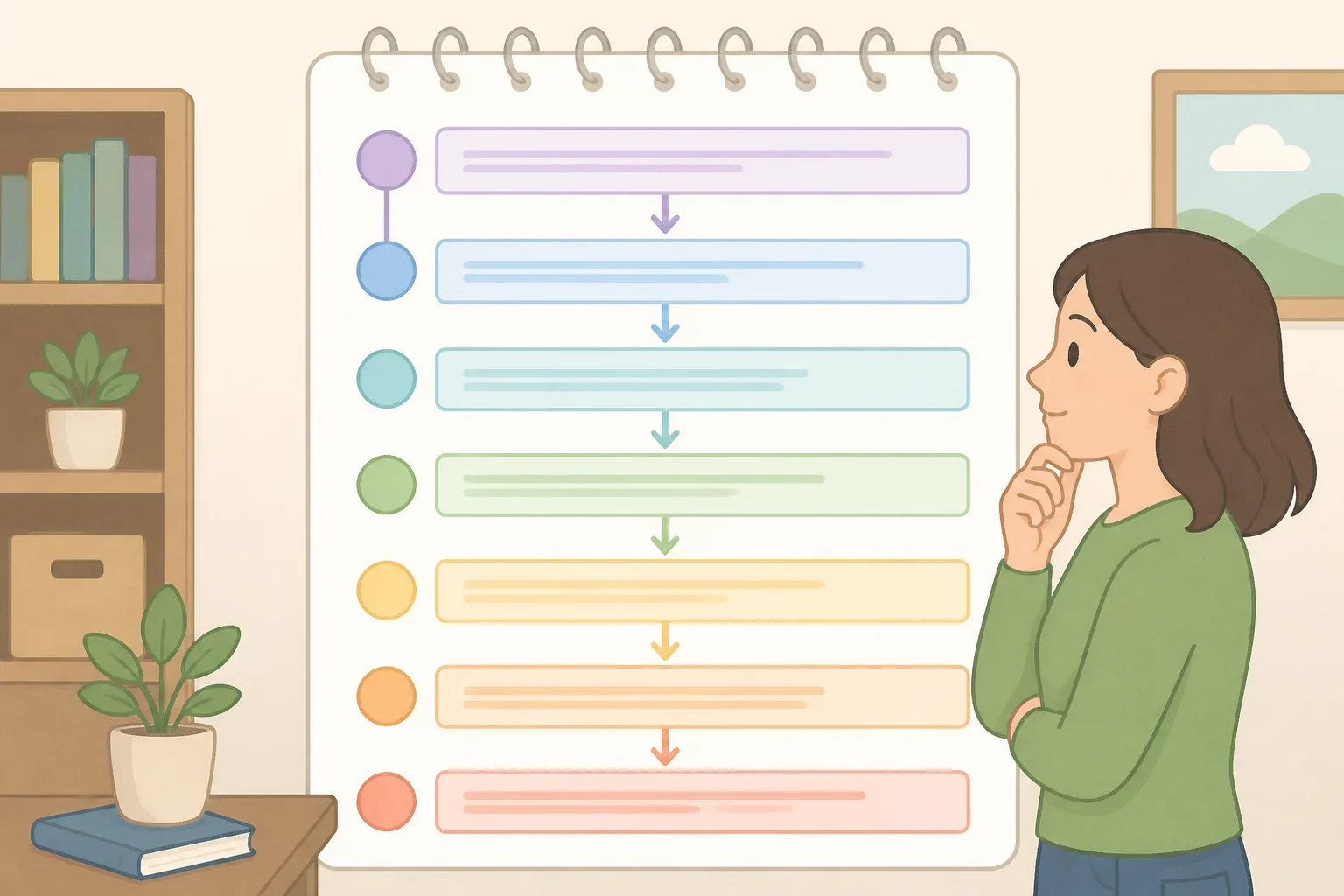
Here's what a completed reverse outline looks like in practice, adapted from an example Oregon State's writing center uses to teach the method. The essay argues that cats make better pets than dogs, and its seven paragraphs reduce to seven short labels:
- Paragraph 1: Introduction and thesis statement
- Paragraph 2: Cats cost less and need less upkeep than dogs
- Paragraph 3: Cats stay quieter and sleep more than dogs
- Paragraph 4: A brief history of household pets and ownership trends in America
- Paragraph 5: Cats are compact, nocturnal hunters with strong night vision
- Paragraph 6: A rebuttal addressing claims that cats are less loyal than dogs
- Paragraph 7: Conclusion
Reading straight down that list surfaces three problems a first read-through might easily miss.
Paragraph 4 sits outside the scope of the thesis, with no clear link to the paragraphs on either side of it (Oregon State). GMU's guidance suggests several options for a label like this, not just one.
A writer could cut the paragraph, since pet-ownership history doesn't directly argue that cats make better pets. A writer could connect it instead, adding a sentence that ties historical ownership trends to modern cost or availability, linking back to paragraph 2's point about affordability. Or a writer could widen the thesis itself, so the essay argues that changing pet-ownership patterns favor cats, which would give the history paragraph an actual job to do (GMU).
Paragraph 5 is trickier, and it's worth walking through how its label actually gets revised, not just flagged. The original label reads: cats are compact, nocturnal hunters with strong night vision. Oregon State's guidance here is to check a label like this against the thesis rather than assume it belongs where it sits (Oregon State).
The question to ask is direct: how does being small and able to hunt in the dark prove that a cat makes a better pet? As written, it doesn't answer that. One workable revision narrows the claim to something that connects: cats' smaller size suits apartments and smaller living spaces. That version ties the paragraph to a reason a reader might already accept, limited living space, instead of leaving the hunting-ability connection unexplained.
Whether to keep the paragraph at all still comes down to the rest of the essay. It earns its place only if the essay's definition of "better" includes something like space or maintenance, a call the writer makes by checking the draft, not something the reverse outline decides on its own.
Paragraph 6 raises a counterargument about dog loyalty, but the outline doesn't show where that counterargument actually gets addressed in the body of the essay (Oregon State).
Reverse outline pattern-to-fix table
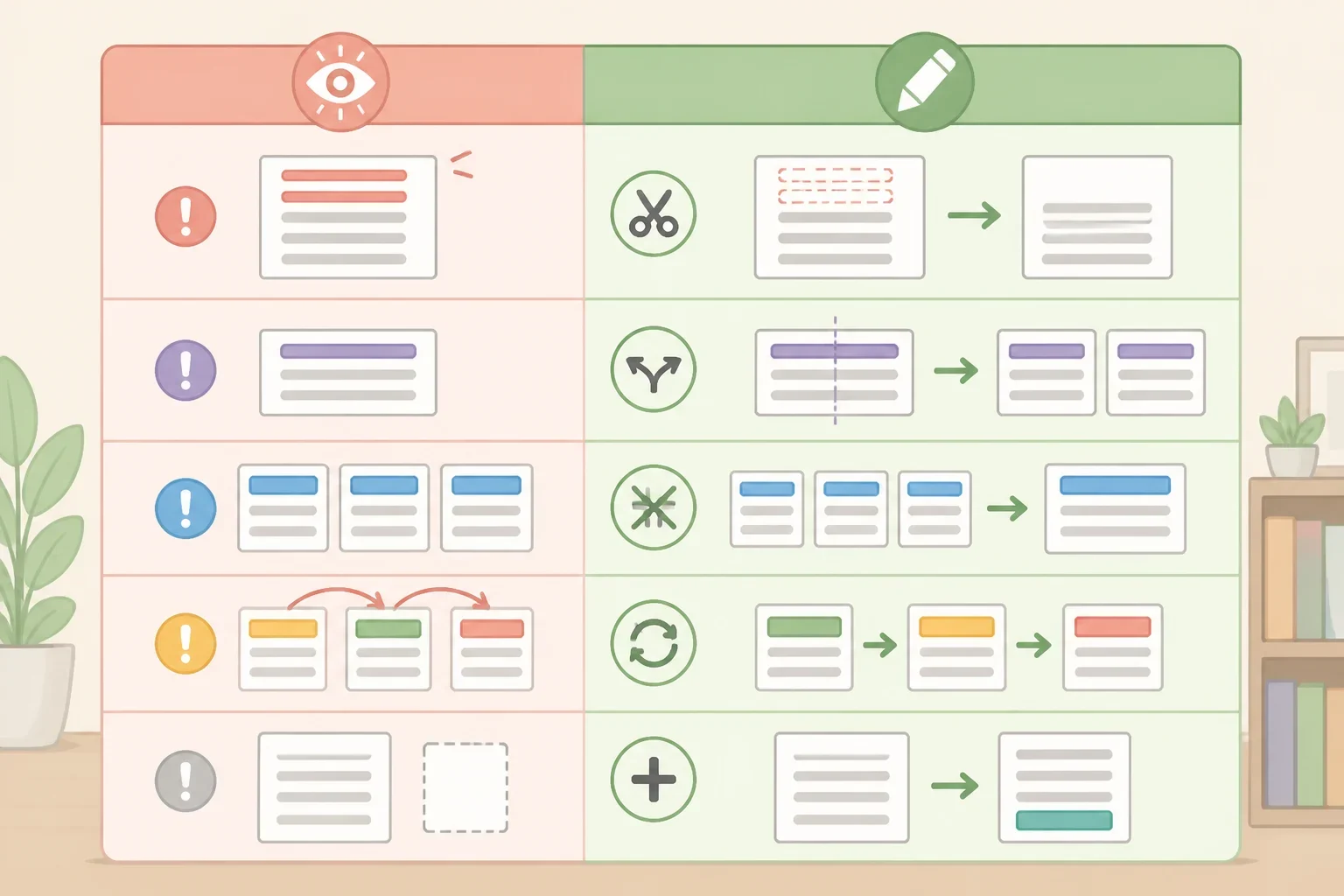
Once the labels are on the page, common problems tend to repeat across different essays. Matching the pattern to the fix is the practical payoff of reverse outlining for revision:
What the outline shows Likely fix No clear main idea in a paragraph Clarify the point, or cut it as filler (GMU) Two ideas crammed into one label Split into two paragraphs (GMU; Oregon State) Same idea shows up twice Consolidate into one paragraph (Oregon State) A label has no link to the thesis Cut it, or widen the thesis (GMU) A reader could lose the thread between two labels Reorder, or add a transition sentence (Oregon State) A required element is missing, like a counterargument Add it (GMU)
Going deeper: a closer look at one stubborn paragraph
The basic version above is usually enough for a standard classroom essay: label every paragraph, compare the list to the thesis, work through the table above. For a single paragraph that still feels off after that, a closer sentence-level pass can help.
Check whether the topic sentence states the paragraph's claim and its connection to the thesis, and whether the final sentence wraps up the point and transitions into what comes next (Baylor; Oregon State). It's slower than labeling paragraphs, so save it for one stubborn paragraph rather than running it across an entire draft.
This sentence-level pass is optional. Reach for it when a paragraph resists a simple cut-or-move fix, not as a step every draft requires.
The same bullet-list habit works as a reading strategy, too. Reverse outlining a source paragraph by paragraph makes it faster to scan what it actually argues and connect it to a research project (Oregon State; GMU).
What to do next
Pick one body paragraph in a current draft. Without rereading it first, write its main idea in four to ten words, the way step 2 above describes. Then check that label against two things: the thesis at the top of the page, and the specific prompt or rubric for the assignment.
If the label doesn't connect clearly to either one, that's the paragraph to work on next. The pattern-to-fix table above is the place to start: cut the paragraph, split it, merge it with another, or add the sentence that makes the missing connection explicit. Reverse outlining won't write that sentence. It just makes clear which paragraph needs it.