
- How to Use a Synthesis Matrix for a Literature Review
- What a synthesis matrix is (and isn't)
- Choosing an organizing lens: theme, chronology, or method
- How to create a synthesis matrix for a research paper, step by step
- From matrix to paragraph: a worked example
- Reading the matrix without overreading it
- What to check before drafting
- What to do next
How to Use a Synthesis Matrix for a Literature Review
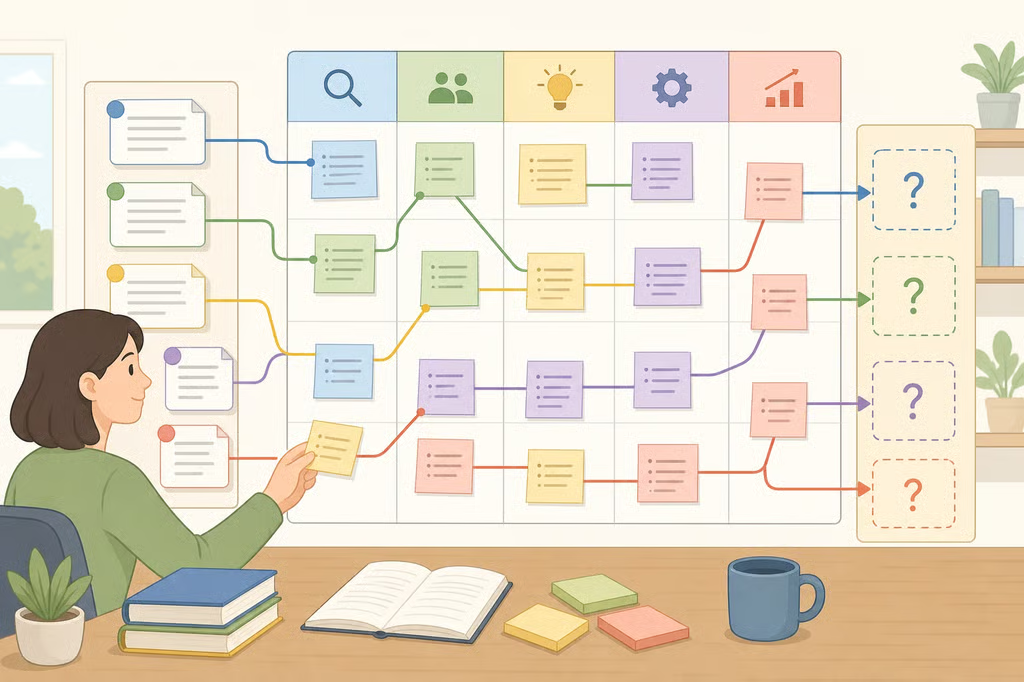
A synthesis matrix turns a stack of disconnected source notes into a theme-based map showing where research agrees, disagrees, or leaves a gap. National University describes it as a tool for organizing sources by theme while surfacing similarities, differences, and patterns in methodology and recommendations for future research. Learning how to use a synthesis matrix for a literature review means learning to compare sources side by side instead of summarizing them one at a time.
A synthesis matrix is a table that pairs sources with the themes, concepts, or ideas running through them, with notes entered wherever a source and a theme intersect, according to North Shore Community College Library. This guide is for high school, college, and adult learners gathering journal articles, reports, or studies for a literature review, research paper, or capstone project.
What follows covers how to set up a matrix, choose what organizes it, fill in the cells so they stay usable later, and read a finished matrix for the patterns that become paper sections. A matrix is a planning tool, not the finished product. The payoff comes from what gets written after the chart is filled in.
What a synthesis matrix is (and isn't)
The goal is synthesis: combining pieces of several sources to build a writer's own point and show how those sources relate to one another, not simply listing what each one said, per University of Oregon Libraries. A string of summaries isn't synthesis. Neither is a comparison that never goes beyond description, or quotations strung together without the writer's own voice, even when the result looks organized on the page (University of Oregon Libraries).
That distinction is the reason a literature review synthesis matrix matters: it's a workspace for analysis, and the strength of the paper depends on what happens after the chart gets filled in, not on the chart itself.
Choosing an organizing lens: theme, chronology, or method
Sources can be sorted a few different ways: by shared theme or concept, by the chronological development of a research question, or by methodology, according to UC Merced Library and University of Oregon Libraries. These read less like competing systems than different lenses suited to different projects. A paper tracing how a debate has shifted over time might lean on a chronological matrix; a paper comparing competing explanations might work better organized by theme; a paper evaluating research quality might sort by method instead. Neither source ties a specific lens to a specific project type, so treat those pairings as examples worth trying, not a formula to follow.
Tracking method alongside theme can also help surface patterns in methodology, which is part of what a matrix is designed to reveal, according to National University. A matrix stays a flexible planning document rather than a fixed form. Rows, columns, and the number of themes should follow the project, not a template built for someone else's paper.
How to create a synthesis matrix for a research paper, step by step

One common layout lists main ideas along the top row and sources down the first column, so each intersection becomes a cell to fill as reading progresses (North Shore Community College Library). Templates vary on this point, so follow whatever orientation an assignment or template specifies, or pick one and keep it consistent for the whole project.
Before much of the matrix gets filled in, read the sources closely enough to find each one's main idea. University of Oregon frames this as part of the synthesis process itself, not a separate task done beforehand (University of Oregon Libraries). It's easier to fill the matrix accurately once that main idea is clear, rather than trying to summarize a source while still skimming it.
Once reading is underway, enter notes and highlighted passages into the box where a source and a theme meet, along with a correctly formatted citation for that source, a step North Shore Community College Library builds into its matrix template. Whatever citation style the assignment requires, that's also the moment to record page numbers or location markers for anything quoted directly, before the source gets set aside and the detail becomes harder to recover.
From matrix to paragraph: a worked example

The table below is illustrative, built from placeholder sources to show how the matrix functions, not from real research findings.
Theme Source A (survey) Source B (interviews) Source C (policy analysis) Barriers to access Notes cost as a barrier Notes cost as a barrier Not addressed Proposed solutions Not addressed Mentions a possible solution Discusses a policy response
Reading down the "barriers to access" column shows a shared pattern: Source A and Source B both raise cost as a barrier, even though they reached that point through different methods, one a survey, the other interviews. The different methods give the writer a reason to ask whether the sources support the same conclusion for similar reasons, a question worth exploring in the paper rather than assuming it's already answered.
The empty cell for Source C isn't necessarily a gap in the research. It could just as easily be a planning question: does Source C simply not cover barriers, or does the project still need a source that connects barriers and solutions directly? Treating the blank cell as a question rather than a conclusion keeps the matrix from overstating what it actually shows.
Put together, that reading supports a cautious synthesis sentence: "Despite relying on different methods, Source A and Source B both raise cost as a barrier to access, though neither connects that barrier to the policy response Source C proposes." Turned into a paragraph with citations, it might read: "Several sources point to cost as a barrier to access (Source A; Source B), despite differences in how that evidence was gathered. Source C's policy analysis addresses a possible response but does not engage with cost directly, leaving a connection the current literature has not fully made." That's the shape of a synthesized paragraph: a shared pattern, a difference worth flagging, and a limitation the writer names instead of skipping past.
Reading the matrix without overreading it

The core analytical move is reading down a theme column across multiple sources, not straight through one source's row, since that's what reveals agreement, disagreement, or a gap (Tulane University Libraries). Not every source will address every theme. Tulane notes that filling in whichever columns are useful is enough, without needing to complete every cell (Tulane University Libraries), and North Shore makes a similar point: not every source a writer finds will cover every part of the topic (North Shore Community College Library).
An empty cell still deserves a second look before it gets treated as meaningful. National University points to research and methodology gaps as one thing a matrix can help a writer find (National University), though a blank cell could just as easily mean a theme was defined too narrowly, or that the right source hasn't turned up yet. Checking the category before assuming the gap is real keeps a writer from overstating what the matrix shows.
A strong paragraph built from the matrix draws on multiple sources, shows how they relate, and builds toward the writer's own point rather than presenting each source as its own mini-summary. UC Merced Library illustrates the difference with a student example that pulls from five sources to build a single argument about royalty payments, in contrast to three other student examples that simply summarize sources one at a time. Five sources made that particular example work; it isn't a minimum every matrix needs to hit.
A few habits tend to undercut synthesis before drafting even starts:
- Writing full sentences, a thesis, or a research question into theme labels instead of short concepts, which North Shore Community College Library advises against
- Recording quotations without page numbers or location markers, which makes them hard to cite accurately once the source has been set aside
- Drafting the paper source-by-source instead of theme-by-theme, which tends to produce a list of summaries rather than synthesis (University of Oregon Libraries)
Some digital tools make the matrix easier to maintain as it grows. The tool described by Tulane University Libraries allows unlimited rows and columns, color-coding by theme, and automatic saving, and National University offers a downloadable synthesis matrix template built around organizing sources by theme. A plain table or a handwritten grid works too for anyone who prefers paper; the spreadsheet features are conveniences, not requirements for the method itself.
What to check before drafting
A few things are worth confirming against the assignment itself before a matrix grows much further:
- What citation style the rubric or prompt requires, since that determines how citations get recorded in the matrix and later in the paper
- Whether the assignment calls for a standalone literature review or a shorter background section inside a larger research paper, since that affects how many sources and how much depth is expected
- What source types count toward the assignment, such as peer-reviewed studies, government reports, or a mix of article types
- Whether the instructor or rubric sets a minimum number of sources or themes
These details vary by course, program, and instructor, so checking them early saves rework once the matrix is already built out.
What to do next
University of Oregon's research guide notes that this work can be messy, and that a matrix may change as the literature review develops. That's expected, not a sign something went wrong (University of Oregon Libraries).
Check the assignment prompt or rubric first for citation style, source requirements, and whether a full literature review or a shorter background section is expected. Choose a lens, theme, chronology, or method, that fits the research question, then set up the grid with sources along one axis and themes along the other. Read each source closely enough to identify its main idea, and fill in the cells with a short paraphrase, a correctly formatted citation, and a page number for anything quoted directly. Starting with a small number of sources and themes is one way to test whether the lens fits before expanding further, though there's no fixed minimum to hit before that becomes useful. Read down a single column and draft one paragraph explaining what those sources collectively show, naming the shared pattern, the meaningful difference, and the gap instead of skipping past them.