

- How to read an assignment rubric before you start writing
- How to understand an assignment rubric: what it's actually telling you
- How to interpret grading criteria and performance levels
- How to use a rubric before writing, not just before submitting
- What to check before drafting: a rubric-reading checklist
How to read an assignment rubric before you start writing
Some students treat the rubric as a final checklist, something to open only after a draft is finished, mostly to see where points got lost. Read it before writing instead, and it turns into something different: a plan for what the paper or project needs to include, in what order, and at what level of depth.
A rubric is a scoring guide that spells out the specific components and expectations of an assignment, according to Hunter College. Giving students a rubric ahead of time has been linked to improved performance, according to research cited by Hunter College (Reddy and Andrade, 2010). Learning how to read an assignment rubric before drafting applies across many assignment types, research papers, essays, presentations, portfolios, and group projects included (Hunter College).
This guide walks through how to map a rubric's parts, interpret its performance levels, weigh its criteria, and turn that information into an outline before a single sentence of the actual draft gets written.
How to understand an assignment rubric: what it's actually telling you
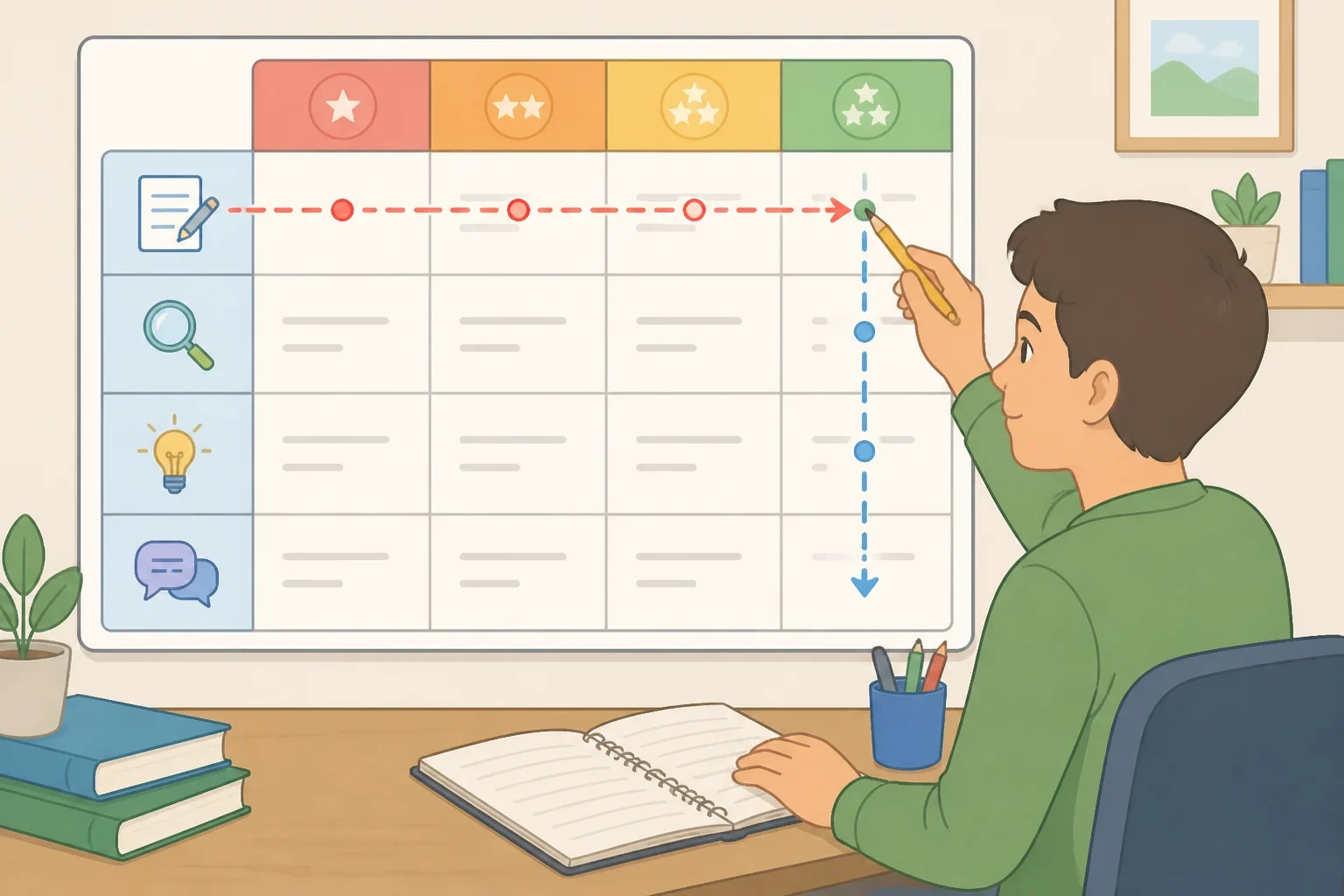
Rubrics vary by instructor and institution, but a common structure, as described by Colorado State University, has three working parts: a task description of what's being assessed, the skills or dimensions being rated (typically rows down the left side), and levels of performance (typically columns across the top) (Colorado State University). Not every rubric follows this layout exactly, but recognizing the pattern makes an unfamiliar one easier to parse.
Where a row and column meet, many rubrics fill in a descriptor: a sentence or two explaining what that skill looks like at that performance level. Thomas Edison State University's example points to a criterion like "purpose for writing" and shows how the top descriptor spells out exactly what a student needs to do to earn the highest point value in that row (Thomas Edison State University).
It helps to keep these terms straight. The criterion names what's being assessed, such as "purpose for writing" or "uses credible evidence." The descriptor explains what quality looks like at a given level for that criterion. The weight, when a rubric assigns one, indicates how much that single criterion counts toward the total grade. Confusing the three makes a rubric harder to use strategically.
Rubrics show up well beyond essays. Hunter College notes they're used to grade research papers, portfolios, presentations, and group projects too (Hunter College), so the reading method below applies whether the next assignment is a five-paragraph essay or a semester-long project.
How to interpret grading criteria and performance levels

Once the parts are identified, the next step is reading across each row rather than down the page. Thomas Edison State University recommends reading the entire rubric before starting any work, understanding every criterion, and comparing descriptors across performance levels side by side (Thomas Edison State University). That comparison is where the planning happens: seeing what separates a top score from a middle or low one, for each skill individually rather than for the paper as a whole.
Some rubrics attach a points scale to each level. One Thomas Edison State University example uses a 4-3-2-1-0 scale per criterion, with total points converting to a letter grade and then a numerical score (Thomas Edison State University). That's one format among several, so check which scale a specific rubric actually uses before assuming it matches.
Weighting works the same way. Colorado State University notes that instructors building a rubric can list measurable grading criteria with optional weights attached to each one (Colorado State University). When a "thesis and analysis" row counts for more of the total grade than a "formatting" row, treating that weighting as a cue for where to spend planning time is a reasonable strategy. The actual weights still depend entirely on the instructor, so read them directly off the rubric in front of you rather than assuming they match a different class.
Colorado State University's assessment office also advises instructors grading student work to start by comparing it against the highest-level performance description first, then work downward to find where it actually lands (Colorado State University). Students can borrow that same order when planning a draft: instead of asking what minimum passing work looks like, start with the top descriptor for each row and treat it as the writing goal.
The table below shows how a descriptor like that can turn into an actual task. It's illustrative, built to resemble the kind of phrasing these rubrics tend to use, not copied from a specific published rubric.
Criterion Top-level descriptor Writing plan Revision check Uses credible evidence Evidence is relevant, well integrated, and followed by the writer's own analysis Assign one source to each body paragraph before drafting it Underline every quotation and confirm a line of analysis follows it Responds to the intended audience Uses appropriate evidence, tone, and explanation for the reader Name the audience and purpose before choosing examples Remove background the intended reader wouldn't need, or add context they'd lack
The pattern holds across both rows: a criterion that sounds abstract on its own becomes workable once the top descriptor gets translated into a concrete task and a way to check for it later.
How to use a rubric before writing, not just before submitting
Texas A&M University's writing guidance recommends closely reading and breaking down the assignment sheet, rather than skimming it, since that makes planning and drafting easier. The rubric deserves the same treatment: pull it apart line by line alongside the prompt, rather than setting it aside until the draft is done.
Some rubrics evaluate whether the writing fits its audience and purpose, not just mechanics. Columbia Gorge Community College frames one core rubric question as how well the writing responds to the needs of its audience (Columbia Gorge Community College). Where a rubric includes a criterion like that, it shapes what a first draft should sound like, not just what gets fixed in revision.
Texas A&M University's guidance also points to several things a rubric or assignment sheet often signals before any writing starts: the genre of the assignment, the core question being answered, the type and number of sources required, and the disciplinary conventions expected in the field. Pulling those details out before outlining can help avoid restructuring a paper later, say if a draft built as a general essay turns out to need the shape of a lab report or a literature review instead.
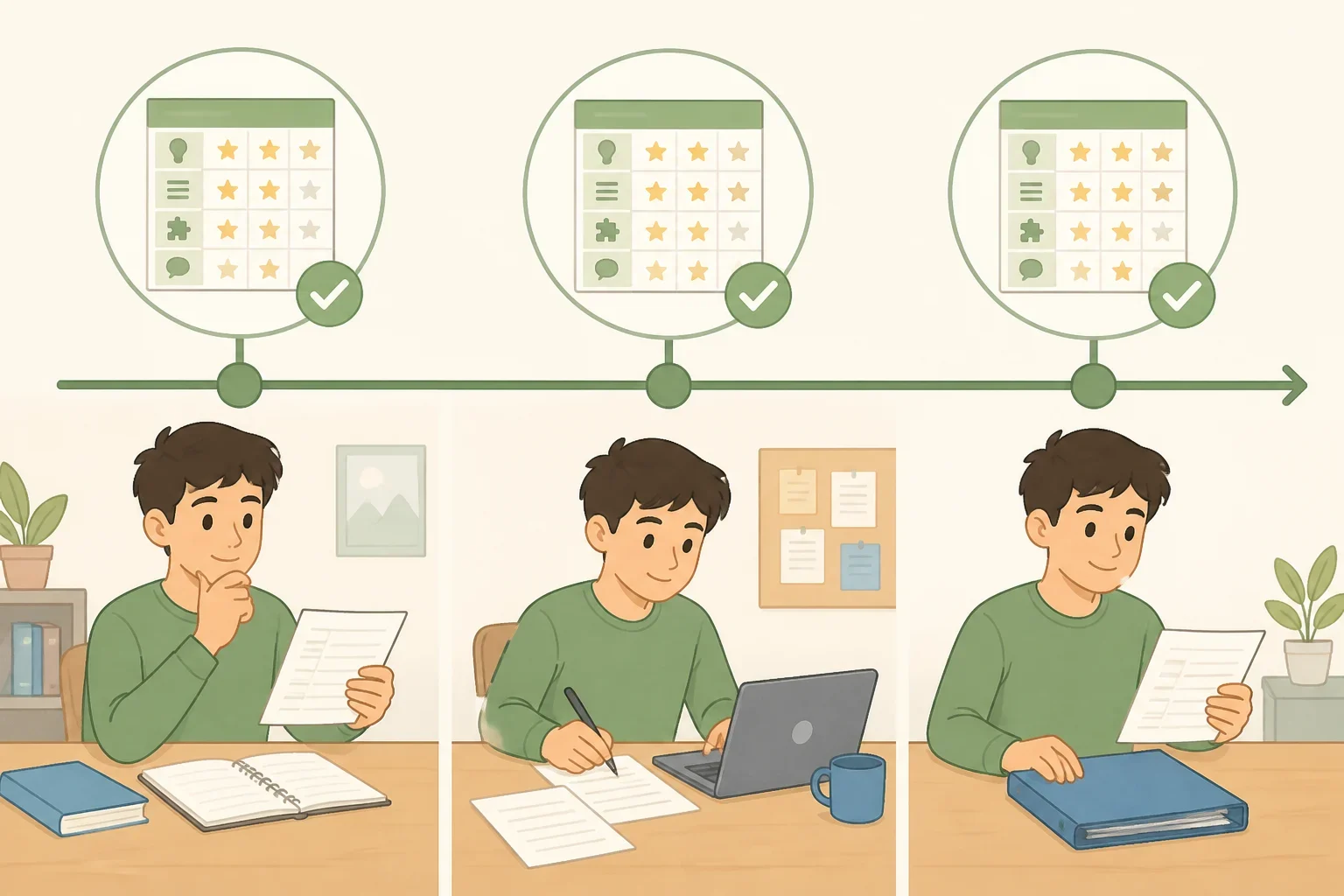
The same criteria can serve a second purpose during revision. Texas A&M University notes that rubric criteria can guide both the start of a writing project and its revision and editing, and Thomas Edison State University recommends returning to the performance descriptors throughout the writing process as a personal measurement tool (Thomas Edison State University). A practical routine built on that advice: pull the rubric back out once before outlining, once mid-draft, and once before submitting, rather than treating it as a one-time read.
Not every rubric found online is built to grade individual work, either. Columbia Gorge Community College's written communication rubric is designed for institutional-level assessment across a program, not for scoring one student's paper (Columbia Gorge Community College). The rubric attached to a specific class assignment is the document students should prioritize, while checking with the instructor if the prompt and rubric seem to disagree.
What to check before drafting: a rubric-reading checklist

Work through the rubric and assignment sheet together, asking:
- Genre and format: Does the sheet specify an essay, report, lab write-up, or another structure, and does the planned draft match it, per Texas A&M University's guidance?
- Point weighting: Which rows carry the most points or percentage, and does the plan spend the most effort where the weight actually sits?
- Top-tier descriptors: What does the highest column say for each row, rewritten as a one-sentence goal?
- Source requirements: How many sources, what type, and how are they expected to be used, according to Texas A&M University's guidance?
- Submission details: Where are the page length, format, and due date listed, and do they match the plan?
- Instructor-specific quirks: Rubric formats and weighting vary by class, so a format from one course shouldn't be assumed to carry over to another.
If an assignment has no rubric attached, or the criteria on the sheet are vague, Texas A&M University's guidance is direct: ask the instructor rather than guessing.
One study adds some real-world evidence to that advice, with limits worth stating plainly. In a study conducted about a decade ago, researchers surveyed 106 early-semester and 89 late-semester undergraduates about their rubric use, published by the Journal on Excellence in College Teaching. Rubric use correlated with higher grades on first assignments and higher GPAs later in the semester, though it showed no measurable connection to final course grades. The same study found students preferred rubrics that combined a checklist with detailed explanations, rather than favoring one format over the other (Journal on Excellence in College Teaching).
Before the next assignment's outline gets started, work through this sequence:
- Read the prompt and rubric together, side by side.
- List each criterion and its weight.
- Rewrite the highest-level descriptor for each criterion as a single task.
- Turn those tasks into section headers or checkpoints in the outline.
- Check the finished draft against each descriptor, row by row, before submitting.
If the prompt and rubric point in different directions on what's required, raise it with the instructor before drafting rather than guessing which one takes priority.