
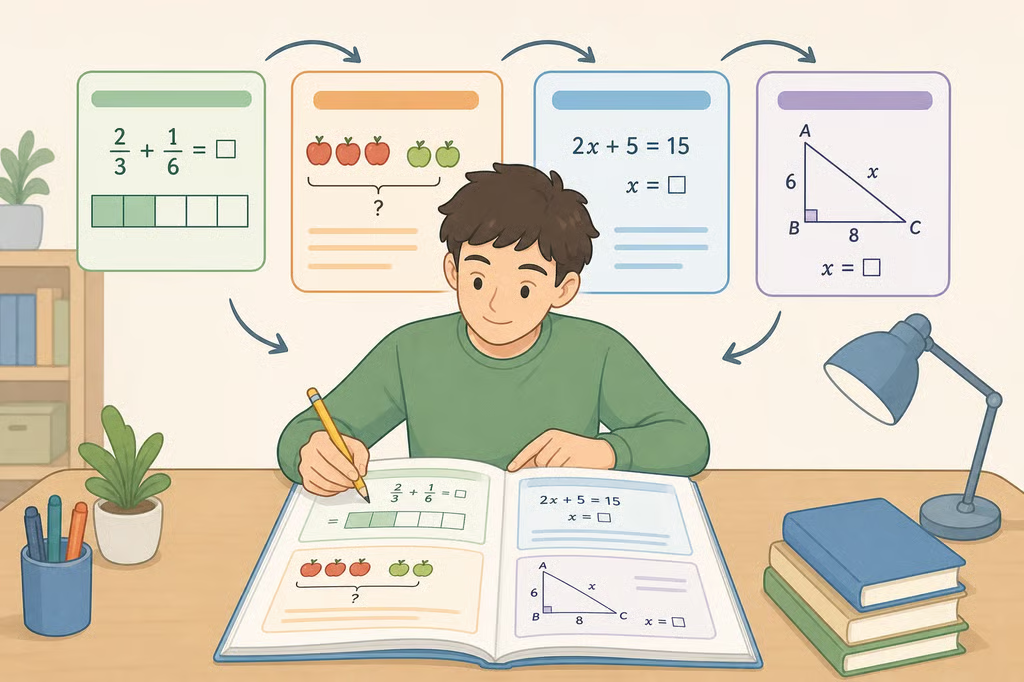
- Interleaving vs blocked practice: how to mix study questions
- Interleaving vs blocked practice: two separate decisions
- How to use interleaving when studying: picking what to mix
- A sample plan for reordering practice questions
- When blocked practice should come first
- What the research doesn't settle yet
- What to do next
Interleaving vs blocked practice: how to mix study questions
If a tutor ever says "mix up the practice problems" instead of working straight down a worksheet, that's the interleaving vs blocked practice question showing up in real life, even without anyone naming it. Blocked practice means finishing every problem of one type before moving to the next. Interleaved practice means alternating between types while the material is still being learned, according to a survey of undergraduates published last year.
Picture a 12-question set covering linear equations, exponent problems, and factoring. Blocked practice looks like questions 1 through 4 as linear equations, 5 through 8 as exponents, and 9 through 12 as factoring. Interleaved practice alternates instead: a linear equation, then an exponent problem, then a factoring problem, repeating that cycle.
Most undergraduates in that same survey had never heard either term by name. Ninety-six percent said they hadn't previously heard "interleaved practice," and 97% said the same about "interleaving." A related paper on math practice, also published last year, lays out the evidence behind interleaving and reports early results from an ongoing trial comparing mostly interleaved and mostly blocked math practice. That paper, along with a related Institute of Education Sciences project description, notes that most mathematics curricula still arrange similar problems in blocks despite research supporting interleaving, a gap worth knowing about before assuming blocked worksheets are simply the norm.
This guide narrows the broader "mix up your study questions" advice into something usable. It covers math problem sets, grammar structures, and classification tasks where similar-looking items get confused, the kinds of material the cited research actually tested, not a claim that mixing unrelated subjects helps every kind of schoolwork. It's written for students working through problem sets alone, language learners sorting out confusable grammar rules, tutors building practice sets, and parents helping with homework without taking it over. What follows is a checklist for choosing what to mix, a sample plan for reordering a set, and guidance on when blocked practice should come first.
Interleaving vs blocked practice: two separate decisions
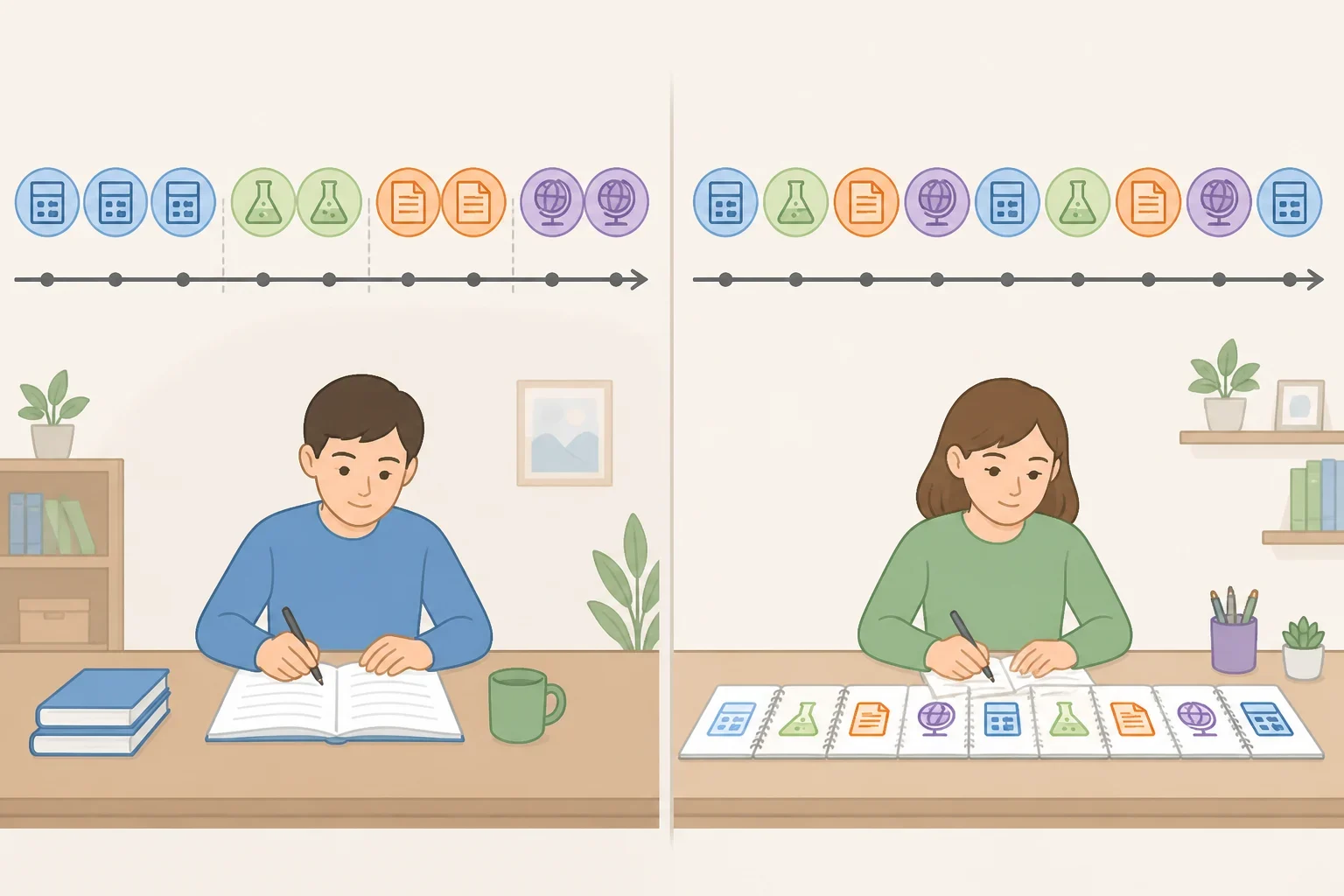
Interleaving and spacing often get lumped together, but they answer different questions. Interleaving is about which problem types sit next to each other in one sitting. Spacing, also called distributed practice, is about how far apart repeats of the same problem type land over time, regardless of whether that one session was blocked or mixed, according to a 2022 review of distribution-of-practice research.
A grade 7 math intervention described in an Institute of Education Sciences project shows how the two work together: problems of different kinds get interleaved within one assignment, while problems of the same kind get distributed across several later assignments. That's a program design, first described about four years ago, not a finished result. The project page lays out planned methods, not outcomes.
Mixing a worksheet without spacing out later repeats only covers half the strategy. Treat "which types do I alternate right now" and "when do I bring each type back later" as two separate planning questions.
How to use interleaving when studying: picking what to mix
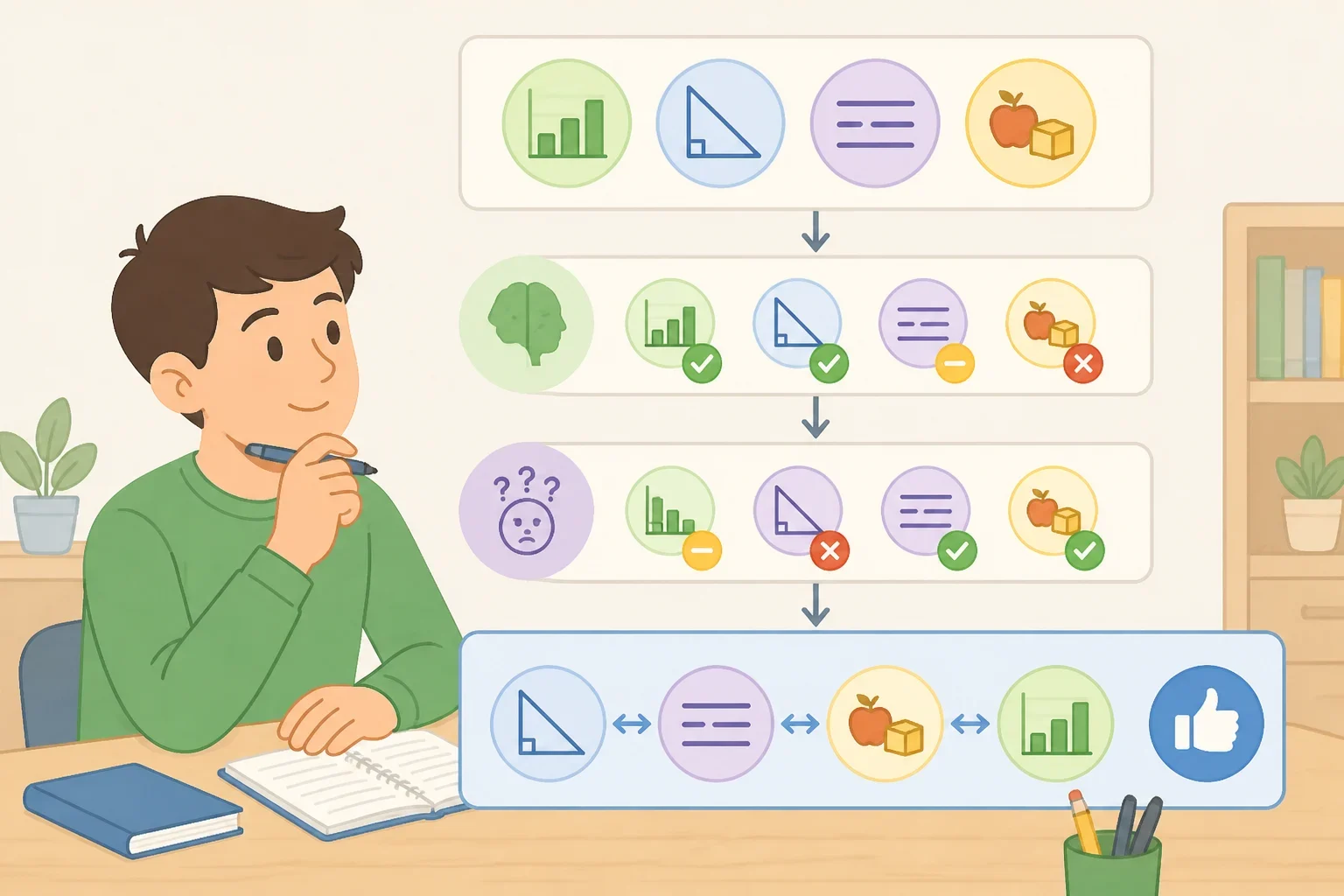
Research doesn't hand over an exact checklist, but a few patterns show up consistently enough to turn into practical screening questions. That's a synthesis for planning purposes, not a validated test. Good candidates for interleaving tend to be similar enough to confuse and require different solution methods, a pattern described in math-practice research and in last year's undergraduate survey, which found the interleaving effect shows up most clearly when the topics being compared are already similar.
That similarity pattern shows up outside math, too. In category-learning experiments, participants who studied rock categories in mixed order classified new, unfamiliar examples more accurately than participants who studied them in blocks, according to a 2023 study published in the Journal of Intelligence. The 2022 review of second-language research describes a related pedagogical recommendation: contrast specific confusable grammar structures, such as simple past and present perfect, within the same session rather than devoting a whole session to one structure, though the results it summarizes varied by which structures and studies were involved.
Before reordering any practice set, it helps to ask:
- Can I currently solve or identify each question type on its own, at least at a basic level?
- Which two or three types do I regularly mix up or misapply?
- Does the assignment or teacher's instructions require a fixed order, or can I reorder my own practice copy?
- How will I check my answers later without just re-reading the solution I already saw?
Reordering practice questions is a review strategy for material already taught. It isn't a substitute for completing assigned work, reading instructions, or getting initial instruction on something new.
A sample plan for reordering practice questions
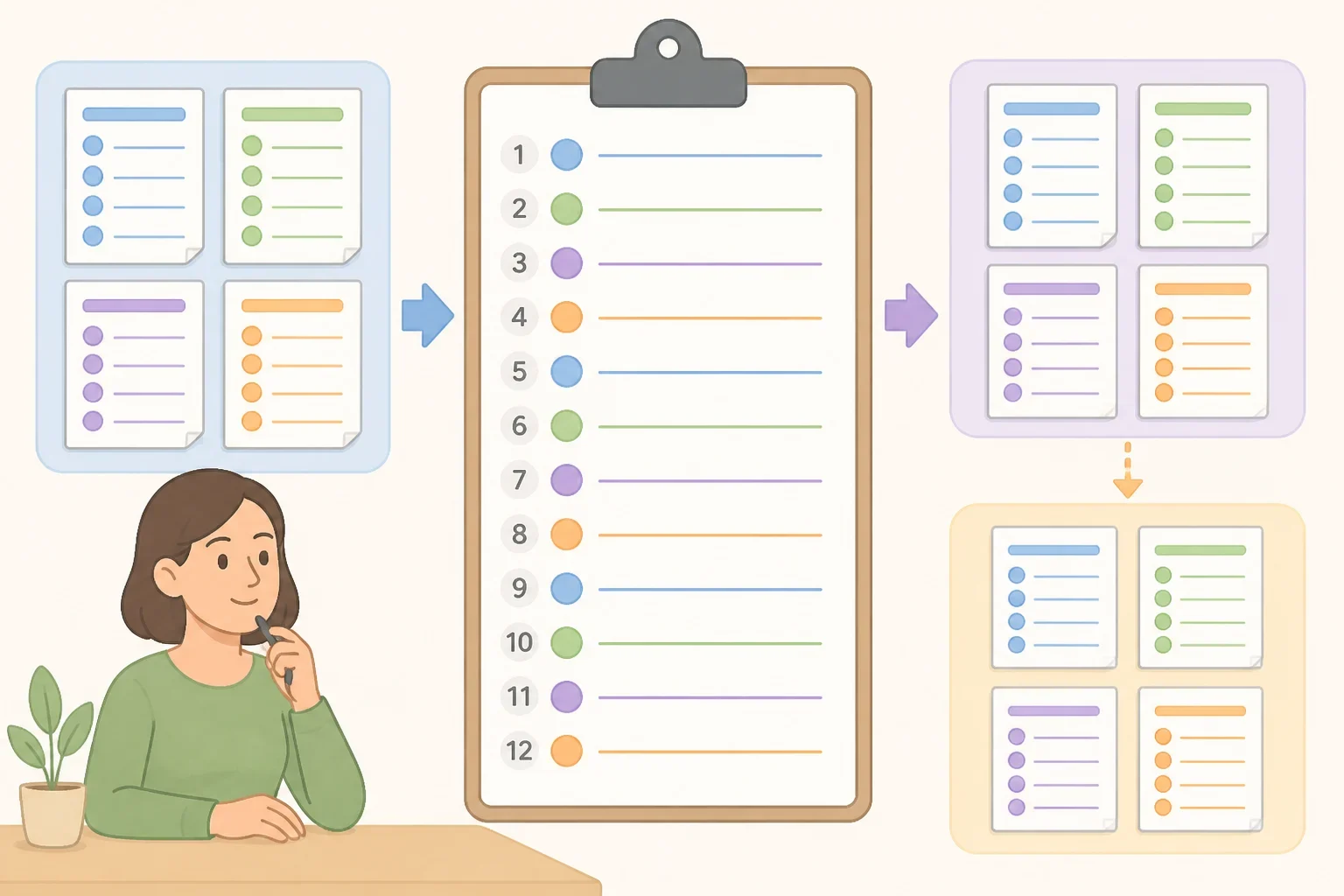
Back to that 12-question algebra set: solving for x, simplifying exponents, and factoring quadratics. If this is a student's first exposure to all three methods, working through them in blocks of four first still makes sense. This sequencing is illustrative, not a tested formula.
Once the learner can solve a few of each type independently, a portion of the remaining questions can be interleaved, alternating types in sequence instead of finishing one type before starting the next. That mirrors how interleaved assignments get restructured in the classroom intervention the IES project describes. A few questions of each type can also be held back for a short follow-up set completed a few days later, rather than finishing everything from all three types in one sitting. "A few days" is a workable example here, not a tested interval from that project design.
The structure adapts across roles:
- Student studying alone: apply the checklist to an existing homework or review packet and reorder a photocopy or digital version.
- Tutor or teacher: build mixed sets from material already taught rather than new content, and plan a short delayed follow-up for the next session.
- Parent supporting homework: help identify which two or three problem types a student confuses, without reordering or completing the assignment for them.
When blocked practice should come first
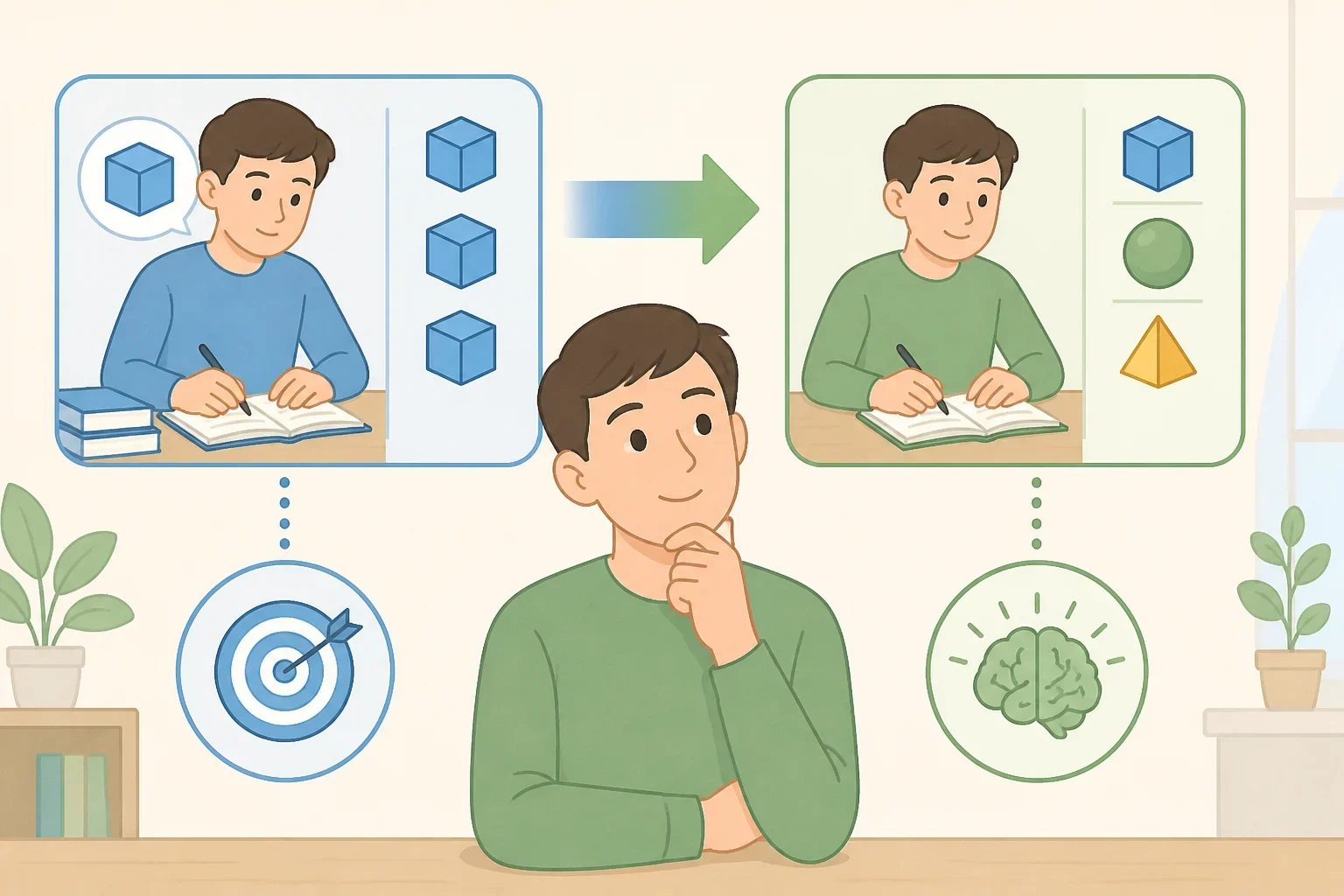
A short blocked phase still makes sense for first exposure to a new rule or skill. As a practical decision rule rather than a universal finding, interleaving tends to make more sense once a learner can perform each type separately and needs practice choosing between them, with spaced review scheduled after that.
The evidence for starting blocked varies by what's being learned. For French pronunciation rules, Carpenter and Mueller found blocked practice led to better learning than interleaving, according to the 2022 review. For relative pronouns, Suzuki and Sunada found a hybrid order, blocked first and then interleaved, more beneficial than either method alone in that specific study.
Timing of the test matters as much as the method. Nakata and Suzuki found that Japanese university students learning three confusable English grammar categories, simple past, present perfect, and conditionals, scored about the same on an immediate test regardless of method, but scored higher after interleaved practice on a test given a week later. Suzuki and colleagues found roughly the opposite pattern studying relative clauses: an interleaving edge on the immediate test, with no difference a week out (2022 review). Neither result generalizes cleanly to every grammar topic; the review's own conclusion is that effective spacing depends on the material and the learner, not one ideal gap.
Even fluency goals don't point one direction. Bui and colleagues found that repeating the same oral task immediately, rather than spacing the repeats out, produced better fluency scores, though not better accuracy or complexity (2022 review). That's a limited result from one type of task repetition, not a general rule that massed practice beats spacing for speaking skills.
What the research doesn't settle yet
Interleaving tends to feel harder than it looks from the outside. In category-learning experiments, participants had no accurate sense that interleaving was helping them, even as their classification performance improved, a study from three years ago found. A 2024 study found something similar: students reported more effort and felt they were learning less while interleaving, at least initially, even though their actual performance improved. That mismatch between how a session feels and how much it helped is worth remembering before judging the strategy by first impressions.
It's also not a guaranteed grade booster, at least by one measure. Last year's undergraduate survey found no significant link between self-reported interleaving use and overall GPA. The cited studies measure outcomes such as classification accuracy, grammar performance, and math achievement rather than GPA, so that single null result shouldn't be read as the final word on classroom benefit.
The large classroom trial is one important test of whether these findings transfer to ordinary math classrooms, not a stand-in for all the research discussed here, much of which concerns language learning and category learning rather than math. The multi-state, grade 7 math trial was first described about four years ago in an Institute of Education Sciences project summary, and last year's paper on math practice reports early results from the first of three planned years of data collection. Neither source goes further than that, so interleaving is best treated as a strategy supported by findings across several research settings rather than a finished, universally confirmed classroom intervention.
What to do next
Pick one review set covering material already taught, not new content, and mix only problem types the student can already handle individually. Reorder a portion by type, hold a few back for a follow-up a few days later, and compare accuracy on that delayed set, not how smooth the first session felt, before deciding whether the approach fits the subject.
Before rearranging anything that's part of assigned work, check the assignment prompt or ask the teacher whether a specific order is required.