
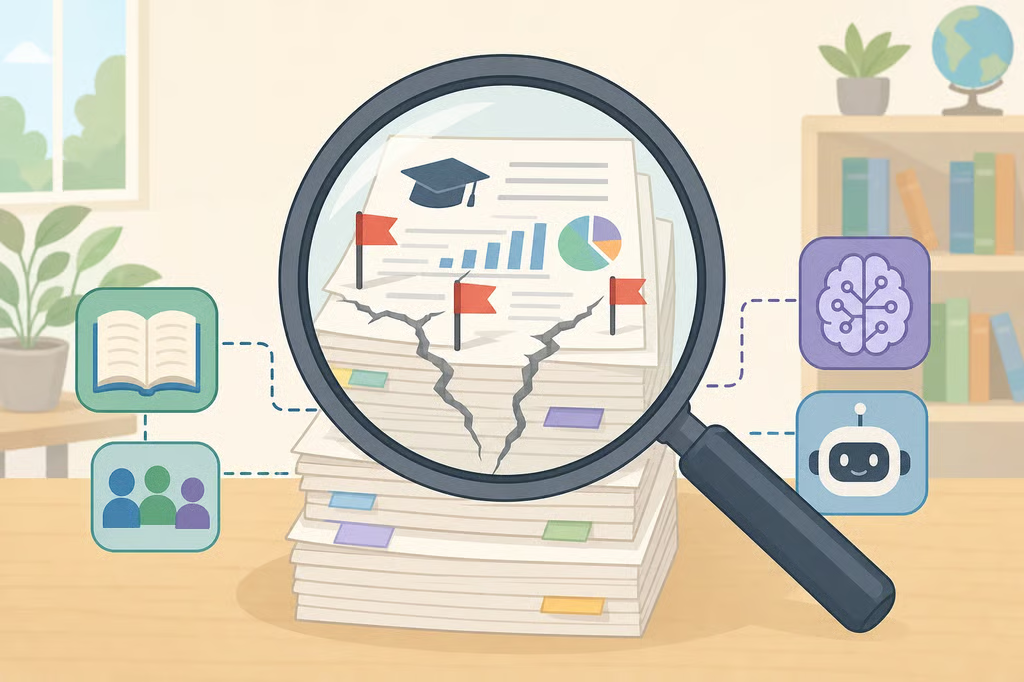
Dozens of research reviews have reported that artificial intelligence improves education. But a forensic audit of 14 influential reviews found serious methodological problems, raising doubts about how confidently schools can rely on their conclusions.
An October 26, 2026, investigation by The Hechinger Report described 39 meta-analyses reporting positive findings about AI in education. Researcher Patrick O'Neill's examination of 14 of those reviews challenged the methods behind their conclusions, including how researchers compared different technologies and measured educational outcomes.
The findings do not establish that AI is ineffective in classrooms. They raise a more specific concern: Schools adopting AI tutors, chatbots, and other learning tools need evidence that students develop lasting knowledge and skills, not simply that they complete assignments more successfully with technological assistance.
Why combining AI studies can be misleading
A meta-analysis combines findings from multiple studies to estimate an overall effect. The method is useful when studies examine similar interventions, measure comparable outcomes, and follow sound research practices.
Problems arise when researchers combine studies of technologies that serve different purposes. An AI tutor offering step-by-step explanations is not equivalent to a chatbot generating essay drafts or an adaptive platform adjusting exercises to a student's progress.
A positive average across those studies may conceal important differences. It also cannot establish that AI caused an improvement if students using the technology received more instruction, practice, or individual attention than the comparison group.
Such differences make it difficult to determine whether better results came from AI itself or from the additional learning activities surrounding it.
What researchers found wrong with 14 AI reviews
In a 2026 forensic audit, published as a preprint, O'Neill examined 14 meta-analyses making broad claims about AI's educational effectiveness. He concluded that none adequately defined what was being measured, sufficiently assessed publication bias, or accounted for substantial differences among the studies.
One recurring problem involved treating different outcomes as interchangeable. Completing an assignment, reducing anxiety, improving test scores, and retaining knowledge are not equivalent measures of learning.
The audit also reported incorrect calculations, questionable statistical methods, and citation problems. Some references reportedly led to unrelated papers, while others appeared to identify research published before the relevant generative AI technology became publicly available.
The reviewed papers appeared in journals associated with major academic publishers, including Springer Nature, Wiley, SAGE, and Taylor & Francis. According to the October 26 investigation, the 14 papers had accumulated more than 3,000 academic citations.
One reviewed meta-analysis was also retracted following a complaint from two Norwegian researchers. That does not invalidate unrelated research, but it illustrates why publication and peer review do not guarantee reliable conclusions.
O'Neill's findings are a methodological critique rather than proof that every AI education study is flawed. The audit directly examined 14 reviews, not all 39 identified in the reporting.
Better assignments don't always mean better learning
A central concern is the difference between performing well with AI assistance and demonstrating knowledge independently.
Students might complete mathematics assignments more accurately with a chatbot while still struggling to solve similar problems without help. Likewise, AI-generated writing suggestions may improve a submitted essay without necessarily strengthening the student's independent writing ability.
The distinction becomes especially important when researchers compare students receiving different amounts of instruction.
The Hechinger Report described one study in which nursing students received three hours of weekly instruction from a teacher using AI, while the comparison group received no equivalent sessions. Another compared students who played games and answered AI-generated questions with students who did neither.
Although the AI-supported groups performed better, those comparisons could not isolate AI's contribution from the benefits of additional instruction, practice, or engagement.
More convincing evidence would examine whether students retain information and apply skills after assistance ends. Follow-up assessments and comparable teaching conditions can help researchers distinguish temporary performance improvements from lasting learning.
Why positive AI results may be overstated
Publication bias occurs when studies reporting positive findings are more likely to enter the published research record than studies showing little or no benefit.
O'Neill reported that approximately two-thirds of the calls for papers he examined specifically encouraged research into AI's educational benefits. If negative or inconclusive findings are underrepresented, reviews may overestimate the technology's effectiveness.
A separate January 2026 meta-meta-analysis by František Bartoš and colleagues examined 1,840 effect sizes from 67 meta-analyses. After adjusting for publication bias, the researchers estimated an average effect approximately one-third as large as the unadjusted estimates. They also found substantial differences among studies, making broad claims about AI-driven learning gains premature.
Other research has reported benefits. A 2026 study in Studies in Educational Evaluation found positive average effects on academic achievement and student motivation. However, the researchers also reported that outcomes varied by subject, intervention duration, educational level, and AI tool.
An August 2026 STEM education meta-analysis published in Artificial Intelligence Review reached a more cautious conclusion. Its initial analysis found positive average effects, but the estimated overall benefit became much smaller after adjusting for potential publication bias.
The researchers also found that AI appeared more promising when it supported students' learning activities rather than replacing the thinking students needed to do themselves.
These studies do not establish a single answer about AI's effectiveness. Their findings differ according to the tools, teaching methods, outcomes, and statistical approaches examined.
Five questions to ask before trusting AI learning claims
Stanford education professor Susanna Loeb told researchers during an October 20, 2026, discussion that her team had collected nearly 900 studies on AI in education but selected only 20 as sufficiently rigorous for an evidence summary. The team had identified 32 additional studies for a planned update.
Loeb cautioned that the available evidence remained too limited for a broad meta-analysis useful to teachers and school leaders. Few of the strongest studies involved U.S. K–12 classrooms, limiting how confidently findings from other settings can be applied to American schools.
Before accepting claims that an AI tool improves learning, educators and families should ask:
- Who participated? Were students comparable in age, grade, and educational background to those who would use the tool?
- What was tested? Did researchers examine an AI tutor, chatbot, adaptive platform, or another application?
- What was the comparison? Did students without AI receive similar instruction, practice, and support?
- What improved? Did researchers measure lasting knowledge and independent skills or only immediate task performance?
- How reliable was the research? Did the studies use sound comparisons and account for negative or inconclusive findings?
An October 2026 University of Minnesota expert consensus report offers additional guidance. Thirty researchers examined 65 learning processes and identified opportunities for AI to support practice and feedback, alongside potential risks to independent thinking and skill development.
The report emphasized using AI to strengthen students' thinking rather than replace it. Those conclusions reflect expert assessments of potential effects, not definitive experimental evidence.
Schools can apply that distinction by testing tools on a limited scale, comparing outcomes with established teaching methods, and checking whether improvements persist without AI assistance.
A positive research finding may justify further investigation, but it cannot guarantee the same results in every classroom. The stronger test is whether students can demonstrate what they have learned when the AI tool is no longer doing part of the work.