
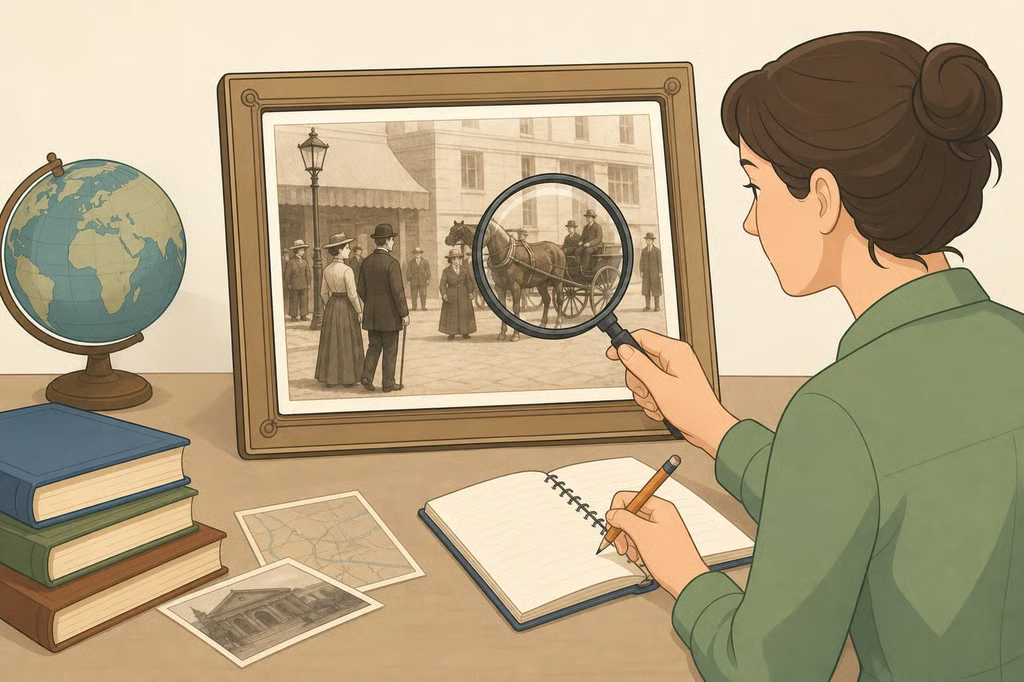
- How to Analyze Historical Photographs: A 5-Step Method for Reading the Evidence
- Who this guide is for
- How to analyze historical photographs in five steps
- Step 1: observe before you interpret
- Step 2: questions to ask about historical photographs
- Step 3: verify the context the photo doesn't show
- Step 4: corroborate with other sources
- Step 5: conclude with labeled certainty
- What to do next
How to Analyze Historical Photographs: A 5-Step Method for Reading the Evidence
Picture three people standing outside a storefront, bundled in heavy coats, scarves, and hats. The photo tells a viewer there are three people, three coats, one building. It doesn't say why those people are there, what they're thinking, or whether the coats mean a cold snap or just a cold climate year-round.
Learning how to analyze historical photographs starts with keeping those two things separate: what the image actually shows, and what a viewer's mind wants to add to it. A photograph is evidence of one moment in one place, not a finished explanation of it, according to the Library of Congress. Handled carefully, a photo can support a real conclusion. Treated as though it explains itself, it produces a guess dressed up as a fact.
This guide walks through a five-step method for interpreting historical photographs: observe, question the frame, verify context, corroborate, and conclude. One real case runs through every step: a Library of Congress photograph of a field marked with regular ridges, where a first guess about what's pictured needs more checking than it first seems (Library of Congress).
Who this guide is for
- High school and college students using a photograph as a primary source in a history paper.
- Teachers building a visual analysis of historical photos activity for a unit or lesson.
- Family historians and lifelong learners trying to date or place an old photo.
Classroom photo analysis isn't limited to archival prints. A Smithsonian American Art Museum lesson published last year, built around a routine called "Five Lenses," notes that the photographs used in the activity can be of anything that interests the student, not just century-old archive material (Smithsonian American Art Museum). The same core method, described below, adapts just as well to a family snapshot as to a photo pulled from a public archive.
How to analyze historical photographs in five steps
The method below works the same way for a family snapshot and an archival print: observe, question the frame, verify context, corroborate, and conclude with labeled certainty. The field photograph used throughout this guide shows a stretch of land crossed by regular ridges, with some patches between them lighter in tone than the rest (Library of Congress). Watching how the reading of that single image changes at each step shows why the order matters.
Step 1: observe before you interpret
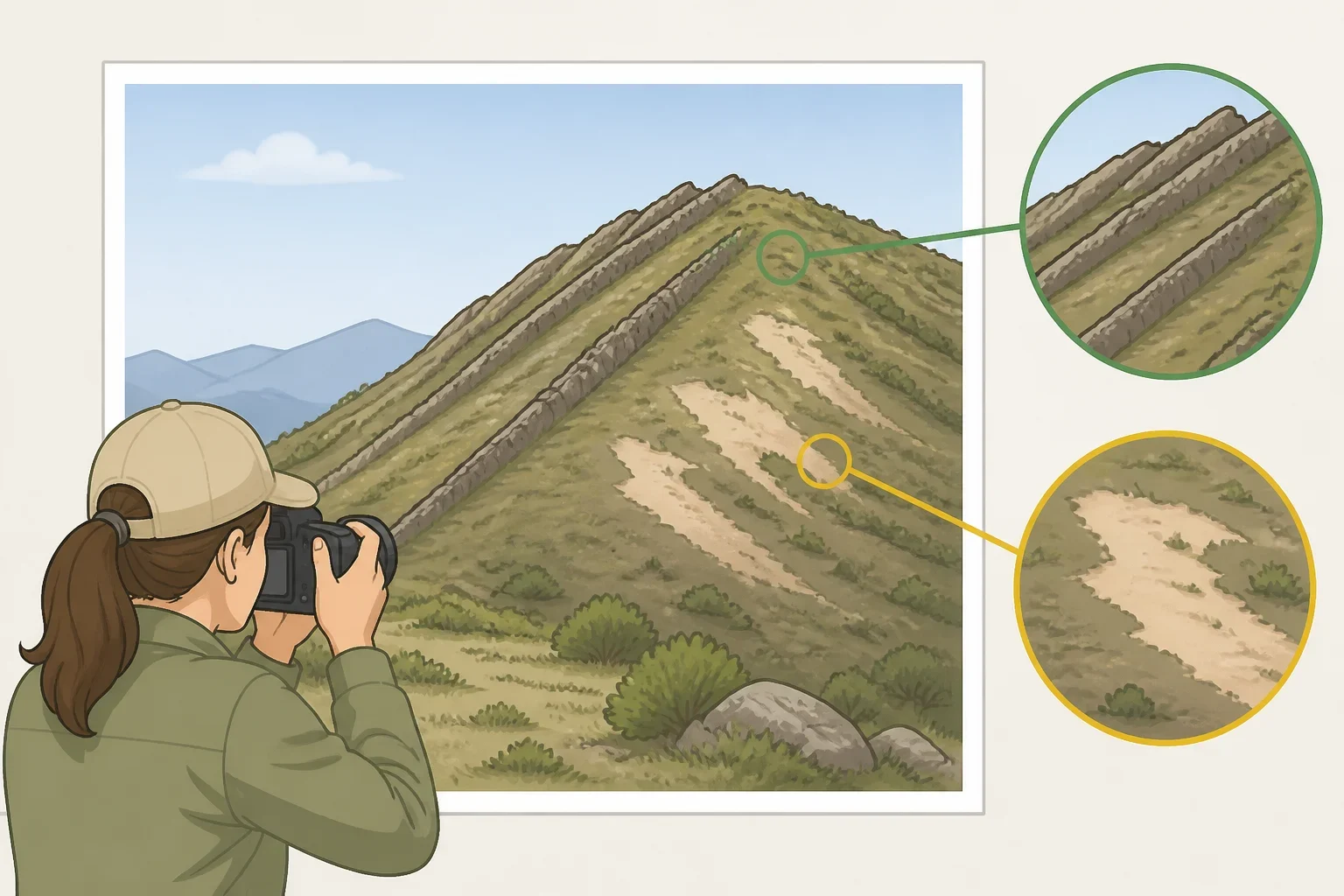
Before drawing any conclusion, list only what's physically visible in the frame. A Library of Congress inquiry routine built for visual primary sources opens the same way: what do you notice first, what words appear, who is shown, how are people arranged, what symbols show up (Library of Congress).
Applied to the field photograph, a plain observation looks like this: a field crossed by regular ridges, with some patches between them lighter in tone than the rest. No people, captions, or buildings appear in the frame. That's the whole observation, nothing about farming, erosion, or location yet.
A single photo contains data within it, and that data is what prompts the next questions, not the other way around (Library of Congress). The ridges and the lighter patches are real details. On their own, they don't yet explain what they mean.
Step 2: questions to ask about historical photographs
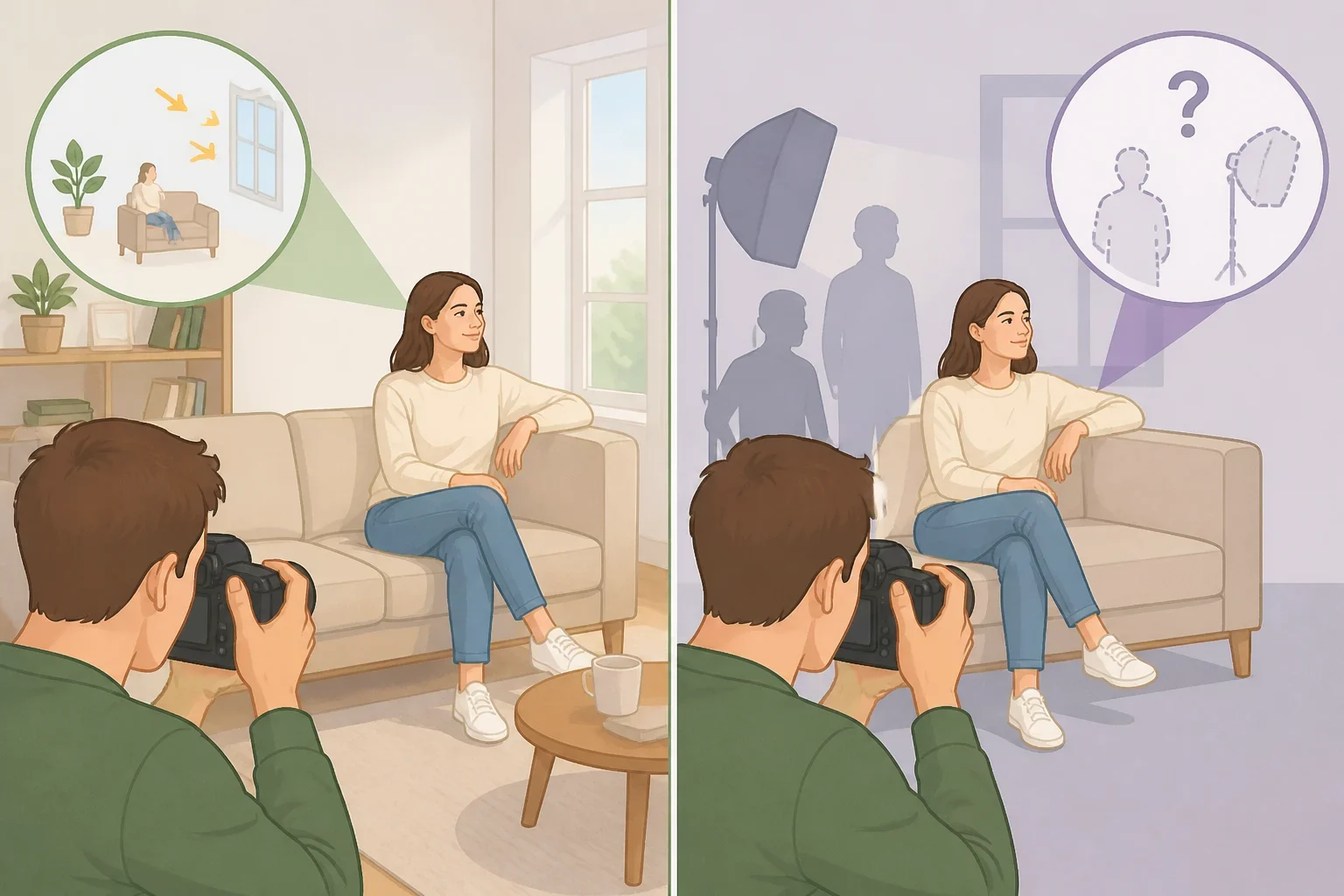
Once the visible details are listed, the next step is generating questions the image alone can't answer. The "Five Lenses" routine asks viewers to examine the same photo repeatedly, through five different angles, to surface questions a single glance would miss (Smithsonian American Art Museum).
- Cultural: what traditions, rituals, or values passed between generations might this scene reflect?
- Governmental: could any laws or policies have shaped what's shown?
- Economical: what industry or source of wealth might connect to this scene?
- Technological: what tools, innovations, or methods would have produced what's visible?
- Geographical: how do the land and climate shape what's pictured, and how are people working within that environment?
(Smithsonian American Art Museum)
The lesson plan itself labels that fourth category "Economical" rather than "Economic," a quirk worth knowing before assigning the material directly to students.
Applied to the field photograph, the geographical lens does the most work right away: regular ridges and lighter patches are clearly about land and how people worked it. The other four lenses mostly turn up open questions rather than answers at this stage, which is the point. They tell a researcher where to look next, not what to conclude yet.
Step 3: verify the context the photo doesn't show
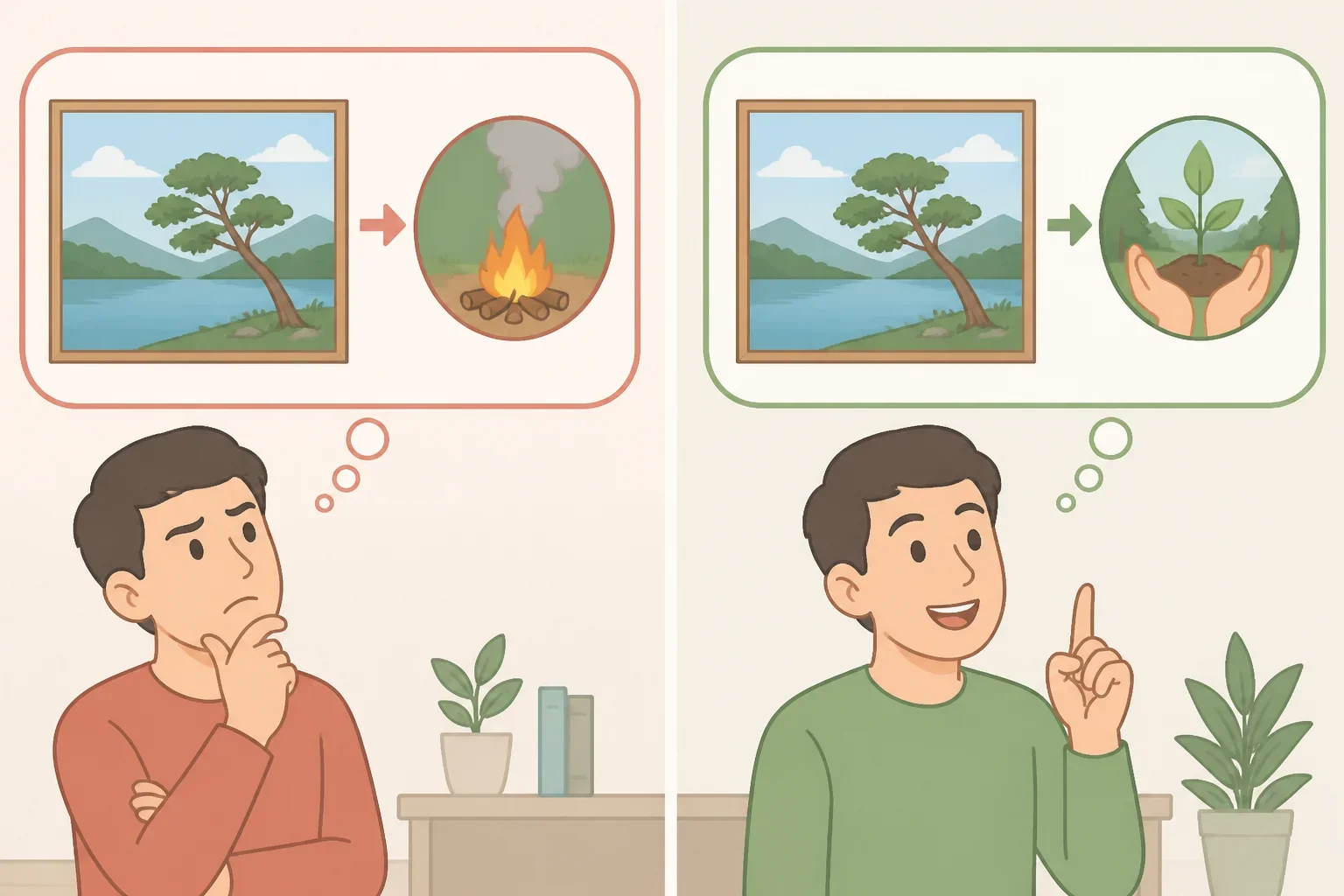
A common risk in photo analysis is treating an inference as settled before checking what's true outside the frame. Primary sources function as data points: they only gain meaning once a viewer builds questions and tracks down evidence beyond what's visible (Library of Congress).
From the ridges alone, students might deduce the image shows a farm, a plausible first interpretation (Library of Congress). That reading isn't wrong, exactly. It's also incomplete.
The accompanying text suggests the lighter-colored patches are grass, planted to help slow gully formation, a detail not visible from the ridges alone (Library of Congress). That one line of context does real work. It reframes the image from ordinary cultivation to a conservation practice, a distinction the photograph by itself could never establish.
Step 4: corroborate with other sources

A single photograph is data about one moment in one place, useful, but never the whole picture on its own (Library of Congress). Comparing related records side by side, instead of relying on one source alone, tends to surface what any single document leaves out. A Library of Congress activity built around competing political platforms encourages students to read at least two accounts and notice how they "talk" to one another, since that contrast builds a fuller picture than either source offers alone (Library of Congress).
The same logic applies to photographs. Comparing an image against other photos, documents, or related records from the same period helps a researcher tell whether what's shown is typical or an outlier, rather than treating one photo as the whole story.
This matters even for photographs from well-regarded archives. The same Library of Congress post that features the field photograph cautions readers not to exempt Farm Security Administration images from the same critical examination applied to any other photo (Library of Congress). A respected collection doesn't substitute for checking the record.
Comparative archives make that kind of checking easier. Smithsonian Gardens' archival activities, for instance, include Burpee seed catalog covers spanning 1884 to 1959, letting a researcher see how imagery and messaging shifted across decades instead of judging one year's catalog in isolation (Smithsonian Gardens). The same principle holds for photographs: a single print rarely shows whether a detail was common practice or a one-time scene.
Step 5: conclude with labeled certainty
The last step is writing conclusions that match the evidence, not conclusions that sound more confident than the research supports. A Library of Congress inquiry routine offers a simple structure for this: observe what's visible, reflect on what can be learned and what's missing, then question what remains to find out (Library of Congress).
- Observed: what's directly visible in the photograph.
- Reflected: what the photograph plus outside research can reasonably establish, and what gaps show up along the way.
- Still a question: what remains unverified even after checking context and comparing sources.
Applied to the field photograph: Observed, a field crossed by regular ridges, with lighter-toned patches running between them. Reflected, the lighter patches are grass planted to help slow gully formation, based on the text accompanying the photograph. Still a question: details the image and its caption don't address, such as the farm's exact location, the planting date, or how common the technique was across the region.
The Library of Congress frames the whole process as a cycle, not a one-time task: formulate questions, gather data, analyze it, communicate conclusions, then raise new questions for further research (Library of Congress).
What to do next
Before citing a historical photograph in an essay, project, or lesson, run it through a short template with four lines: Observed, Reflected, Still a question, and Source to check next. Filling in all four takes a few minutes and holds up far better than one confident sentence that papers over the gaps.
For the "Source to check next" line, name the specific caption, archive record, or textbook citation worth verifying against an independent source before repeating it as settled fact. If an assignment comes with a rubric or a required source-analysis format, confirm the expected structure with the teacher before turning in the final write-up.