
- How AI affects student learning: what surveys reveal
- How students are actually using AI for schoolwork
- How AI affects student learning: when help becomes cognitive offloading
- The benefits students and parents report
- Using AI without handing it your thinking
- What schools are, and aren't, doing about it
- What to check and do next
How AI affects student learning: what surveys reveal
Nearly two in three teens who use AI for schoolwork say they go straight to a chatbot for an answer instead of working through a problem themselves, a pattern that worries education leaders because it can replace students' own problem-solving (Common Sense Media, via The 74, this week). That single number captures the tension running through most of what researchers currently know about how AI affects student learning: the same tool that helps a struggling student understand a concept can just as easily let a rushed student skip the thinking altogether.
Generative AI use in schoolwork stopped being a fringe behavior a while ago. High school AI use for schoolwork climbed from 79% to 84% between January and May 2025 (College Board, 10 months ago). Among students in middle school grades and up, AI use for homework rose from 48% to 62% between May and December 2025 (RAND, 5 months ago). Those aren't small shifts. They describe a habit that's now part of how most students, from middle schoolers doing algebra homework to college freshmen drafting essays, approach schoolwork.
This article draws on three recent surveys, from RAND, Common Sense Media, and College Board, to look at what the data shows about AI use in schools and student learning, where the evidence stops short of proof, and what students, parents, and teachers can do this school year with what's currently known.
How students are actually using AI for schoolwork
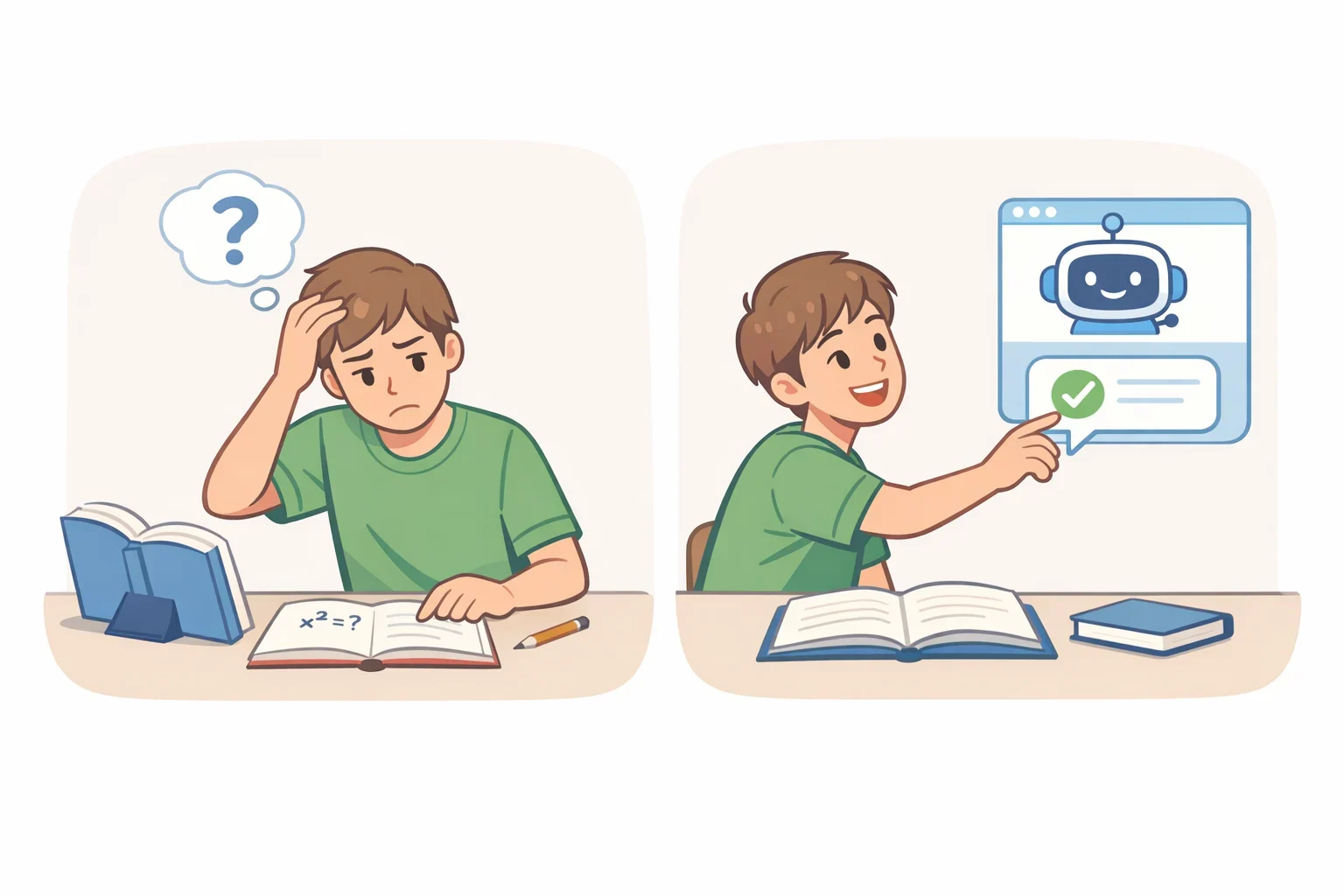
Use is broad and still climbing. Seventy percent of teens ages 13 to 17 now use AI for schoolwork, based on a nationally representative sample of 1,017 teens surveyed in April and May (Common Sense Media, via The 74, this week). That's not a niche behavior tied to one subject or one type of student.
How students use it changes by age. High schoolers most often turn to AI to brainstorm or get a clearer explanation of an assignment, something 37% reported. Middle schoolers use it differently: 32% say their most common use is simply looking up facts (RAND, reported by Education Week, 5 months ago). A middle schooler asking AI when World War I started is doing something different from a high schooler asking it to help structure a full essay.
Who's using AI most may surprise some parents. A College Board follow-up survey conducted in December found that high-achieving students, along with students showing signs of "senioritis," are among the most expansive AI users (The 74, this week). Heavy AI use isn't concentrated among students who are struggling. It shows up just as often, maybe more, among students who are already doing well or who've mentally checked out of a class.
Because adoption is this broad, treating AI as an occasional shortcut misreads where things stand. The more useful question isn't whether to allow AI use. It's which specific uses support learning and which ones quietly replace it.
How AI affects student learning: when help becomes cognitive offloading
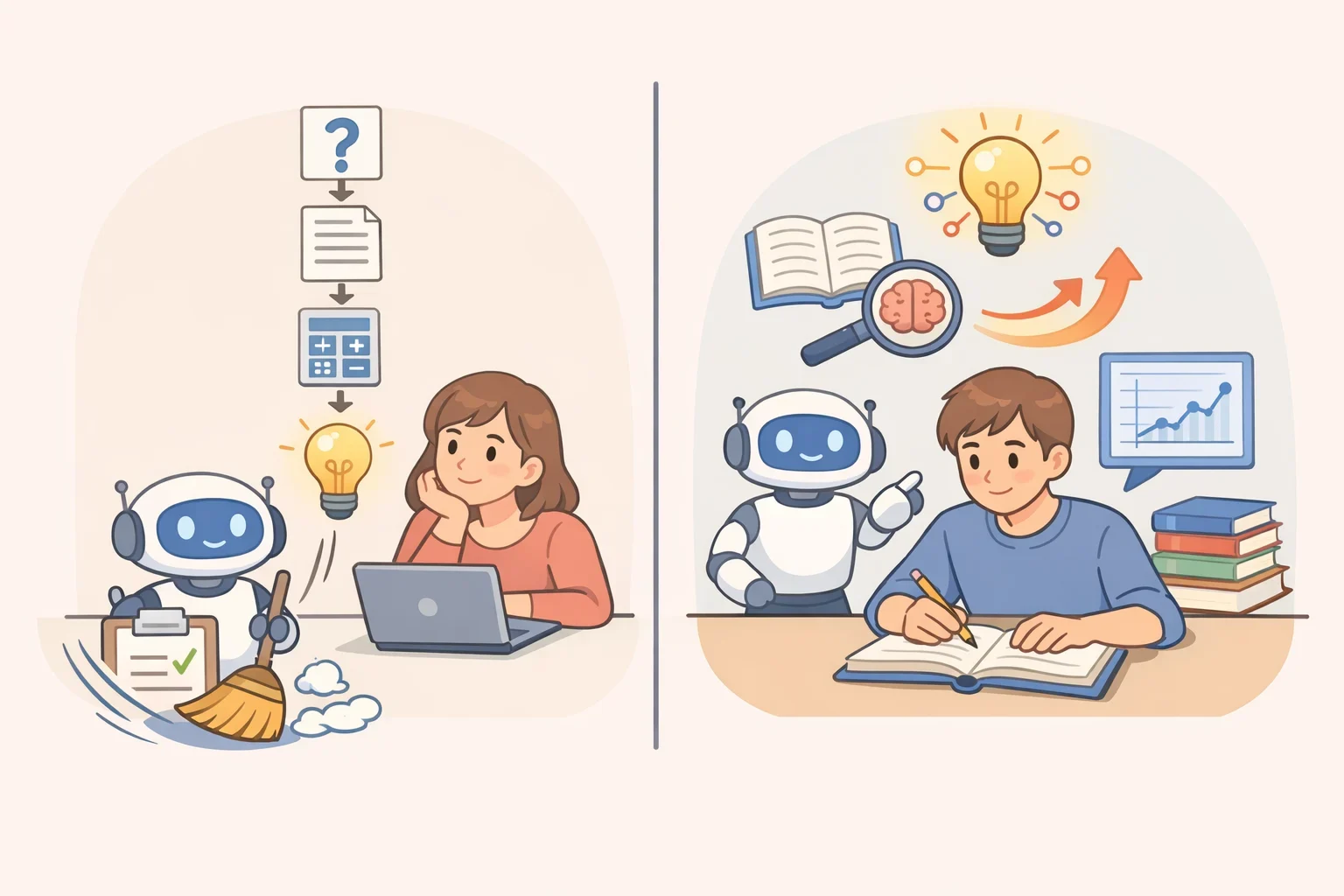
RAND's researchers frame this exact question around two competing effects. "Cognitive offloading" is when AI does the mental work a student would otherwise do. "Cognitive augmentation" is when AI pushes a student toward deeper or more thorough work. That distinction, not AI use itself, is what RAND identifies as the variable that determines whether a given use helps or hurts (RAND, 5 months ago).
Students themselves are increasingly worried about which side of that line they're on. As of December 2025, 67% agreed that greater AI use for schoolwork would harm critical thinking, up more than 10 percentage points from ten months earlier. Concern was even higher among college students, at 70% (RAND, via Education Week, 5 months ago).
Some of that worry lines up with self-reported behavior. Thirty-eight percent of teen AI users say having the tool available leads them to develop fewer original ideas. Thirty-nine percent say that using AI to finish an assignment leaves them feeling like they missed out on the learning it was supposed to produce (Common Sense Media, via The 74, this week).
Reacting to the finding that most AI-using teens go straight to a chatbot for answers, former U.S. Education Secretary John King, an advisory board member for Common Sense Media's Youth AI Safety Institute, said the habit is worrying "because we can't allow AI to become a substitute for students doing the learning themselves" (The 74, this week).
Heather Schwartz, co-director of the American Youth Panel at RAND, offers an important caveat, though. "Just thinking it harms your critical thinking isn't proof that it's harming your critical thinking," she told Education Week, while noting that a handful of emerging studies do suggest AI is "functioning like a crutch for students" (Education Week, 5 months ago). That distinction matters: these surveys measure what students believe and report about their own habits, not a measured decline in thinking skills.
Schwartz also described the mechanism she watches for: the moment a student faces a blank page or an unsolved math problem with no obvious first step. That friction, she said, is a cognitive challenge that draws on background knowledge. An AI tool that removes the step, however well it explains the material, still removes the thinking, "and I think it's shortchanging your learning in the process" (Education Week, 5 months ago).
Early dependency data adds a related layer. Among kids who use AI for homework help, 16% report difficulty starting or finishing homework without it. That share jumps to 28% among kids who use AI for homework daily (Common Sense Media Youth AI Safety Institute, 2 months ago). A similar pattern shows up more broadly: 80% of kids overall say a month without AI wouldn't be hard, but among daily users, 42% say it would be (Common Sense Media Youth AI Safety Institute, 2 months ago).
None of this proves AI use causes measurable harm to learning. It's a warning sign worth a direct conversation, especially for a student who notices they can't start an assignment without opening a chatbot first.
The benefits students and parents report
The same surveys show real upside, and the picture is genuinely mixed rather than one-sided. Among teen AI users specifically, 77% describe AI as a support tool, something they use for brainstorming, checking work, or getting feedback on writing. Sixty-six percent of teen AI users say it helps them understand schoolwork, not just finish it faster (Common Sense Media, via The 74, this week).
Parents and educators see value too. Nearly six in 10 parents of high schoolers agree it's better for students to use generative AI than not to, and more than 85% consider learning to use AI tools a valuable part of a high school education (College Board, 10 months ago).
Whether a given use counts as cheating is also more contested than a simple ban-or-allow policy suggests. Only 45% of surveyed students classified using AI to get direct homework answers as cheating. Most other AI-assisted tasks, brainstorming, checking grammar, explaining a concept, weren't seen as cheating by a majority of students at all (RAND, 5 months ago).
That split explains why blanket rules tend to satisfy no one. A policy treating every AI interaction as cheating ignores students using it to understand material better. A policy with no guardrails ignores students using it to skip the work entirely. The practical question is how to tell which category a specific use falls into before starting an assignment, not after a teacher raises a concern.
Using AI without handing it your thinking
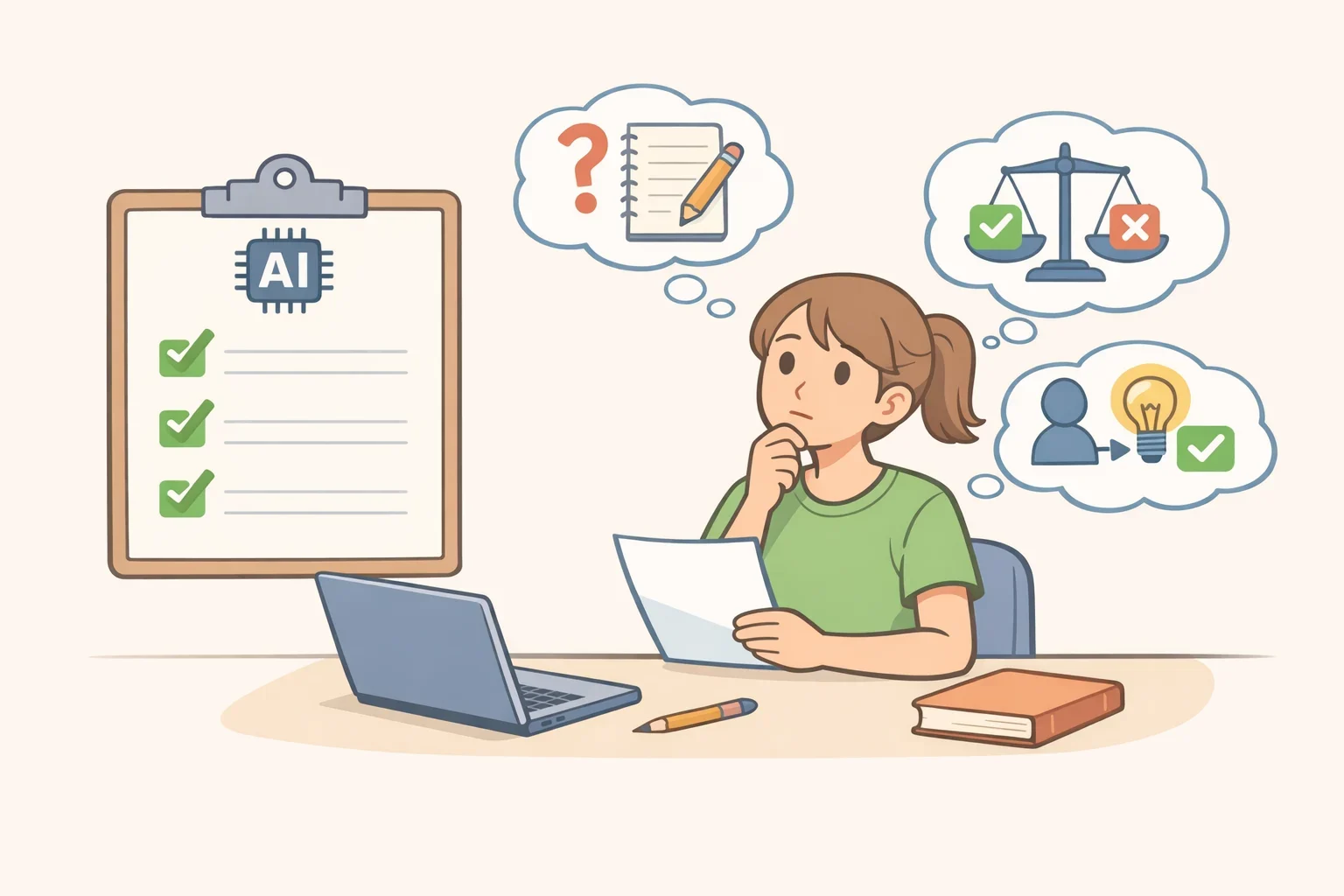
The RAND and Common Sense findings point to a workable distinction students can apply on their own, even without a written school policy. Assuming a teacher or school allows AI use at all, some patterns tend to support learning rather than replace it:
- Asking AI to quiz you after you've already worked through the material
- Comparing a finished draft against a rubric to see what's missing
- Asking for two possible counterarguments to a thesis, then checking them against assigned readings
Other patterns tend to shift the mental work away from the student before any thinking has happened:
- Asking AI for the first step before attempting a problem
- Asking a chatbot to write a paragraph, then lightly rewording it
- Treating a chatbot's answer as a verified fact without checking a real source
That last habit is worth flagging on its own. AI chatbots can state incorrect information confidently, and a student who never checks the underlying source has no way to catch it.
Before opening an AI tool for an assignment, three questions help sort which category a given use falls into: What did I do before I opened AI? Could I explain and defend this answer out loud without it? Does my teacher or school actually allow this specific use? A "no" to the first two is a sign the assignment's purpose, giving a student practice at a skill, is being skipped rather than supported.
There's a longer-term stake here too. Asked what skills matter most for their futures, teens pointed to things AI can't easily replace: 55% named working well with others, 50% named fact-checking and critical thinking, and 48% named reading and understanding complex information (The 74, this week). Those are close to the exact skills that get skipped when a student offloads a problem to AI before attempting it, which is one more reason the "what did I do first" question is worth answering honestly.
What schools are, and aren't, doing about it
Instruction hasn't caught up with use. Only 30% of teens say a teacher has ever talked with them about using AI safely, and just 26% say a teacher has covered how to judge whether AI-generated information is accurate (Common Sense Media, via The 74, this week). Alex Kotran, CEO of the AI Education Project, called that gap "a pretty big alarm bell," noting that students are using AI constantly while "flying blind" about how to evaluate it (The 74, this week).
School policy is fragmented, not absent. Roughly two in five schools or districts prohibit student use of generative AI outright, about one in five allow it with no policy in place, and 16% leave the decision to individual teachers (College Board, 10 months ago). That range means a student can move between two classes in the same building and land under two different sets of rules.
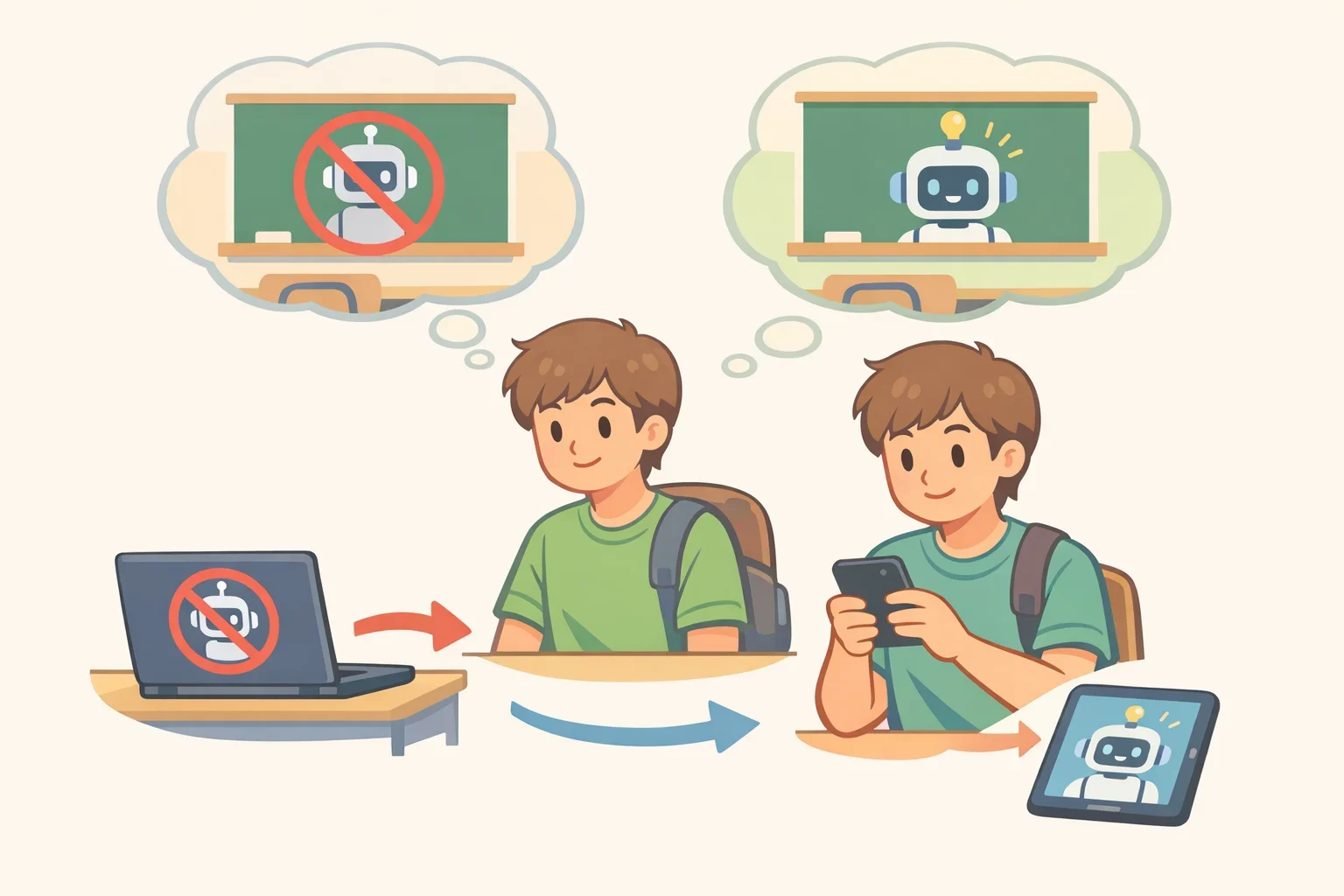
Blocking access doesn't necessarily end the behavior schools are trying to prevent. Among the 44% of teen AI users who say they've had a tool blocked on a school device, 59% say they simply switched to a personal device with less oversight (Common Sense Media, via The 74, this week). That doesn't mean blocking never works. It means a block alone doesn't guarantee the underlying use stops; it can just move somewhere less visible to a teacher or parent.
Kotran's recommendation centers on redesigning assignments so students demonstrate what they know in the classroom, regardless of how much AI they used at home. "Even if a student is going home and using AI, it's not going to help them because ultimately they're going to have to go and demonstrate their knowledge in the classroom," he told The 74, adding that adapting assignments well requires teachers to understand what AI can actually do (The 74, this week).
RAND's researchers point to a related but separate recommendation: schools should identify which specific AI use cases lead to offloading versus augmentation, then set clear, schoolwide expectations rather than leaving rules to shift by classroom. Consistency alone, RAND notes, could ease some of students' worry about AI harming their thinking, even if it can't eliminate the behavior entirely (RAND, 5 months ago).
For now, most students don't have that clarity. Only about one-third of middle and high schoolers report their school has a specific rule about AI use in homework (RAND, via Education Week, 5 months ago). That's a clear cue to check a school's actual, current policy rather than assume a national standard, because right now there mostly isn't one. Common Sense Media also introduced a new Digital Literacy & Well-Being curriculum this week, along with a professional development course on AI and student well-being, aimed at building AI literacy skills for K-8 and high school students (The 74, this week), which gives schools without a policy yet somewhere concrete to start.
What to check and do next
The data doesn't settle whether AI is helping or hurting students' ability to learn. It shows both things happening at once, sometimes in the same student, depending on which task and which moment. Most teen AI users call it a support tool, and most also admit to habits, like going straight to a chatbot for answers, that they associate with weaker thinking (Common Sense Media, via The 74, this week).
What's confirmed by the current surveys is straightforward: use is rising quickly, self-reported behavior is genuinely mixed, and most students have never had a substantive conversation with a teacher about safe or accurate AI use. What isn't confirmed is causation. None of this data proves AI use produces a measurable drop in critical thinking or academic performance; these are surveys of perception and self-reported habits, not controlled studies of learning outcomes, a distinction Schwartz specifically flagged (Education Week, 5 months ago). That gap matters for how to read any headline claiming AI is definitively hurting or helping students.
The practical step for this week: check the actual AI policy for each specific class before an assignment is due, rather than assuming one district-wide rule covers every teacher. Ask directly which parts of an assignment are meant to be done without AI support, and why. Parents and teachers can use the numbers above, particularly how few students report ever discussing AI safety or accuracy with a teacher, as a starting point for that exact conversation this week.