
AI literacy in schools: why guided use beats blanket bans
If a student uses AI to challenge an argument, is that the same as asking it to write the argument? The actions involve the same technology, but they create very different learning experiences. One can prompt a student to question evidence. The other can remove the need to think through the task.
That distinction is why AI literacy in schools should be taught as a core academic skill. Schools should not give students unrestricted access to general-purpose chatbots, but blanket bans are too blunt. Students need guided practice in questioning, verifying, and appropriately using AI-generated information, along with clear limits on when independent work must remain independent.
The available research does not support either extreme. IES reported last month that general-purpose AI can hinder learning when it reduces cognitive effort or replaces student thinking. A review from Stanford SCALE found six months ago that only 20 high-quality causal studies had rigorously examined AI’s effects on students or educators. Strong claims in either direction are running ahead of the evidence.
The useful question is not simply whether students can access AI. It is what the tool is asking them to do.
What AI literacy means in school
AI literacy is more than writing effective prompts or receiving polished answers. It includes understanding what an AI tool can and cannot do, recognizing that a fluent response may still be wrong, checking claims against reliable sources, protecting private information, and following the teacher’s rules for a particular assignment.
Students also need to understand the difference between assistance and substitution. Asking for questions that clarify an essay argument is different from requesting a finished essay. Using a tutoring tool for a hint is different from submitting its solution without understanding the steps.
This belongs in ordinary academic instruction, not only in a technology class. In English, students can examine an AI-generated interpretation of a poem. In science, they can compare an explanation with a teacher-selected source. In social studies, they can look for missing perspectives, unsupported claims, or language that presents an opinion as fact.
Younger students might compare a short AI explanation with one source chosen by the teacher. Older students can evaluate citations, omissions, competing interpretations, and the quality of an argument. The goal is not to make every student an AI engineer. It is to strengthen the reading, writing, research, and reasoning habits students already need.
What the evidence shows, and what it does not
The research base is still developing. Stanford SCALE reported six months ago that its review examined more than 800 academic papers related to AI and K–12 education in its repository as of October 2025, but identified only 20 high-quality causal studies. It also found no high-quality causal studies of student AI use conducted in U.S. K–12 classrooms. Most studies measured short-term rather than long-term outcomes.
That limitation should change the tone of school policy. It calls for careful testing, clear goals, and regular review. It does not prove that every classroom use is unsafe, just as it does not prove that a new chatbot will improve learning.
An IES summary published last month identifies three broad patterns:
- Teacher-mediated and AI-augmented tutoring may support learning.
- Student-facing AI tools show mixed effects.
- General-purpose AI may hinder learning when it reduces cognitive effort or replaces student thinking.
Students in particular studies who used general-purpose chatbots while learning or studying were more likely to have lower exam performance, shallower learning processes, and weaker recall, even when they felt the tools were helpful. In another research-paper task, students using a traditional search engine produced higher-quality reasoning and argumentation than students using a general-purpose AI chatbot, according to IES last month.
A search engine still requires a student to choose sources, read them, compare them, and build an argument. A chatbot can make it tempting to accept a polished answer before any of that work happens. The problem, then, is not access alone. It is whether the design and classroom routine preserve the thinking the assignment is meant to develop.
Why restrictions alone are not enough
The strongest case for limiting AI deserves a direct answer. The evidence base is thin. General-purpose chatbots can reduce the effort that learning requires. Students may also perceive AI-mediated feedback as less caring and supportive than feedback from a teacher, IES reported last month.
Those are good reasons to reject unmanaged adoption. They are not a strong case for treating every AI interaction as equivalent.
A blanket ban removes the opportunity to examine the tool under supervision. It also leaves schools without a way to teach students how to verify, question, and responsibly use AI-generated material when they encounter it. A guided policy carries more responsibilities, but that is precisely why it needs local rules, teacher preparation, and regular review.
Equity makes the policy choice more complicated. IES identified a gap in research on how AI tools might benefit students without private tutoring or extracurricular support. Stanford SCALE also reported six months ago that very little research examines AI’s effects on equity, student wellness, or social development.
A guided-use policy will not be fair if approved tools, reliable internet access, or adult guidance are available only to some students. Before adopting a tool, schools should ask:
- Who can access it at school and at home?
- What happens for students with limited internet or no quiet place to work?
- Has the tool been reviewed for privacy and access concerns?
- What training will teachers receive?
- What learning goal is the tool meant to support?
A ban can avoid some immediate procurement questions, but it does not teach students how to judge AI-generated material. Avoiding the tool is not the same as teaching the skill.
How schools should teach AI literacy to students
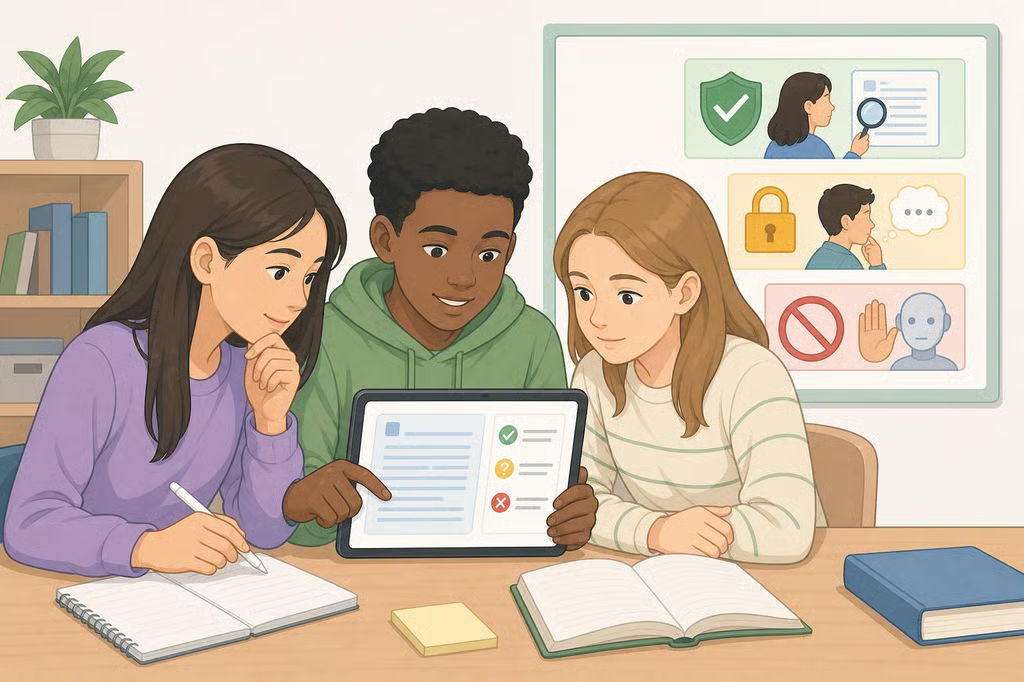
A cautious approach supported by the current evidence is teacher-mediated use. The teacher sets the purpose, chooses or approves the tool, explains what students should evaluate, and decides which parts of the work must be completed without AI.
A classroom activity might look like this:
- The teacher asks an AI tool to explain a historical event or scientific concept.
- Students compare the explanation with independent sources.
- Students mark claims that are supported, incomplete, unclear, or wrong.
- They revise the explanation and explain why each change was necessary.
- They write a short response without copying the AI output.
For younger students, the comparison could involve a brief explanation and one teacher-selected source. Older students could examine whether citations support the claims, which perspectives are missing, and how different sources interpret the same issue.
IES recommended last month using AI interactions to teach critical thinking and having students identify and review multiple sources. The source also discusses “sycophancy,” a tendency for AI companions to validate users’ beliefs rather than challenge their thinking. That gives teachers a useful question for students: What evidence supports this, and what might be missing?
Tool design matters, too. Stanford SCALE reported six months ago that tutoring systems with pedagogical guardrails, such as hints and guided reasoning, showed more promising outcomes than general-purpose chatbots that provide answers directly.
The findings from IES add an important limit. Tutoring-specific chatbots that provided hints without giving away answers produced exam performance comparable to traditional study methods, not better. AI also appeared more effective when paired with traditional strategies such as note-taking than when used by itself.
In a narrower set of studies, students used an AI model fine-tuned for pedagogy while expert tutors provided direct supervision. Those students performed as well as or better than students working with human tutors alone, according to IES. That finding applies to a supervised, pedagogy-tuned approach, not to AI tutoring generally.
Which uses should be limited
These are examples, not universal rules. Requirements vary by teacher, school, district, grade level, and assignment. Students should check the prompt before using a tool.
Schools may allow AI for:
- generating questions for review
- brainstorming possible topics
- receiving feedback on a draft, when the teacher permits it
- practicing a skill with hints rather than finished answers
- comparing an AI explanation with reliable sources
- helping a teacher identify possible misconceptions for further instruction
Schools may restrict or prohibit AI for:
- writing a complete response for graded submission
- solving an assessment intended to measure independent skill
- inventing sources, quotations, data, or citations
- paraphrasing copied material to disguise plagiarism
- entering private student information into an unapproved tool
- completing work when the assignment specifically requires no AI assistance
Independent checks remain essential. A student may use a permitted tool during practice and still need to complete a quiz, writing sample, oral explanation, or other assessment without AI. That allows the tool to support learning while giving the teacher a clearer view of what the student can do alone.
Last year, the U.S. Department of Education issued guidance saying AI uses may be allowable under federal education programs when they comply with applicable law and regulation. The guidance addresses responsible integration, privacy, AI literacy, and parent engagement. It does not create unrestricted student access or a universal school policy.
What students, families, and schools should check
Before using AI-generated material for schoolwork, ask:
- What does the assignment permit?
- Is the tool helping with the learning process, or doing the thinking?
- Which claims can be checked in a textbook, library database, official source, or other reliable material?
- Does the response include an invented source, quotation, statistic, or detail?
- Can the student explain the answer without opening the tool?
- Has any private or identifying information been entered?
- Does the final work accurately show the student’s own reasoning?
Families can ask whether the school has written guidance separating permitted uses, such as feedback or tutoring support, from prohibited uses, such as answer generation on independent work. Teachers can request shared examples and training rather than being left to create rules alone. School leaders should clarify the learning goal for each approved tool and review access and privacy concerns before expanding use.
Schools should teach responsible AI use in education because students need practice making judgments about AI, not practice accepting it. The next step is concrete: ask the school to identify one approved classroom use, one independent assessment, and one source-checking routine before expanding access.