
- AI Tutoring for Kids Math Mistakes: What Evidence Shows
- What the evidence can and cannot answer
- How AI tutoring for kids math mistakes should work
- The clearest evidence on AI feedback for math learning
- Why practice habits and human-AI tutoring support change the picture
- Can you trust AI-generated feedback?
- A checklist for choosing an AI math tutor for children
- What this means for choosing an AI math tutor
AI Tutoring for Kids Math Mistakes: What Evidence Shows
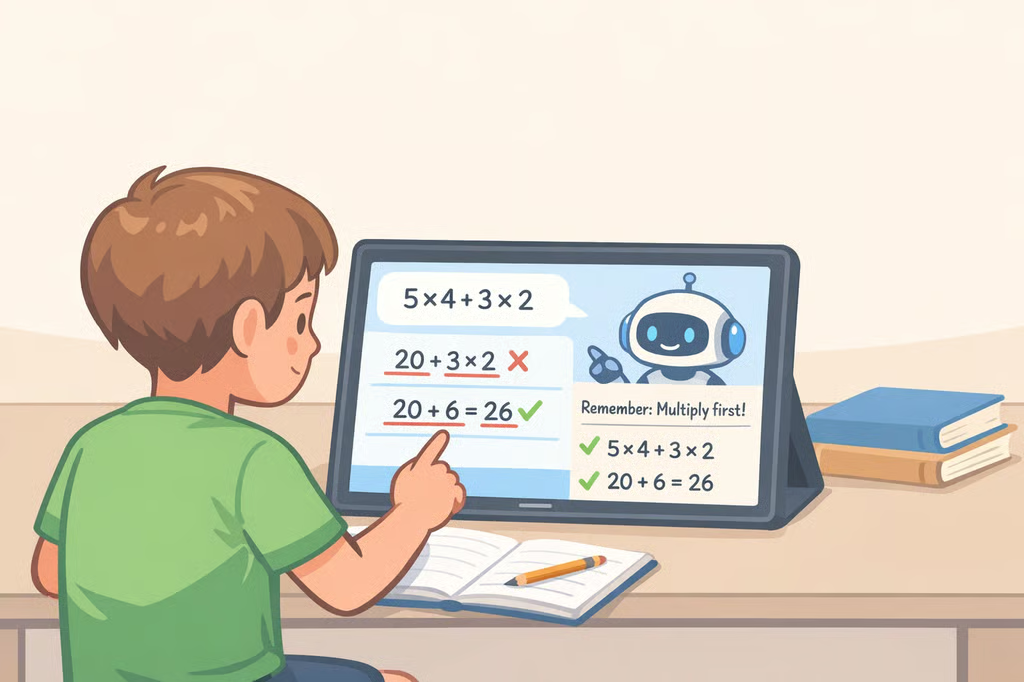
A student gets a math problem wrong. An AI tool jumps in. Does it show the correct answer and move on, or does it help the student figure out where the reasoning broke down? That difference, whether a tool just corrects a mistake or actually helps a student learn from it, is the real question behind AI tutoring for kids math mistakes, and it matters more than most product pages let on.
The research base here is thinner and narrower than it looks. The two studies most directly relevant to that question involve a gifted math program at one school in Thailand and participants assigned to problems in four subject areas, from elementary algebra through statistics. Neither study directly represents a typical elementary or middle school classroom. Other studies covered here look at Grades 3-5 students in one Michigan district and a middle school human-AI tutoring program. Every number below belongs to a specific group of students, not to "students" as a category, and that distinction shapes how far any parent or teacher should trust the results.
One trial offers the clearest single comparison: students using an intelligent tutoring system with automated, real-time feedback scored noticeably higher on a post-test than students using the identical system with no feedback at all, 3.54 versus 2.85 (ERIC/EJ1487439). A separate study of 274 participants found that only the group receiving ChatGPT-generated help improved significantly over no help; researchers detected no statistically significant difference between ChatGPT's help and help written by a human tutor, a narrower finding than saying the two are interchangeable (PubMed).
No study reviewed here tested the specific four-step sequence this article calls "slow math": attempt, feedback, explanation, retry. That routine is a practical proposal built from what these studies suggest about feedback and practice, not a protocol any single trial has validated. What follows separates what's been demonstrated from what's a reasonable next step, and closes with a way to check any personalized AI math tutoring tool before trusting it with a child's homework.
What the evidence can and cannot answer
Before looking at any single study's numbers, it helps to know what each one actually tested. These four studies ask different questions, and treating them as one body of evidence about AI and math mistakes would be a mistake of its own.
- The Thai intelligent tutoring system study compares automated, real-time feedback against no feedback at all, inside one gifted math program.
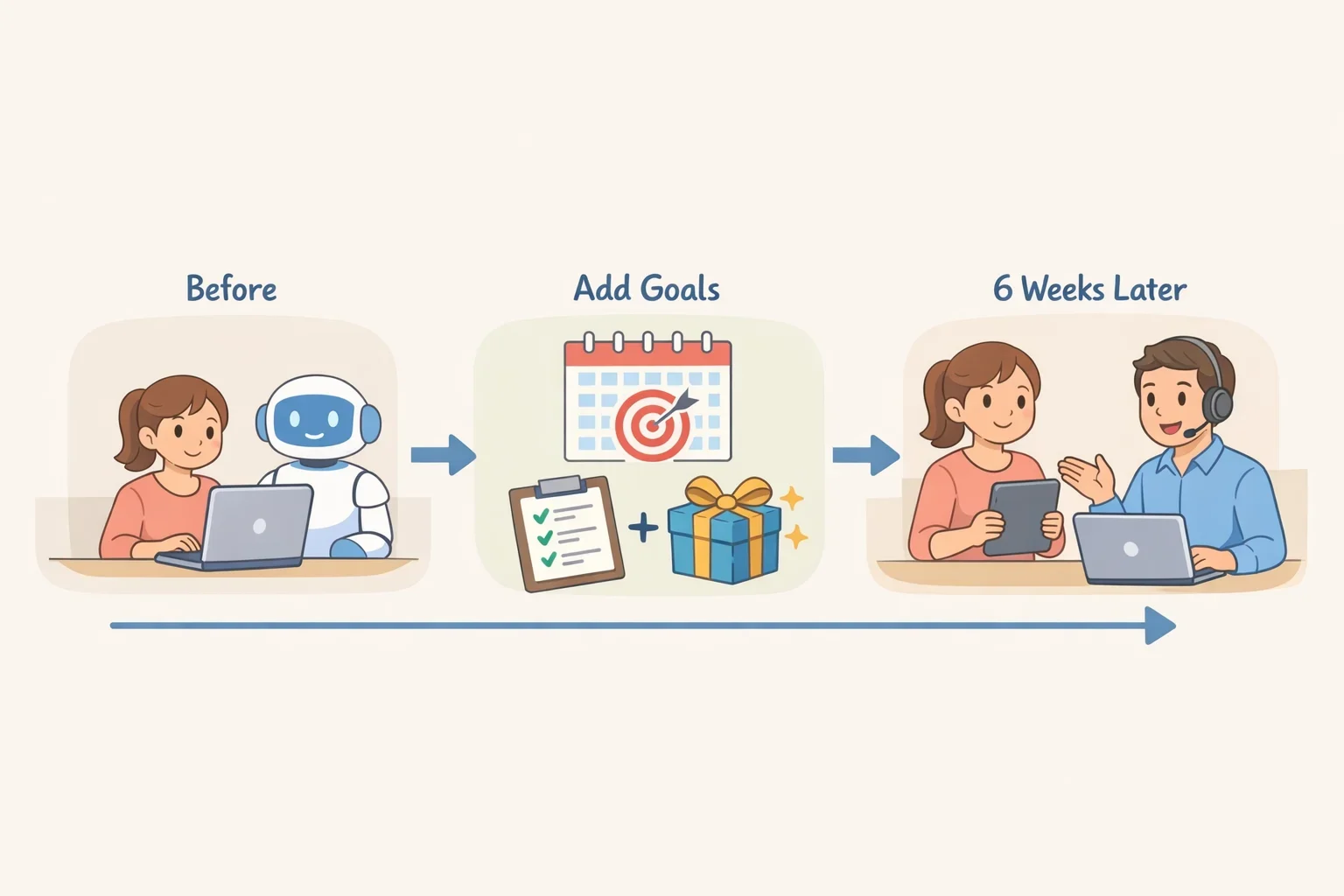
- The hybrid human-AI tutoring study looks at what happens when weekly goals and rewards were added to an existing tutoring program partway through, without a randomized comparison group.
- The IXL Math study compares a broad online math program against standard classroom instruction for Grades 3-5 students; it wasn't built specifically to help students review and correct mistakes.
- The ChatGPT study compares generated hints, human tutor-authored hints, and no help at all, and separately measures how often the generated hints passed a quality check.
None of these four studies, alone or combined, proves that a specific app will produce these results for a specific child. Each answers a narrower question, and keeping those questions separate is the only honest way to read the numbers.
How AI tutoring for kids math mistakes should work
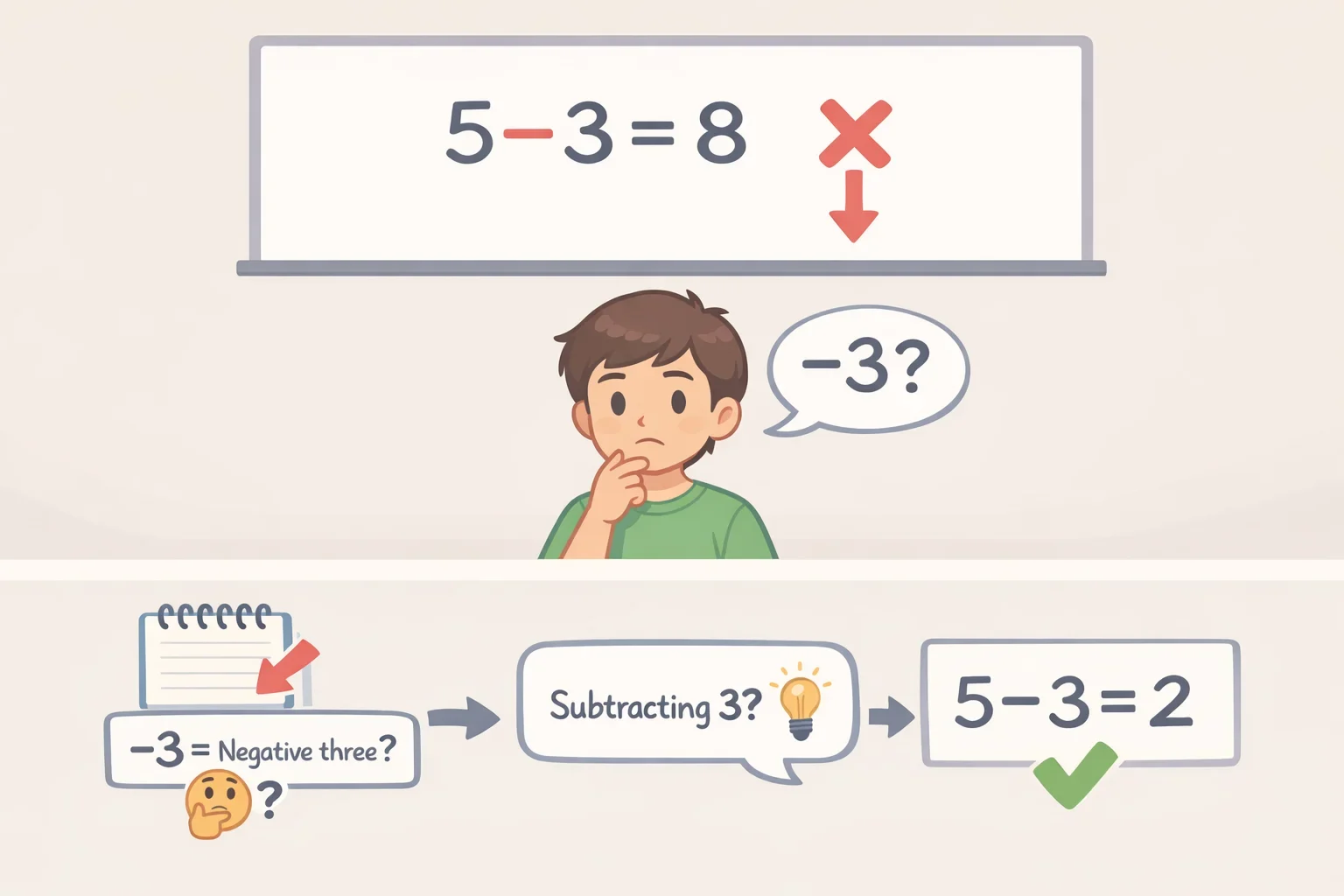
Picture a student solving −2x = 6. Dividing both sides by −2 gives x = −3, but the student writes x = 3, missing the negative sign in the division. A tool built only to reveal answers just displays "x = −3" and lets the student copy it down. Nothing about that interaction touches the sign error the student actually made.
A feedback-based approach works differently. Instead of simply marking the answer wrong, it might ask the student what 6 divided by −2 equals, and require an explanation of the sign before letting the answer change. The student works through the division, accounts for the negative sign, redoes the calculation, then gets a second, similar equation to solve without help. That sequence, attempt, feedback, explanation, retry, is the "slow math" routine proposed in this article. No cited study tested it as a packaged unit, but it's a reasonable interpretation of evidence showing benefits from automated, real-time feedback over no feedback at all.
A literature review hosted by the National Science Foundation helps explain why that distinction matters. It separates four uses of generative AI in math education: solving problems, tutoring and giving feedback, adapting mathematical tasks, and helping teachers plan lessons (NSF Public Access Repository). A tool built for one of those jobs shouldn't automatically get credit for outcomes measured in another. A homework app that generates practice problems isn't necessarily helping a student understand a mistake, even if it runs on the same underlying technology as a feedback tool.
Watch for this while a student works through one real homework problem: does the tool ask for the work, not just the answer, and does it name the specific step that went wrong before it lets the student move on? Those two behaviors separate a feedback tool from an answer machine. The full checklist near the end of this article covers what else to check, including practice design, oversight, and privacy.
The clearest evidence on AI feedback for math learning
The most direct study reviewed here comes from a randomized controlled trial in Measurement and Geometry involving 120 students in the Mathematics Program for Gifted Students at Khon Kaen University Demonstration School in Thailand. Researchers used systematic random sampling to select 78 of those students and split them between an intelligent tutoring system with automated real-time feedback and an identical system with no feedback at all (ERIC/EJ1487439).
Two terms come up throughout this research, and a general research-methods distinction, not a specific study finding, is worth stating plainly before the numbers pile up. "Statistically significant" means a result is unlikely to be due to chance alone, given the sample size and the size of the difference measured; it doesn't say whether the difference is large enough to matter in daily practice. "Effect size" measures how big that difference actually is, on a scale that lets researchers compare results across different tests and groups. A statistically significant result can still carry a small effect size, and a large effect size in one small study doesn't guarantee the same result in a bigger, more varied group of students.
The Thai study's results need to be read carefully, because it reports three different statistics that measure different things. Post-test scores rose from an identical starting point of 1.90 to 3.54 in the feedback group and 2.85 in the no-feedback group, a difference researchers called modest (η² = .095). A separate relative-gain analysis, comparing how much each group improved relative to where it started, found the feedback group's gain exceeded the no-feedback group's by 23.29 percentage points, with a much larger effect size (η² = .73). A third figure looked at individual students rather than averages: 74.4% of the feedback group reached an "Advanced" performance tier, compared with 43.6% of the no-feedback group.
That 0.73 figure is the number most likely to be overgeneralized. It's a real result from one small sample drawn from a gifted program, not a ceiling on what AI feedback can achieve everywhere. A different age group, subject, or tool could produce a smaller effect, or a larger one. The Thai study's gifted-program setting also looks different from the Grades 3-5 sample in the IXL study discussed next, and that contrast is worth keeping in mind before assuming results transfer from one group of students to another.
Why practice habits and human-AI tutoring support change the picture
Two other studies never tested mistake-review directly. Their value lies elsewhere: they show that practice volume, goals, and adult involvement shape whether any tool, AI-driven or not, produces measurable gains.
One study followed 110 middle school students in a hybrid human-AI tutoring program over 12 weeks, where students used personalized software with feedback and hints while human tutors provided ongoing support. After six weeks, researchers added weekly goal-setting: each student set a target for time or skills to master, earned a reward for hitting it, and had a tutor check in on that progress. Because goal-setting, the rewards, and the related tutor check-ins arrived together as one packaged change, the interrupted time-series design used here can't isolate which piece drove the result (ERIC). What it can show is that weekly practice time rose by about 25% and skills mastered per week rose by about 40% after that point, with the effect holding steady over the following weeks.
A cluster-randomized trial gets closer to isolating cause and effect. Researchers randomly assigned teachers, not just students, to either implement IXL Math, an online program covering roughly 1,500 skills for Grades 3-5, or continue business-as-usual instruction. The rollout ran across four elementary schools in one Michigan district starting in February 2023 and continuing through that spring. The treatment group's average outcome was estimated to be 0.13 standard deviations above the comparison group, translating to roughly 10 additional points on the Renaissance Star Math assessment (ERIC).
The same study found IXL usage correlated with achievement at 0.30 to 0.57, meaning students who used the platform more also tended to score higher, though correlation alone doesn't show that usage caused the increase. Researchers also reported gains of 13 to 17 points for Hispanic, special-education, English-language-learner, and low-income students in this district (ERIC), though the study doesn't say whether that pattern would hold elsewhere.
IXL's design centers on broad practice across many skills, built-in rewards, and diagnostic data teachers can use to adjust instruction; it wasn't built around the step-by-step error correction the Thai and ChatGPT studies tested. Both approaches can help a student improve, but they work differently, and a program's marketing doesn't always make clear which one it's actually giving a family.
Together, these two studies suggest that whatever benefit a feedback tool offers depends heavily on whether students keep practicing, and that goals, rewards, and adult check-ins can help drive that engagement. Neither study says anything directly about reviewing mistakes as the mechanism behind the gain. When a school or program reports an achievement bump from a math platform, it's worth asking what usage level, goal structure, or adult support came bundled with it. The software alone may not explain the gain.
Can you trust AI-generated feedback?
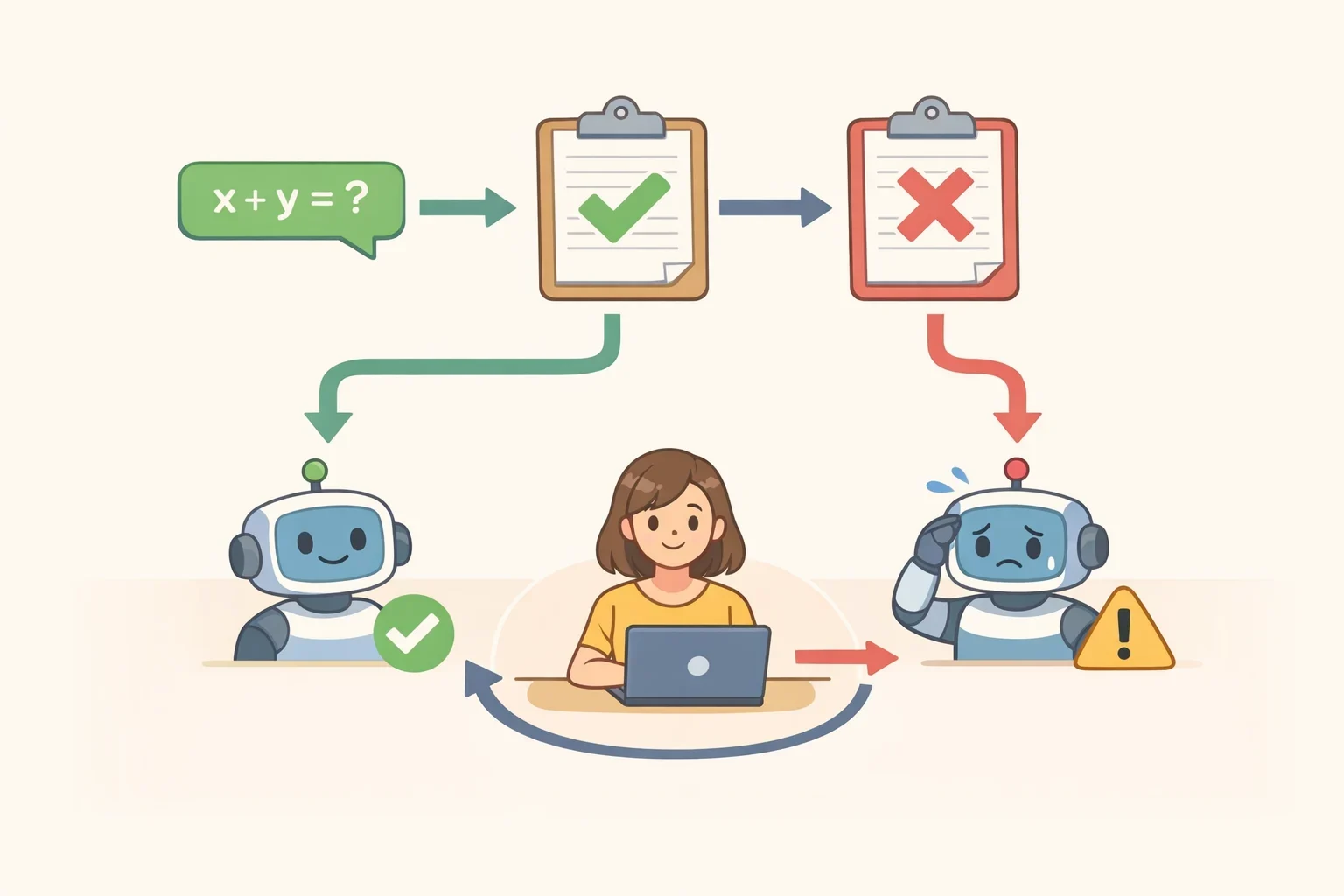
Of the studies reviewed here, the ChatGPT trial offers the clearest test of how reliable AI-generated math help can be. Researchers randomly assigned 274 participants to receive ChatGPT-generated hints, human tutor-authored hints, or no help, across four subject areas: elementary algebra, intermediate algebra, college algebra, and statistics (PubMed).
Only the ChatGPT-versus-no-help comparison reached statistical significance. Researchers found no statistically significant difference between ChatGPT and human-tutor help in learning gains or time-on-task, a narrower claim than saying the two work equally well. It means the study didn't detect a difference with the sample it had, not that a difference couldn't exist.
The reliability figures matter most for anyone deciding whether to trust a tool's explanation. In the tested pipeline, 32% of ChatGPT's initial responses failed quality checks. A mitigation technique called self-consistency, which has the model generate multiple answers and check for agreement, cut that failure rate to near 0% for algebra problems, but about 13% still failed the study's quality checks for statistics problems. Those figures describe one research pipeline at one point in time. The study does not establish how another model or product would perform.
A double-digit quality-check failure rate on statistics problems is worth taking seriously, especially when a student is already unsure whether their own reasoning was correct. Accepting an unverified, incorrect explanation can lead a student to "fix" a step that wasn't actually wrong, or to walk away with a flawed rule in place of the correct one. If a student can't identify their own error, or the AI tool's feedback is contradictory or unclear, the more reliable move is to stop using the tool for that problem and bring it to a teacher, tutor, or other qualified adult rather than guessing.
Two informal checks, proposed here rather than validated by any single study, make the "slow math" routine usable rather than vague:
- Corrected error: the student names the specific step that was wrong, explains why, and redoes the calculation without being told the final answer.
- Solved unaided: a similar problem, attempted the next day without hints.
Neither is a formal assessment. They're checks a parent or teacher can run at home or in a tutoring session, and they work best tracked across several real practice sessions rather than judged from a single one.
A checklist for choosing an AI math tutor for children
Before adding any tool to a student's homework routine, it helps to check five things separately. Personalized AI math tutoring products often advertise strong feedback, but the categories below don't always come as a package.
- Feedback capability: Does it identify the specific step or misconception behind the error, not just mark the final answer wrong? Does it offer a hint before revealing the full solution?
- Practice design: Does it require an attempted correction before moving on, and follow up with a similar problem the student solves unaided?
- Human oversight: Does it make it easy for a teacher or parent to see what the tool told the student, especially on subjects like statistics, where the ChatGPT study found a higher quality-check failure rate?
- Assignment rules: Does the teacher or school allow this specific tool for this specific type of assignment? A tool acceptable for practice problems may not be allowed on a graded assessment.
- Privacy: Does the platform explain what student data it collects, retains, and shares? Check whether the school or district has reviewed the platform and what its privacy policy says.
Running through this list takes a few minutes and can catch a mismatch between what a tool advertises and what it actually does during a real homework session.
What this means for choosing an AI math tutor
AI can support guided math practice when it keeps a student reasoning through a mistake instead of just handing over the right answer. The strongest evidence for that comes from one gifted-program trial with a narrow sample, and the supporting studies point in a consistent but modest direction: sustained practice, goals, and adult check-ins matter as much as any single AI feature, and generated hints can hold up about as well as a human tutor's, with reliability that still varies by subject.
None of that proves a specific child will learn more from a specific app, and no study tested the attempt-feedback-explanation-retry sequence as a single routine.
Run one recent homework problem through the checklist above and note which items the tool actually performs. Confirm with the teacher whether the tool is allowed on that type of assignment before using it for anything graded. Then track, over real use rather than one session, whether the student can name and correct the specific error and solve a similar problem unaided the next day. That's an additional check on whether the child can apply the idea independently, not a replacement for the score a program displays at the end of a session.