
- Retrieval Practice vs Rereading for Midterms: What Works
- Retrieval practice vs. rereading: what the studies actually measured
- Does rereading help you study for a midterm?
- Retrieval practice for exam preparation: what counts as active recall
- What students can do: building a retrieval-based study routine
- What to do next
Retrieval Practice vs Rereading for Midterms: What Works
When a midterm is still days or weeks away, choosing between retrieval practice and rereading, sometimes framed as active recall vs. rereading, can matter as much as the number of hours spent studying. A 2024 study comparing retrieval practice with repeated study found that students who tested themselves on a passage recalled about 2.7 times as many ideas a week later than students who simply reread it: 19.65% of ideas recalled versus 7.35% (World Journal of English Language, 2024).
Right after studying, the pattern flipped slightly. Rereading edged out testing, 25% versus 23.5%, though researchers reported that difference wasn't statistically significant (World Journal of English Language, 2024). A study published in 2025 on 113 second-year high school students found a similar direction: spaced repeated retrieval led to better retention than repeated encoding or a single retrieval attempt within one 50-minute lesson (DOI: 10.4189/shes.23.155, 2025).
This article breaks down what those studies measured, why rereading tends to look better than it performs, and what a retrieval-based routine can look like for students weighing the best study method for midterms. It applies to middle school, high school, and college students preparing for any exam with a gap between studying and test day.
Retrieval practice vs. rereading: what the studies actually measured

The 270-student study divided participants into three conditions: four rounds of restudying with no test, three rounds of studying followed by one test, and one round of studying followed by three tests. Each condition was then tested either immediately or one week later, which produced six groups in total (World Journal of English Language, 2024).
On the delayed test, the repeated-testing group recalled 19.65% of ideas, ahead of the single-test group at 16.65% and the repeated-study group at 7.35% (World Journal of English Language, 2024). Even a single test beat four rounds of rereading a week out. Researchers described this as evidence that testing reduces the rate of forgetting, rather than simply checking what a student already knew (World Journal of English Language, 2024).
Participants in the repeated-testing group had only one study period, compared with four for the repeated-study group (World Journal of English Language, 2024). Despite less exposure to the material, they retained more of it a week later. The repeated-study group's edge on the immediate test looked real at first, but that advantage did not persist on the delayed test (World Journal of English Language, 2024).
The 2025 classroom study points in a related direction from a different angle. Within one 50-minute lesson, 113 second-year high schoolers from three liberal arts classes went through spaced repeated retrieval, repeated encoding, or a single retrieval attempt, then completed free-recall tests (DOI: 10.4189/shes.23.155, 2025). Spaced repeated retrieval significantly outperformed the other two conditions. Repeated encoding isn't identical to rereading, so this isn't a direct rereading comparison the way the 270-student study is, and the researchers flagged their own limitation: results came from a single lesson, and they called for future work using delayed testing across different school subjects (DOI: 10.4189/shes.23.155, 2025).
Neither study covers every student, subject, or exam format. Participants were Saudi EFL undergraduates and students from three high-school classes, tested on prose passages and short lesson content, not math problem sets or lab exams. A review passage within the Frontiers study notes that laboratory and classroom research broadly favors retrieval practice over repetition for long-term learning, a pattern consistent with both studies here (Frontiers in Education, 2024).
Does rereading help you study for a midterm?

Rereading isn't without a place in studying. Getting familiar with new material before trying to recall it can be a reasonable way to open a study session, though that's a practical suggestion rather than something the cited studies tested directly.
The trouble shows up when rereading becomes the main way a student tries to hold onto material for days or weeks before an exam. Edutopia describes four cognitive steps involved in learning: attention, encoding, storage, and retrieval, with retrieval identified as the step most tied to long-term retention (Edutopia, 2025). In that framework, rereading mainly repeats the attention and encoding steps, while retrieval requires pulling information back out of storage without looking at it, which may help explain why rereading feels productive without necessarily building the kind of memory a delayed exam draws on.
Survey data shows a gap between what the research favors and what students actually do. Among 202 Saudi undergraduate EFL students who studied a 451-word passage on "The Teenage Brain," 55.6% reported mainly restudying and 24.6% rereading, while only 19.8% used testing strategies such as self-quizzing (Frontiers in Education, 2024). Asked what they'd do near the end of a study sequence, 53.6% still said restudying, compared with 28.1% who chose testing with review (Frontiers in Education, 2024).
Those numbers reflect stated preferences and self-reported behavior on one short passage, not performance on a live midterm in a different subject. The researchers concluded that the Saudi EFL students in their sample viewed testing as an ineffective study strategy throughout the learning process, even though its use increased somewhat by the later stages (Frontiers in Education, 2024).
Retrieval practice for exam preparation: what counts as active recall

Retrieval practice doesn't require a formal quiz. Any activity where a student closes their notes and tries to bring information back to mind counts, whether or not it's graded. Edutopia lists several accessible formats: free recall, where a student writes down everything remembered about a topic without looking at notes; self-questioning; writing from memory; and short quizzes built from a student's own material (Edutopia, 2025).
That distinction matters for the exam-format question, too. Answering short-answer questions from memory, outlining an essay without notes, working a math problem without a worked example in view, or explaining a lab process out loud are all forms of retrieval, even though none of them resemble the multiple-test conditions used in the studies above.
What students can do: building a retrieval-based study routine
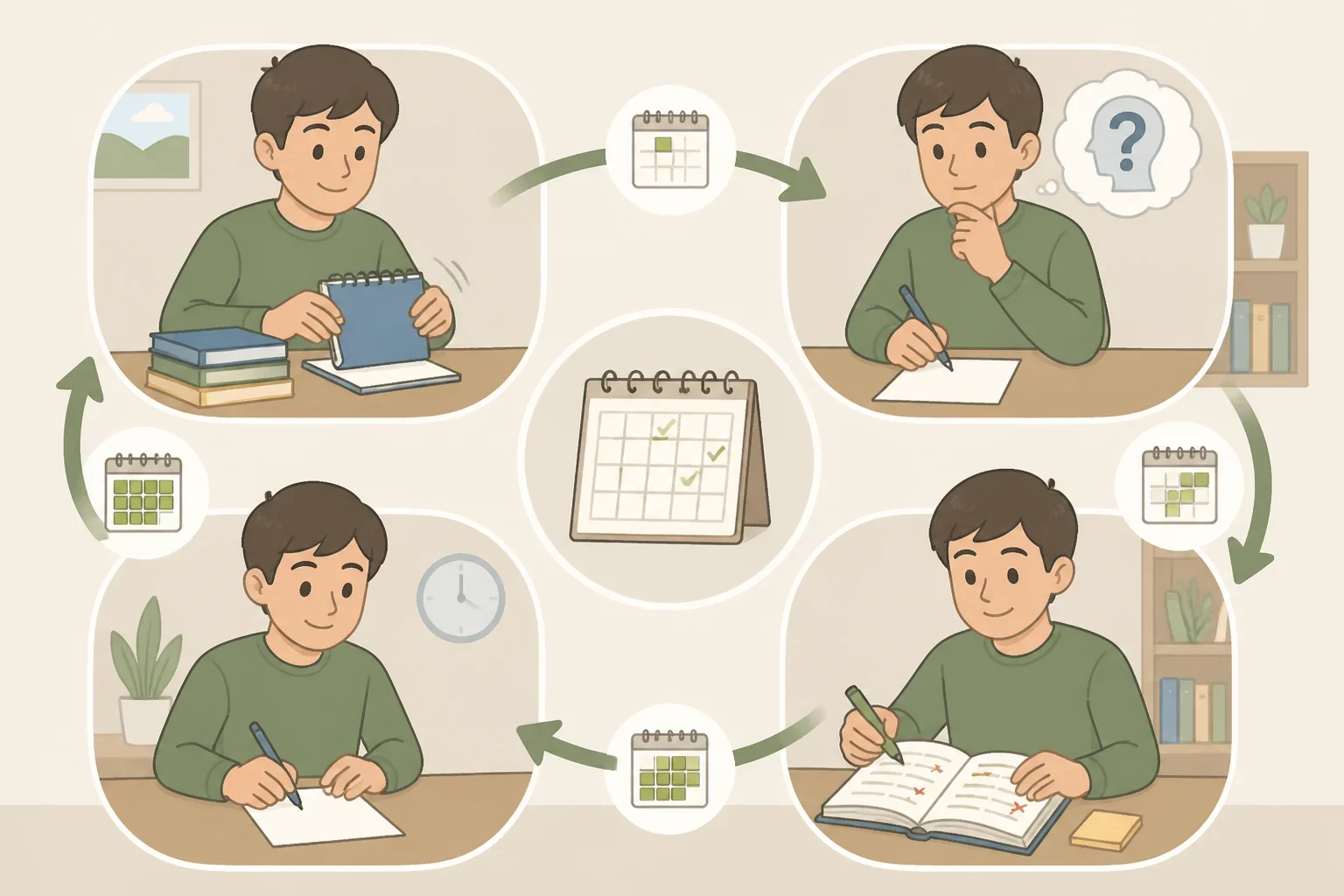
The research points toward retrieval over rereading for delayed exam recall, though it doesn't hand students a ready-made study calendar. What follows is a suggested routine based on that research, not a protocol the cited studies tested directly:
- Read the material once, focused on understanding rather than memorizing.
- Close the notes or textbook and write or say everything that can be recalled.
- Check what was written against the original notes and mark what got missed.
- Return to the missed material a few days later and repeat the recall step.
That last step, spacing recall attempts across several days, extends what the 2025 study found within a single lesson to a longer study timeline. The study itself measured spacing within one 50-minute class period, not across a multiday calendar, so treat multiday spacing as a reasonable application of the idea rather than a result the study confirmed directly (DOI: 10.4189/shes.23.155, 2025).
Checking answers against notes after a recall attempt is a practical way to catch what's missing, though the 270-student study tested recall without giving students feedback afterward, so it didn't isolate how much that checking step adds on its own (World Journal of English Language, 2024).
One more principle worth applying, though it's editorial advice rather than a tested finding: study methods work best when they match how the exam is actually structured. Before locking in a routine, check the syllabus, a review guide, sample questions, or a rubric if one exists, or ask the instructor directly what format the midterm will use. History students might outline an essay from memory instead of rereading notes; math students might work problems without looking at solved examples first, then check the steps; science students might explain a process or label a diagram from memory before checking a textbook. These are ways to apply the research, not outcomes the cited studies tested directly.
What to do next
Replace one planned rereading session this week with a closed-book recall attempt on a topic from an upcoming midterm. Check the answers against notes, mark anything missed, and schedule a second recall attempt on that same material a few days later rather than waiting until the night before. Then confirm with the instructor or course syllabus what format the exam will actually use, since a study routine works best when it matches how the material gets tested.