
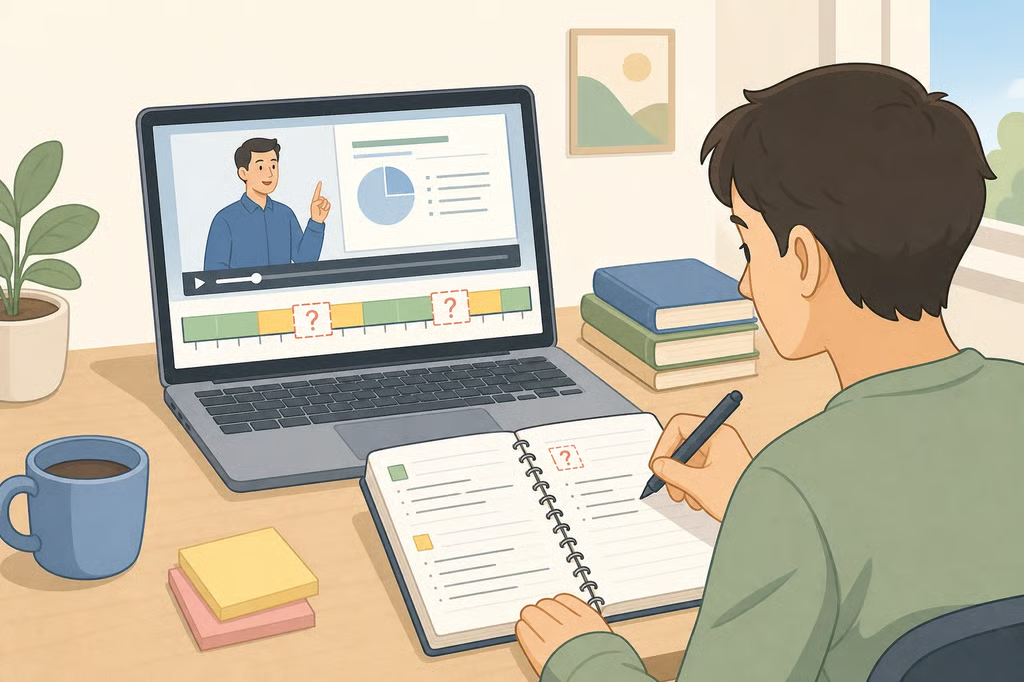
- How to study from recorded lectures without rewatching
- Who this applies to
- The five-step workflow for studying recorded lectures without rewatching
- Effective note-taking for recorded lectures
- Testing recall before you rewatch anything
- How to retain information from recorded lectures: speed and spacing
- What to check before relying on this method
- What to do next
How to study from recorded lectures without rewatching
Replaying an entire class recording for a second time feels like studying, but that hour might be better spent elsewhere. A field experiment with 196 undergraduate psychology students, published last year, found that students who reported taking notes during their first viewing of a recorded lecture scored higher on a follow-up test than students who watched without taking notes, according to research published in The Internet and Higher Education. That finding points to a better question than whether to press play again: how to study from recorded lectures without rewatching them start to finish, and instead spend that time closing the specific gaps that remain.
This guide lays out a workflow that cuts down on full rewatches without pretending you'll never hit play a second time. Watch with a purpose, test what actually stuck, then go back only to the exact moments that exposed a gap. The steps below draw on studies of note-taking, playback speed, and spaced review, with the limits of that evidence spelled out along the way.
Who this applies to
This method can be useful for anyone learning from asynchronous video: college students in online or hybrid courses, high schoolers in flipped classrooms, and adult learners working through self-paced programs. It's especially useful before exams built on recorded content, where rewatching hours of video isn't realistic.
The note-taking study behind much of this guidance used undergraduate psychology students watching a single 12-minute lecture on the topic "Learning strategies" (The Internet and Higher Education). The playback-speed research tested 320 participants across two experiments, but the published findings don't specify participants' field of study or how long the lecture ran, so it's unclear how the results would carry over if your own lectures run 75 minutes on dense technical material, rather than the short lecture on learning strategies used in this study.
A separate study of 72 participants, who watched a 10-minute video on the autonomic nervous system, adds a caution worth naming directly: it found no significant overall benefit from note-taking on learning performance, and showed that prior knowledge and age significantly affected the relationship between pauses, note-taking, and learning performance, according to research published on eScholarship. No single study should be treated as the final word for every learner or every course.
The five-step workflow for studying recorded lectures without rewatching
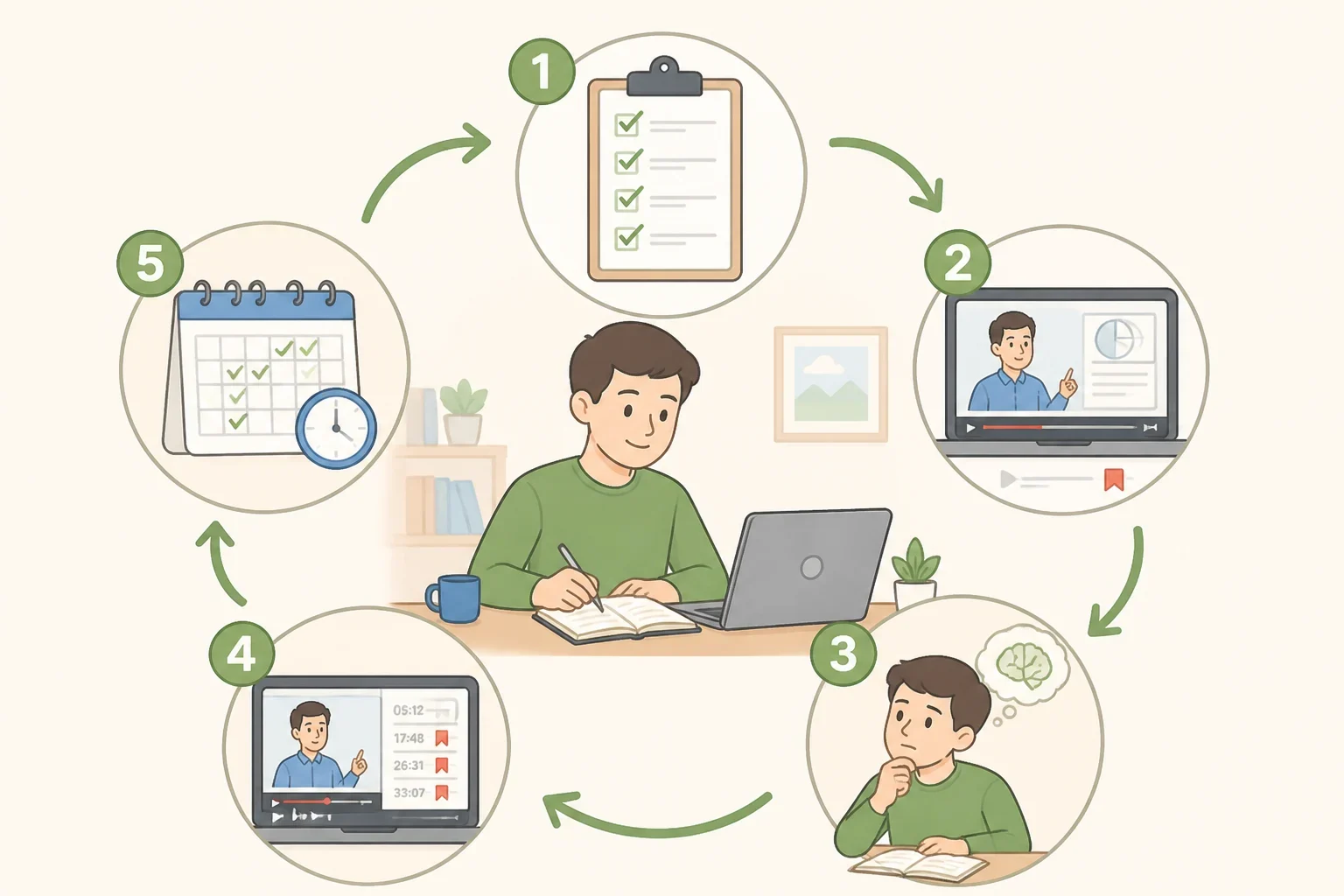
- Watch once, with intent, and take timestamped notes instead of aiming for a full transcript.
- Close the video and retrieve: write a blank-page recall or attempt a related practice problem.
- Compare your recall or your problem attempt against your notes.
- Rewatch only the timestamps tied to whatever that comparison exposed as shaky.
- Revisit the material again later, spaced out over days or weeks, using recall rather than passive replay.
Each step is covered in more detail below: what counts as a real gap worth rewatching, how to take notes that actually support that judgment call, and how spacing fits into the picture once the exam is still weeks away.
Effective note-taking for recorded lectures
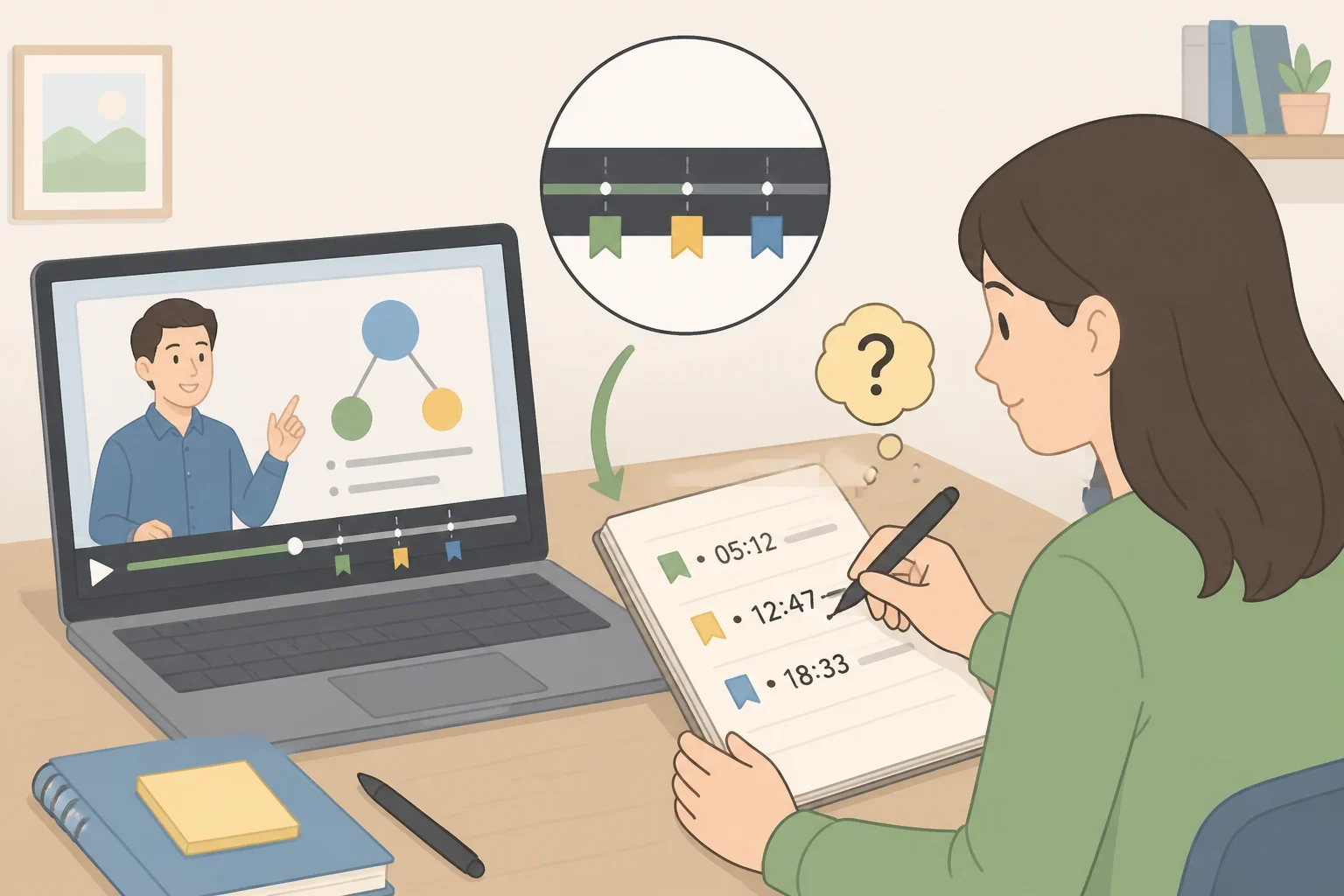
Before pressing play, open a blank note page and silence your phone. In the study of 196 undergraduates, smartphone sounds during the lecture reduced how often students who'd been asked to take notes actually followed through, and those same sounds directly hurt scores for students who weren't taking notes at all (The Internet and Higher Education).
Take notes during the first viewing rather than planning to catch up later from a transcript. The 67 students who reported taking notes also reported stronger engagement with the material and outperformed the 129 students who didn't on a posttest. A mediation analysis found that engagement mediated the note-taking effect on learning outcomes (The Internet and Higher Education).
Note-takers in that study scored about the same whether or not smartphone sounds occurred, while non-note-takers didn't get that same protection (The Internet and Higher Education). Active note-taking may buffer some distraction, though that pattern comes from one study, not a guarantee across every classroom or platform.
Instead of pausing to transcribe everything, jot a timestamp next to anything confusing. Picture a hypothetical 35-minute biology lecture that explains ATP yield around the 18-minute mark: a note reading "18:40, lost on how ATP yield is calculated" does more later than a paragraph copied from a slide. That's an illustrative example, not a detail from the cited studies. In a history or literature lecture, the same habit might look like "24:10, unclear why the treaty failed." That timestamp is what step four uses for targeted review.
Testing recall before you rewatch anything
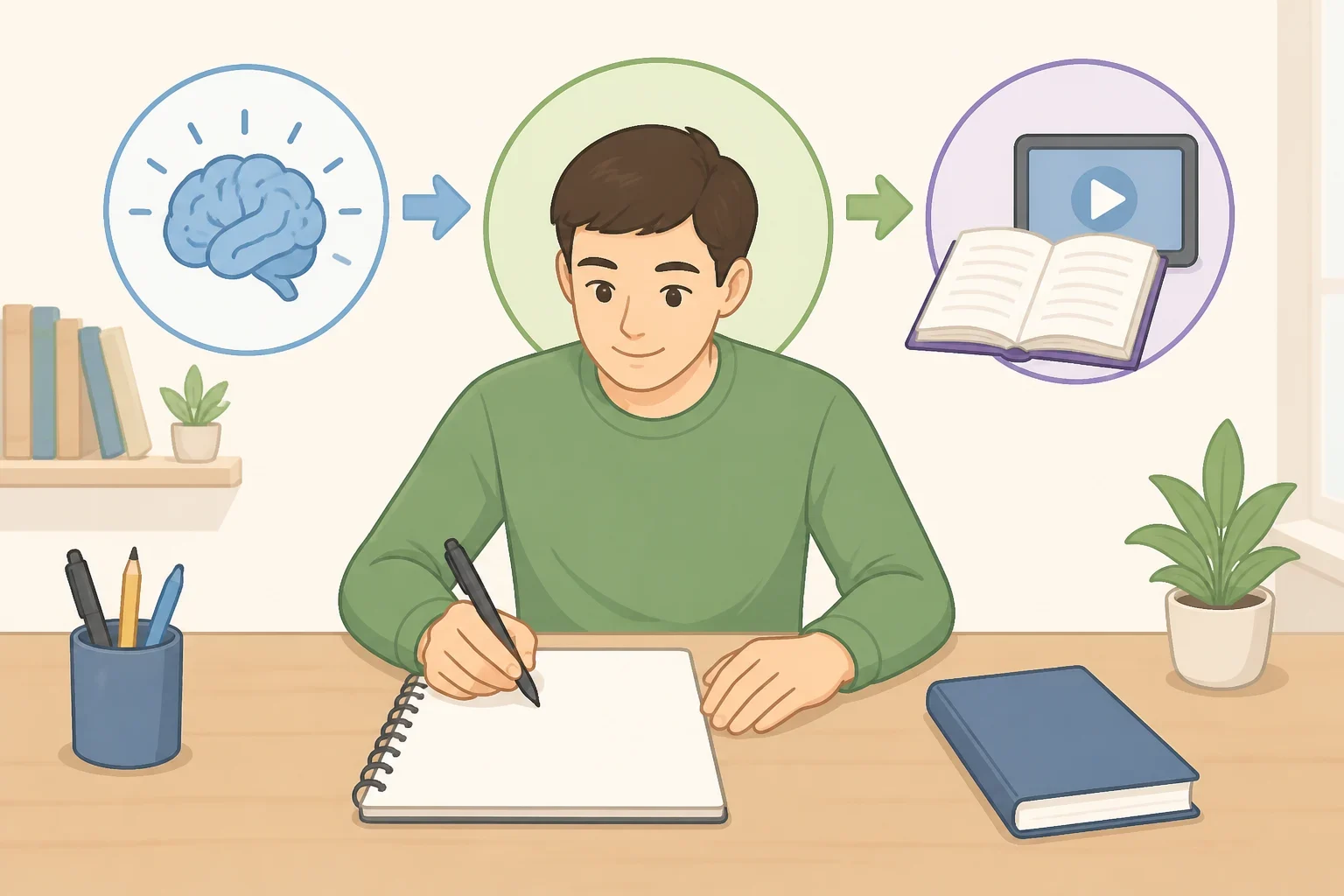
Once the lecture ends, close the video. Before opening your notes, write down everything you remember about the topic on a blank page. This retrieval practice, sometimes called a brain dump, helps separate what you actually know from what only feels familiar because you just watched it (Cornell Engineering Learning Initiative).
For math or science lectures, swap the blank-page recall for a related practice problem. Struggling with it independently for about 10 to 15 minutes before checking any resource is a more effective strategy than rereading notes first, according to UNC's Learning Center. In humanities or discussion-based courses, you may need to write your own recall prompt rather than lean on a ready-made problem set, something like "What caused this change?" or "How does this argument support the thesis?" A concept-heavy science course can use either approach, or both.
A real gap isn't just a moment that feels a little fuzzy. It's a wrong answer, a definition you can't produce without help, a step in a process you can't explain, or a connection between ideas you can't make on your own. Compare your recall or your problem attempt against your notes only after you've finished it, and let whatever surfaces that way, not general unfamiliarity, decide what earns a rewatch.
Rewatch only the timestamped segments tied to those specific gaps. One caution applies here from UNC's Learning Center: trying to solve every assigned problem instead of a representative sample from each topic can trick you into overconfidence. UNC's Learning Center describes this pattern as a "fluency illusion," where recognizing a solution method feels like actually knowing it (UNC Learning Center). The same logic applies to rewatching: recognizing content on a second viewing isn't the same as being able to produce it from memory later.
How to retain information from recorded lectures: speed and spacing
Playback speed is one of the easiest levers to adjust, and it comes with limits. Across two experiments with 320 total participants, increasing speed up to 2x showed no meaningful drop in memory for the material or in mind wandering, though learners reported enjoying the lecture less as speed increased, according to research in The Journal of Experimental Education.
Push past 2x, though, and memory for the content measurably declined, and the increase in mind wandering with time on task often observed in recorded lectures didn't improve just because the video played faster (The Journal of Experimental Education). The published study description doesn't establish how these results apply to advanced or highly technical courses, so for dense, unfamiliar material, or a lecture in a language you're still learning, slowing back to normal speed is a reasonable precaution rather than a tested rule. You might test a faster speed first on familiar material and back off if comprehension slips.
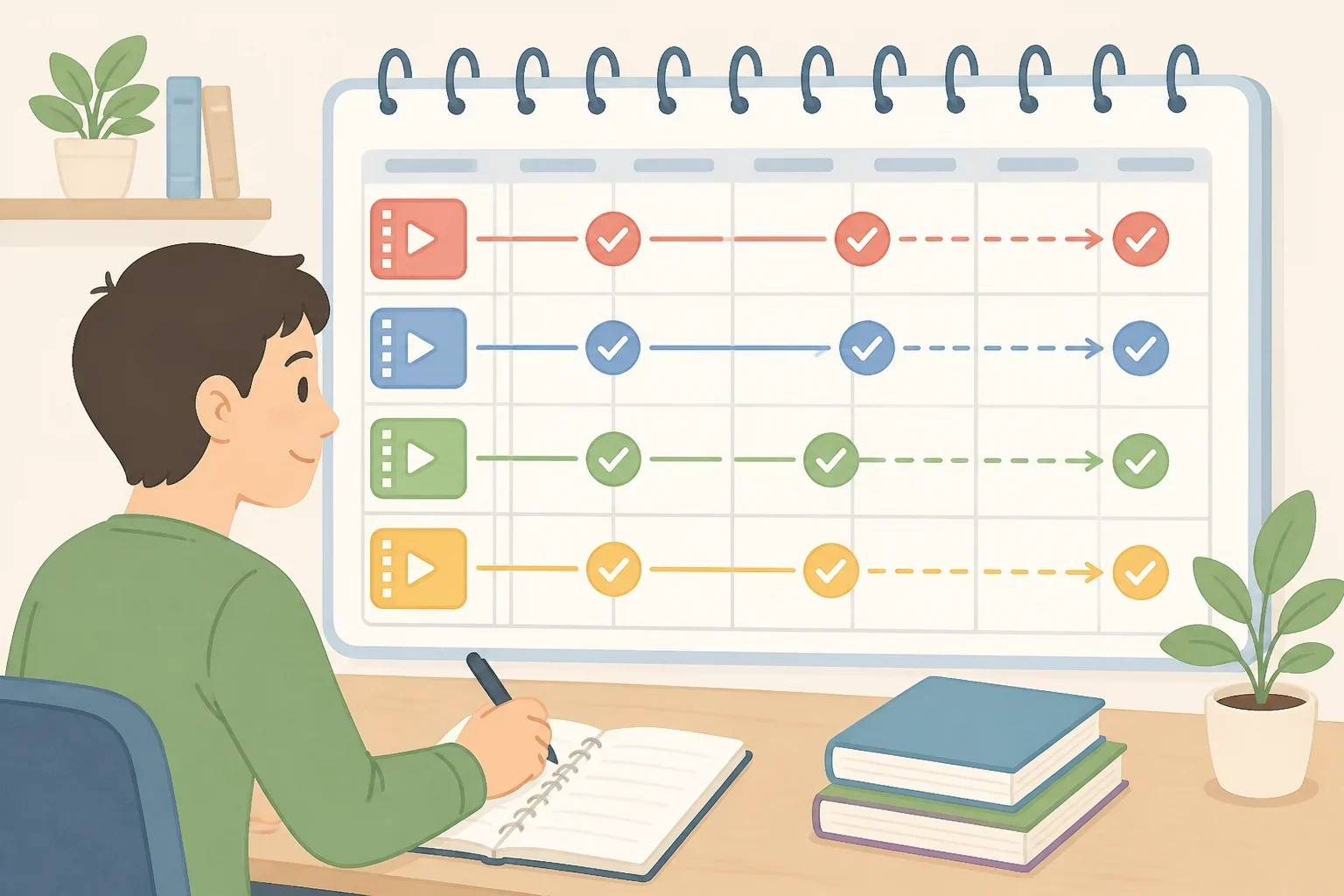
For material worth retaining past the next test, plan to revisit it three to five times spread across a week, several weeks, or a full semester rather than relying on one exhaustive rewatch. That guidance, drawn from Cornell Engineering's learning resource, treats the exact timing between retrieval attempts as less important than simply making sure revisiting happens repeatedly before the exam (Cornell Engineering Learning Initiative).
Mixing topics during those review sessions, rather than reviewing one subject start to finish, showed a measurable benefit in at least one course described by Cornell's learning resource. In an introductory physics course, students who practiced interleaved, mixed-topic problems over eight weeks showed median improvements of 50% and 125% on two later surprise tests, compared to students who practiced one topic at a time, even though the interleaved group rated the method as harder and believed it helped less (Cornell Engineering Learning Initiative).
What to check before relying on this method
- Confirm your course platform supports variable playback speed and check whether captions or transcripts exist. Captions, transcripts, pause controls, and speed adjustments can be necessary learning supports rather than optional conveniences, and availability varies by platform and course, so check what your specific course provides.
- Don't default to 2x speed for dense technical content or a lecture in a language you're still learning. The published study description doesn't say how its findings apply to advanced or highly technical courses, so treat 2x as a starting point to test on familiar material, not a fixed rule.
- Ask your instructor whether recorded lectures come with embedded quizzes, stated learning objectives, or slide decks. These weren't tested in the studies cited here, but they're a practical way to narrow down what needs review, since they point at what the instructor already considers important.
What to do next
Try the five-step workflow on one lecture this week before applying it across a whole course. For an exam built on several weeks of recorded content, spread the steps across a schedule instead of running them once: notes on one day, recall or a practice-problem attempt a day later, a targeted rewatch of flagged timestamps a day or two after that, and a mixed-topic self-test in the days before the exam.
Rewatch a segment when recall or a practice problem exposes something specific you got wrong or couldn't produce, not simply because the material feels familiar on a second pass. That distinction is what keeps this method faster than starting the lecture over from the beginning.