
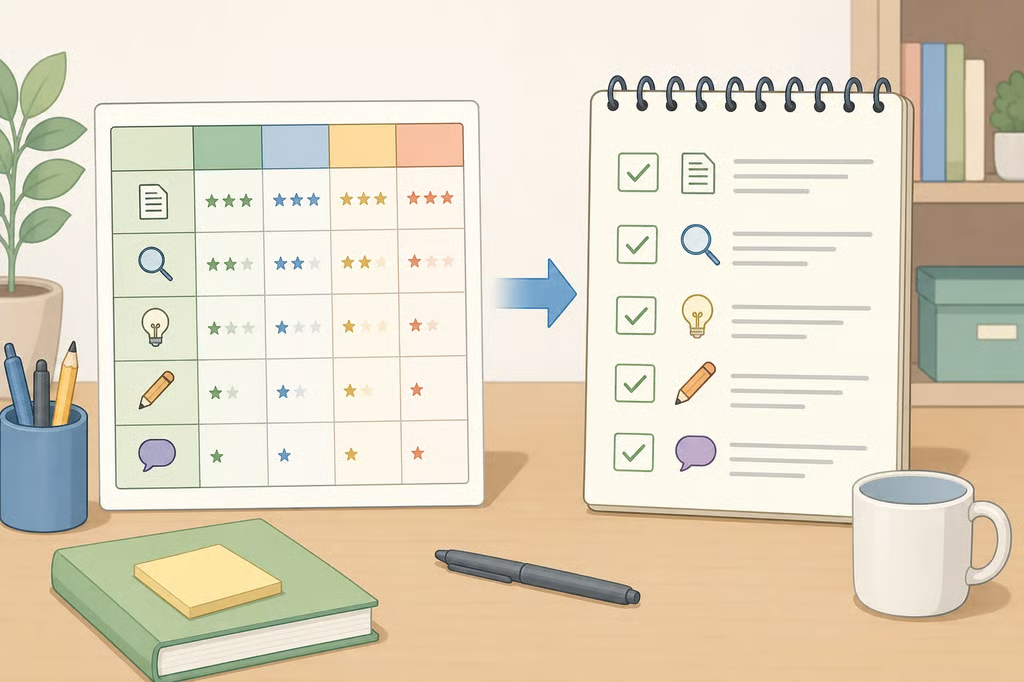
How to turn a grading rubric into an assignment checklist
A rubric can spell out what strong work looks like, but even a well-built one isn't self-evident to a student trying to use it mid-draft. A rubric is often used to evaluate the quality of work against performance levels, Teaching@UW explains, which is a different job than helping someone track progress while the work is still underway. If you're wondering how to turn a grading rubric into an assignment checklist, the short answer is: don't rewrite the rubric. Build a second, simpler tool that runs alongside it.
A rubric is a scoring tool with three parts: criteria tied to what students are supposed to learn, a performance scale, and descriptors that separate a strong response from a weaker one, according to ASCD. That structure defines specific levels of achievement in measurable terms, UConn CETL explains, which makes it well suited to judging how well something was done. It's a clunkier fit for a much narrower question you'll ask yourself constantly while working: did I actually do the thing? A checklist using yes/no or complete/incomplete options is built for confirming that a specific task got done satisfactorily, HTH Unboxed explains, and that's a different job than the one a rubric handles.
Rubrics can guide work during an assignment and help evaluate it afterward, Teaching@UW explains. Splitting off a checklist lets the rubric concentrate on evaluation while a simpler tool handles the guiding.
This guide walks through converting select rubric criteria into a working checklist, with a full worked example, a rule for handling criteria that don't reduce cleanly to yes/no, and a copyable template you can adapt. It applies whether you're staring down an essay, a group project, a lab report, or a presentation.
What a rubric vs. checklist actually does for you

Before sorting anything, it helps to separate three documents that often get treated as one. A rubric describes assessed qualities, things like thesis strength or evidence quality. The assignment prompt usually carries logistical requirements: length, format, deadline, sometimes a source count, and teacher instructions or a class platform can add still more rules that appear in neither document.
With that distinction in mind, the split between a rubric and a checklist gets simpler. A rubric's criteria describe what matters; its performance scale and descriptors describe how well it was done. A checklist only handles the first half, since it's built to confirm presence, not measure quality.
Checklists work well specifically when you need to confirm a required element exists, such as a thesis statement, a specific number of sources if the assignment calls for one, or a formatted title page if the prompt requires it, HTH Unboxed explains. Notice the conditional language there: a checklist item is only a requirement when something in the prompt, rubric, or teacher instructions actually says so.
One guardrail matters throughout: a checklist, like the rubric it's built from, isn't a substitute for instruction. It can flag that a citation is missing, but it won't teach a student how to evaluate whether a source is credible in the first place. If a checklist item keeps coming up short no matter how many times you revise it, treat that as a sign the underlying skill needs instruction or practice, not another pass with the checklist.
How to convert a rubric into a checklist, step by step
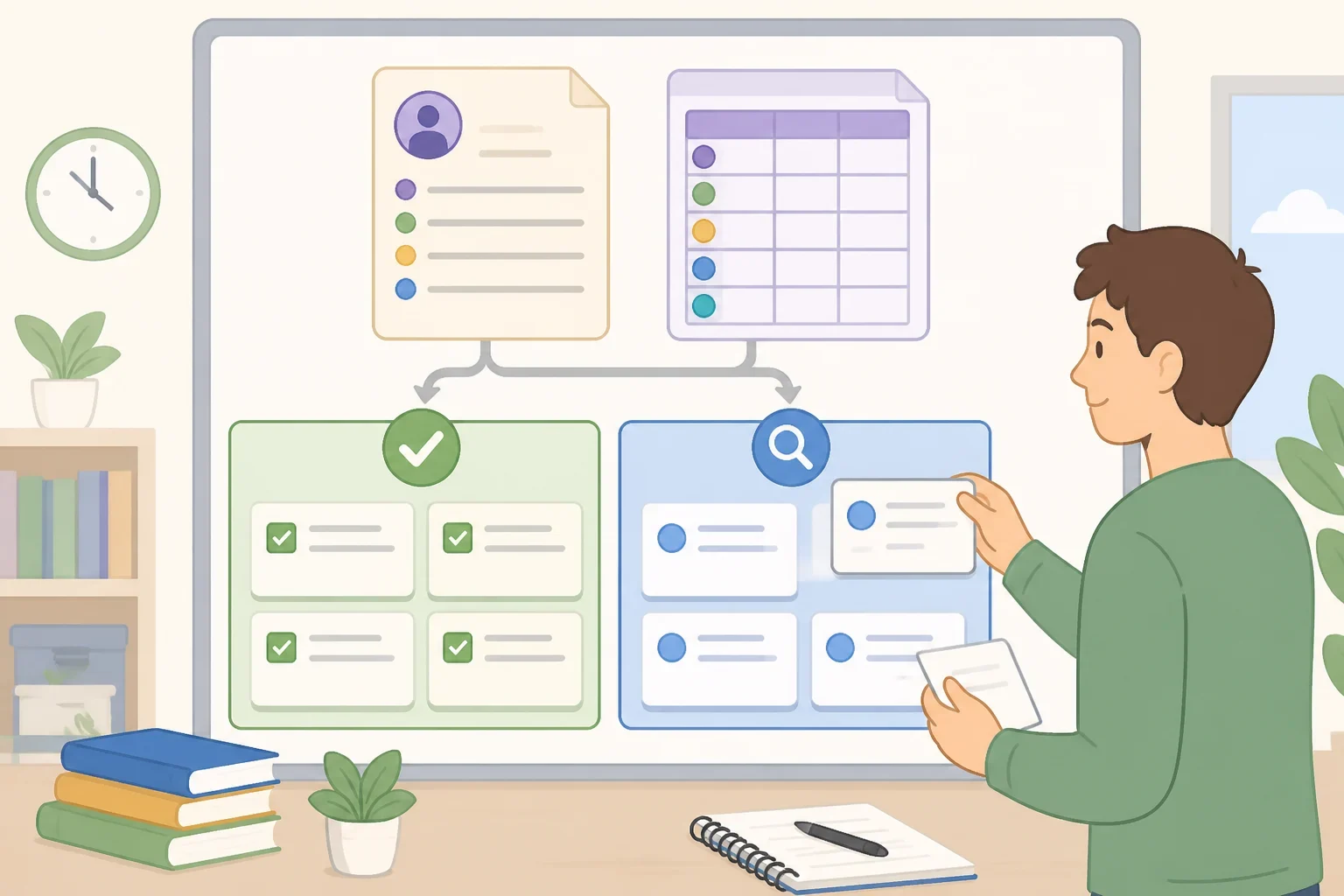
Start by gathering every document that defines the assignment, since requirements don't live in the rubric alone.
- Copy logistical requirements from the prompt and any teacher or platform instructions: length, format, deadline, file type, source count.
- Copy assessed qualities from the rubric: the criteria describing what strong work is supposed to look like.
- Mark anything that conflicts between documents, or any requirement that isn't stated anywhere, and flag it for the teacher.
What you end up building isn't strictly a rubric-only checklist. It's an assignment checklist informed by the rubric, with logistical requirements folded in separately from the prompt and instructions.
From there, sort every rubric criterion into one of two piles: things you can confirm with a plain yes or no, and things that require judging quality. A criterion like "includes a works-cited page" is binary. A criterion like "demonstrates sophisticated analysis" isn't.
Performance criteria are the areas an instructor flagged as central to doing well on the assignment, Teaching@UW explains, so this sorting step is really asking which of those central areas can be checked off and which need to stay under quality review.
Keep the resulting list short. Fewer criteria make it easier to prioritize what matters, both for the person doing the work and the person grading it, Teaching@UW explains.
Some criteria land in between. A common example is "uses credible evidence." It isn't cleanly binary, so resist flattening it into "I included sources" and calling it done. Pull out whatever verifiable piece the prompt actually specifies, such as a required source count or type, and leave the quality question, how credible each source is, on the rubric where it belongs. If the prompt never states a number or type, ask the instructor rather than guess at a requirement that was never set.
Once you know which items belong on the checklist, rewrite them in short, parallel, affirmative language describing what you did rather than what's missing, a practice UConn CETL recommends for rubric design generally and one that works just as well here. "I state a specific thesis in my introduction" is easier to reread quickly than "thesis not vague."
Finally, group items by phase rather than by rubric order: before starting, draft complete, revision, submission. That arrangement matches how the work actually unfolds instead of forcing you to jump around a document written for grading, not drafting.
A worked example: rubric line to checklist item
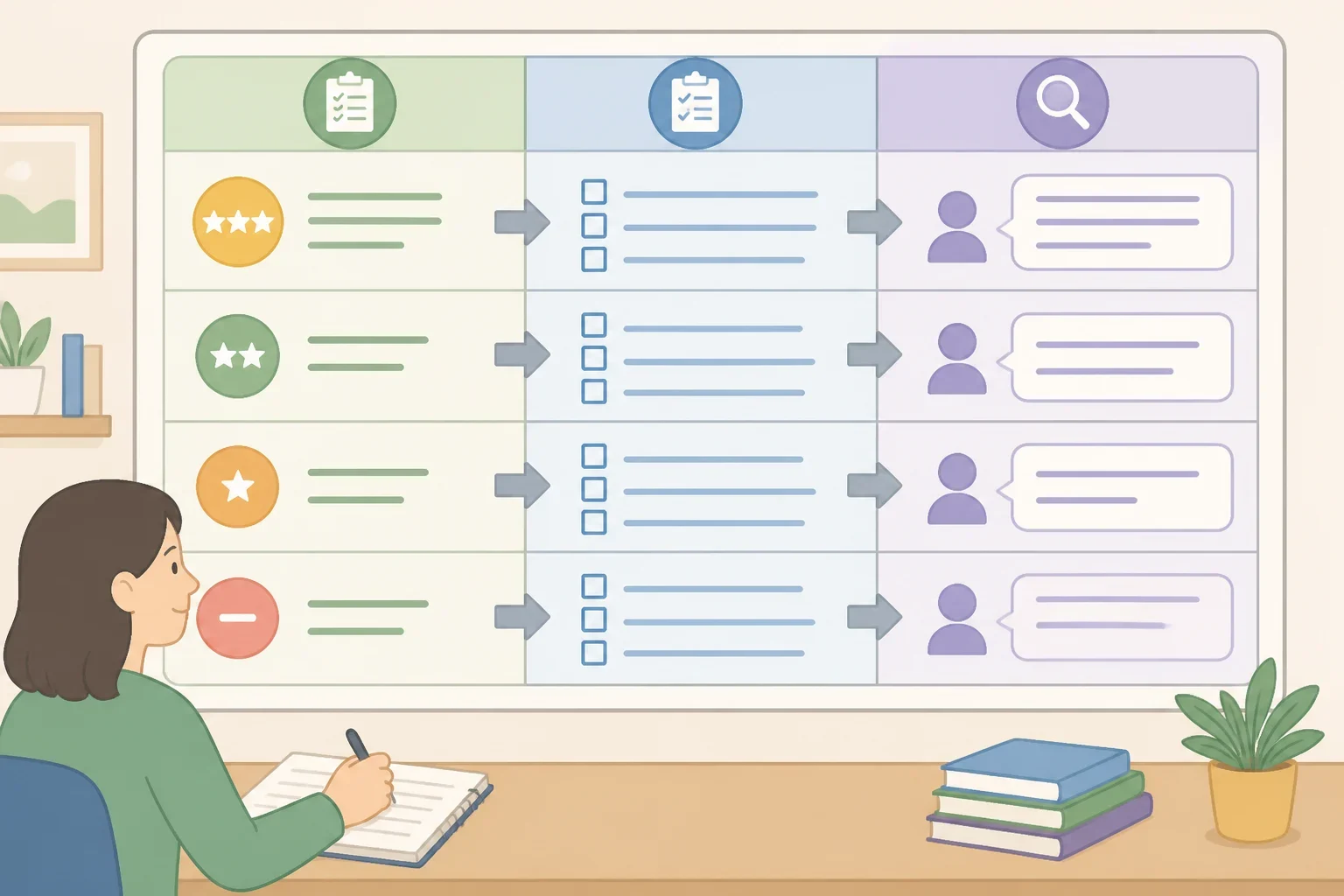
Take three lines from a research paper rubric: "has a clear thesis," "uses credible evidence to support claims," and "cites sources in APA style." Here's how each one sorts out.
Rubric criterion Checklist item Stays on the rubric for quality review Has a clear thesis I state a specific thesis in my introduction Whether the thesis is genuinely well-defined and arguable Uses credible evidence to support claims I include the number and type of sources the assignment requires, if the prompt specifies one How credible and thorough each source is in supporting its claim Cites sources in APA style I formatted every citation in APA style, if APA is the format specified Whether citations are used precisely and consistently throughout
A successful research paper needs a well-defined purpose, a thesis, which is why that criterion converts so directly into a checklist line. Citation format only becomes a checklist item when the assignment actually names a style; if the prompt is silent, don't assume APA or any other style, check the instructions or ask.
"Uses credible evidence" is the criterion that resists a clean yes/no. Splitting it three ways, a checklist item for the countable part, a rubric-only note for the quality part, and a flag if the prompt never defines the standard, keeps the checklist honest about what it can and can't confirm. A performance scale can help you distinguish adequate evidence from stronger evidence, ASCD explains, though a teacher's feedback or a source-evaluation lesson can resolve the same question just as well.
The same split works outside a research paper, too:
- Presentation: "Uses effective visuals" becomes a checklist item, "I included the required visual or demonstration," while "the visual clarifies rather than repeats my point" stays a rubric quality check.
- Lab report: "Analyzes results" becomes a checklist item, "I included a results section and referred to the data," while "my explanation connects the data to the hypothesis" stays a rubric quality check.
Once sorted, those items can be arranged by phase. Here's the shape as a copyable template, labeled by whether each item is required, recommended, or a check that belongs on the rubric instead:
- [ ] Before starting: I identified the assignment's required format, length, deadline, and source rules. (Required if the prompt states it)
- [ ] Draft complete: I addressed each required component listed in the prompt. (Required; for the research-paper example above, that means a stated thesis and formatted citations)
- [ ] Quality review: I matched my work to the descriptor for the target performance level, such as how credible my evidence is. (Rubric quality check, not a checklist item)
- [ ] Submission: I checked the required file type and submission location. (Required if stated)
Using the checklist while you draft, revise, and submit
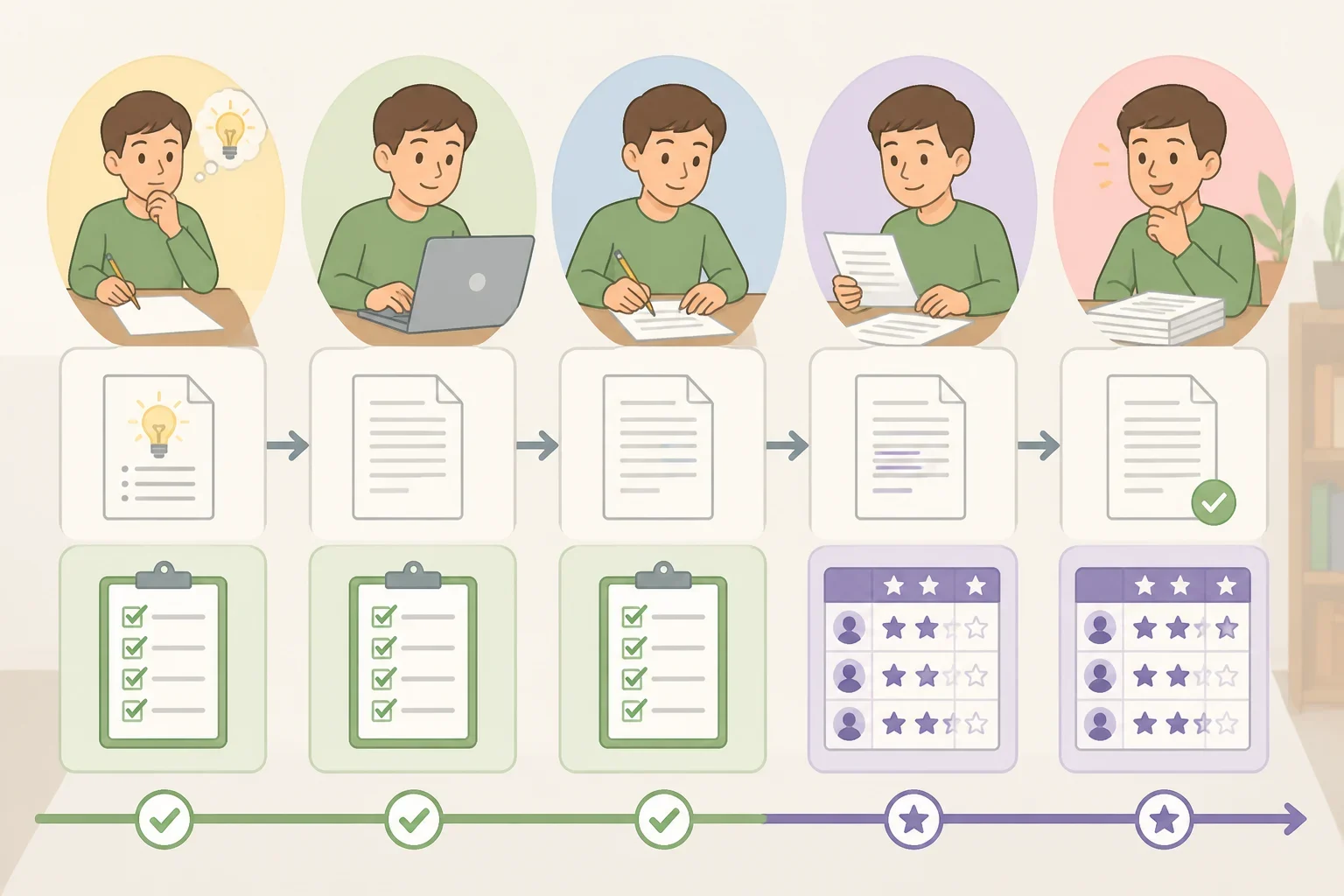
Not everything on a checklist carries the same weight. Source count, citation style, and format are requirements only when the prompt or rubric actually states them. Running the checklist at multiple points in the drafting process, or trading it with a classmate for a quick review, are useful strategies, not rules every assignment enforces.
Getting the rubric, and the checklist built from it, at the same time the assignment is introduced helps set expectations before the writing even starts, Teaching@UW points out. If a teacher hasn't shared the rubric yet, it's worth asking for it early rather than building a checklist from guesswork.
The quality-review step is where the checklist hands off to the rubric. Instead of just rereading the descriptors, match the draft to the closest performance-level description for each remaining quality criterion and identify a specific change suggested by the next-level description. Research on feedback by Hattie and Timperley, cited in the ASCD piece, frames this as matching work to a description rather than guessing at what's wrong.
A fully checked list only confirms that the required pieces are present. It isn't proof the work meets a high standard until it's also been checked against the rubric's descriptors, which is the step that helps you review quality, not just completion.
What to do next
Pull up the actual prompt, rubric, and any teacher instructions for the assignment in front of you. Copy logistical requirements from the prompt and instructions, copy assessed qualities from the rubric, and flag anything unclear before sorting further.
Build the template from this article using your own assignment's requirements: before starting, draft complete, quality review, submission. Use it once as a completion check near the end, then go back to the rubric's descriptors specifically to find what a next-level response would look like for each remaining quality criterion.
If a criterion involving source credibility, argument strength, or lab technique keeps challenging you no matter how carefully you check the box, treat that as a sign to ask a teacher or tutor for instruction on that specific skill. A checklist can confirm the work is there. It can't teach you how to make it better on its own.