

- Exam Wrapper for Midterms: What It Is and How to Use It
- What is an exam wrapper and how does it work?
- How to use an exam wrapper for midterms after a graded test
- Exam wrapper vs. test corrections: what's the difference?
- Exam wrapper questions for students: a midterm exam reflection worksheet
- Can an exam wrapper improve your next exam score?
- What to check before acting on the results
- What to do next
Exam Wrapper for Midterms: What It Is and How to Use It
A disappointing midterm score can feel like the end of the conversation, but reviewing that graded exam carefully can help identify exactly what to address before the next one, according to Washington State University's Academic Success & Career Center (WSU ASCC). An exam wrapper for midterms is a short reflection exercise built around that idea, turning a graded test into a diagnostic tool instead of a final judgment on how the semester is going. Some implementations ask students to complete it in 10 minutes or less, working through one central question: what happened on this exam, and what should change before the next one (Alliant CTE).
This guide covers what an exam wrapper is, a step-by-step process for using one after a midterm, how it differs from a test correction, a set of exam wrapper questions for students to work through, and an honest look at what the research says about whether the exercise raises scores.
What is an exam wrapper and how does it work?
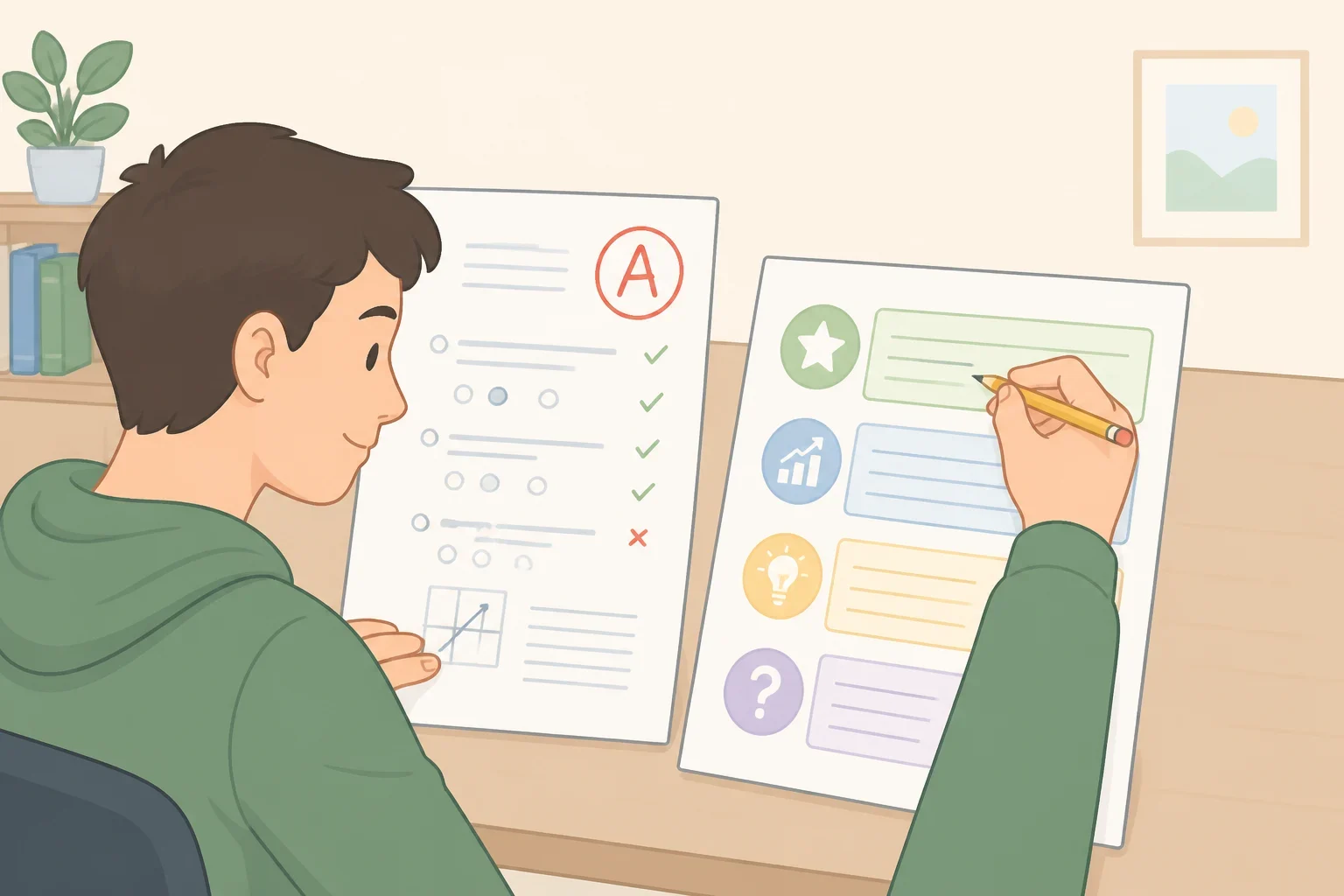
An exam wrapper is a short, structured self-review that "wraps around" an exam, meaning it happens before the test, after it, or both, and it's designed to help students plan their studying, reflect on performance, and figure out what to try differently on the next one (IU CITL). IU describes it as often presented as a survey when a graded exam is returned, giving students a structured chance to think through what happened instead of just checking a grade and moving on.
Alliant's Center for Teaching Excellence traces the technique to Carnegie Mellon University's Eberly Center for Teaching Excellence & Educational Innovation. That account describes the original purposes as helping students identify their own strengths and weaknesses to guide further study, reflect on whether their preparation time and study strategies were appropriate, and characterize the kinds of errors they made to spot recurring patterns (Alliant CTE).
A few practical details worth knowing before filling one out:
- The format is short. Some instructors ask students to complete it in 10 minutes or less (Alliant CTE).
- Content usually isn't graded. Students often earn credit for completing the wrapper, not for particular answers.
- It can happen at three points: before the exam to describe a study plan, right after finishing but before seeing the score, or once the graded exam comes back.
How to use an exam wrapper for midterms after a graded test
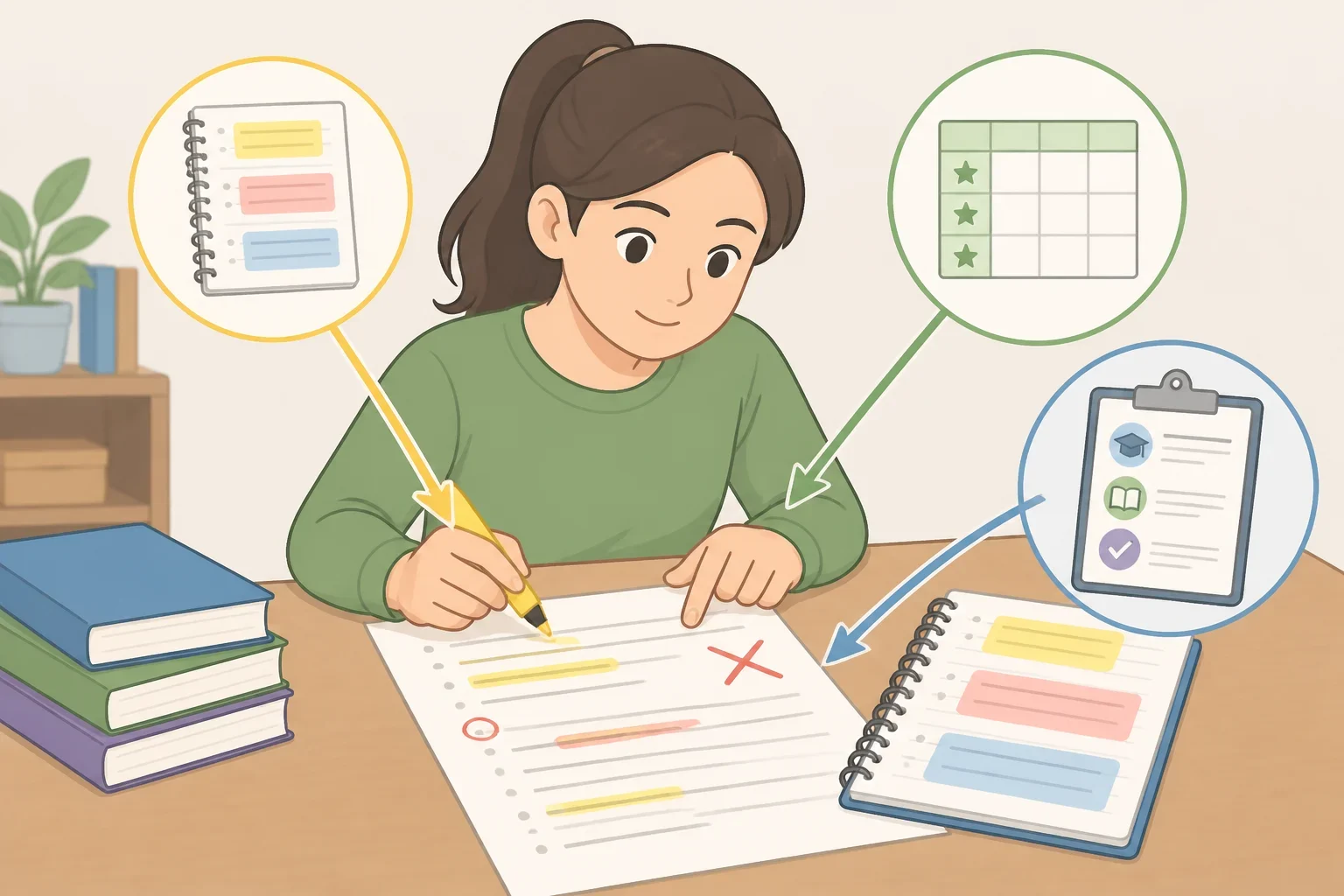
A class doesn't have to hand out an official wrapper for a student to run this process with a graded midterm in hand.
Expect to feel a little worn out, then refocus. WSU notes that it's normal to feel drained after midterms, especially when a score comes back lower than hoped, and frames the period right after as the moment to refocus for the rest of the term (WSU ASCC).
Review each mistake, not just the total score. WSU recommends going through grades and feedback carefully and reviewing mistakes individually to identify areas for improvement.
Write down what preparation actually looked like. Alliant's recommended wrapper sequence moves from questions about preparation into deeper analysis, reviewing what a student actually did before studying the errors themselves (Alliant CTE).
Pull the syllabus back out. WSU points to the syllabus as a reliable place to catch details that got missed the first time, including exam format, grading policy, and upcoming deadlines.
Ask the professor to clarify anything unclear. WSU also recommends going directly to the instructor for clarification on feedback or performance rather than guessing at what a comment meant.
Exam wrapper vs. test corrections: what's the difference?

The two tools solve different problems, and it helps to know which one a class is offering. A wrapper asks a student to step back and analyze preparation, study habits, and error patterns across the whole exam (IU CITL). A test correction typically asks a student to revisit specific missed questions and explain or repair the reasoning behind each one, sometimes for partial credit back.
Whether corrections are offered, whether they affect the grade, and what deadline applies depends entirely on the instructor. Some classes run both processes side by side, a wrapper for reflection and a correction option for partial credit. Others offer neither. Check the syllabus or ask directly rather than assuming a correction option exists.
Exam wrapper questions for students: a midterm exam reflection worksheet
Research on exam wrappers points to a few recurring categories: how much time and effort went into studying, which study habits were used, whether the student engaged with the course's stated objectives, and the reasons points were lost (Alliant CTE). IU's version also asks students to recognize where they did well, not only where they lost points, alongside identifying patterns of error or difficulty (IU CITL).
One caution worth keeping in mind while filling this out: a poor result can get blamed on bad study habits when the actual problem is a gap in understanding the concept itself (Alliant CTE). Don't assume the fix is always "study more." Sometimes the fix is understanding one specific idea better.
The table below is a Classroom-created worksheet built around those categories. It's not a validated research instrument, just a starting point for working through a graded exam:
Stage Questions to answer Preparation How many study sessions happened before this exam, and what did each one actually involve? Was time spent practicing retrieval and application, or mostly rereading notes and slides? Performance Which question types caused the most trouble, and where was partial credit earned instead of full credit? Was there enough time to finish, or did pacing cost points? Error type Is this a knowledge gap, an application error, a misread prompt, a timing issue, or unclear feedback that needs follow-up? Treat the last two as possible categories for personal review, not standard research categories. What evidence supports this diagnosis: an instructor comment, the answer key, the rubric, or a second read of the question? Next action What specific task will address this, by what date, and how will understanding get checked, such as a practice set, a follow-up question to the instructor, or a study group?
A worked example of how the categories connect: a student loses points on equilibrium problems, traces the cause to a genuine concept gap rather than a careless mistake, decides to review the lecture example and solve three new problems by Thursday, and plans to ask the instructor how to recognize that type of setup on future exams.
Can an exam wrapper improve your next exam score?
The evidence is mixed, and the wrapper works best when a finding turns into a specific, dated action instead of staying on paper. For practical purposes, connect each finding to a specific action. WSU recommends replacing vague goals like "study more" with something concrete, such as reviewing chapters 3 and 4 and completing practice questions by Friday, tied to a study timeline with weekly targets (WSU ASCC).
Take the worksheet example above: if most lost points traced back to misreading prompts rather than missing knowledge, the action isn't "study more." One option is rereading each prompt twice before answering and practicing with a couple of timed past questions each week leading up to the next exam. That's one possibility among several, not a fixed formula.
IU advises trying newly identified strategies and dropping ones a student already judged unhelpful, which turns the wrapper into a loop tied to each exam rather than a one-time worksheet (IU CITL).
Research findings on the tool are inconsistent. Alliant's summary notes that some studies link wrapper use to higher scores on a following exam, while other studies found no difference in exam performance or in metacognitive test scores (Alliant CTE). Alliant reports an anecdotal teacher view that a single wrapper may be less useful than a process repeated across exams. Treat the wrapper as a reasonable tool to try alongside actual studying, not a guaranteed way to raise a grade.
WSU also points students toward its own campus resources, including tutoring, its Math Learning Center, and its Writing Center, as places to get help early rather than waiting until finals (WSU ASCC). These named services are specific to WSU, so check what a given campus actually offers rather than assuming the same options exist everywhere.
What to check before acting on the results
A few things depend on the specific class, so verify these before assuming a certain path is open:
- Whether the instructor allows test corrections, regrade requests, or resubmissions, and by what deadline.
- Whether an unresolved question is better suited to office hours, a TA, or a tutoring center, depending on what the school offers.
- What the syllabus says about exam format and grading for the remaining tests in the term.
What to do next
With the graded midterm in hand, three steps turn this into a plan for the next exam:
- Complete the worksheet using the returned exam, rubric, or answer key. If none of those are available, a review based on memory is a limited substitute, so ask the instructor what feedback can be provided before relying on memory alone.
- Choose one error pattern and schedule one measurable practice task tied to a date.
- Ask the instructor or TA one specific question if the cause of a missed point still isn't clear.
Whether test corrections, regrade requests, or resubmissions are available depends on the instructor and the syllabus, so confirm before assuming one of those options is open.