
How to Prepare for an Open-Book Exam: A Study Guide
Open-book access does not eliminate the need to understand the material. Kansas State University explains that open-book exams evaluate students on "understanding rather than recall and memorization," typically by asking them to apply material to new situations, analyze how ideas connect, or use their materials as evidence for an argument. Knowing how to prepare for an open-book exam starts with that distinction: the goal isn't gathering more pages, it's understanding the material well enough to use it quickly.
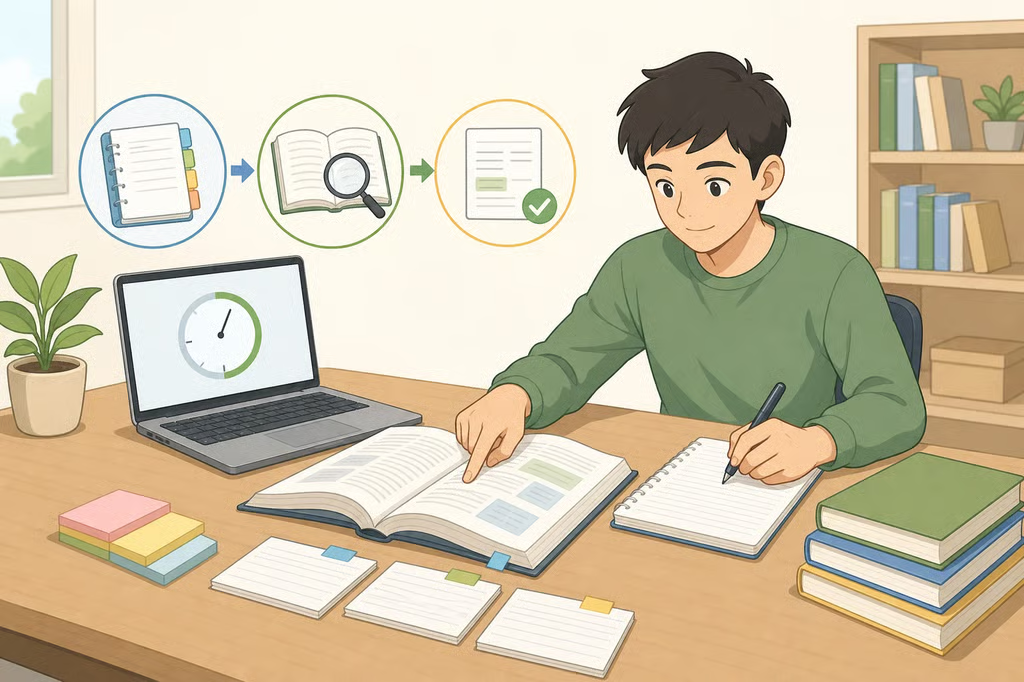
Preparing well comes down to four steps: confirm exactly what your instructor allows, study the material through active recall instead of rereading notes, build a short reference system you can search fast, and rehearse under a timer before test day. This guide covers each step for high school, college, and adult learners facing either a timed in-class exam or a take-home assignment. Some of the research behind these steps focuses specifically on college-level courses, which is worth keeping in mind as you apply it to your own classes.
A systematic review published last year looked at 25 studies spanning 11 countries and 3,349 participants, drawing on research published between 1950 and 2025 (Systematic Review). It found that open-book and closed-book exams measured meaningfully different abilities, based on notably lower score correlations between the two formats. The review excluded high school courses and online exams, so its findings apply most directly to in-person college settings. The study techniques described later in this guide come from broader learning research and may still help high school and adult learners, even though this particular review didn't test them directly.
First, confirm what your exam allows
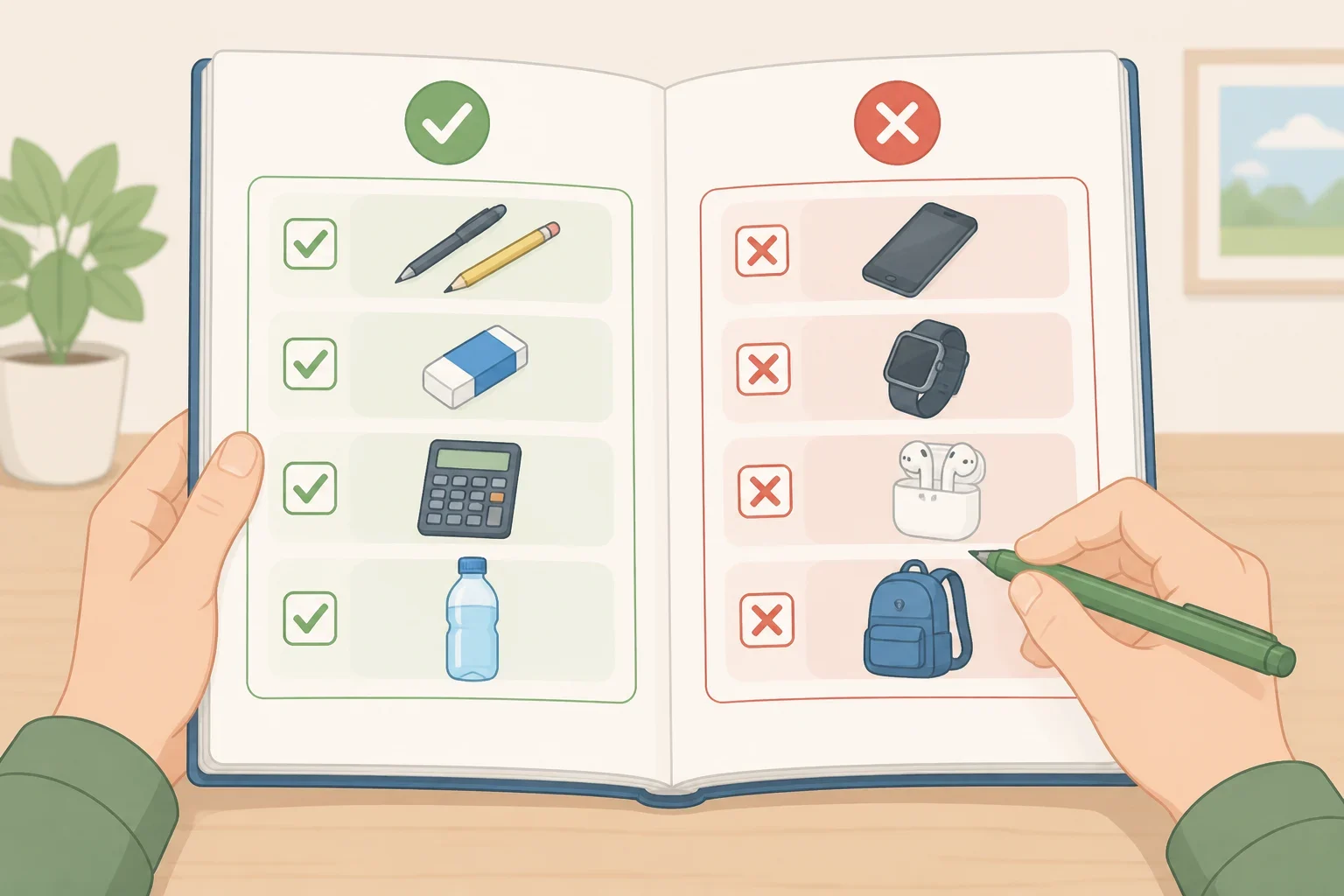
Rules for open-book exams vary by instructor, so nothing here should replace what a syllabus or professor says directly (Kansas State University). Your instructor may specify a formula sheet, a full textbook, annotated notes, or another set of materials entirely, and how much access you get depends on how the exam is designed.
Format varies too. An exam can be take-home or in-class, with questions shown in advance or kept unseen until test time (Kansas State University).
Institutional policy can get specific fast. At London Business School, faculty must identify authorized materials in advance, and examples include study aids, formula sheets, textbooks, or annotated course notes, though the school recommends limiting those aids to faculty-produced sheets covering only formulas, definitions, and concepts students aren't expected to memorize (London Business School). Take-home exams there are treated as open-book by default, since there's no one enforcing closed-book conditions (London Business School). Electronic devices like phones, tablets, and laptops aren't permitted at LBS unless faculty specifically authorize them, and materials suspected to be unauthorized can be confiscated, which may result in disciplinary action (London Business School). That's one institution's policy, not a universal rule, but it illustrates why students should check their own school's rules rather than assume.
Before building a study plan, ask your instructor:
- What materials are permitted, and are personal notes allowed alongside the textbook?
- Are electronic devices or internet access permitted at all?
- Is the exam take-home or in-class, and how much time is allowed?
- Will exam questions be shared in advance, or unseen until test time?
What these exams are actually testing
Once the rules are settled, it helps to know what the exam is checking for. Kansas State's guidance lists the core skills: applying material to new situations, analyzing how elements relate, synthesizing or structuring information, and evaluating an argument using materials as evidence (Kansas State University). The emphasis is not limited to recall.
Access to materials doesn't automatically translate into a better score, either. In the systematic review, students' own ratings of how helpful they found the open-book format weren't correlated with how well they actually performed (Systematic Review). The finding suggests that access to materials alone is not a reliable indicator of performance, which is part of why the studying done beforehand carries so much weight.
How to study for an open-book test without memorizing everything
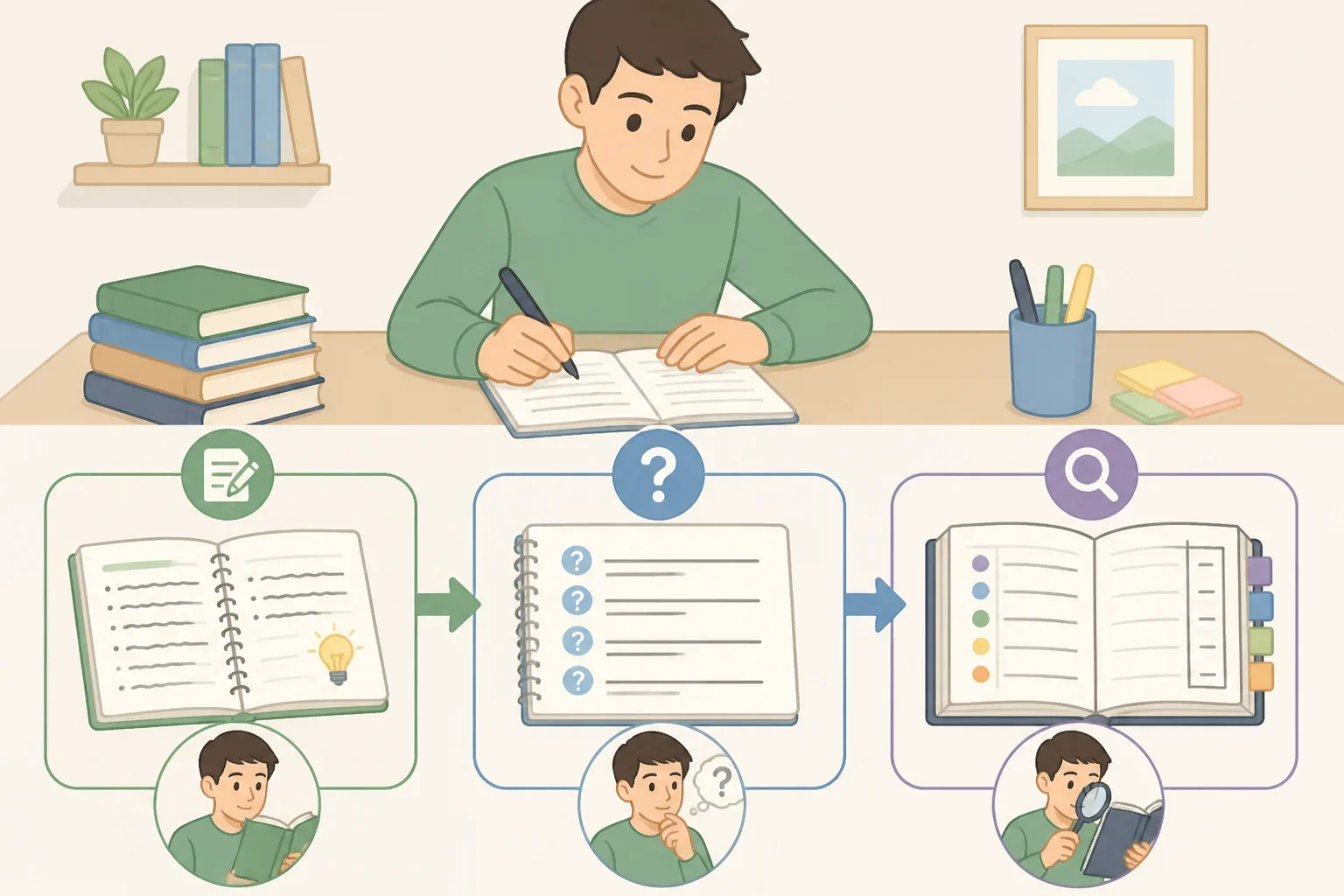
Real learning still has to happen before test day. A review of 63 experiments in health professions education found that retrieval practice and distributed practice, meaning spacing study sessions apart instead of cramming, performed better than rereading or control conditions in 43 of those experiments (Systematic Review of Distributed and Retrieval Practice, 2023). That research covers health professions courses specifically, not open-book exams, but it supports a broader point: testing yourself tends to beat passively rereading.
A separate study of 152 undergraduates examined elaboration, or explaining ideas in your own words rather than copying them. On a test given a week later, elaboration improved both factual knowledge and comprehension, and students who generated their own examples during retrieval practice showed stronger comprehension gains than students who simply reviewed examples someone else provided (Learning and Instruction, 2024). Students who combined self-generated explanations with retrieval practice also had the most accurate sense of what they actually knew, which may help when deciding what's safe to answer from memory and what needs a lookup (Learning and Instruction, 2024).
Kansas State's guidance points the same direction: practice with model questions, but skip memorizing model answers. Instead, test how you'd approach a question and what you'd actually need to look up (Kansas State University).
Consider a chapter on photosynthesis as an example of how this plays out in practice. Rather than copying the whole section into a notebook, write a short summary in plain language of what the process does and why it's relevant to the course. Draft two or three questions of your own and try answering them without notes first. Then build a short index of key terms and formulas with page numbers next to each, so during the actual exam, deciding whether to answer from memory or check a term takes seconds instead of minutes.
How to organize notes for an open-book exam
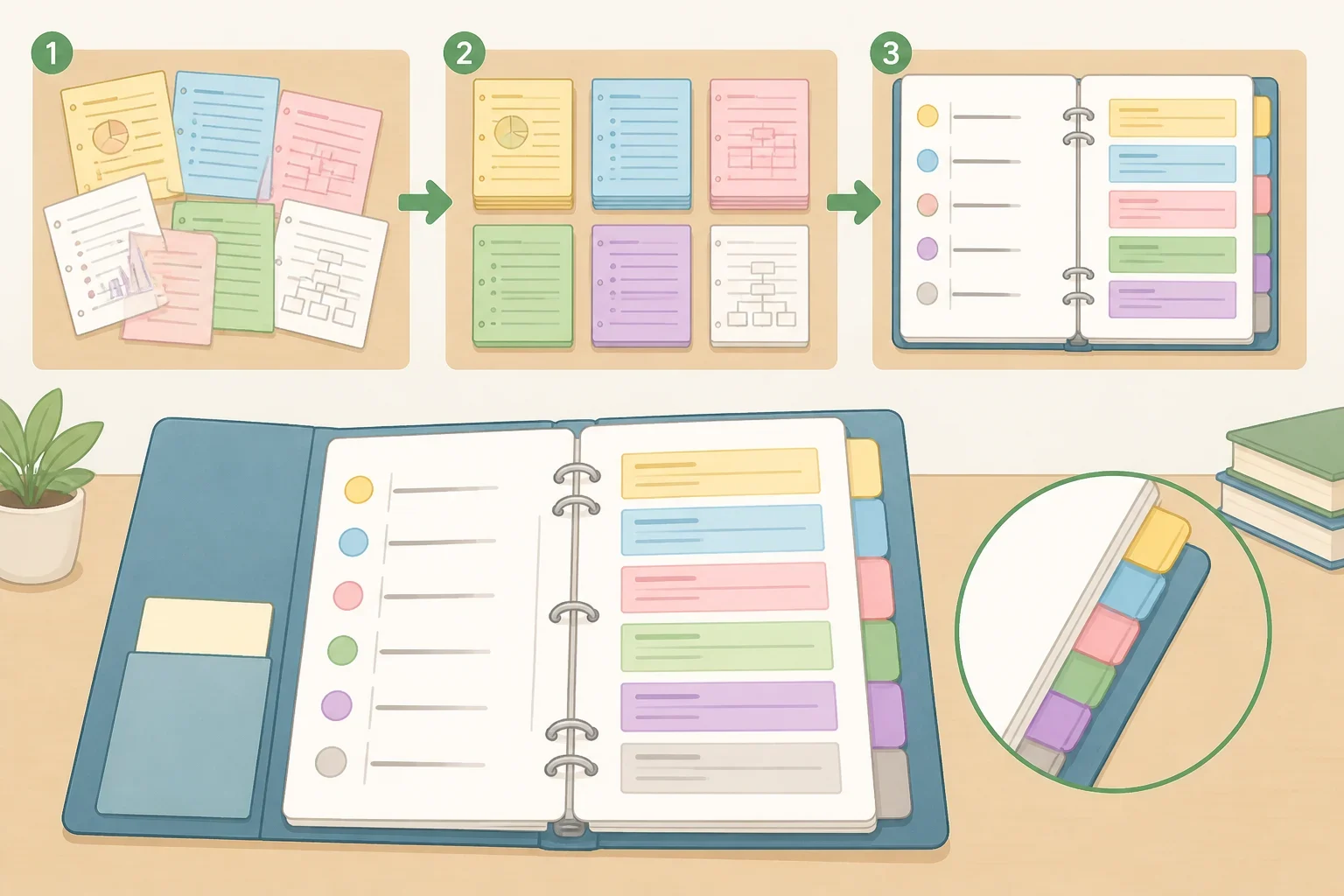
Once the material is understood, the next task is a reference system that doesn't cost time during the test. Kansas State notes that exam time is limited, so organizing materials for quick retrieval can affect how efficiently that time gets used (Kansas State University). Their recommended tactics include:
- Short, topic-based summaries instead of full copied pages
- An index with page references for fast lookup
- Tabs, sticky notes, or color-coding to mark key sections
- Formulas and dates listed separately from other notes
- Brief personal commentary noting why a source matters, which also shows you've thought the material through
There's a real cost to skipping this. The systematic review found a positive correlation between time spent writing and exam score, alongside a negative correlation between time spent consulting books and score (Systematic Review). That's an association, not proof that flipping through pages causes lower scores; students who search more might simply be less prepared going in. Either way, the point of a tighter reference system is to reduce that searching in the first place.
The right format still depends on what's allowed and how the exam runs:
- Timed, in-class exam: a concise one- or two-page index with page references tends to be easier to navigate under pressure than a full binder, though the format still has to match whatever materials your instructor authorizes.
- Take-home exam: confirm rules on collaboration and internet access before starting, since take-home exams are sometimes open-book by default simply because no one is proctoring them (London Business School). Budget time for each section rather than assuming the absence of a clock means unlimited time.
Exam-day strategy: managing time and lookups
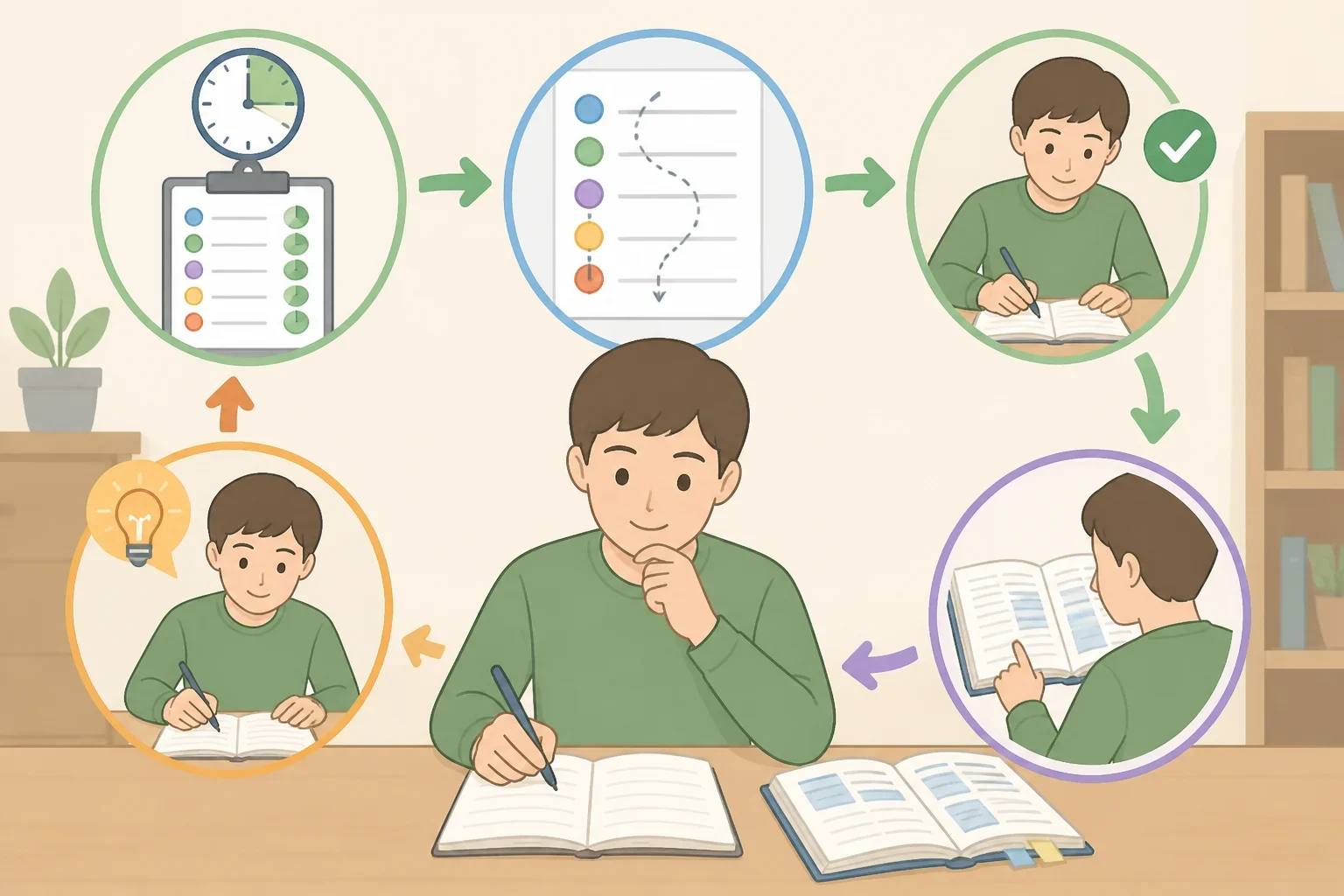
Kansas State recommends reading through every question first, roughly estimating how much time each deserves, and answering the ones you're confident about before tackling questions that need heavier resource-checking (Kansas State University).
The same guidance warns against over-answering. Aim for concise, evidence-based responses instead of exhaustive ones, and use quotations sparingly, working a few words into a sentence rather than dropping in long block quotes (Kansas State University).
Time adds up faster than it seems. In the reviewed studies, open-book test-takers spent close to 50 minutes on average compared to about 40 minutes for closed-book peers, likely due to consulting supplementary materials (Systematic Review). That extra time isn't guaranteed on every exam, so decide in advance how lookup time gets used: for verifying a detail or confirming a formula, not for figuring out a concept from scratch.
What to do next
The review reported mixed results on whether open-book access alone raises scores. It also found that students who spent more than half their exam time consulting books scored lower overall (Systematic Review). That's an association, not evidence that bringing more materials causes weaker performance; it may simply reflect that less-prepared students need to search more in the first place.
Retrieval practice, self-generated examples, and explaining ideas in your own words all have support in the learning research cited here, even though none of it was conducted on open-book exams specifically (Learning and Instruction, 2024; Distributed/Retrieval Practice Review, 2023). They're reasonable strategies to build a study plan around, especially when the goal is durable understanding rather than short-term recall.
Before the next open-book exam, confirm the instructor's exact rules on materials, devices, and format instead of assuming they match a previous class. Then build a short index or summary sheet and test it under a timer using a past or sample question. If more time goes to searching than writing, trim the reference system further rather than adding more pages to it.