
Macbeth Historical Context: Real King, James I, and Politics
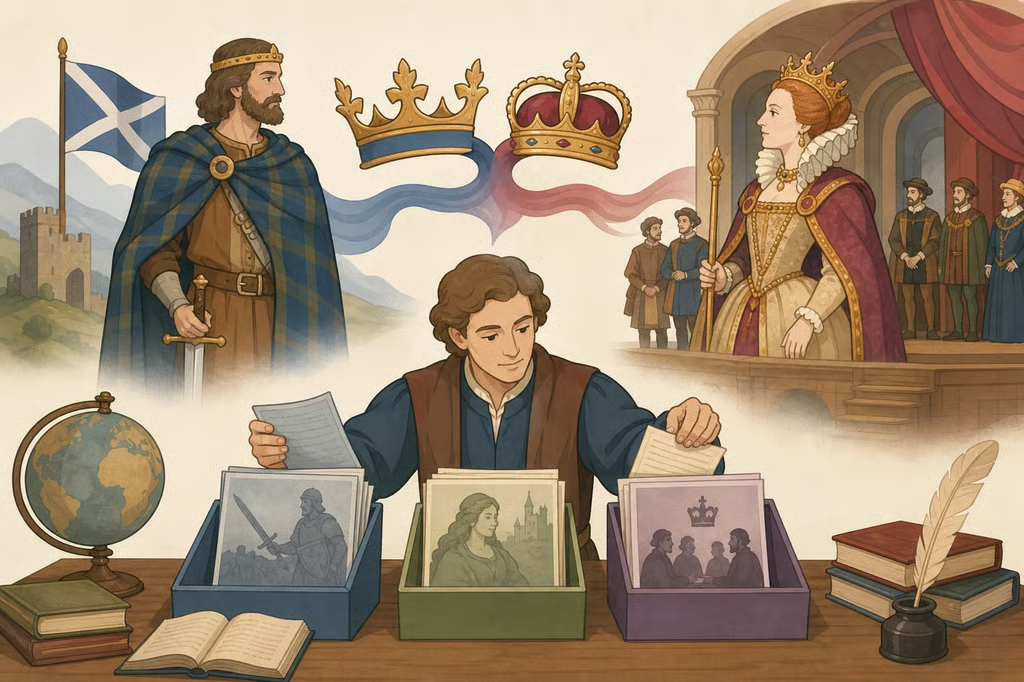
Reading Macbeth for class usually comes with one vague label attached: "historical context." That phrase is actually doing three separate jobs. There's a real eleventh-century Scottish king, a legend that medieval and Renaissance writers built around him long before Shakespeare picked up a pen, and the specific political pressures of 1606, when a Scottish king sat on the English throne. Sorting out the Macbeth historical context means treating these as three distinct layers, not one blur of "olden times."
The historical Macbeth ruled as King of Alba for 17 years, from 1040 to 1057, a reign the Institute of Historical Research describes as "relatively lengthy" for the period (IHR, 2023). Shakespeare's play was first staged in 1606, three years after Scotland's James VI became James I of England, by which point generations of chroniclers had already reshaped the real king into legend (IHR, 2023; Penn State/OUP, 2023). For an essay, the useful move is keeping those layers separate: what's documented history, what's inherited legend, and what's Shakespeare's own invention each need different evidence, and blending them tends to overstate a claim a teacher will flag.
The real king behind the play
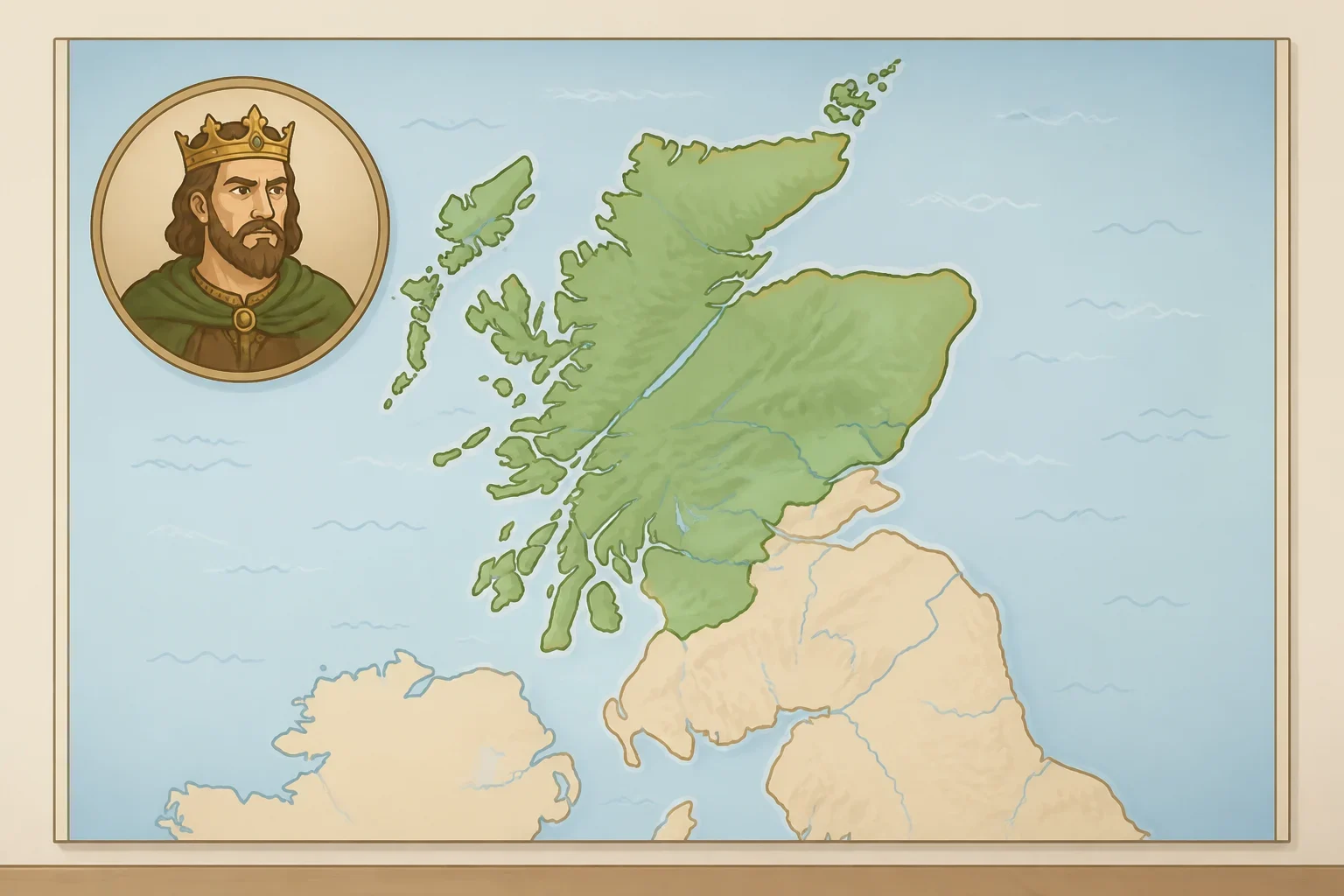
That 17-year reign already cuts against the idea of a ruler too unstable to hold power for long. Historian Benjamin Hudson's Macbeth before Shakespeare (Oxford University Press, 2023) provides a fuller picture of the historical ruler: Macbeth fought Vikings and English forces, made a pilgrimage to Rome, and sheltered Norman knights. He also used new fighting tactics and built a more international approach to government, alongside encouraging intellectual pursuits (Penn State/OUP, 2023).
With his queen, Gruoch, Macbeth was a documented benefactor of churches (Penn State/OUP, 2023). That detail has no clear equivalent in Shakespeare's play, where ambition drives the couple rather than patronage.
These facts explain how Shakespeare transformed a historical figure for dramatic effect, contrasting an internationally engaged ruler with Shakespeare's violent claimant to the throne. They don't, on their own, prove anything about what the play means; that argument still has to come from the text itself.
How chroniclers turned a king into a legend
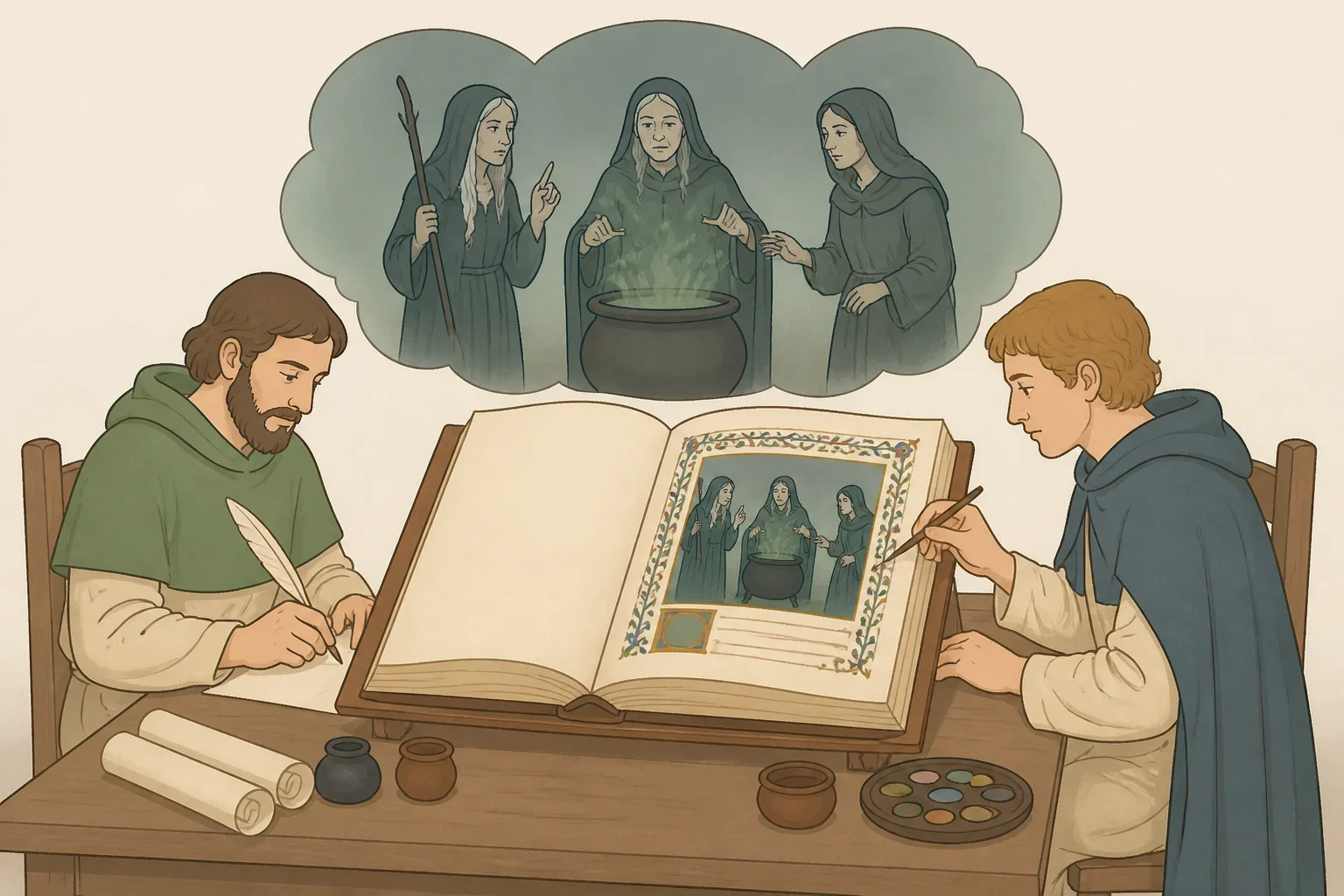
The gap between the historical record and the play becomes clearer when tracing the writers who reshaped Macbeth long before Shakespeare touched the story. Hudson writes that the transformation began almost immediately after the king's death, as medieval and Renaissance writers gradually replaced him with what Hudson calls a "semi-literary character" developed and embroidered "to suit their own political and cultural agenda" (Penn State/OUP, 2023).
One early example: Andrew of Wyntoun's Cronykil of Scotland, written well before Shakespeare, already has the "Werd Systrys" appearing to Macbeth in a dream to deliver prophecies (Book 6, Chapter 18) (IHR, 2023). Shakespeare's primary source, Raphael Holinshed, later described the sisters as "resembling creatures of elder world," with a marginal note in his chronicle calling them "the weird sisters or feiries" (IHR, 2023). That phrasing lines up closely with the language Shakespeare later gives his own witches.
By the time Shakespeare sat down to write, he'd inherited a Macbeth who was already supernatural, part of a legend still taking shape rather than a blank historical record he invented from scratch. If an assignment asks for a comparison between the historical figure and Shakespeare's character, the chronicle tradition, Wyntoun and Holinshed, is the missing middle step. Cite it, and the evidence complicates the claim that Shakespeare invented the witches independently.
Macbeth and King James I: witches, Banquo, and Jacobean politics
Macbeth was first staged in 1606, three years into James VI of Scotland's reign as James I of England (IHR, 2023). Its mostly Scottish setting and its witches speak to the new king's own nationality and interests, a connection students are often already aware of before they open the play (Bath Spa ResearchSPAce, 2026).
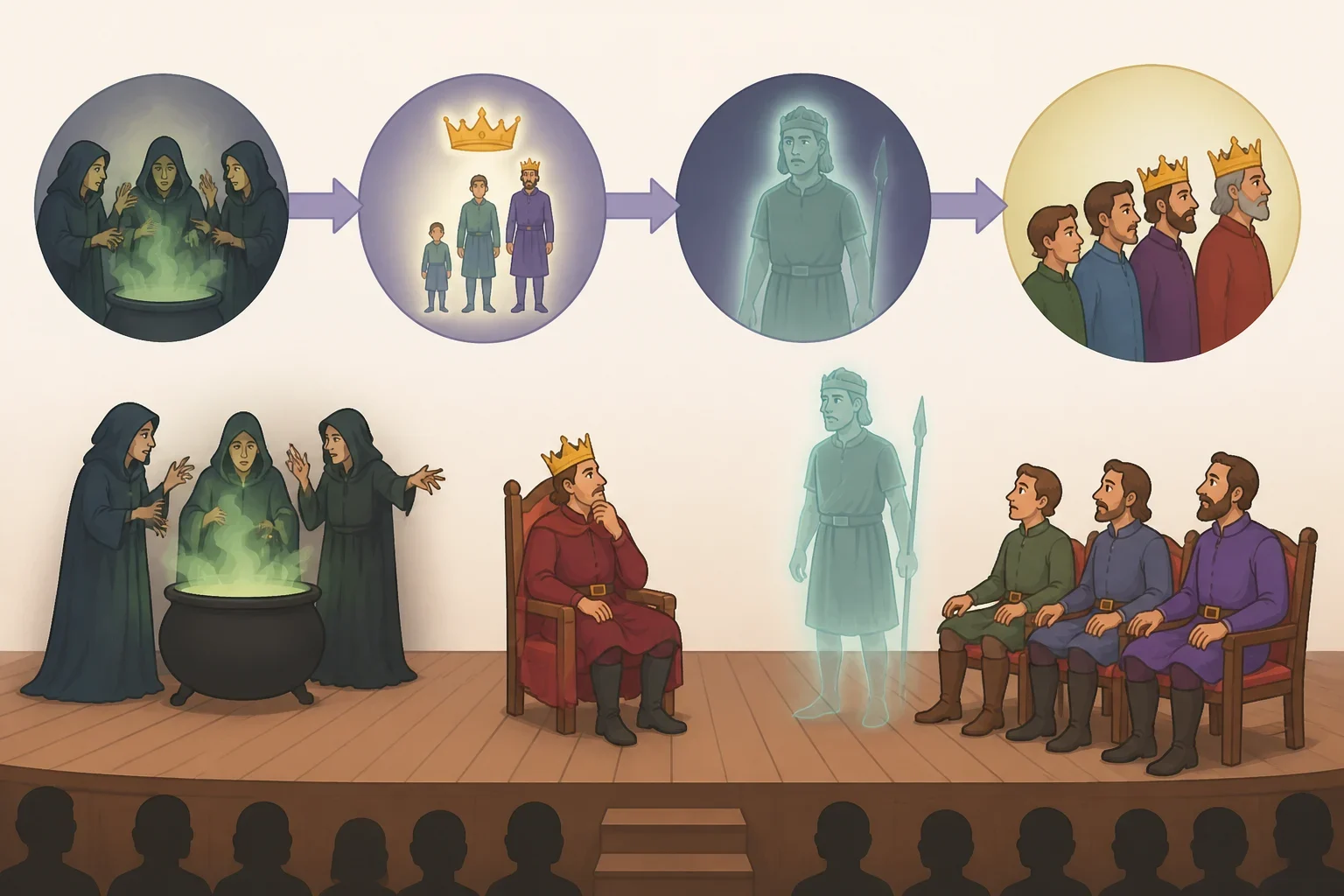
One connection is genealogical. Banquo was believed to be the ancestor of the Stuart line, meaning James himself (IHR, 2023). That belief gives the coronation-style procession of future kings in Act 4, Scene 1 potential dynastic significance for the play's original audience, though the source doesn't establish how every viewer in that audience understood it.
A second connection runs through witchcraft belief. Shakespeare's witches have familiars and the ability to fly in Act 1, Scene 1, and the power to raise storms in Act 1, Scene 3 (IHR, 2023). Storm-raising specifically had been a prominent belief in the North Berwick witch trials of the 1590s, which would have made it familiar to James and his court (IHR, 2023). That's as far as the record goes: it shows familiarity with the belief, not that James personally investigated those trials, and an essay claiming more than that reaches past the evidence.
Taken together, the Banquo lineage and the witchcraft references explain why the play might flatter James. They don't settle whether Macbeth endorses monarchy without question, and that's a harder, separate question.
Macbeth political context: kingship and 'birthdom'
That harder question is exactly what a teaching essay added this month to Bath Spa University's open-access research repository takes up. The essay's author states the teaching goal directly: to respond to and challenge "students' assumption that the play is Jacobean propaganda" (Bath Spa ResearchSPAce). Instead, the author invites students to read Macbeth as a reflection on its cultural moment, the unsettled politics of one Scottish monarch ruling England, Scotland, Ireland, and Wales together (Bath Spa ResearchSPAce).
One piece of evidence for that reading: the play names England, Ireland, and Wales, and uses the terms "kerns" and "galloglasses" within that wider archipelagic frame, yet the words "Scot," "Scottish," and "Scottishman" never appear once (Bath Spa ResearchSPAce). That absence is worth noticing in a play so often nicknamed "the Scottish play."
The sharpest case study is a single word. In Act 4, Scene 3, as Macduff and Malcolm discuss how to reclaim Scotland from Macbeth's rule, Macduff uses the term "birthdom," and the essay's author poses the question directly: to what does this word refer? (Bath Spa ResearchSPAce). Modern editions gloss it inconsistently, as "birthright," "country," "native kingdom," or "native land" (Bath Spa ResearchSPAce). Is Macduff demanding his personal birthright, or naming the country itself? The essay's author calls "birthdom" "a timely neologism, evincing the geopolitical dynamics of the Jacobean period" (Bath Spa ResearchSPAce), which frames the word's ambiguity as carrying real political weight rather than just being a translation gap.
The same scene raises the question the essay's author poses to open discussion: does Macbeth's resistance to an invading "Anglo-Scottish army" mark him out as a national "hero," or does "the tyrant" mobilise nationalist rhetoric to secure his own power (Bath Spa ResearchSPAce)? The essay doesn't answer that for readers. It uses the question to open discussion, and that's exactly how it should function in student writing too: a contested point, not a settled conclusion.
What to do next
Check the assignment prompt or rubric first. It likely asks for one of three arguments, and each pulls from different evidence:
- Comparing the historical king to Shakespeare's character: pair Hudson's biographical research, especially the church-patronage detail, with a scene showing ambition driving Shakespeare's Macbeth and Lady Macbeth.
- Explaining the James I connection: pair the Banquo lineage or the North Berwick witchcraft parallels with the relevant act and scene, and state plainly that these show cultural background, not proof of what Shakespeare personally intended.
- Analyzing the play's politics of nationhood: pair the "birthdom" passage in Act 4, Scene 3 with the play's absence of the words "Scot" and "Scottish."
Whichever direction the assignment calls for, name one historical or scholarly source, name one passage from the play, and say directly what the historical evidence can prove and what it can't. Before citing Hudson's book, the IHR blog, or the Bath Spa essay, confirm the citation format the assignment requires and pull publication details from the source itself rather than from a summary like this one.