
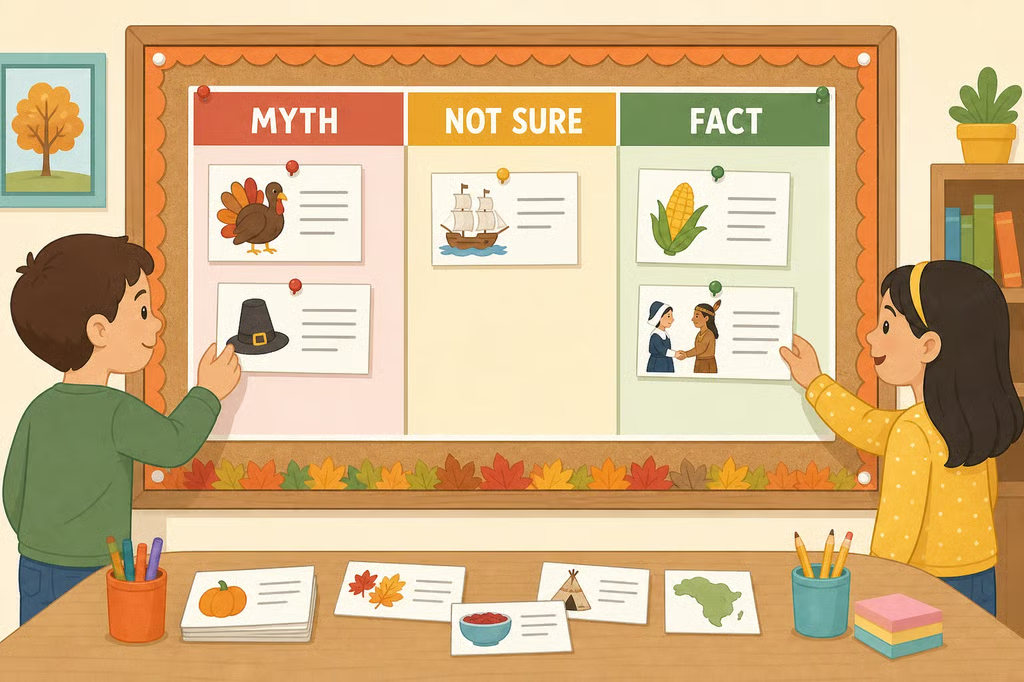
- Thanksgiving myths vs facts classroom activity for grades 6-10
- What this Thanksgiving primary sources lesson plan teaches
- How to run the three-column evidence sort
- A Continental Army "day of publick thanksgiving"
- The five claim cards and teacher answer key
- Why "traditional" Thanksgiving food is newer than it looks
- Grade-band adaptations and a companion resource
- Exit ticket: check for transfer
- What to check before teaching
Thanksgiving myths vs facts classroom activity for grades 6-10
Ask a class of sixth graders what happened at the first Thanksgiving and most will describe a feast: turkey, pumpkin pie, new neighbors sitting down together as friends. Ask them to name the record that proves any of that, and the room usually goes quiet. That gap between what students assume and what the historical record actually documents is exactly what a Thanksgiving myths vs facts classroom activity should target.
This guide walks through a three-column evidence sort for grades 6 through 10. Rather than retelling a familiar textbook paragraph, students test five claims against two very different kinds of records: a Revolutionary War military orderly book and a century of American cookbooks. Claim cards, grade-band directions, and an exit ticket are included below.
What this Thanksgiving primary sources lesson plan teaches
The goal is historical thinking, not trivia. Can students tell the difference between what a record documents, what a reader can reasonably infer, and what the record leaves out or contradicts?
For materials, gather:
- A three-column organizer, printed or projected, labeled Confirmed by the record, Reasonable inference, and Not confirmed or contradicted
- The five claim cards listed below
- The excerpted source lines from the next two sections, printed or projected
- The three exit-ticket statements near the end of this guide
Suggested timing: about 50 minutes for the sort and discussion, then a second period for a short written response on what the records actually show versus what's been assumed on top of them. Class length, reading level, and accommodations will change that estimate, so treat it as a starting point.
How to run the three-column evidence sort
Walk students through the same five steps for each claim card:
- Read the assigned excerpt from the source set below.
- Underline or highlight the line that supports, challenges, or says nothing about the claim.
- Place the card in one column of the organizer.
- Write one sentence justifying the placement, using the underlined line as evidence.
- After small-group or whole-class discussion, revise the placement if a classmate points out something missed.
That fifth step matters most. Historical thinking isn't about landing on the right answer immediately. It's about being willing to move a card once new evidence comes up in discussion.
A Continental Army "day of publick thanksgiving"
Most students have never worked with a military record before, which makes this a good first primary source. In 1777, Congress designated a day of thanksgiving, and the 3rd New York Regiment stationed at Fort Stanwix observed it. Lt. Col. Marinus Willett recorded the order in the regiment's orderly book the day before: "Tommorrow is the day appointed by Congress to be Observed as a day of publick thanksgiving throughout the United States. No duty will therefore be done in this garrison, unless it would but to mount the Necessary Guards" (National Park Service, 2022).
Nothing in that entry mentions a feast, a meal, or a celebration. It excuses soldiers from work and posts guards, nothing more. Later Christmas entries from the same garrison stay just as sparse: a December 1779 order grants soldiers a gill of rum and a day off from cleanup duty, and entries from 1780 and 1781 note only weather or "nothing remarkable" (National Park Service, 2022).
Project or hand out these four lines, since they form the source set for the claim sort below:
- The 3rd New York Regiment at Fort Stanwix observed the 1777 "Continental Thanksgiving," and the record makes no mention of large feasts or celebrations.
- Willett's orderly book entry: "Tommorrow is the day appointed by Congress to be Observed as a day of publick thanksgiving throughout the United States. No duty will therefore be done in this garrison, unless it would but to mount the Necessary Guards."
- A December 24, 1779 entry grants a "Gill rum" and excuses fatigue duty for Christmas, without describing a meal.
- The December 25, 1780 and 1781 entries read, in full: "Nothing Remarkable" and "Last Evening fell a small snow."
The five claim cards and teacher answer key
Give each student or pair the three-column organizer described above. In the third column, have students add a quick label: unsupported, contradicted, or added later. Those are different situations, and the distinction matters for how confidently students can write about each claim afterward.
Hand out these five cards:
- Continental Army soldiers observed a designated day of thanksgiving in 1777.
- That thanksgiving day included a shared holiday feast for the garrison.
- Every Christmas during the war involved a special garrison-wide celebration.
- Canned pumpkin was a kitchen staple used for colonial-era pumpkin pie.
- Cookbooks devoted specifically to holiday meals have existed since early America.
Card 1 is confirmed directly. Willett's entry documents the order and the excused duty.
Card 2 belongs in the "not confirmed" column. The record states what didn't happen (regular duty) but says nothing about food, so students should mark this unconfirmed rather than assume a feast took place.
Card 3 is contradicted. The 1780 and 1781 entries describe weather and nothing else, which challenges any assumption that the garrison marked the holiday the same way every year.
Card 4 is contradicted by the cookbook timeline: canned pumpkin only replaced hand-stewed fresh pumpkin later in the 20th century, well after the colonial period (Library of Congress Magazine, 2024).
Card 5 needs a more careful label than true or false. The Library of Congress's earliest holiday-adjacent cookbook dates to 1742, but cookbooks specifically devoted to the holidays didn't become popular until after World War II, so "since early America" overstates how consistent that tradition has actually been (Library of Congress Magazine, 2024). Students should note that a claim can be partly true and still misleading.
Why "traditional" Thanksgiving food is newer than it looks
Students will likely ask why the feast story feels so solid if the record is this thin. Part of the answer is that a lot of what feels timeless about Thanksgiving actually took shape in the 20th century, not before it.
Clinton Drake, a reference librarian in the Library of Congress's History and Genealogy Section, points to detailed cookbooks that began appearing around the turn of the 20th century and expanded further once home refrigeration became common (Library of Congress Magazine, 2024). Curator Cheryl Harbster notes that convenience foods like cake mix became popular in the 1940s and reshaped how Americans cooked for the holidays soon after (Library of Congress Magazine, 2024).
Even a detail as small as canned pumpkin has a specific date range. Before it was available, Harbster explains, "bakers would simply cut up fresh pumpkins and stew them themselves" rather than opening a can (Library of Congress Magazine, 2024). None of this makes Thanksgiving food traditions fake, but it does mean "we've always done it this way" often translates to "we've done it this way since the 1940s or later," a distinction worth having students sit with.
Grade-band adaptations and a companion resource
Middle school (grades 6-8) works well with the four Fort Stanwix lines above, the guided organizer, and small-group discussion. High school (grades 9-10) can add the fuller cookbook excerpts from the Library of Congress piece and write an independent source evaluation instead of filling in a template, explaining in their own words why each claim landed where it did.
For teachers who want to extend the lesson into the settler-and-Native history most students already associate with Thanksgiving, Amerind For Educators publishes a companion unit built for that purpose. Its ELA lesson includes nonfiction reading passages, comprehension questions, and its own Thanksgiving myths-versus-facts Venn diagram activity, along with a reading called "Harvest Ceremony, Beyond the Thanksgiving Myth" (Amerind For Educators, 2022). That history involves sourcing and perspective questions beyond what a single class period can cover, so treat it as a separate second lesson rather than folding it into the evidence sort above.
Exit ticket: check for transfer
Once students have worked through the five claim cards, hand out three new statements and ask them to sort each one without guidance:
- Every Christmas entry in the Fort Stanwix orderly book describes a large feast.
- Refrigeration influenced how detailed and elaborate cookbooks eventually became.
- Convenience foods like cake mix were already common in the 1800s.
Statement 1 is contradicted. The December 25, 1780 and 1781 entries mention only weather, nothing resembling a feast. Statement 2 is confirmed, since detailed cookbooks expanded specifically once home refrigeration arrived (Library of Congress Magazine, 2024). Statement 3 is contradicted, since cake mix didn't become popular until the 1940s, more than a century after the 1800s (Library of Congress Magazine, 2024).
If most students sort these correctly without prompting, that's a reasonable signal the categories from guided practice transferred to statements they hadn't seen before. It isn't a guarantee the skill will hold on every future topic, but it's a solid starting point.
What to check before teaching
Pull up the Fort Stanwix blog post and the Library of Congress cookbook article, then decide which excerpts to project or print. Choose the middle school or high school version based on the class, and decide whether the Amerind For Educators unit fits as a follow-up lesson or extension work for students who finish early.
Verify each excerpt against the claim cards and mark your own answer key before class, so discussion doesn't stall on a claim you haven't thought through yet. The goal isn't to hand students a shorter, corrected version of the Thanksgiving story. It's to have them practice saying what the evidence shows, what it suggests, and what still isn't known.