

AI-Generated Fake Citations: How to Verify in 3 Steps
A citation that looks flawless on the page, correct journal name, correct year, official-sounding title, can still point to nothing at all. That's the risk with AI-generated fake citations, and it's turning up in student papers, research drafts, and published academic work alike.
Researchers tested this directly last year. When GPT-4o was asked to write six literature reviews, it produced 176 citations. Checking each one against library databases turned up 35 references, about 19.9%, that were non-existent academic references with no identifiable source at all. Among the 141 that did lead somewhere real, 64, or 45.4%, contained bibliographic errors such as wrong dates or broken DOIs. Add both groups together and roughly 56% of everything GPT-4o cited was either fabricated or inaccurate in some way (JMIR Mental Health, last year).
That number matters for anyone who has used an AI tool to draft a paper, build a source list, or speed up a literature search, which by now covers a lot of students, tutors, and researchers. The rest of this guide walks through what a citation check can and can't tell readers, a three-step routine for verifying any reference, and a classroom exercise for practicing it before a bad citation ends up in a final draft.
Who runs into this problem
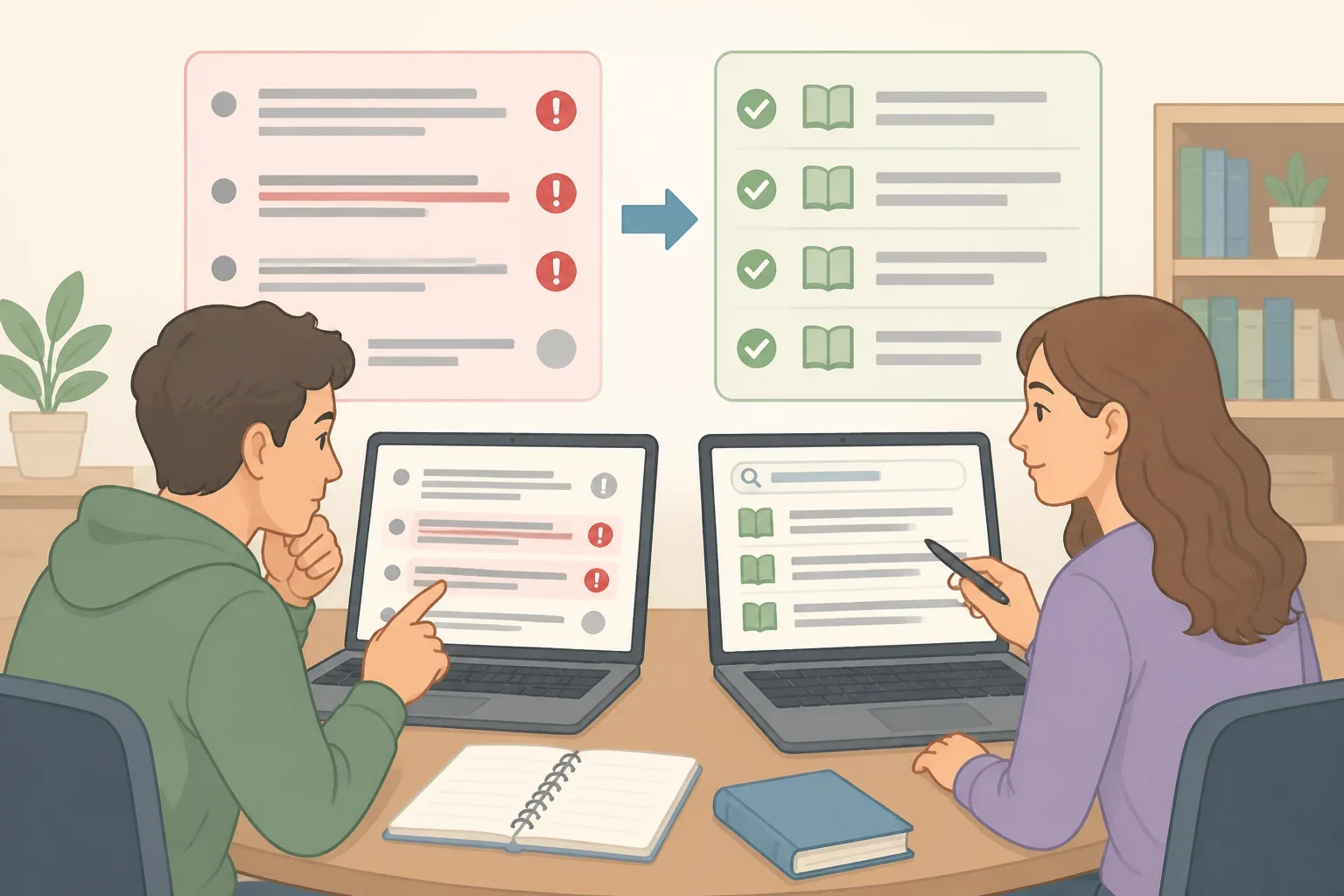
Students using AI to jumpstart a paper's bibliography face this most directly, since a fabricated source can slip past a quick read and cost points on accuracy or academic-integrity grounds. But the problem doesn't stay in the classroom.
A preprint reviewing citation-verification tools, posted this summer, summarizes outside findings suggesting AI hallucinated citations are spreading well past homework assignments. It cites a Lancet audit that found 4,046 fabricated citations across 2,810 biomedical papers, with the rate climbing steadily from 2023 into 2025 and 2026, a separate study by Zhao and colleagues estimating roughly 146,932 hallucinated citations across four research repositories in 2025, and an ACL 2026 review that caught citations to nonexistent literature in more than 100 accepted conference papers (arXiv, Badalova & Mayr, posted this summer).
College students writing term papers, graduate researchers drafting literature reviews, and professionals submitting to journals or conferences are all working with the same imperfect tool, and none of them are exempt from checking its output.
What citation-checking actually verifies
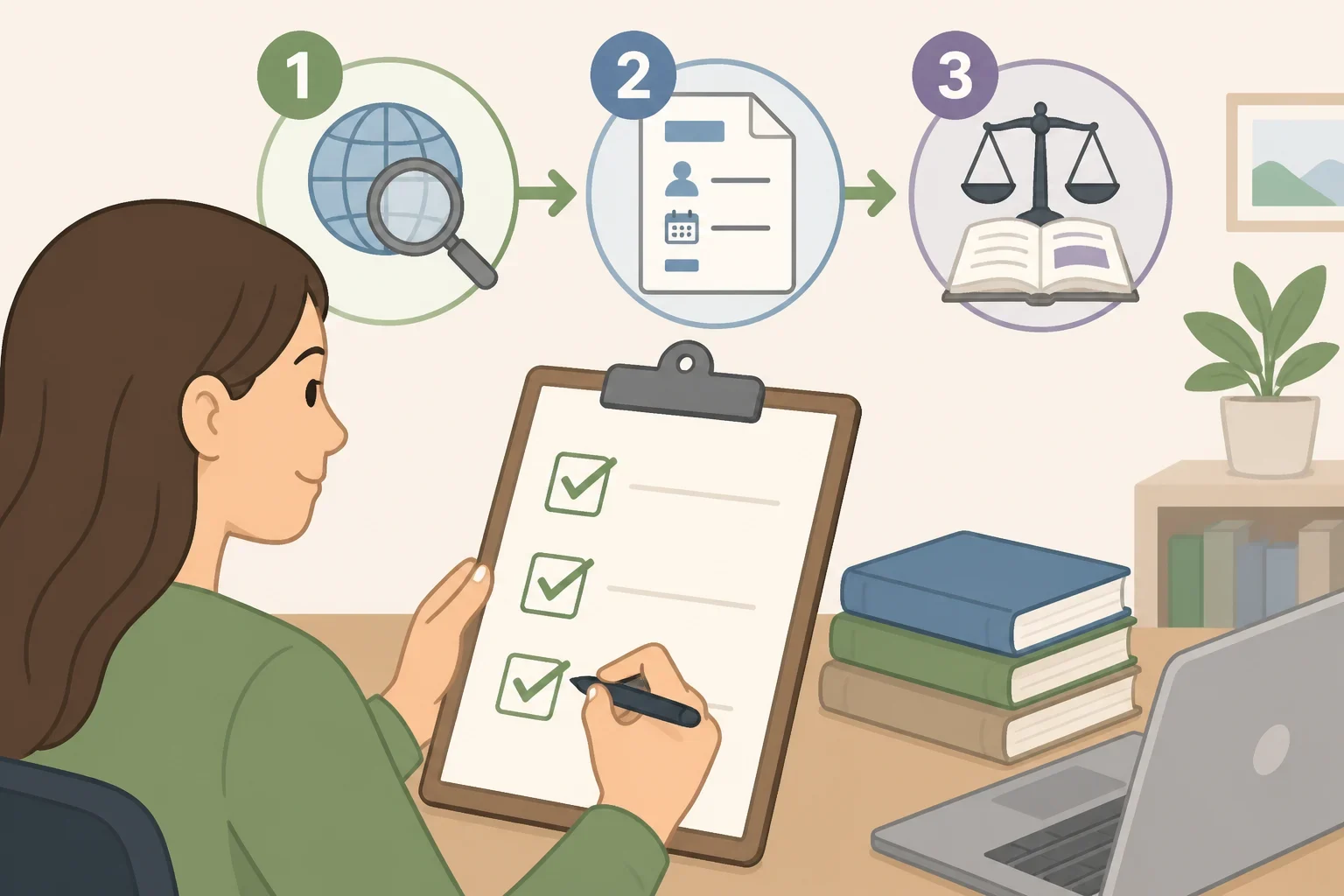
A citation holds up only if it answers three separate questions. Does the source exist? Do the title, authors, date, journal, and DOI match exactly? And does the source actually say what it's cited for?
APA Style has flagged this directly: AI tools will confidently generate citations to works that aren't real, or cite real works that don't actually support the claim attached to them (APA Style, last year). That second failure mode is easy to miss, because a citation can pass a basic search and still be wrong for the sentence it's supporting.
Fabrication risk also isn't the same across every topic. In the JMIR experiment, GPT-4o fabricated only 6% of citations on a well-covered subject, major depressive disorder, compared with 28% and 29% on two narrower disorders, binge eating disorder and body dysmorphic disorder. In this study, fabrication climbed as the topic got less commonly researched, which is a reason to look more closely at citations on niche or emerging subjects (JMIR Mental Health, last year).
One more distinction worth stating plainly: general AI-text detectors don't check any of this. They assess writing style, not whether a reference exists or whether its metadata is correct, so running a paper through a detector says nothing about whether its citations are fabricated AI references (arXiv, Badalova & Mayr, posted this summer). Checking a citation and checking for AI-written text are two different jobs, and confusing them is a common mistake among students and teachers alike (Pace University Library Guide).
How to check if a citation exists: a three-step routine
Running down a suspicious reference doesn't require special software. It takes three checks, done in order, every time.
Step 1: Locate the source. Search the exact title in Google Scholar or a library database first. For biomedical topics, check PubMed directly. If a DOI is listed, resolve it at doi.org rather than trusting that it looks legitimate. Researchers verifying GPT-4o's citations used this same layered approach, cross-checking Google Scholar, Scopus, PubMed, WorldCat, and publisher databases before ruling a citation real or fabricated (JMIR Mental Health, last year).
Step 2: Match the metadata exactly. Compare title, authors, year, journal, and DOI character for character. Watch for a DOI that resolves to an unrelated paper, a title that's close but not identical, or a source missing a DOI altogether. A missing DOI isn't automatic proof of fabrication, but it's a flag that calls for closer manual review.
Step 3: Confirm the source supports the claim. A citation can be entirely real and still fail here if the paper doesn't actually say what it's cited for, the exact failure APA warns about above. This step requires reading enough of the source, at minimum an abstract, to check the claim against it.
Automated AI citation verification tools can help prioritize which references deserve this scrutiny, but they shouldn't be the final word. In a manual comparison of 104 references, 33 of them problematic, tools like RefChecker and CheckIfExist caught more issues but also produced more false positives, while HalluCiteChecker missed more real problems while incorrectly flagging fewer valid citations (arXiv, Badalova & Mayr, posted this summer). Whatever a checker reports, clean or flagged, still needs the manual title, author, DOI, and venue check from steps one and two before anyone trusts it.
If the full text sits behind a paywall, that's not a reason to skip verification. Existence and metadata can usually be confirmed through a publisher's abstract page, a library catalog record, or a database entry, without reading past the first page.
Practicing the routine: a classroom exercise
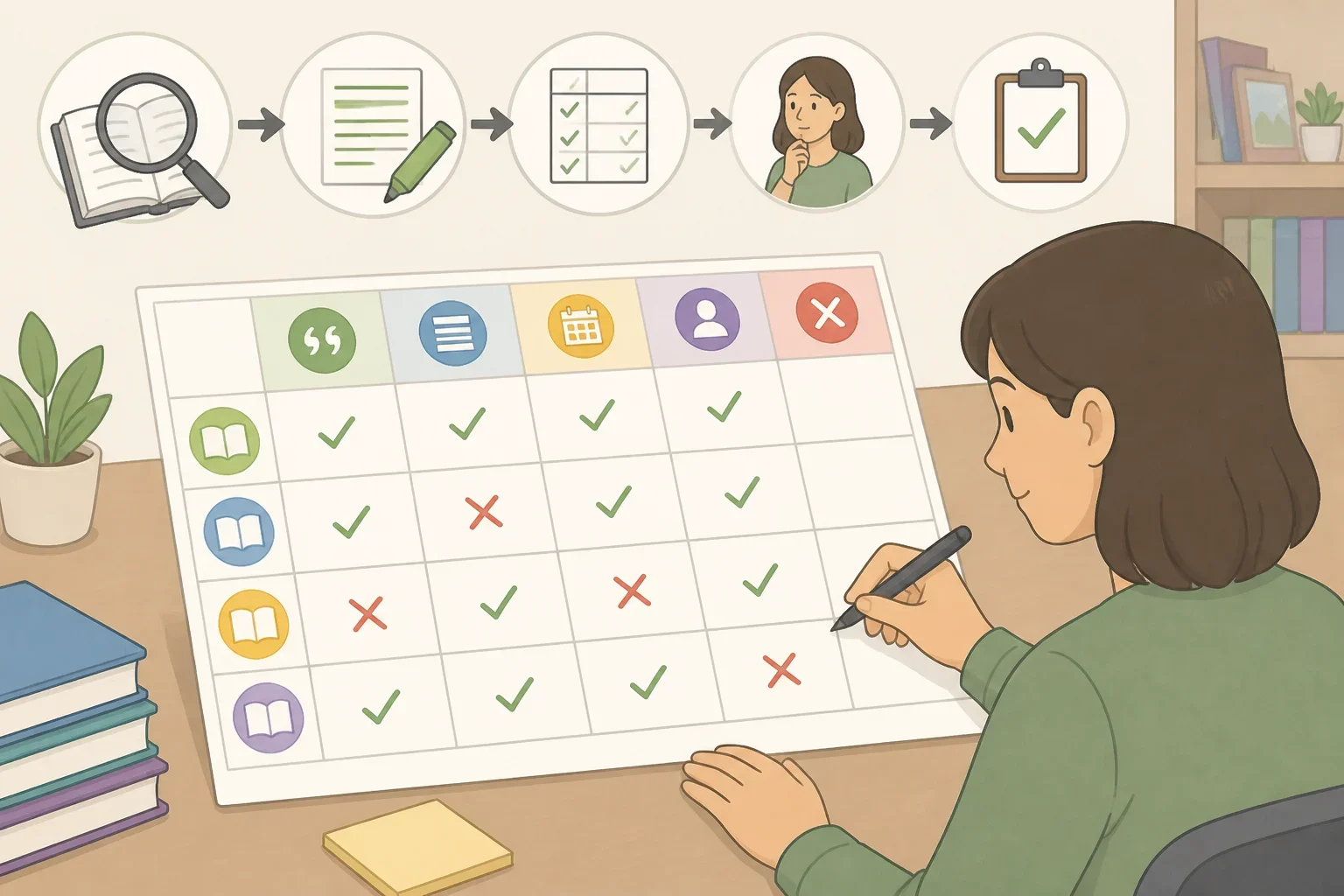
The three-step check is easiest to learn by working through a mix of real, fabricated, and slightly-wrong citations rather than reading about them. One workable format: a seeded bibliography of eight to ten AI-generated citations, worked individually or in pairs during a single class period, with a follow-up discussion afterward.
A simple worksheet with four columns, Located?, Metadata Match?, Supports Claim?, Verdict, gives students a place to record what each step turns up. For an illustrative example: a citation attributed to a real-sounding journal and year, attached to a claim about treatment effectiveness, where the DOI resolves to a completely unrelated paper on a different topic. That's a metadata-mismatch failure, and it's more subtle than an outright fabricated reference, which is exactly why it works as a teaching example before students move to their own set.
The deliverable worth asking for isn't just a verdict on each citation. Have students note which step, existence, metadata, or claim support, is what actually caught the problem. That distinction is the point of the exercise: the three steps catch different failure types, and a student who only checks whether a source exists will still miss citations that are real but misapplied.
Before running this with a class, confirm the current AI-use policy for the assignment. Acceptable-use rules for AI-generated drafts and citations vary by teacher, school, and program, and a verification exercise built around AI output should match whatever policy already governs the class.
Why this goes beyond one assignment
Fabricated citations aren't confined to student drafts or even to academic writing. An AI-generated summer reading list that circulated last year included only five real titles out of fifteen, the same kind of failure showing up in an everyday context rather than a research paper (APA Style, last year).
Disclosure is a related but separate obligation from verification. APA Style specifies that AI use should be disclosed in a method section, author note, or other relevant place in the text, and that the AI tool itself should be cited (APA Style, last year). Disclosing that a tool was used says nothing about whether its output was checked. A paper can follow every disclosure rule and still cite sources that don't exist.
What to do next
Before turning in a paper, submitting a literature review, or handing a class an AI-generated source list, run every citation through the three steps: locate it, match the metadata, and confirm it supports the claim. Don't stop at "the source exists," since that catches only one of the three failure types described above.
Check the assignment's or publication's current AI-use and disclosure policy separately from the citation check itself; they cover different requirements. And if this becomes a recurring class or study-group exercise, build a small seeded bibliography ahead of the next research unit so students can practice the routine on citations where the answers are already known.