
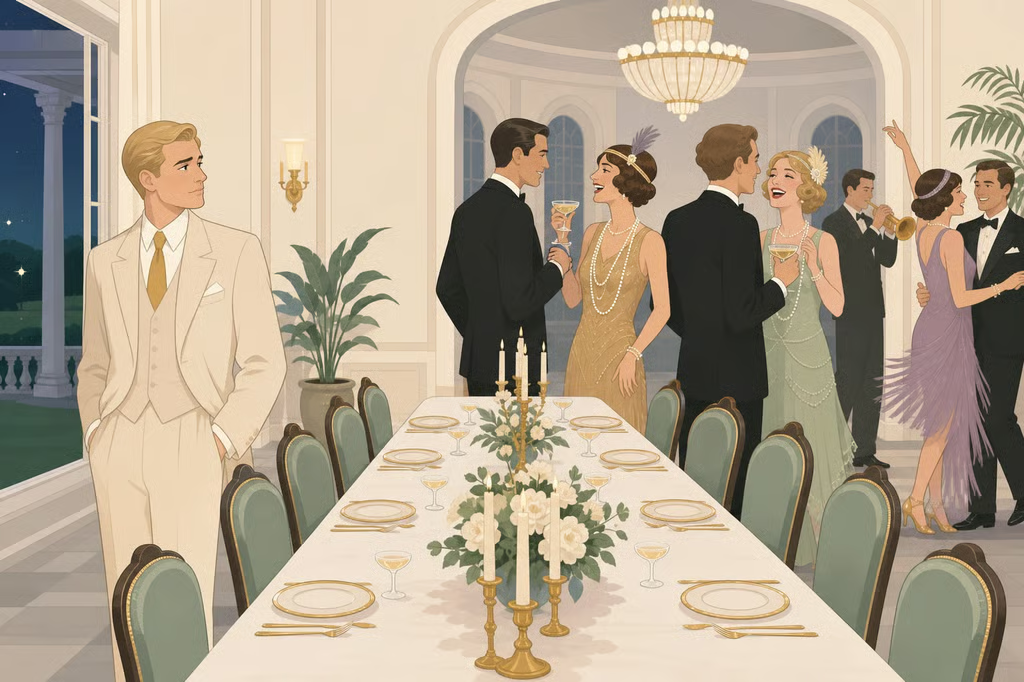
- The Great Gatsby Historical Context: Class in the Jazz Age
- Why 1925 and the postwar years both matter
- The Great Gatsby and the Roaring Twenties: consumer culture and new money
- New money versus old money: the limits of the Jazz Age
- Prohibition and the business behind Gatsby's fortune
- Immigration and gender politics around the novel's characters
- Turning one historical fact into textual evidence
The Great Gatsby Historical Context: Class in the Jazz Age
Jay Gatsby owns a Rolls-Royce, a station wagon, and a machine in his kitchen that can juice two hundred oranges in half an hour, yet none of it buys him a seat at the Buchanans' table. That gap between visible wealth and social acceptance runs through the historical context of The Great Gatsby, and getting there starts with a date question that trips up plenty of student essays: F. Scott Fitzgerald published the novel in 1925 (Save My Exams), after finishing his drafts the previous summer and telling his editor, Maxwell Perkins, that he believed it was "the best American novel ever written" (Hodder Education).
That confidence didn't match the reception. The novel drew mixed reviews and sluggish sales, a rockier start than Fitzgerald's debut, This Side of Paradise, which had sold out its first 3,000-copy print run in three days (Hodder Education). The unease running underneath the glamour didn't come from nowhere, and the sections below connect that history to specific lines and scenes so an essay has something more precise to cite than general background about jazz and flappers.
High school and college students drafting a paper on the novel are the main audience here, along with the teachers assigning it. Each section ties documented history to a scene or quotation from the text, material that belongs in a body paragraph rather than sitting in an introduction as scenery.
Why 1925 and the postwar years both matter
The story Fitzgerald built carries the weight of what came right before it. More than 115,000 American soldiers died in barely a year of fighting in Europe, and between 1918 and 1920 a flu epidemic killed nearly 700,000 Americans, reaching close to a fifth of the population (Humanities LibreTexts).
Warren Harding won the 1920 election in a landslide, campaigning on a promise to move past that loss: "America's present need is not heroics, but healing; not nostrums, but normalcy; not revolution, but restoration," he told voters (Humanities LibreTexts). When he took the oath of office in March 1921, his inaugural address called for "the resumption of our onward, normal way" (Humanities LibreTexts). The country he addressed was still absorbing shocks like the more than thirty mail bombs anarchists sent out in a single day in May 1919 (Humanities LibreTexts).
Fitzgerald and Ernest Hemingway belonged to what Gertrude Stein named the Lost Generation, writers marked by the disorientation the war left behind (Save My Exams). Nick Carraway opens his account of Gatsby by describing his own restlessness after returning from the war, actively searching for "a reason, an inspiration, a dream to believe in once again" (Chapter 1). Hodder Education's analysis reads that line as generational disillusionment rather than ordinary moodiness (Hodder Education), a reading worth pairing with the postwar facts above rather than leaving the quote to stand alone.
The Great Gatsby and the Roaring Twenties: consumer culture and new money
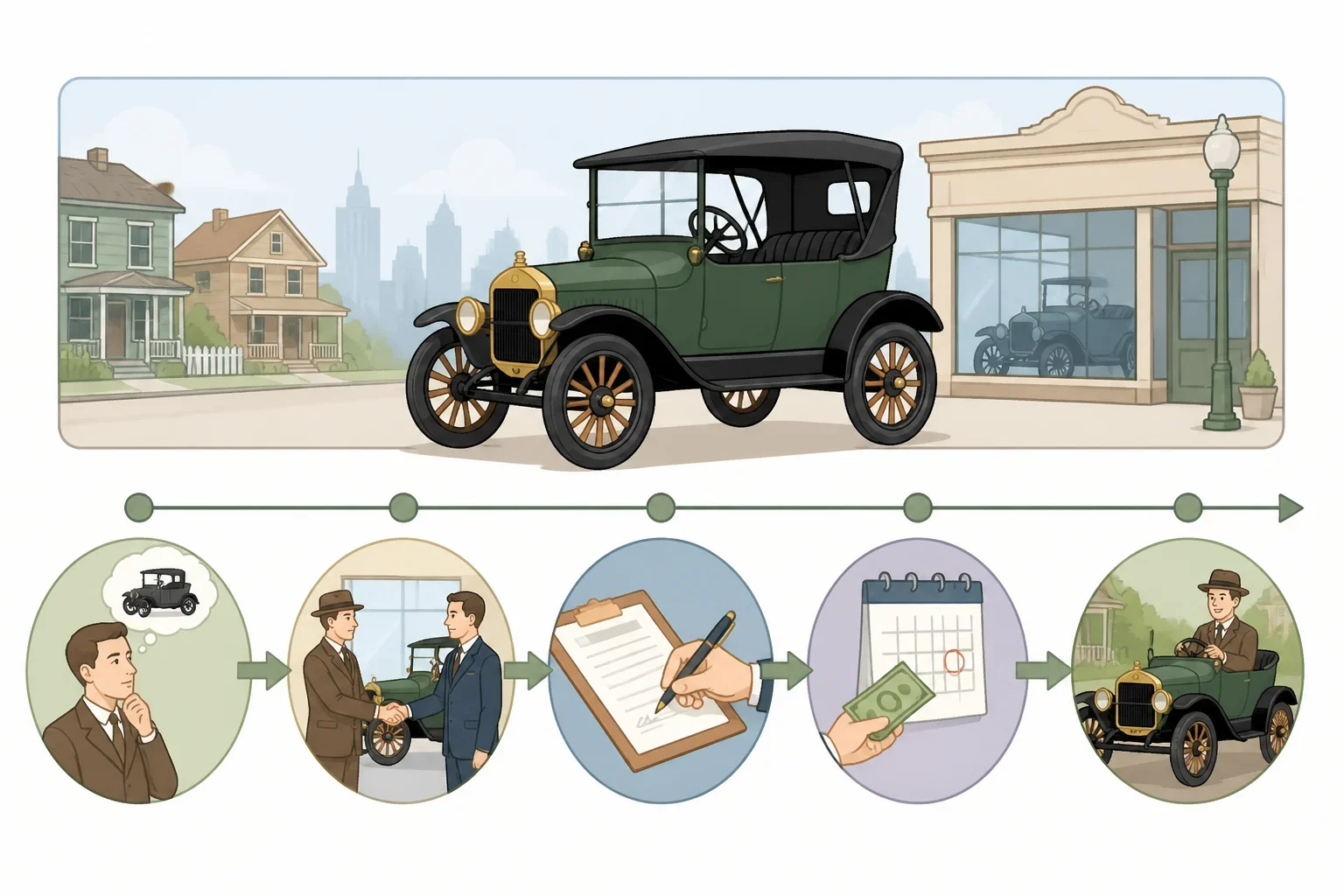
Once wartime economic controls lifted, unemployment spiked to 20 percent before that recession was followed by a decade of expanding consumer production and credit, the stretch of years now nicknamed the Roaring Twenties (Humanities LibreTexts). By 1927, more than 60 percent of American cars were bought on credit, and Ford's factories were turning out a Model T every ten seconds by 1925 (Humanities LibreTexts). Those figures come from the middle and later years of the decade, but they help place Gatsby's conspicuous cars within the era's expanding automobile culture rather than treating them as pure exaggeration.
Fitzgerald renders that world directly: "On weekends his Rolls-Royce became an omnibus, bearing parties to and from the city between nine in the morning and long past midnight, while his station wagon scampered like a brisk yellow bug to meet all trains" (Chapter 3), a passage Hodder Education calls one of the novel's central fantasy spectacles (Hodder Education).
The same abundance shows up in smaller details. Gatsby's kitchen holds a machine that "could extract the juice of two hundred oranges in half an hour" (Chapter 3), and Nick compares his neighbor's lit-up house at two in the morning to "the World's Fair" (Chapter 5) (Hodder Education). That line points to the 1901 Pan-American Exposition in Buffalo, an event built around electric-light displays that drew eight million visitors and that a young Fitzgerald himself attended, a month short of his sixth birthday (Hodder Education). Chapter 3 also describes the fortnightly "corps of caterers who came down with several hundred feet of canvas and enough coloured lights to make a Christmas tree of Gatsby's enormous garden," a scene Hodder Education reads as Fitzgerald's own miniature version of that spectacle (Hodder Education).
Mass entertainment was expanding at a similar pace nationally: weekly movie attendance climbed to 40 million in the early 1920s, and roughly half of American homes owned a radio by 1930 (Humanities LibreTexts). Read next to the caterers scene, those numbers place Gatsby's parties inside a broader national shift toward public spectacle rather than one man's private extravagance.
New money versus old money: the limits of the Jazz Age
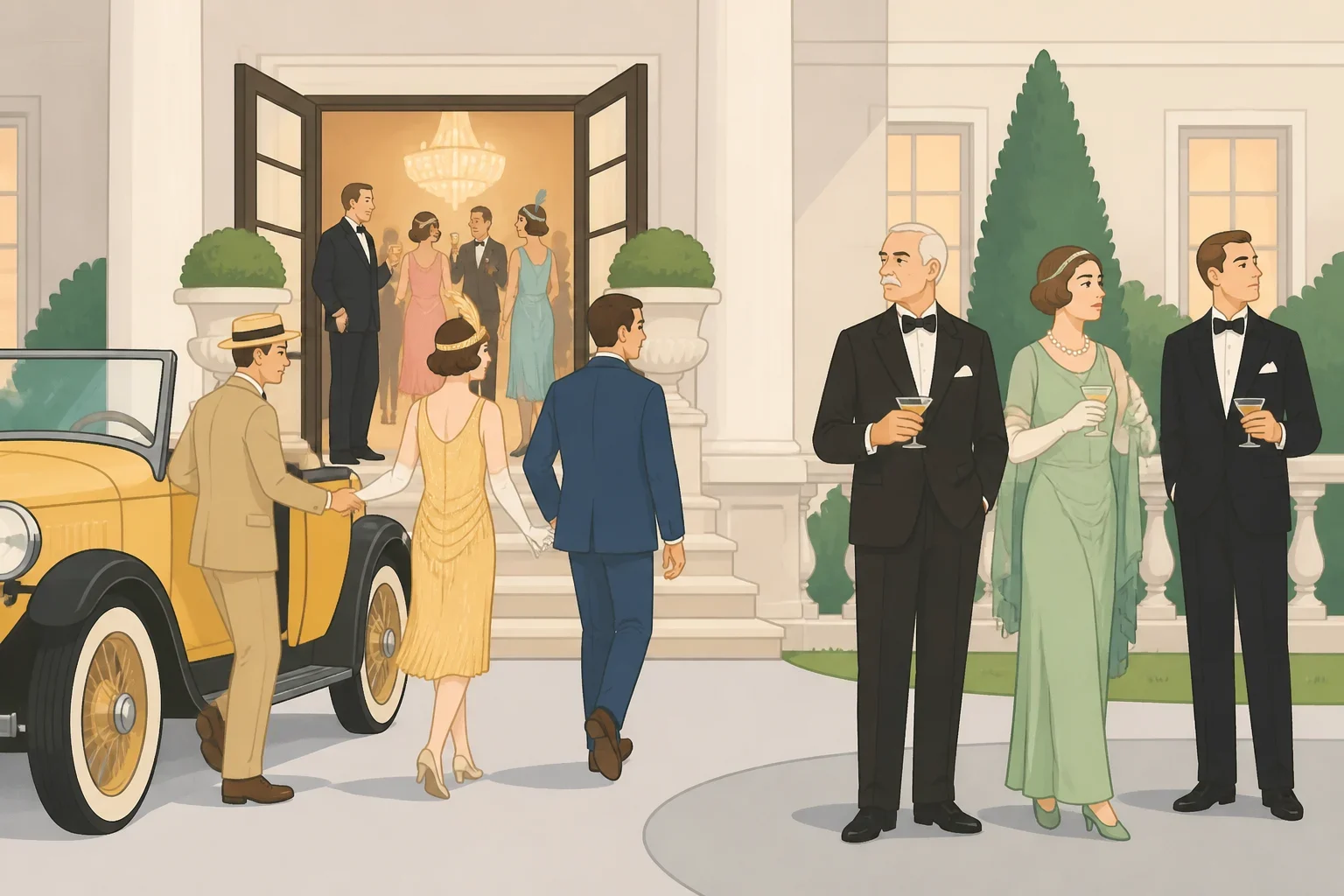
Postwar prosperity produced what Save My Exams describes as a "new money" consumer culture, fueled by credit and mass production, that challenged the era's established social hierarchy (Save My Exams). Gatsby fits the American Dream ideal of the self-made man in that reading (Save My Exams), and the novel makes that self-invention literal: Gatsby is a reworked version of James Gatz, the seventeen-year-old who adopts a new identity after rowing out to warn a yacht owner about an approaching storm, a moment Hodder Education reads as signaling "mobility, adventure and acquisitiveness" all at once (Hodder Education).
That self-invention runs into a wall the money never quite clears, which is the claim worth building an essay around: visible wealth buys Gatsby access to spectacle, not membership in the Buchanans' inherited social class. Scholar Peter Gregg Slater notes that Tom Buchanan fixates on Gatsby's background and objects to being introduced merely as "the polo player," even though Tom himself can "offer no alternative" label (Save My Exams). Slater reads that irritation as class anxiety sitting alongside Tom's racial rhetoric, not separate from it, and the objection suggests that Gatsby's wealth never quite resolves questions about where it came from or whether it belongs.
The same divide shows up from the other direction. Hodder Education notes that George Wilson, the working-class garage owner, would have looked out of place wandering into Gatsby's gardens, comparing his presence there to how anomalous a disaffected mill worker's appearance at the 1901 World's Fair would have seemed (Hodder Education). Spending power fills Gatsby's garden with orange-juice machines and canvas-and-light displays, but it never quite settles who belongs at the party and who doesn't, an argument worth testing against a specific scene rather than accepting as a given.
Prohibition and the business behind Gatsby's fortune
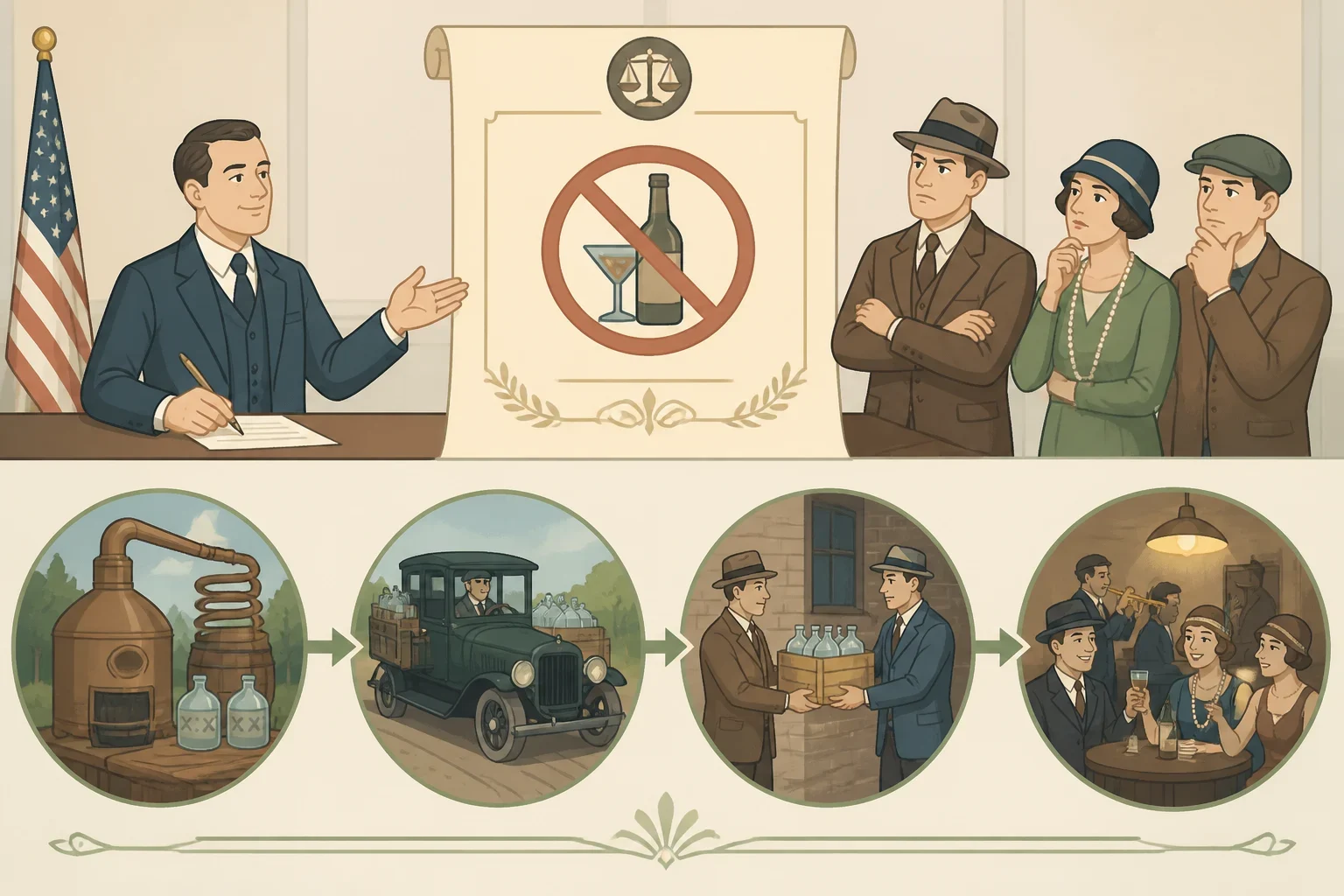
Prohibition took effect under the Eighteenth Amendment in January 1920, banning the manufacture and sale of alcohol nationwide (Humanities LibreTexts). Save My Exams' overview of the novel's context links the resulting bootlegging economy to organized crime and corruption (Save My Exams), the same climate that produced the Teapot Dome scandal: officials leased government oil land in Wyoming to private companies in exchange for cash, and Interior Secretary Albert Fall was later convicted and imprisoned for it (Humanities LibreTexts).
Fitzgerald builds that corruption into Gatsby's world without much comment. A police commissioner counts among Gatsby's friends, and state senators mingle with other guests at the height of national Prohibition (Hodder Education). At Gatsby's parties and during his one run-in with a traffic cop, law enforcement barely registers: in Chapter 4, a motorcycle officer pulls Gatsby over for speeding and lets him go almost as quickly as he stopped him (Hodder Education).
Literary scholar Barbara Will argues that for most of the novel, Gatsby functions as "a force of corruption: a criminal, a bootlegger, and an adulterer," a harder image than the golden host Nick's narration sometimes presents when he insists that "Gatsby turned out all right in the end" (Save My Exams). An essay claiming Gatsby earned his wealth honestly needs to weigh that claim against these hints of bootlegging rather than take Nick's admiration at face value.
Immigration and gender politics around the novel's characters
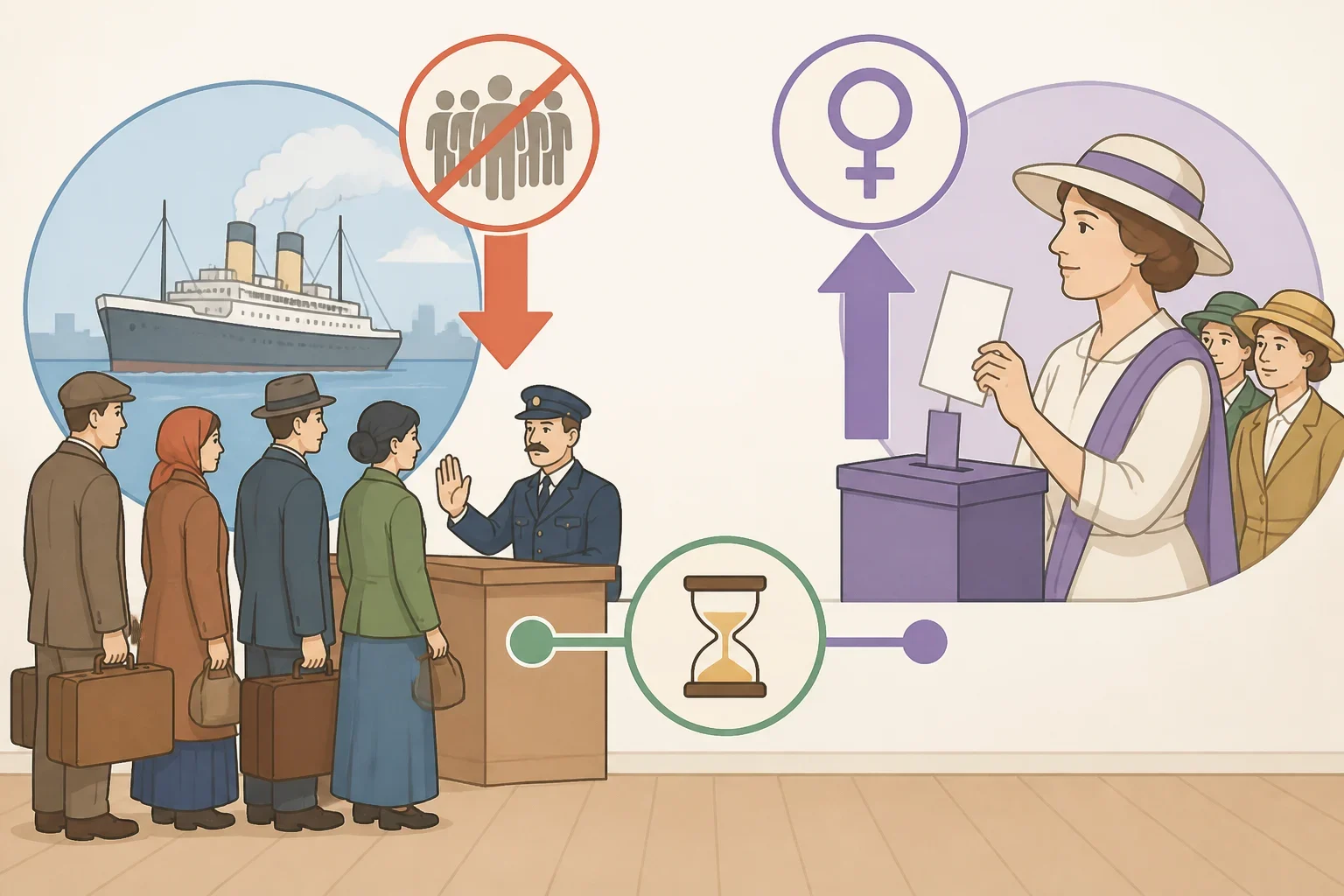
The novel's social issues extend past the parties into immigration law and gender politics, even though neither is a central plot event. The Johnson-Reed Act of 1924 imposed strict national-origin immigration quotas and explicitly excluded Asian immigrants (Humanities LibreTexts). Slater connects that climate of what he calls "heightened ethnic concern" to Tom Buchanan's remarks about "the superior white race and the inferior colored races" (Save My Exams), a reading that places Tom's outburst inside the same exclusionary climate shaping national policy at the time, not proof that Fitzgerald wrote the scene as direct commentary on the law.
Gender politics run alongside that. Women had won the vote through the Nineteenth Amendment in 1920, though the proposed Equal Rights Amendment was introduced and then defeated in Congress, and only a small minority of women worked outside the home during the decade (Humanities LibreTexts; Save My Exams). Save My Exams frames that suffrage gain specifically as won "for white women," phrasing that different teachers and textbooks qualify differently given how discriminatory barriers still kept many women of color from voting in practice. Check how a specific course frames the scope of the Nineteenth Amendment before repeating a claim about it in an essay.
Against that backdrop, Save My Exams reads Jordan Baker's career as a professional golfer as an example of newfound female economic independence, while Daisy Buchanan still represents the traditional role expected of upper-class women (Save My Exams). Both are interpretations built on the novel's characters, useful for a paragraph on gender roles once paired with a scene involving Jordan or Daisy rather than treated as settled fact.
Turning one historical fact into textual evidence
Historical context should sharpen a reading of a scene, not replace it. A paragraph that lists background information, a statistic here, a scandal there, doesn't prove anything about the novel on its own. What proves a point is a fact paired with a specific line, plus a sentence explaining the connection.
Try it with the immigration material above: the fact is the Johnson-Reed Act's national-origin quotas and exclusion of Asian immigrants; the quote is Tom's line about "the superior white race and the inferior colored races"; the explanation is that Tom's outburst echoes an argument circulating in the same climate that was shaping immigration policy the year Fitzgerald finished his drafts, which turns one line of dinner-table dialogue into evidence of how far that anxiety reached.
Before drafting an essay on the historical context of The Great Gatsby, check how a teacher or textbook defines interpretive terms like "the American Dream" and "the Jazz Age," since courses often want a specific version of each term applied consistently. Then work through the same steps with one more scene, the traffic stop in Chapter 4 or Gatsby's crowded garden in Chapter 3 both work well: identify the historical fact, quote the scene, and write one sentence on what the context changes about the reading. That habit keeps historical background working as evidence instead of standing in for the close reading a strong essay still needs.