

AI in College Admissions: How to Check Essay Policies
If you are applying to college during the 2026 application cycle, do not assume that every school treats artificial intelligence in college admissions the same way. Notre Dame offers a useful example: its admissions office permits limited AI help with spelling, grammar, and brainstorming, but says applicants must write the submitted material themselves. Other colleges may use different language, or may not have a publicly posted college admissions AI policy.
That leaves applicants with a practical job before they use an AI tool: check each college’s instructions, identify the boundary between assistance and authorship, and ask the admissions office when the wording is unclear. A policy search will not tell you how colleges detect AI-written essays, because the public materials reviewed here do not describe specific detection tools or review procedures. It can tell you what a school expects you to submit.
What Notre Dame’s AI policy allows

Notre Dame’s admissions office affirms and adopts the Common Application’s Fraud Policy as it applies to application materials. The policy prohibits submitting the substantive content or output of an artificial intelligence platform as an applicant’s own original work. Notre Dame also says that applicants may use AI for spelling and grammar review or for brainstorming before writing.
That creates a useful starting distinction:
- Brainstorming before drafting: Asking an AI tool for possible topics, questions to consider, or ways to organize personal experiences is closer to the use Notre Dame describes as allowed.
- Spelling and grammar review: Using a tool to identify a misspelled word or a grammar issue also fits the published allowance.
- Writing the response: The applicant must produce the essay, short answer, activity description, and other submitted material.
- Generating or substantially rewriting the response: Asking a tool to write an answer, produce an activity description, or rewrite a paragraph in a new voice moves toward the prohibited conduct described by Notre Dame.
The distinction is not merely whether a tool appears somewhere in the writing process. It is whether the submitted words and ideas remain the applicant’s own work. Notre Dame says it values each applicant’s unique voice, thoughts, and experiences, qualities it says artificial intelligence or a third party cannot replicate. Notre Dame
Consider two prompts:
- “Give me questions that could help me remember a meaningful experience from volunteering.”
- “Write a 150-word response about how volunteering changed me.”
The first request can support reflection before drafting. The second asks the tool to create the response itself. Under Notre Dame’s published policy, that difference matters.
A grammar check deserves care, too. Automated editing can change more than punctuation. It may replace a familiar word, smooth out an unusual sentence, or shift the tone of a personal story. Read every suggested change. Keep wording that sounds like you, reject changes that alter your meaning, and make sure the final response still reflects your own experiences and decisions.
Notre Dame also states that submitting material generated, drafted, or substantially written by AI tools may result in the revocation of an admission offer or potential expulsion. Notre Dame That is the consequence named in this particular policy. It should not be treated as proof that every college uses the same definition of “substantially written,” or that every institution has adopted the same consequences.
What the policy does not answer

A published rule can explain what a college prohibits without explaining exactly how the college would identify a violation. Notre Dame’s policy states the value it places on an applicant’s voice, thoughts, and experiences. It does not describe a software detector, a review workflow, a threshold for suspicion, or the frequency with which applications are investigated.
That gap matters when students search for information about how colleges detect AI-written essays. The available materials do not establish which schools use detection tools, how accurate those tools might be, or whether an admissions office relies on them at all. Treat online claims about universal detection, guaranteed detection, or easy ways to avoid detection as unverified unless a college has published information supporting them.
The safer question is not “Can the college tell?” It is “Can the applicant show that the submitted work was written responsibly under that college’s rules?”
Saving your own work can help answer that question. Keep dated outlines, brainstorming notes, early drafts, and revision history in a folder for each application. This is sensible documentation of your writing process, not a guarantee that a college will accept a particular use of AI or resolve a policy question in your favor. It simply preserves evidence of how the work developed.
NACAC’s recorded second annual AI virtual forum shows that admissions professionals are discussing how AI may affect the field. The forum includes expert discussion, ethical considerations, and demonstrations of AI-powered tools designed for college counseling and admission professions. NACAC The source identifies the forum as recorded on Wednesday, August 19, 2026, rather than as a current live event. Its existence demonstrates professional interest and exploration, not widespread adoption of a particular essay-screening system.
That distinction is easy to lose. AI used by an admissions office, counselor, or application platform is a separate issue from AI used by an applicant to create an essay. A college may explore technology for advising or administrative work while still requiring applicants to submit entirely original writing.
AI-generated college essays and school-specific rules

The research available for this article documents Notre Dame’s policy. It does not establish a universal AI rule for all colleges that accept the Common Application. Do not transfer Notre Dame’s wording to another school without checking that school’s instructions.
Policies can appear in several places:
- the admissions website
- the application instructions
- personal-statement guidance
- supplemental essay prompts
- an application integrity or academic integrity page
- a fraud policy
- an applicant agreement or certification
Search each college’s website using terms such as “AI policy,” “application integrity,” “academic integrity,” “fraud policy,” and “original work.” Then read the actual application instructions, not just a search-result summary or a discussion on social media.
Check the main personal statement and the supplemental questions separately. A school may place its most specific language beside the application or inside a general integrity policy. If the instructions mention essays but do not mention activity descriptions, do not assume those descriptions are exempt. Ask the admissions office how the rule applies to every part of the application you plan to submit.
Record the date you checked the policy and save a copy or screenshot of the relevant page for your files. Web pages can change during an application cycle. A record helps you remember which instructions you relied on, although it does not replace following any later direction from the college.
If no policy is posted, silence is not the same as permission. Send a short, specific written question to the admissions office. For example:
Does your office have a policy on using AI for brainstorming, proofreading, or drafting application essays and short answers?
You can also ask about activity descriptions and whether the school distinguishes between a grammar check and a rewritten passage. Keep the question narrow enough that the response addresses the exact use you are considering. Save the reply with your application records.
Parents, counselors, and tutors can use the same process. Help a student locate the policy and understand its terms, but do not rewrite the student’s essay for them. A counselor can point out an unclear sentence or ask questions that help the student develop an idea. The applicant should remain responsible for the experiences, language, and final decisions in the submission.
A practical boundary for using AI
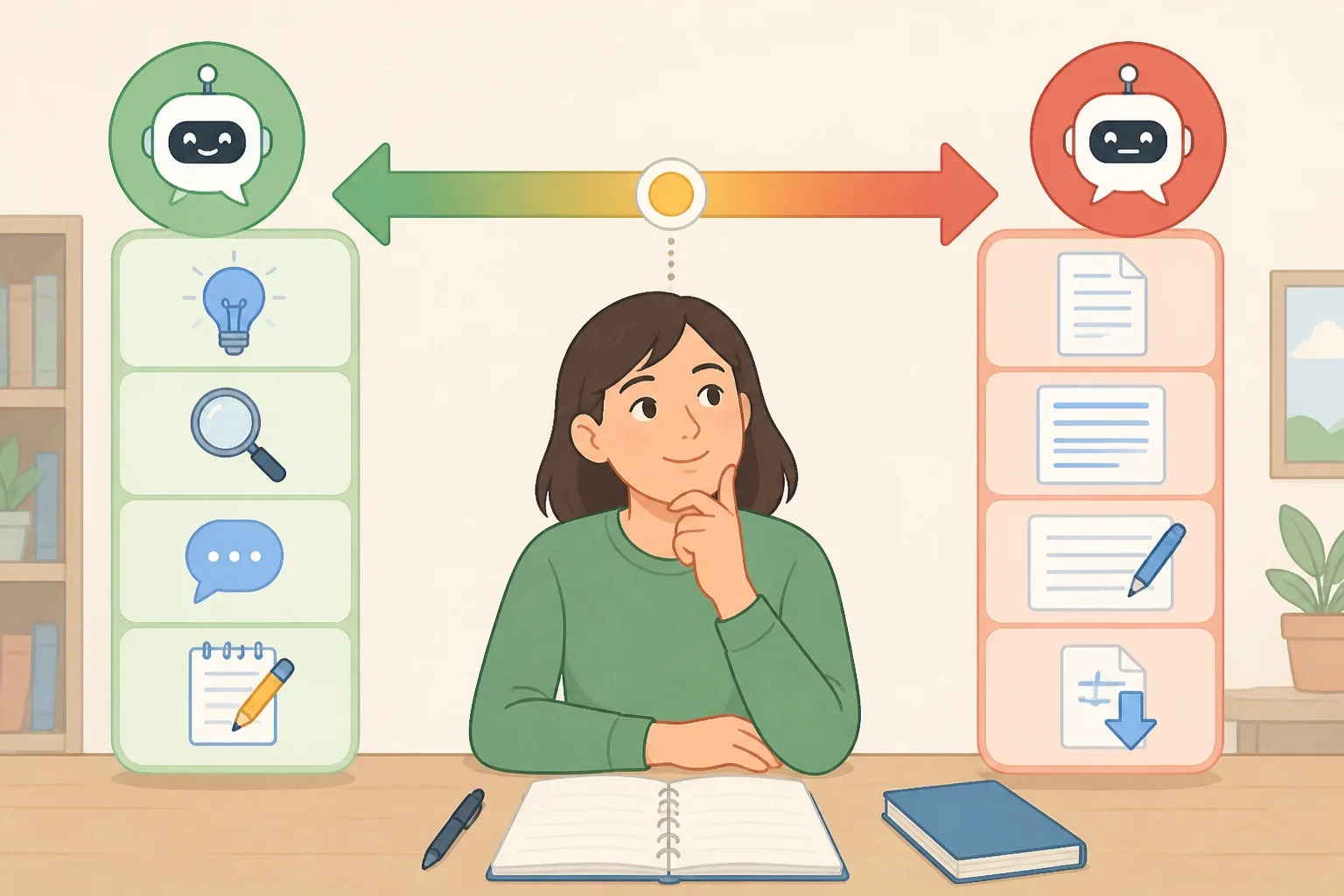
The safest way to use AI during an application is to keep it outside the actual authorship of the response. That does not mean every possible use is automatically accepted by every college. It means the student begins with the school’s stated rules and chooses the least risky form of assistance.
Possible uses to check against a school’s policy include:
- generating questions for personal reflection
- creating a list of possible themes before drafting
- identifying spelling errors
- flagging possible grammar problems
- explaining a word or grammatical concept
- suggesting that a sentence may be unclear
Uses that create greater risk include:
- asking AI to write a personal statement
- generating a short answer from a few facts
- asking for an activity description to paste into an application
- submitting AI-produced sentences as if the applicant wrote them
- asking a tool to make the writing sound more impressive or more like a successful applicant
- accepting a substantial rewrite without carefully considering whether the language remains the applicant’s own
The line may not always feel sharp. Suppose a student writes a paragraph and asks an AI tool to “make it stronger.” The tool might correct grammar, or it might replace the paragraph with language the student would never use. The student should not rely on the label attached to the request. Read the result closely, compare it with the original, and check the college’s policy. If the tool has supplied the substance or voice, do not submit that version.
A student who needs help with clarity can use a human writing process instead: read the paragraph aloud, mark the sentence that feels confusing, ask a teacher or counselor what question the paragraph should answer, and revise it independently. That approach takes longer, but it keeps the applicant in control of the work.
What broader admissions AI activity means for applicants
AI is also part of a wider discussion about how admissions offices and counseling organizations may change their processes. In April, NACAC described an Innovation Summit where more than 130 education professionals gathered to discuss changes to the college admission system. The topics included artificial intelligence in admission, direct-admission policies, interactive transcripts, and other advising models. NACAC
That discussion may affect how students receive information or guidance in the future. It does not change the authorship rules for an essay a student submits today. An admissions office’s interest in using AI for efficiency, personalization, or access is not permission for an applicant to use AI to write an application response.
Common App has also publicly described its work with EdVisorly as an exploration of AI to simplify parts of the college admissions process. Common App The supplied information identifies this as an exploration. It does not establish a universal applicant policy, explain every feature of the tool, or answer questions about student data and safeguards. Applicants should avoid treating a platform’s technology work as a ruling on what they may submit.
For students and families, the useful habit is to separate three questions:
- What technology might a college or application organization be exploring?
- What does this particular college allow applicants to do?
- What material must the applicant personally write and submit?
Only the second and third questions determine how you should prepare your essays.
A checklist before you submit
Before using AI on an application, complete these steps:
- Search every target college’s admissions website for an AI policy, fraud policy, application integrity policy, or academic integrity guidance.
- Read the personal-statement instructions and each supplemental prompt.
- Check whether the policy covers essays, short answers, activity descriptions, and other written materials.
- Separate brainstorming and proofreading from drafting and rewriting.
- Save dated outlines, notes, drafts, and revision history.
- Record the date you checked each policy.
- Email admissions if the wording is unclear, and save the response.
- Review every final response to confirm that it reflects your own experiences, ideas, and voice.
Notre Dame provides a concrete example of a college allowing limited assistance while prohibiting AI-generated or substantially AI-written application material. Its policy is a guide to one school’s expectations, not a substitute for checking the schools on your list. Before submitting, verify the rule for each college, keep the actual writing in your hands, and ask a direct question when the policy leaves room for doubt.