

Why Colleges Require Supplemental Essays: Key Insights From UGA
The University of Georgia removed its supplemental essay for the 2027 first-year application after concluding that the second response added little beyond the Common App personal statement. The decision offers a clear case study in why colleges require supplemental essays: an extra response should provide information that the rest of the application does not.
UGA says its review process will remain the same, including its attention to writing strength. That evaluation will now come from one essay instead of two, UGA Admissions said this summer. The change applies to UGA, not to college applications generally. It does, however, put a practical question in front of applicants and admissions offices: What does each required essay add?
What college supplemental essays are meant to show

An admissions essay can give readers information that does not appear in grades, activities, test scores, or other structured sections of an application. “The admissions essay is an opportunity for applicants to offer a glimpse into who they are, beyond all the structured information on the application form,” Rene Kizilcec, an information scientist at Cornell, said in Cornell Chronicle in September 2025.
The answer depends on the prompt. A personal statement may focus on an experience, perspective, or interest that shaped the applicant. A “why this college” response asks for a school-specific explanation. A program prompt may ask how an applicant’s preparation connects to a particular field. Another response may add context that is not visible in the activities list or transcript.
Those responses should not be treated as interchangeable. A student who uses the personal statement to explain how caring for a family member changed their view of responsibility would not necessarily answer a prompt asking why a particular college’s program is a good match. Repeating the same story in both places may produce polished writing, but it does not give the reader much new information.
That distinction helps explain how admissions officers may use supplemental essays. A response can help them evaluate school-specific interest, preparation for a program, a possible contribution to a campus community, or context for another part of the application. The point is not that every college uses every prompt in exactly the same way. Requirements and review practices vary.
Before writing, applicants can ask three questions:
- What information is this prompt seeking?
- Does that information already appear in the personal statement, activities list, or another section?
- Is the response required for every applicant, or only for a particular program, major, or scholarship?
No single checklist applies to every college. It does provide a way to test whether an essay has a distinct purpose rather than simply adding another page.
Cornell’s research also shows why admissions offices may value specific, individual writing. Researchers compared 30,000 human-written college essays with responses produced by eight large language models, Cornell Chronicle reported in September 2025. Even when the models received information about a person’s race, gender, and geographic location, they produced highly uniform writing that often repeated prompt keywords and presented personal details formulaically.
The finding does not show that every AI-assisted essay can be identified, or that personal details cannot be imitated. It does show why a prompt built around reflection and precise experience may be more useful than one that invites a generic account of achievement.
Why UGA removed its second essay
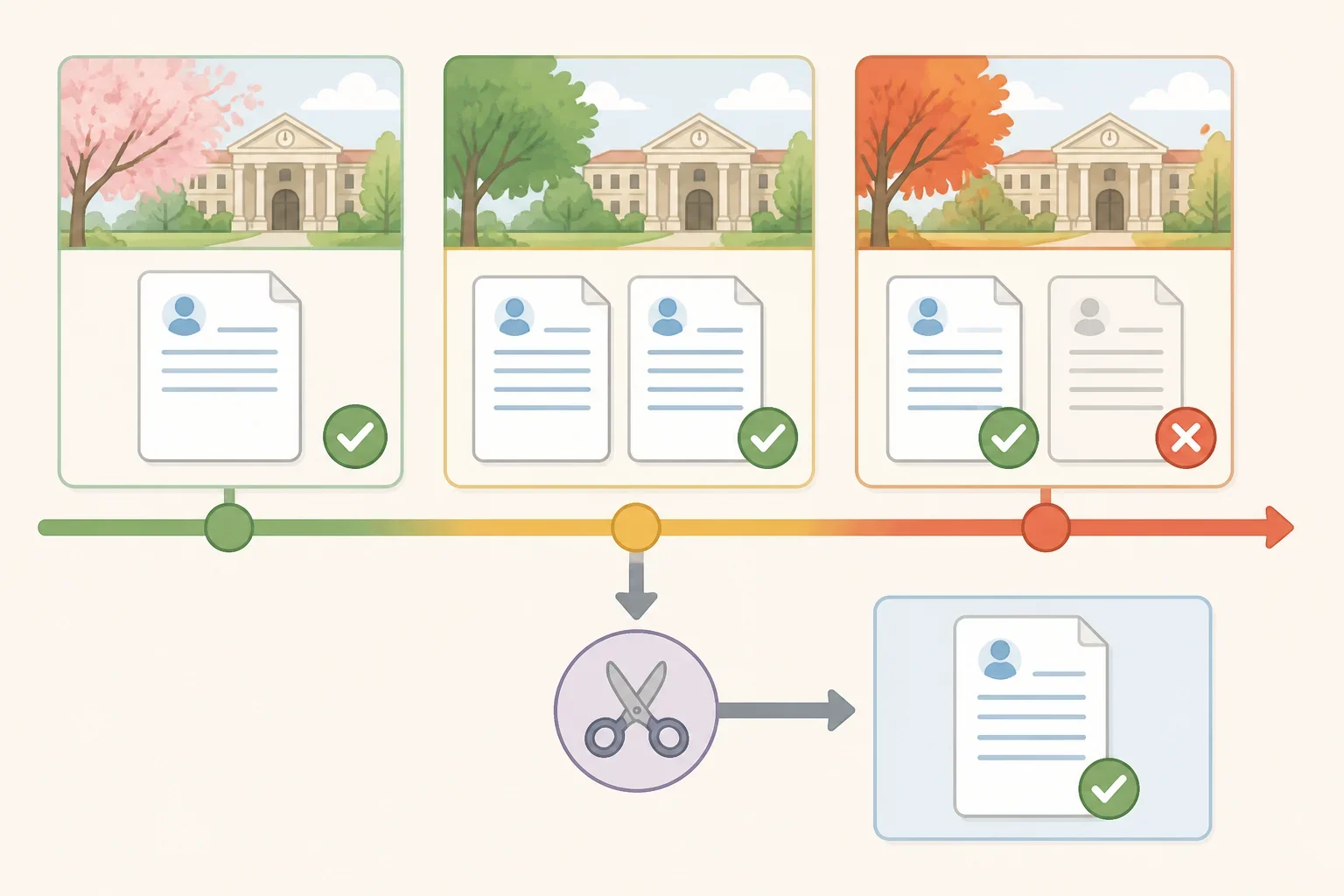
UGA’s stated reason was redundancy. The university said it had reviewed its process “over the last few years,” comparing the information it received from reading one essay with the information it received from reading two. The second essay “did not give us much beyond” the Common App essay, UGA Admissions said this summer.
The university also said its review process would stay the same, with writing strength assessed through the remaining essay. Applicants who consider writing a strength will have more time to work on the response UGA plans to read, according to the university.
That explanation matters because it does not establish that supplemental essays generally lack value. It shows that one institution concluded its own second prompt was not producing enough additional information to justify the work involved. Another college could reach a different conclusion if its prompts address separate parts of the application.
The burden is not trivial. More than half of students rank college applications as their most stressful academic experience, according to Brookings in 2023. The same analysis found that students who completed the application essay were 50% more likely to submit an application than students who did not.
That 50% figure describes an association, not proof that the essay itself caused students to apply. Students who finish an essay may differ from students who stop earlier in other ways. The finding still gives colleges a reason to examine whether each requirement serves a clear purpose, especially when applicants are applying to several institutions.
UGA’s removal of its supplement is therefore a narrow institutional decision with a broader implication. If an additional prompt repeats information already available to admissions readers, the college has to weigh the limited benefit against the time required from applicants, counselors, teachers, and staff.
How AI complicates supplemental essay requirements

Artificial intelligence raises a separate question about the value of an essay: What does the response reliably show about the applicant if software may have shaped the writing?
The clearest evidence in the available research comes from an arXiv preprint examining one large U.S. public-policy master’s program, not undergraduate admissions as a whole. The researchers analyzed nearly 7,500 applications submitted between 2020 and 2025, the arXiv paper reported last month. The program prohibited generative AI use, yet in the 2025 admissions cycle, nearly 60% of applicants submitted at least one essay classified as primarily AI-generated by GPTZero at high confidence, according to the paper.
That classification is a research measure, not proof that every flagged essay was written by AI. GPTZero separates human, mixed, and AI-written text, and its AI-written category can include human text rewritten by AI. Submitted essays were not systematically screened, adjudicated, or penalized by the admissions office. Admissions staff performed better than chance when judging whether essays appeared to be AI-written, but their performance was imperfect, with an AUC of 0.70 and a reported 95% confidence interval of 0.65 to 0.75, the researchers reported last month.
Essay quality rose after ChatGPT became available, with the largest gains in grammar, style, and clarity. Improvements were more modest in voice, responsiveness to the prompt, commitment to public service, and demonstrated leadership, the arXiv paper reported last month. The researchers associated AI-flagged essays with lower admission rates in the 2023 and 2024 cycles. Their models estimated a 3.48-percentage-point lower admission probability overall, and about a 6.0-percentage-point decrease for the typical applicant who used AI, the study reported last month.
Those are estimated associations from one graduate program, not confirmed penalties imposed on every applicant. They do not establish that AI use caused a particular admission decision, and they should not be transferred directly to high school applicants.
The Cornell findings point to a related concern. The models produced polished prose, but they often made personal details sound formulaic, even when prompted with information about a specific person. Jinsook Lee, the Cornell study’s first author, advised students to develop their own ideas and write the first draft themselves, then use AI for refinement or proofreading only when a college’s policy permits it, Cornell Chronicle reported in September 2025.
Together, the studies raise a policy question rather than settle one. If colleges require essays to learn something personal and trustworthy, they may need prompts that produce information difficult to duplicate elsewhere in the application. They may also decide that some prompts no longer justify their cost.
What applicants should verify

UGA’s change applies to UGA’s 2027 first-year application. It does not change another college’s requirements or AI policy. Applicants should check each admissions website for:
- The current personal statement, supplemental essays, and short responses
- Whether a prompt applies to all applicants or to a specific program
- Whether the college permits AI for brainstorming, drafting, editing, or proofreading
A workable process is to sort colleges into no-supplement, short-response, and multiple-essay groups. For each prompt, write one sentence describing the information it seeks, then compare that sentence with the personal statement and activities list. If the response adds nothing distinct, the draft may be repeating the application rather than answering the question.
The larger issue remains unresolved. Colleges may redesign prompts to obtain information they can trust, or they may reduce essay requirements as authorship and distinctiveness become harder to evaluate. Applicants can respond to that uncertainty by reading each prompt closely, checking the current policy directly, and reserving their strongest writing time for responses that ask for something genuinely absent from the rest of the application.