
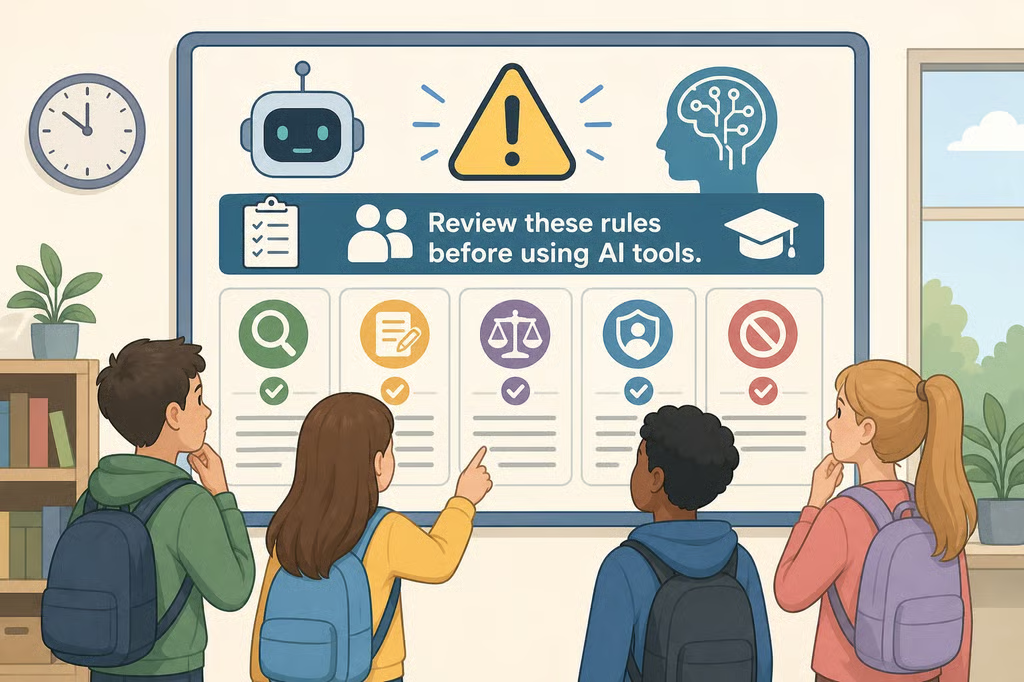
- Penalties for students using AI in school: policies decide
- What consequences can follow AI misuse?
- What to do before using AI on schoolwork
- How AI use policies in schools determine consequences
- Federal AI guidance does not replace local rules
- Why AI detectors should not decide the case alone
- Can disclosed AI still undermine learning?
Penalties for students using AI in school: policies decide
The penalties for students using AI in school depend on the assignment, the applicable course or school policy, the student’s conduct, and the process used to review a concern. No source here establishes one nationwide penalty. The research points instead to institution-specific academic-integrity policies, which means brainstorming with an AI tool, using undisclosed generated text, and submitting work that misrepresents authorship may be treated differently.
That distinction matters. Disclosure can show transparency when AI use is allowed or conditionally allowed, but disclosure cannot authorize a tool that the assignment prohibits. The rule and the student’s conduct under that rule determine the outcome. Schools should publish those boundaries clearly instead of treating every interaction with AI as automatic misconduct, and students should check the applicable rule before opening a tool.
What consequences can follow AI misuse?
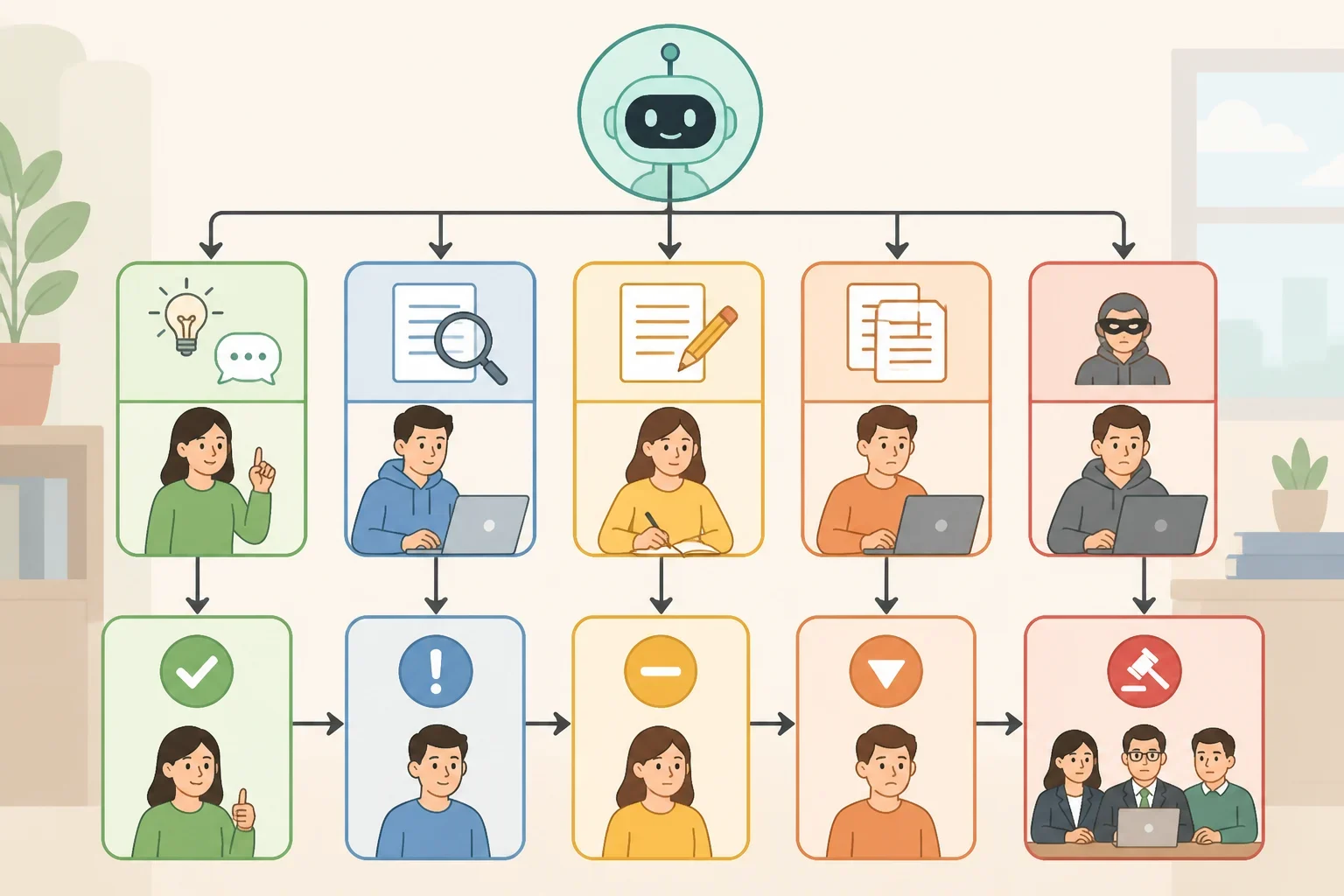
The available research does not document a universal penalty schedule. It supports a narrower conclusion: whether a student’s use is academic misconduct depends on the academic-integrity policy of the applicable institution (Perkins et al.).
That can leave students with several very different situations:
- Using AI to brainstorm before writing
- Asking for tutoring or an explanation
- Using AI to revise grammar or translate text
- Submitting AI-generated sentences, analysis, or citations
- Failing to disclose a use that the policy permits only with disclosure
- Using AI on an assignment that expressly bans it
Those categories are not interchangeable. An AI tutor may be permitted in one class, while submitting its solution instead of showing independent work may violate that class’s requirements. A student who discloses prohibited use has been transparent, but has still used the tool against the instructions.
The most accurate answer to “What happens if a student uses AI?” is not “nothing” or “automatic failure.” It is: read the assignment, course policy, school policy, and disclosure requirements before deciding what a particular use means.
What to do before using AI on schoolwork

The practical question is often urgent. An assignment is due, the policy is short or vague, and an AI tool is only a click away. Use this order of checks:
- Read the assignment first. Look for language about ChatGPT, generative AI, editing tools, translation, brainstorming, tutoring, citations, or outside assistance.
- Check the syllabus and school policy. The assignment may set a stricter rule than the general course policy. Look for the academic-integrity section and any explanation of how concerns are reviewed.
- Ask one narrow question if the rule is unclear. For example: “May I use an AI tool to brainstorm three possible topics if I write the outline and draft myself?” A specific question is easier to answer than “Is AI allowed?”
- Stay within the permission. If feedback is allowed but generated prose is prohibited, do not paste generated sentences into the submission.
- Follow the required disclosure format. If disclosure is required, identify the tool and describe what it did according to the teacher’s or institution’s instructions.
- Keep your own drafts and notes when appropriate. They may help explain how the work developed, but they do not replace compliance with the assignment rule or guarantee that a concern will be resolved.
Before opening an AI tool, save or copy the assignment’s AI instructions. If the rule remains unclear, ask the teacher that one narrow question.
How AI use policies in schools determine consequences
A study published three years ago examined academic-integrity questions involving large language models in formal assessments, with a focus on higher education. Its authors concluded that deciding whether AI use constitutes misconduct belongs to the academic-integrity policy of the particular institution, which must account for how the tools are used (Perkins et al.).
The researchers also concluded that AI use should not automatically be treated as plagiarism or an academic-integrity breach when students clearly explain how they used the tools. That is a research conclusion, not a rule that overrides a teacher’s instructions or a school’s code of conduct.
The paper defines plagiarism, drawing on Perkins et al. (2019), as misrepresenting the effort made by the author of a written document (Perkins et al.). This puts authorship and honesty at the center of the concern. It does not mean that every institution must permit disclosed AI assistance.
For K-12 students, the applicable document may be a classroom policy, assignment sheet, student handbook, district policy, or code of conduct. For college students, it may be a course policy, department rule, or institution-wide academic-integrity process. The controlling requirement is the one that applies to the student’s class and assignment.
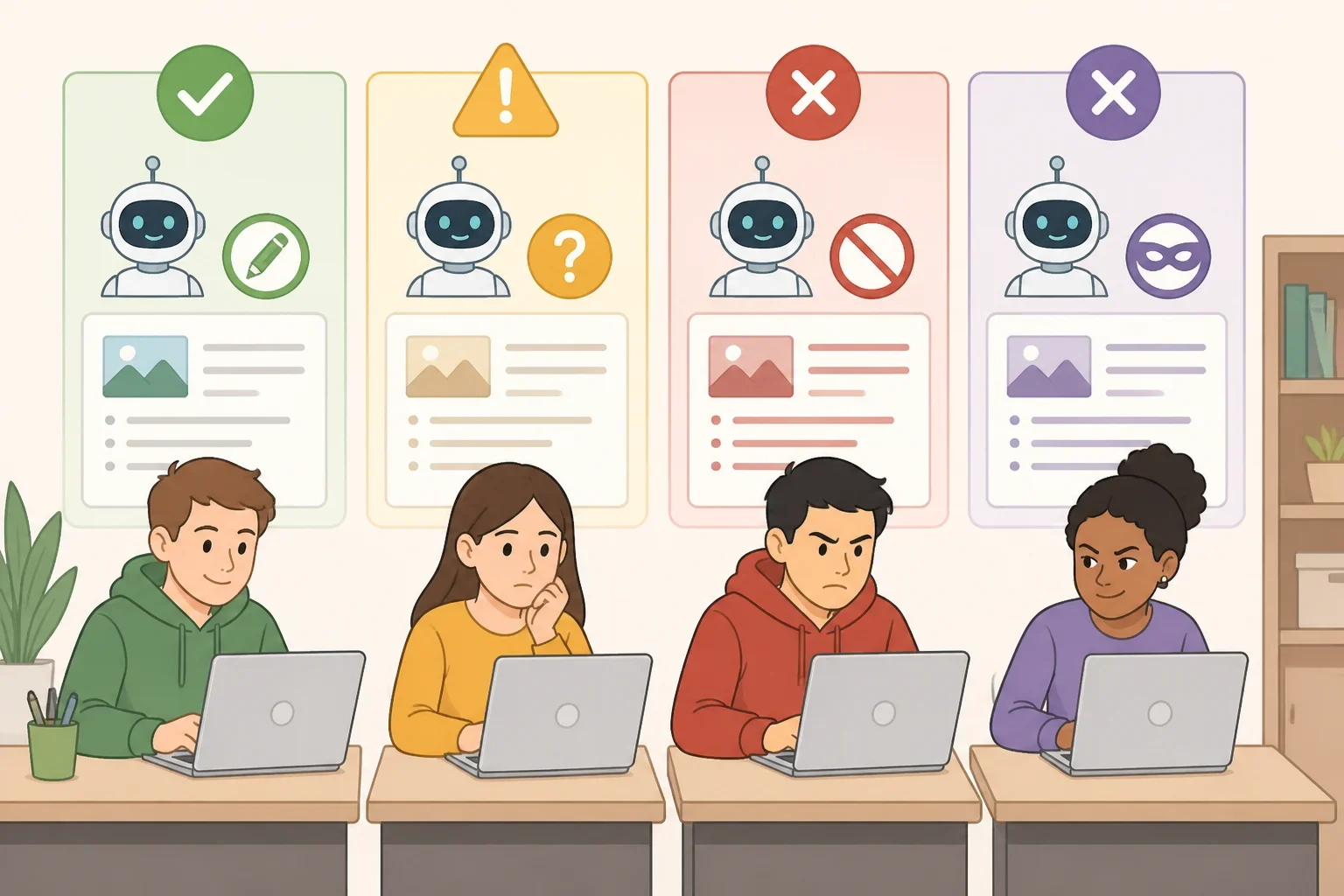
A useful way to read those rules is to separate four situations:
- Permitted use: The instructions allow a defined use, such as brainstorming or tutoring, and the student follows any disclosure requirement.
- Undisclosed permitted or conditional use: The tool may have been allowed in some form, but the student did not provide the required explanation.
- Prohibited use: The assignment or policy bars AI, whether or not the student discloses it.
- Misrepresented authorship: The student presents generated work as independent work, concealing how it was produced.
Disclosure can address transparency in the first two categories. It does not transform the third or fourth into acceptable work.
Federal AI guidance does not replace local rules
Last year, the U.S. Department of Education said AI uses may be allowable under existing federal education programs when they comply with applicable laws and regulations (Department). The guidance described AI-based instructional materials, AI-enhanced tutoring, and AI for college and career pathway exploration, advising, and navigation.
The Department also proposed a supplemental grantmaking priority focused on AI literacy and integration. That proposal concerned federal grant priorities, not permission for a student to use AI on a particular essay, lab report, test, or discussion post. Local educators and institutions still set requirements for submitted work.
Last month, a Department letter outlined five principles for responsible education technology: educator-led, ethical, accessible, transparent, and protective of student data (Department). Those principles support clearer communication about AI, but they do not replace a course policy.
A survey published two years ago collected responses from 1,217 participants across 76 countries and examined multicultural views of generative AI in higher education (survey). The researchers reported a strong relationship between cultural perspectives and views about AI’s benefits, risks, academic dishonesty, and the need for ethical guidelines. Schools should not assume that every community understands “responsible use” in exactly the same way. The survey does not establish a universal student rule.
Why AI detectors should not decide the case alone
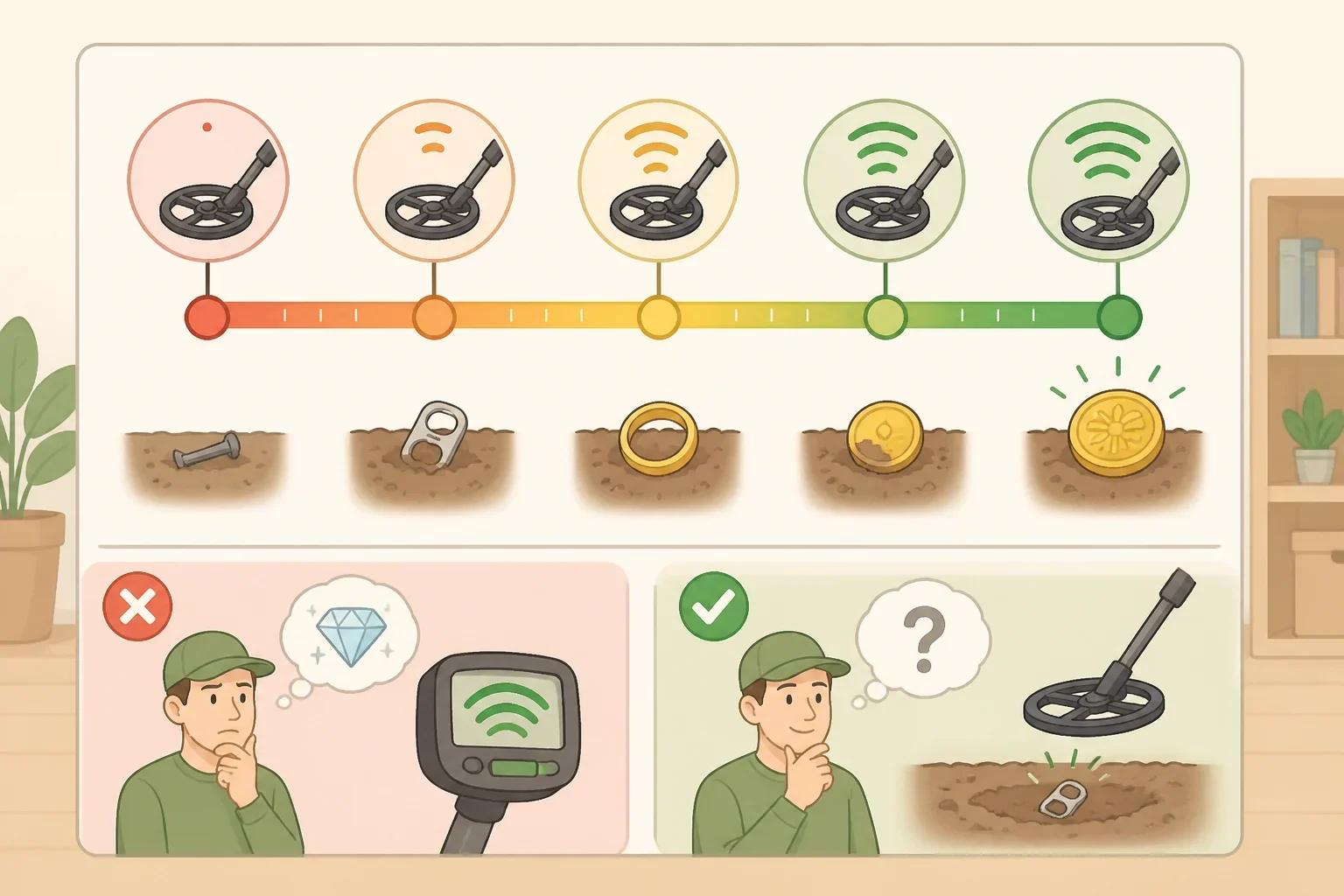
Detection evidence can inform a review, but the cited research does not support treating a detector result as conclusive proof of student misconduct. The available figures come from GPT-2 and GPT-3-era studies, so they are not current accuracy ratings for every commercial detector now available.
In one study discussed by Perkins et al., participants correctly identified human and machine-generated text 59.5% of the time, barely above chance (Perkins et al.). Another cited study reported 57.9% accuracy for GPT-2 text and 49.9% for GPT-3 text (Perkins et al.).
A detection-support tool called GLTR improved participant identification from 54% to 74% in one cited study (Perkins et al.). Those figures describe that study’s participants and conditions, not the performance of a modern commercial detector.
An ERIC overview published four years ago stated that there was no definitive way to identify text created by large language models and recommended adapting assessments to reduce their effect on academic integrity (ERIC). The overview predates current systems, but its warning remains useful: a detector can raise a question without settling the entire question.
Perkins et al. describe detection as an ongoing “arms race,” because new models and methods for avoiding detection require detection tools to be continually reassessed (Perkins et al.). Students should not assume a detector will miss prohibited work. Schools, however, should not make a detector score the entire basis for a serious academic-integrity decision.
Can disclosed AI still undermine learning?
Some educators object that even disclosed AI use may allow students to skip the thinking an assignment is designed to develop. That concern deserves a direct answer. Transparency does not prove that a student learned the material, and the research supplied here does not establish whether AI use improves or harms learning outcomes.
Still, banning the tool is not the only way to protect learning. Last year’s Department guidance described AI as a possible support for personalized learning, tutoring, and differentiated instruction, not as a replacement for educators (Department). The ERIC overview recommended adapting assessments rather than relying on detection alone (ERIC).
That points toward a stronger response: define when AI may be used, require students to disclose that use, and design assignments that ask students to show their reasoning, drafts, or application of course concepts when appropriate. Treating every AI interaction as misconduct does not resolve the learning concern. It may push use out of view, where teachers have less information about how students are working.
Disclosure does not make every use acceptable. Clear rules, honest disclosure, and assignments designed around learning provide a fairer standard than punishment aimed at the software itself.
Before using AI, check the assignment and course policy. Ask a specific question when the rule is unclear, follow the answer, and disclose permitted assistance in the required format. Schools should make that process easier by defining allowed and prohibited uses in plain language, explaining how concerns will be reviewed, and treating detection software as one piece of information rather than the rule itself.