
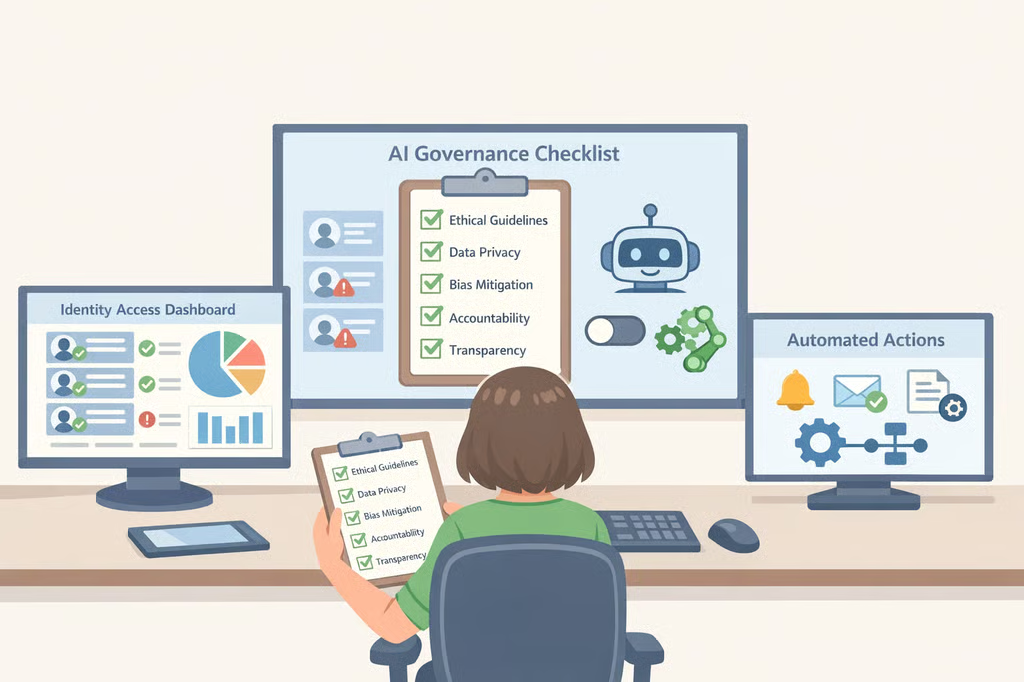
If an AI system can read student records, send emails on your institution's behalf, or update a status flag without a person clicking approve first, your existing acceptable-use policy may not cover the risks involved.
That's the core question behind agentic AI governance: once software can act instead of just draft, the decision point shifts from content quality to identity, access, and accountability. NIST describes agentic AI systems as designed to understand complex workflows and achieve goals autonomously with little or no human intervention.
This checklist focuses on what federal standards bodies have published about agent identity, authorization, testing, and risk management, along with one university's public AI policy.
Everything here reflects voluntary federal frameworks, not a legal mandate, and none of it replaces your institution's own legal or privacy review, particularly for FERPA, state student-privacy laws, accessibility requirements, or records retention. Route those specific questions to a privacy officer, general counsel, or records office before any tool touches student data.
- Who this checklist is for
- What makes agentic AI different from tools you already use
- What's confirmed and what's still voluntary in agentic AI standards
- Why autonomous access raises the stakes
- AI agent governance starts with access mapping
- Agentic AI risk management before production
- Scope looks different for a district than for a college
- If there's no agentic AI policy at your institution yet
- The next step before any agent goes live
Who this checklist is for
This checklist is built primarily for the person who reviews or approves an agentic tool's access to student or institutional systems: a district technology director, a college IT or compliance lead, or a dean's office evaluating a new advising tool.
The seven-step workflow below produces materials for that kind of review meeting: an access map, a risk classification, a named owner, an approval matrix, a test record, and an incident contact.
Teachers, advisors, and other staff have a narrower but more urgent question: what can they connect to institutional accounts right now, before a district- or college-wide policy exists?
The section near the end, "If there's no agentic AI policy at your institution yet," is written specifically for that situation.
What makes agentic AI different from tools you already use
Many existing AI policies focus on user prompts and output review: a person types a request, reads what comes back, and decides whether to use it. Agent governance has to cover more than that because agentic systems can pursue goals and take actions with limited human supervision.
The practical question isn't whether a vendor calls its product "agentic." It's which specific actions the system can take on its own.
Can it retrieve a student's grades without someone clicking a button? Send an email to a parent? Update a field in the student information system?
NIST's AI Agent Standards Initiative addresses issues including security, identity, interoperability, testing, and voluntary technical standards for agents, which is one reason agentic AI requires more than a conventional acceptable-use update.
Before adopting any tool marketed as agentic, ask the vendor or your IT department to list, in writing, exactly which actions the system can take without a person approving each one. That list determines how much of the workflow below applies.
What's confirmed and what's still voluntary in agentic AI standards
NIST's AI Agent Standards Initiative aims to support secure and interoperable AI agents through technical convenings, gap analyses, research, and voluntary guidance that can inform industry standards.
That work is still developing. NIST is conducting research into agent authentication, identity infrastructure, security evaluation, and human-agent and multi-agent interactions rather than offering a finished agent-specific implementation standard.
A related National Cybersecurity Center of Excellence project examines how existing identity standards and best practices can be applied to software and AI agents, including identification, authorization, auditing, and controls against prompt injection.
Public comment on the February 2026 concept paper closed April 2, 2026, and NIST lists the project as reviewing comments. It remains an exploratory project rather than a finished reference architecture an institution can implement today.
NIST's broader Generative AI Profile for the AI Risk Management Framework is voluntary and covers risks and practices including pre-deployment testing, content provenance, privacy, security, and incident disclosure. It was published in 2024 for generative AI broadly, not specifically for autonomous agents.
Howard University provides one published example of institution-wide AI governance. Its policy took effect April 24, 2026, and establishes a university-wide framework covering governance, accountability, privacy, security, academic integrity, and compliance for faculty, staff, students, contractors, and other users.
It addresses AI generally rather than creating a dedicated governance framework for autonomous agents, so it is more useful as a structural example than as a ready-made agentic AI policy.
Before accepting a vendor's claim that its agentic tool is "production-ready," ask which specific standard or framework its governance claims rely on and whether that source is final guidance, an emerging standard, or a proposal still under development.
Why autonomous access raises the stakes
Once an agent can reach diverse data sets, tools, and applications, the governance question moves from content quality to identity and authorization: who or what the agent is, and exactly what it's allowed to access or change.
Prompt injection is one risk to account for. NIST's Generative AI Profile addresses information-security risks involving adversarial inputs and recommends adversarial testing and other controls before deployment.
Privacy risk also grows as access expands. Generative AI systems can infer sensitive information from data they process, making the scope and combination of accessible records important governance questions when an agent can work across several institutional systems.
Before granting an agent standing access, get specific answers to these questions:
- Does the agent operate under its own service identity, or does it use a staff member's credentials?
- Can permissions be limited by record type, role, school, or time window rather than granted all at once?
- Are retrieved records held in prompts, logs, or vendor systems after the task finishes, and for how long?
- Can a person stop a task that's already in progress?
- What does the agent do when it encounters conflicting or incomplete student data?
Picture an advising agent built to read student records and draft outreach emails to students falling behind. That's a legitimate use case.
The governance question is whether the same standing access could also let the agent touch enrollment status, grades, or financial-aid data unless someone specifically restricts it. That advising agent carries through the rest of this guide.
This checklist does not establish FERPA obligations, state student-privacy requirements, accessibility rules, records-retention schedules, or procurement policy. Confirm those with a privacy officer, legal counsel, or records office before deployment.
AI agent governance starts with access mapping
Before an agentic tool gets anywhere near student data, separate three decisions: what data it can read, what tools or systems it can call, and what actions it can execute without a person approving each one.
A tool can reasonably need read access to grades to draft an advising email while having no business updating enrollment status on its own.
Step 1: Map the three layers. For the advising agent, write down what it may read, such as student records or grades; what systems it may call, such as email or scheduling tools; and what it may execute without a person checking first.
Step 2: Classify by two separate dimensions. Data sensitivity and action risk aren't the same thing. A general advising note might be less sensitive than grades or financial-aid files, even if the agent only reads them and never acts on what it finds.
Action risk works on its own scale. Drafting content for a person to review carries less risk than automatically sending a message, while changing enrollment status or releasing financial-aid information warrants a much higher level of review.
High-action-risk steps should require human verification before execution. NIST identifies confabulation, confidently produced false or erroneous content, as a risk associated with generative AI.
This two-dimension model is a practical way to structure an institutional review, not a risk-classification system specified by NIST.
Step 3: Assign a named human owner. Not just a department. Assign a specific role or person accountable for the agent's use and outcomes, with authority to investigate or stop the system if a problem occurs.
Agentic AI risk management before production
Step 4: Set an approval threshold for each risk level. Low-risk drafting might not need sign-off. Moderate-risk actions might need a lighter review. High-risk actions, such as changing enrollment status or releasing financial-aid information, should require approval before execution.
Confirm whether the system actually supports a hold-for-approval state that pauses a flagged action until a person signs off.
Step 5: Test before deployment, not after. Test for prompt injection, unauthorized access, data exposure, incorrect actions, and other foreseeable failure modes before an agent touches real student data.
NIST's Generative AI Profile provides risk-management practices that can help inform testing, while NIST's agent-specific evaluation work remains under development.
Step 6: Monitor, log, and build a revocation process. Review access on a schedule and remove it when it is no longer needed rather than granting standing permissions indefinitely.
Step 7: Define incident response internally before you need it. NIST's 2024 Generative AI Profile noted the absence of standardized formal channels for documenting AI incidents and pointed instead to public databases with varying reporting criteria.
Institutions should have their own internal reporting path, responsible owner, escalation process, and response timeline.
Evidence to request from any vendor
Bring this list into a contract or renewal conversation:
- A written access map showing exactly what the agent reads, calls, and executes
- The risk level the vendor assigns to each action the agent can take, and the criteria used
- What identity or authentication credentials the agent operates under
- Whether the system supports a hold-for-approval state before executing flagged actions
- Test results or a written summary of adversarial testing performed before deployment
- Logging detail, retention periods, and the process for revoking access
- The vendor's incident-notification contact and contractual notification timeline
Here's what the access map could look like for the advising-agent example:
| Layer | Example | Risk classification | Approval needed | Logging expectation |
|---|---|---|---|---|
| Reads | General advising notes, contact info | Lower to moderate sensitivity | Access based on institutional policy | Record accessed and timestamp |
| Reads | Grades, financial-aid files | High sensitivity | Restricted access and periodic review | Access log with record identifier |
| Calls | Email system, scheduling tool | Moderate | Review based on action and audience | Log each call and resulting action |
| Executes | Drafts an outreach email for a person to send | Lower action risk | Human reviews before sending | Draft and reviewer |
| Executes | Sends a scheduling confirmation automatically | Moderate action risk | Institution-defined approval threshold | Action, timestamp, recipient |
| Executes | Changes enrollment status or releases aid information | High action risk | Approval before execution | Approver, action, timestamp, outcome |
Adapt the columns to the system your institution is considering. A grading assistant, research tool, and admissions agent each need their own access map because the data they touch and the actions they can take differ.
Scope looks different for a district than for a college
A K-12 district and a four-year university don't necessarily need the same approval structure. One workable model for a district is a centralized approval process before any school deploys an agent, with school-level controls layered on for student-specific data.
A college or university might instead use separate review paths for advising, academic records, research, and administrative systems because those functions often sit with different offices and involve different data.
Neither approach is a universal rule. IT, compliance, privacy, security, and institutional leadership should determine the structure that fits the organization.
If there's no agentic AI policy at your institution yet
If a school, district, or college doesn't have a written policy on agentic tools, don't connect an unapproved tool to student or institutional accounts in the meantime.
Write down the proposed use case, including what data it would read and what actions it would take, and route that document to IT, privacy, security, or administration for review before using the tool in coursework, advising, or administrative work.
This applies to individual teachers and advisors as well as institution-wide deployments.
The next step before any agent goes live
Before an agentic tool gets system access, document six institutional controls: a three-layer access map, a risk classification for its actions, a named human owner, an approval threshold for high-risk actions, a pre-deployment test record, and a defined incident-response process.
Pair those controls with the seven vendor-evidence items above so the institution can verify that the technical system supports the governance requirements placed around it.
Current NIST work on agent standards, identity, authorization, and evaluation remains voluntary and under development.
Before an agentic tool touches student records, grades, financial-aid data, or institutional systems, get its access and safeguards in writing and confirm with IT, privacy, security, administration, or legal counsel which institutional policies and legal requirements apply.