
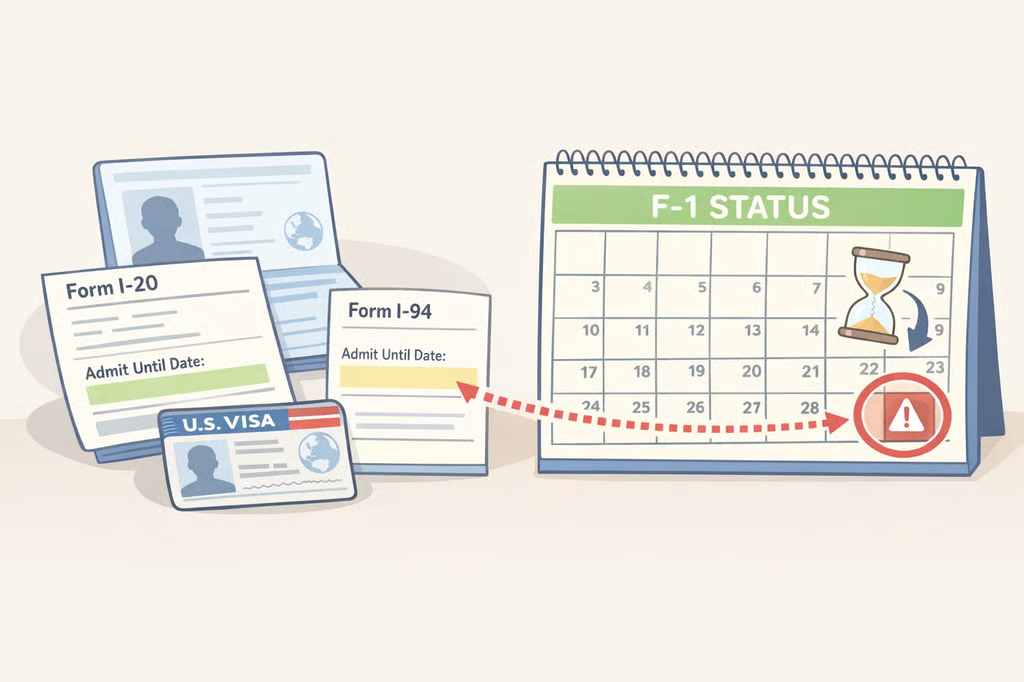
F-1 students applying for Optional Practical Training (OPT) or a STEM OPT extension will face new filing rules beginning September 15, 2026, if a federal rule takes effect as scheduled. A Department of Homeland Security final rule published July 17 replaces the longstanding “duration of status,” or D/S, framework for F, J, and I nonimmigrants with fixed periods of admission. DHS says congressional review could still change the effective date or terminate the rule.
The change makes the expiration date on Form I-94 much more important. Students who need more time to complete a program or pursue OPT may also need to request an extension of stay from US Citizenship and Immigration Services. Transition protections mean not every current student will immediately need another application.
F-1 filing terms to know
D/S, or duration of status: The current framework generally allows F-1 students to remain in the United States while pursuing an authorized course of study or practical training and otherwise maintaining status, without a specific expiration date on Form I-94.
Admit Until Date (AUD): Under the new system, Form I-94 will show a specific date through which the student is admitted instead of “D/S.”
Extension of stay (EOS): A request to USCIS for authorization to remain beyond the current admission period.
Form I-765: The Application for Employment Authorization used for post-completion OPT and STEM OPT.
Form I-539: The form USCIS currently uses for many requests to extend or change nonimmigrant status.
Which OPT forms will you need?
F-1 students who are in the United States in valid D/S status when the rule takes effect receive transition protections. They generally may remain through the program end date on the Form I-20 valid on September 15, 2026, subject to the transition limits, plus the existing 60-day departure period.
There is also a temporary OPT exception. An eligible transition student who files Form I-765 for post-completion OPT on or before March 18, 2027, before the applicable admission period expires, does not need a separate Form I-539 for that requested OPT period. A STEM OPT applicant covered by the transition provision can receive the same exemption by filing Form I-765 on or before March 18, 2027, before the current OPT EAD expires.
If the employment authorization is approved, the student may remain in F-1 status through the EAD expiration date plus 60 days. DHS also reserves authority to extend the temporary I-539 exemption in six-month increments.
Students admitted under the new fixed-date system may need both Form I-765 and an extension-of-stay application when the requested OPT period extends beyond their authorized admission. DHS recommends concurrent filing when both are required.
When travel changes your OPT filing path
International travel after September 15 can move a student who was previously admitted for D/S into the fixed-admission system.
A transition student who leaves the United States before filing for post-completion OPT or STEM OPT and is then readmitted with a fixed admission period must file both the employment-authorization application and the applicable extension-of-stay request.
Travel after Form I-765 has already been filed is treated differently. DHS says a transition student who leaves while the employment-authorization application is pending or after it is approved will be readmitted under the fixed-period system. The rule does not say that this travel automatically creates the same two-form filing requirement that applies when the student leaves before filing.
Before traveling with an OPT or STEM OPT application pending, students should review their Form I-94, Form I-20, application status, and travel documents with their designated school official (DSO).
OPT and STEM OPT deadlines to track
September 15, 2026: The scheduled effective date of the fixed-admission rule.
March 18, 2027: The current deadline for eligible transition students to file Form I-765 under the temporary exception from a separate extension-of-stay application.
Students entering the fixed-admission system face a shorter post-completion timeline. Post-completion OPT generally must be filed no later than 30 days after the program end date, rather than the previous 60 days. The requested OPT start date also generally cannot be more than 30 days after the program end date.
As of August 7, 2026, USCIS practical-training guidance still describes the rules in force before the September 15 effective date, including the existing 60-day post-completion OPT filing window. Students filing around the transition should make sure they are following the rules that apply to their admission and filing date.
Can you work while an application is pending?
Filing an extension-of-stay application does not by itself authorize a student to begin post-completion OPT. Under the final rule, an F-1 student with a timely filed EOS may continue a full course of study while the application is pending, but post-completion OPT employment generally cannot begin until the required EOS and employment authorization are approved.
STEM OPT retains a separate protection. A student who timely and properly files for a 24-month STEM OPT extension may generally continue working for up to 180 days after the existing post-completion OPT EAD expires while USCIS considers the application.
Certain existing F-1 employment can also be protected while a timely filed EOS is pending. On-campus employment, Curricular Practical Training, and qualifying severe-economic-hardship employment may receive automatic extensions for up to 240 days. That provision does not create a 240-day extension of an OPT or STEM OPT EAD.
The new 30-day F-1 departure period
Students admitted under the fixed-date system generally receive 30 days after completing their program or authorized post-completion practical training to prepare to depart or otherwise obtain authorization to remain in the United States. That replaces the previous 60-day period for students governed by the new framework.
Students protected by the transition provision can retain the 60-day period tied to their earlier D/S admission. Travel and readmission after the rule takes effect can change which framework applies.
The I-94 expiration date also carries greater consequences under fixed admission. A student who timely files a qualifying extension-of-stay request is considered to be in a period of authorized stay while USCIS decides the application and does not accrue unlawful presence merely because the prior admission period expires during adjudication. If USCIS denies the EOS after the admission period has expired, the student generally must depart.
What to check before you file or travel
If a deadline has already passed, an application has been denied, or your status history is unclear, do not rely on the general timelines alone. Review the record with your DSO and, when individual legal consequences are involved, a qualified immigration attorney before filing or traveling.
Before filing for OPT or booking international travel, pull your most recent Form I-94 and determine whether it shows “D/S” or a specific Admit Until Date. Compare that record with the program end date on Form I-20 and, if applicable, the expiration date on your current Employment Authorization Document.
Bring those records to your DSO and confirm which filing path and deadline apply. A DSO can update information and make recommendations in SEVIS, but a school update does not replace a USCIS extension-of-stay approval when one is required.