
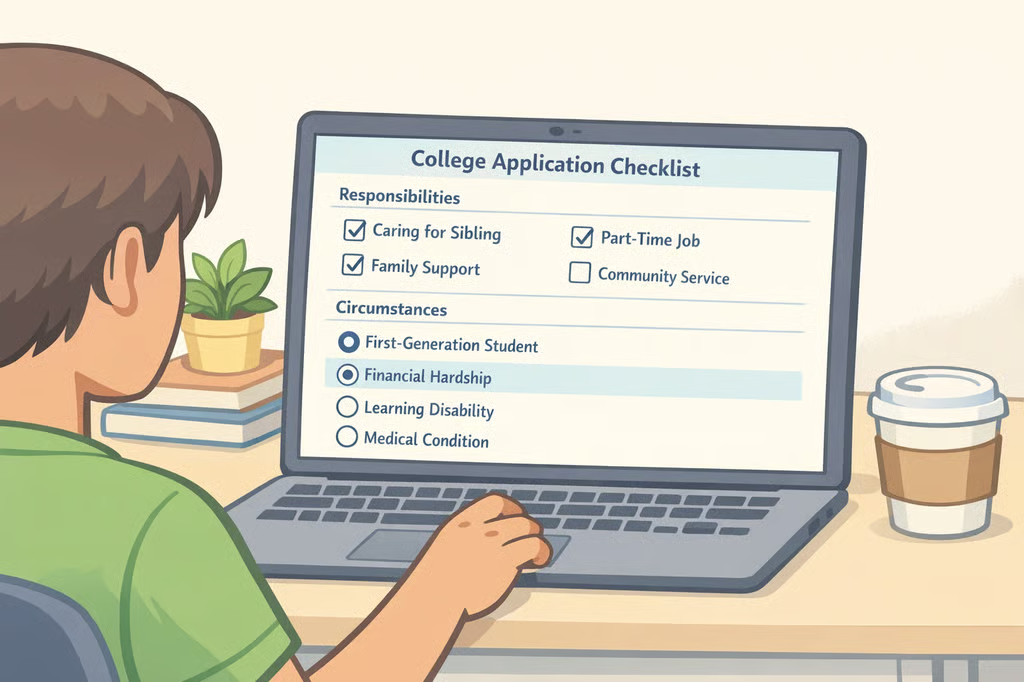
College applications do not always show how much of a student’s time is spent outside school on work, caregiving, transportation or other household needs. The 2026–27 Common App addresses some of that missing context through its Responsibilities and Circumstances checklist.
The checklist has two parts with different rules. Household Responsibilities uses a four-hours-per-week threshold; Circumstances does not. Understanding that distinction can help students report their experiences accurately without leaving out relevant information or treating ordinary chores as major responsibilities.
Common App encourages applicants to share not only extracurricular activities but also their work, responsibilities and circumstances when those experiences provide useful context about how they spend their time outside the classroom.
The checklist is separate from the optional Challenges and Circumstances response and Additional Information section. Each serves a different purpose, so students generally should not repeat the same explanation across multiple parts of the application.
How the two checklists differ
Responsibilities and Circumstances appears in the Activities section of the Common App. Applicants can select multiple options or choose “None of these” when nothing applies.
Selecting “None of these” is a complete answer. Students do not need to identify a hardship or household responsibility simply to make an application appear stronger.
The key distinction is the time requirement. Household Responsibilities covers qualifying duties that take at least four hours per week. The Circumstances portion instead asks whether students have experienced particular living situations and does not use the same weekly-hours test.
Household responsibilities: When the four-hour rule applies
Household Responsibilities covers substantial duties that meet an important family or household need rather than occasional chores.
The listed responsibilities include helping family or household members with appointments and similar tasks, performing farm work or unpaid work for a family business, translating or interpreting, managing household finances, providing transportation, caregiving and working a paid job that contributes to household income. An “Other” option covers qualifying responsibilities that do not fit the standard choices, according to a July 2026 review of the current Common App checklist by college admissions consultant Alexis White.
Students should select a responsibility only when they regularly spend four or more hours per week on it. Routine chores or occasional help generally do not qualify when they fall below that threshold.
For example, occasionally washing dishes or running an errand is different from regularly managing household tasks because another family member cannot do so.
A responsibility can also be temporary. A student who takes on substantial caregiving duties for several weeks during a family emergency may still have a qualifying responsibility during that period if it meets the application’s criteria.
Circumstances: When the four-hour rule does not apply
The Circumstances checklist has no weekly-hours requirement. Instead, students select the listed situations they have experienced.
Current options include commuting 60 minutes or more to and from school each day, experiencing homelessness or another unstable living situation, living without consistent heat, power, water or food, lacking reliable or usable internet, and living independently outside a boarding-school setting.
Students with a commute near the stated 60-minute threshold should pay close attention to the exact wording shown in their application rather than applying the Household Responsibilities time rule to this section.
Health problems, discrimination, family disruptions, grief, natural disasters and similar hardships are not fixed options in this checklist. Students who want colleges to understand those experiences may instead use the optional Challenges and Circumstances response.
When to explain your circumstances further
Checking a responsibility or circumstance does not automatically require another explanation. Extra detail is useful when the checklist alone does not give admissions officers enough context to understand how an experience affected a student’s academics, activities or opportunities.
The relevant Common App sections serve different purposes:
Section | Best use |
| Responsibilities and Circumstances | Select qualifying household responsibilities and listed circumstances |
| Activities | Describe a substantial job, caregiving role or other commitment that warrants its own activity entry |
| Challenges and Circumstances | Explain a significant experience or hardship and how it affected you |
| Additional Information | Provide important application context that does not fit naturally elsewhere |
Common App introduced the current optional Challenges and Circumstances prompt with a maximum of 250 words and reduced Additional Information from 650 to 300 words beginning with the 2025–26 cycle. In its official announcement of those changes, Common App listed examples for the challenges prompt including community disruption, discrimination, family disruptions, housing instability, military deployment, natural disasters, physical health and mental well-being.
Students do not need to fill every available writing space. If an experience is already clear from the checklist or Activities section, repeating it elsewhere uses space without adding useful context.
Where common situations belong
A few examples show how the sections can work together.
Regularly translating for family members: Select the interpreting or translating responsibility if it takes at least four hours per week. Consider listing the role in Activities as well if it represents a substantial commitment.
A long daily commute: Select the Circumstances option if your commute meets the threshold stated in the application. Additional explanation may be useful if the commute significantly reduced the time available for academics or activities.
A part-time job that supports household income: Select the Household Responsibilities option if the job takes at least four hours per week, and list the job in Activities when appropriate. Add further context only if its effect on your application would otherwise be unclear.
A family health crisis: The crisis itself is not a fixed Circumstances checklist option, but caregiving or household duties created by it may qualify under Household Responsibilities. The Challenges and Circumstances response can explain how the broader situation affected you.
How much personal information should you share?
Students decide how much sensitive information to disclose. The Challenges and Circumstances prompt tells applicants to share this information only if they are comfortable doing so.
Keep explanations factual and focused on information that helps admissions officers understand the application. A difficult experience does not need to become a dramatic personal story. Briefly explaining what happened and how it affected school, activities or opportunities may provide enough context.
Avoid repeating an identical account in several sections. If the same experience appears more than once, each placement should add something different.
Before you submit your Common App
Before submitting, make sure every selected Household Responsibility meets the four-hours-per-week threshold, every Circumstances option accurately reflects your experience, and any written explanation adds information that is not already clear elsewhere.
The 2026–27 Common App opened on August 1, 2026. Read each question as it appears in your application before submitting, and answer according to your actual responsibilities and circumstances rather than what you think a college wants to see. Accurate context is more useful than trying to make an experience sound more significant than it was.