
- Kids Online Safety Act Senate committee approval: how it compares to the House's KIDS Act
- What the KOSA Senate Commerce Committee vote advanced
- Two legal tools, same goal: duty of care versus enumerated safeguards
- What the House-passed KIDS Act would require for minors' accounts
- What this means for schools, and what it doesn't
- Where critics push back
- What remains unresolved
- What to check now
Kids Online Safety Act Senate committee approval: how it compares to the House's KIDS Act
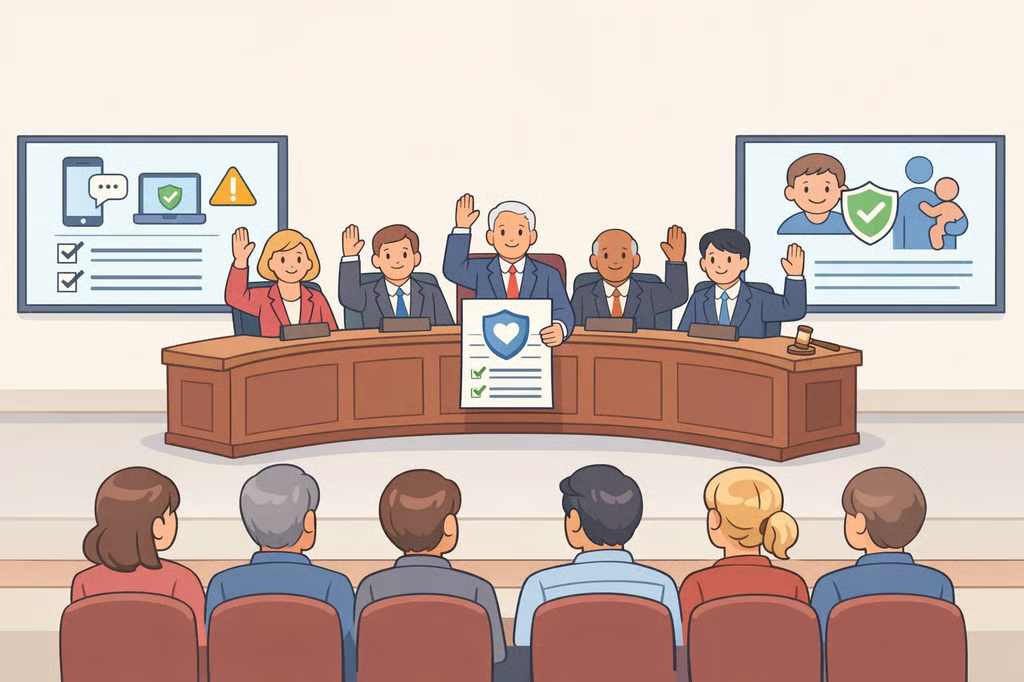
The Senate Commerce Committee advanced the Kids Online Safety Act on August 5, one of four child-safety bills the panel moved out of five considered at that markup, according to the Senate Commerce Committee. This Kids Online Safety Act Senate committee approval keeps alive a bill, known as KOSA or S. 1748, that would require social media platforms, online games, messaging apps, and video streaming services to build stronger protections for young users into their core designs.
The bill still needs a full Senate floor vote, and it isn't traveling alone. The House already passed a different bill aimed at the same goal, the KIDS Act, and the two chambers took different legal approaches to get platforms to change how they treat minors' accounts.
Parents, students, and teachers managing school-issued devices or classroom apps are probably the ones with the most immediate questions here. Short answer: nothing changes yet, since neither bill has been signed into law. Here's what each one would actually do, and where they still disagree.
What the KOSA Senate Commerce Committee vote advanced
KOSA's support in the Senate predates last week's markup. A committee release from Senate Commerce Republican staff cites 75 cosponsors, while Ranking Member Maria Cantwell's opening statement at the markup put the number at 74; both accounts point to the same underlying fact, that the bill passed the full Senate 91-3 in 2024 (Senate Commerce Committee). The exact cosponsor count depends on which release you read, but both numbers describe a bill with unusually broad bipartisan backing.
The House passed its own version, the KIDS Act (H.R. 7757), 267-117 last month, and the Senate Commerce Committee received it and referred it to itself in July (Congress.gov). The two bills remain separate measures. Last week's markup advanced S. 1748 on its own; it did not merge the Senate and House approaches into a single bill.
Two legal tools, same goal: duty of care versus enumerated safeguards
The disagreement between the bills is legal, not just political. S. 1748 would create a duty of care, requiring covered platforms to exercise reasonable care when designing features that could create or worsen specific harms to minors (CRS).
H.R. 7757 leaves that language out. Its Kids Online Safety section instead requires platforms to establish, implement, and enforce "reasonable policies, practices, and procedures" addressing harms to minors, with no comparable duty-of-care provision (CRS). Put concretely: under the Senate bill, a platform would have to show it exercised reasonable care before launching a feature like an infinite-scroll feed. Under the House bill, that same platform would instead need documented policies addressing that category of harm. Sens. Marsha Blackburn and Richard Blumenthal, the Senate bill's sponsors, criticized the House for removing the duty-of-care section (CRS).
The bills also disagree on how much a platform has to know before a rule applies. S. 1748 defines "know" as actual knowledge or knowledge "fairly implied on the basis of objective circumstances," while H.R. 7757 uses the broader "know or should have known" standard (CRS). That gap matters for scope: a broader standard doesn't require proof a platform actually knew a user was a minor, so more accounts could end up covered. S. 1748 would also direct the FTC to publish guidance on applying its knowledge standard; H.R. 7757 includes no comparable directive (CRS).
Deadlines and audits diverge too. Under S. 1748, platforms averaging fewer than 10 million monthly active users get 21 days to respond to a harm report, while larger platforms get 10 days. H.R. 7757 sets a flat 10-day window for every covered platform, regardless of size (CRS). S. 1748 exempts platforms under that same 10-million-user threshold from mandatory third-party audits; H.R. 7757 requires annual audits, starting 18 months after enactment, for every covered platform (CRS). H.R. 7757 would be enforced by the FTC and state attorneys general (CRS).
What the House-passed KIDS Act would require for minors' accounts
Much of the public conversation about "what KOSA requires" is actually describing the Kids Online Safety section the House built into H.R. 7757. CRS defines a covered platform there as a public, internet-connected service that lets users create a searchable profile, primarily exists to let people share and view user-generated content, is designed to promote engagement, and uses personal data to target ads or recommendations (CRS).
For any user a covered platform knows is a minor, H.R. 7757 would require limits on who can contact them, a stop to recommending their profile to unrelated adults, hidden online or offline status, restrictions on sharing their location, limits on features that encourage compulsive use, and a way to opt out of personalized recommendations (CRS).
Parents would get tools to view and change a minor's privacy settings, restrict purchases, see and limit time spent on the platform, and get notified before a minor accepts a new direct-message request, with the option to turn off direct or disappearing messages entirely (CRS).
The House bill goes further in a few places. It bans disappearing messages for minors on social media outright. It requires AI chatbots to disclose to minors that they aren't talking to a human. Platforms where more than a third of the content counts as sexual material harmful to minors would have to adopt technology that identifies minors and blocks their access to it (Congress.gov). Online video game platforms would need parental tools to limit who can message a minor and to restrict in-game purchases (Congress.gov).
Cantwell described S. 1748 as covering some of the same ground. In her opening statement, she said the Senate bill would set "protective default settings" limiting design features that encourage extended scrolling, along with a reporting mechanism platforms must respond to (Senate Commerce Committee). That's a bill sponsor's summary, not a line-by-line statutory comparison; for the structural differences between the two bills, the CRS side-by-side is the more precise source.
The committee also advanced two related but separate measures at the same markup. The Chatbot Act would let parents limit a child's chatbot use and disable push notifications and reward incentives. The Youth AI Privacy Act would require chatbots to disclose they aren't human, limit how long they retain conversation history, and set privacy protections for minors' data (Senate Commerce Committee). Neither is part of KOSA itself.
What this means for schools, and what it doesn't
Both bills define their obligations by what a platform does, not by how a student happens to access it. A service becomes "covered" because it's public, lets users build a searchable profile, and uses personal data for recommendations or ads, not because a school issued the device a student used to log in (CRS).
That means whether a classroom app or learning platform falls under either bill depends on whether it meets that statutory definition, not on some blanket school exemption. A technology coordinator checking compliance should read the covered-platform definition directly rather than assume a school tool is automatically excluded.
What neither bill touches: a district's own device management, content filtering, or incident-response procedures. Those stay governed by each district's existing policy, separate from whatever Congress eventually passes. If a student reports harassment or a safety concern involving a school account, the school's existing reporting protocol still applies today, regardless of where either bill ends up.
Where critics push back
The ACLU opposed the KIDS Act ahead of last month's House vote, warning that its approach to enumerated harms could push platforms to remove content the government might consider "inappropriate" for minors, including information about addiction recovery, mental health resources, and gender-affirming care (ACLU). The group's concern is that vague harm categories, not any specific mandate, create the incentive to over-remove.
The ACLU also warned that compliance pressure could push platforms toward broader age-verification systems, increasing how much personal data platforms collect, raising breach risk, and potentially locking out adults who can't verify their age (ACLU).
Both bills explicitly state they should not be read to require age-gating or age-verification functionality (CRS). The dispute, then, is over how platforms might choose to comply, not what the statutory text itself demands.
CRS also notes that civil liberties groups and some commentators have raised First Amendment concerns specifically about the duty-of-care standard in the Senate bill, arguing it could function as speech regulation rather than product-design regulation (CRS).
What remains unresolved
H.R. 7757 specifies that the FTC and state attorneys general would enforce its Kids Online Safety section (CRS). Current committee materials don't describe a parallel enforcement mechanism for S. 1748, so how the Senate version would be enforced if it becomes law is still an open question.
The House bill would also preempt state laws that conflict with its requirements, while preserving state tort and product-liability claims and allowing states to pass stricter protections for minors (CRS). Whether the Senate bill takes the same approach to state law isn't addressed in the materials reviewed for this article.
Procedurally, S. 1748 still needs a full Senate floor vote, and the House and Senate would need to agree on one version before either bill reaches the president's desk. Last week's committee action is a step in that process, not the end of it.
What to check now
Neither bill is law, so nothing here changes a platform's, school's, or family's legal obligations today. A few things are worth doing anyway:
- Parents: Check the settings your child's platforms already offer, apart from either bill, for messaging permissions, location sharing, personalization opt-outs, purchase limits, and screen time. Don't assume one platform's tools match another's; check each one directly.
- Students: Locate the in-app reporting tool for harmful contact or content before you ever need it. For anything urgent, a trusted adult or 911 is still faster than any pending legislation.
- Educators: Confirm with a technology coordinator whether the district's existing incident-reporting procedure covers social media accounts accessed on school devices, since neither bill sets that requirement for districts.
- Anyone tracking the bills: Follow S. 1748 through the Senate Commerce Committee's press releases and H.R. 7757 on its Congress.gov page for the next procedural step, rather than assuming either one has already taken effect.