
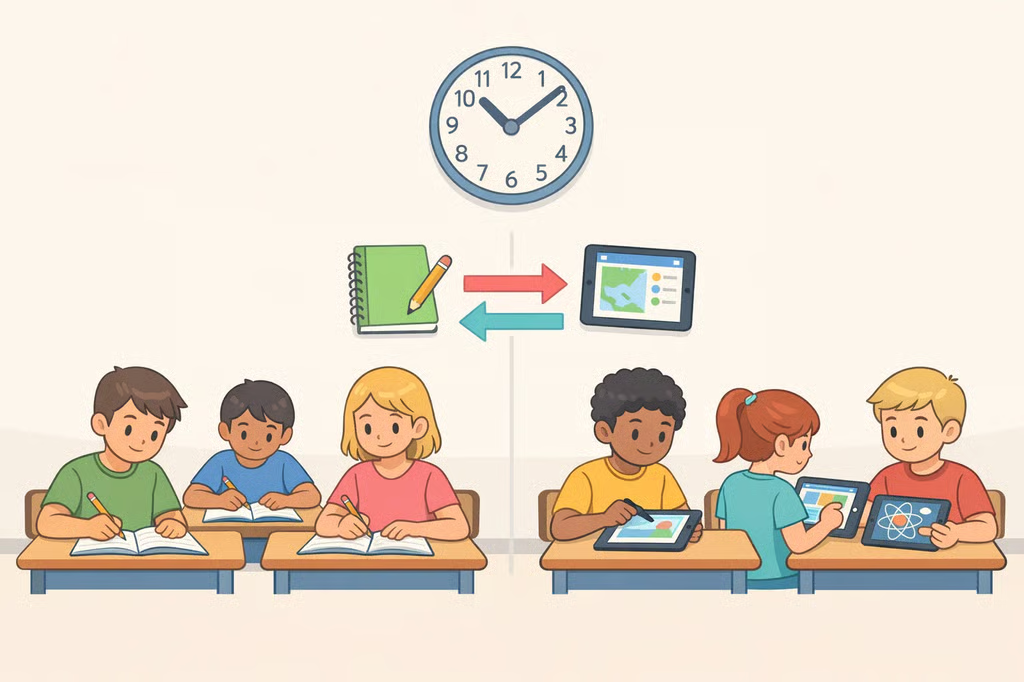
- Pen and paper vs technology in the classroom: what RISD's new rules actually restrict
- Richardson ISD's new limits target passive screen time, not all classroom technology
- Texas' phone law is a separate rule, aimed at personal devices
- What research does, and doesn't, establish about cutting screen time
- Handwriting vs. typing for students: when does handwriting help recall?
- Printed text vs digital text: comprehension research stays mixed
- When an IEP or 504 Plan overrides a device policy
- What to check before assuming a policy applies to you
Pen and paper vs technology in the classroom: what RISD's new rules actually restrict
Richardson ISD, a Texas school district, is capping passive screen time by grade level while still allowing technology for creating, collaborating, and researching, according to an announcement the district posted in late July (Richardson ISD). The move puts specific numbers on a question schools have circled for years, pen and paper vs technology in the classroom, and it lands alongside two other developments this year: a statewide law restricting personal phones, and research on when handwriting or printed text actually helps students learn. Families facing a new device rule this fall are often dealing with more than one policy at once, and it helps to know which one is actually in play.
Richardson ISD's new limits target passive screen time, not all classroom technology
The district draws a line between "productive" screen time, when students are creating, collaborating, solving problems, or researching, and "passive" screen time, largely watching videos or presentations, which will now be capped by age (Richardson ISD).
The recommended passive-time ceilings are:
- Pre-K and kindergarten: 10 to 15 minutes in a single session
- Grades 1 through 4: 15 to 20 minutes, in chunks
- Grades 5 and 6: 20 to 30 minutes, the widest allowance
- Grades 7 through 12: 15 to 20 minutes per class period
These are RISD's own recommendations, not a state requirement or a research-backed threshold that other districts have to follow (Richardson ISD).
Alongside the caps, RISD says it will extend YouTube restrictions to secondary campuses, stop using technology as a behavior reward or default indoor-recess activity, and increase monitoring of student devices during independent work with district-approved tools (Richardson ISD). The district also plans to keep watching how the limits play out in classrooms and adjust as needed, which makes the current numbers a starting point rather than a settled rule.
Texas' phone law is a separate rule, aimed at personal devices
Texas House Bill 1481 has restricted student use of personal electronic devices, including cell phones, during instructional time since the 2025-26 school year began last fall, according to guidance the Texas School for the Blind and Visually Impaired published earlier this year (TSBVI). That guidance describes the law's purpose as reducing distraction and supporting student engagement, and it frames HB 1481 specifically around students' own devices, not school-issued ones.
Richardson ISD's announcement, by contrast, is about classroom technology use and passive screen time, a different subject from a state law about personal phones. Whether a "less screen time" rule at a given school traces back to a state law, a district policy, or a teacher's own classroom expectation changes what it actually covers, and a district handbook or teacher's syllabus is where that distinction gets spelled out.
What research does, and doesn't, establish about cutting screen time
An OECD literature review found that digital tools can boost engagement and personalize instruction, but the effect isn't automatic; it depends on how deliberately teachers put those tools to use (OECD, published last year). The same review flagged risks, including distraction, equity gaps, and cyberbullying, that schools need to manage for digital learning environments to work well.
That review looked at digital tools broadly. It doesn't test Richardson ISD's specific screen-time caps, and the district's own plan to monitor and adjust its limits suggests it doesn't yet have classroom-level evidence that these exact thresholds improve learning. What the research does support are two narrower questions worth separating from the policy news: whether taking notes by hand improves recall, and whether printed text is easier to understand than a screen.
Handwriting vs. typing for students: when does handwriting help recall?
An unpublished thesis-based systematic review and meta-analysis out of the University of Louisville pulled together 33 eligible reports, covering 42 independent samples and 88 effect sizes, comparing recall among secondary and college students who took notes by hand versus by typing (University of Louisville meta-analysis). Nearly half of those reports, 48%, were unpublished dissertations, theses, or conference papers, which the researcher noted makes publication bias an unlikely explanation for the pattern found.
The analysis found a modest overall edge for handwriting on quizzes given shortly after a lecture: an average effect of Hedges' g = +0.144, which translates to roughly 57% correct for handwriters versus about 50% for typists, averaged across studies rather than a score any individual student should expect to hit (University of Louisville meta-analysis).
The finding is also narrow. It comes almost entirely from short recall quizzes given right after brief lectures, and it doesn't show that writing by hand improves long-term retention, essay writing, math work, or elementary-level learning (University of Louisville meta-analysis). The strongest factor in the analysis wasn't note-taking format at all. It was whether students got a chance to review their notes afterward, and when they did, the recall advantage nearly disappeared (g = -0.414 interaction effect). The practical implication is narrow, too: short-term lecture recall when there's no chance to review notes afterward, not a general case for the benefits of writing by hand in school.
Students who already use a typing accommodation, or who have dysgraphia or slower handwriting, should stick with their existing accommodation rather than switch formats based on one study.
Printed text vs digital text: comprehension research stays mixed
A 2023 systematic review of 23 peer-reviewed studies involving students ages 6 to 18 found inconsistent results on reading comprehension: some studies showed no meaningful difference between paper and digital reading, while others found an edge for paper (PubMed-indexed systematic review). A reader's prior comprehension skill and existing reading habits were among the strongest predictors of performance in either format.
Family and school factors mattered too. Socioeconomic status was linked to stronger reading achievement in both formats, with a somewhat larger effect for paper reading, and the number of books at home along with a school's technology habits also shaped outcomes (PubMed-indexed systematic review). That pattern points toward checking what works for a specific student on a specific reading task rather than assuming either format wins by default.
When an IEP or 504 Plan overrides a device policy
Format decisions look different, though, when a student's accommodation plan is involved. Guidance interpreting Texas' HB 1481 states that federal law, specifically the Individuals with Disabilities Education Act (IDEA) and Section 504 of the Rehabilitation Act, requires schools to provide accommodations that give students equal access to instruction regardless of a general device policy (TSBVI). The same guidance states that when a student's IEP or 504 Plan specifically lists a personal device or assistive technology as an accommodation, the student must still be allowed to use it, and that denying access would put a school out of compliance with that student's legal rights.
That protection applies to accommodations already written into a student's plan. A student who wants to use a device but doesn't have that accommodation documented should be referred to the school's Admission, Review and Dismissal (ARD) committee or 504 committee for review, rather than assuming a blanket "no phones" rule applies to them (TSBVI).
This guidance addresses Texas' HB 1481 specifically. Families outside Texas dealing with a similar phone or screen-time policy should ask their own district how a comparable accommodation review works, since the process can vary by state and school.
What to check before assuming a policy applies to you
None of this settles whether cutting screen time improves learning across the board, and the handwriting and reading research support narrow, task-specific conclusions rather than a blanket case for paper over screens. What it does clarify is which rule applies where, and that's the piece worth confirming before changing how a student takes notes, reads, or completes an assignment.
Ask the teacher or district directly which policy is actually in play this fall, then get the source in writing, whether that's a state law, a district recommendation, or a classroom expectation. Families with an IEP or 504 Plan should pull out the written plan, identify the case manager or 504 coordinator, and ask how any new screen-time or device policy will be handled for that student before it takes effect.