
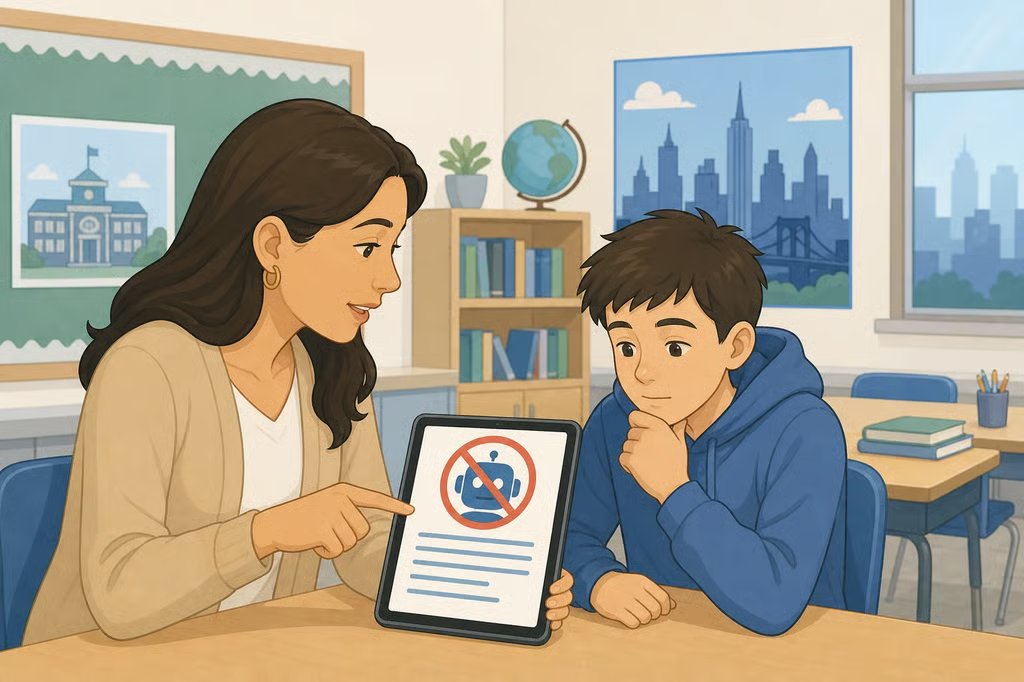
New York City has restricted student-facing generative artificial intelligence (AI) in public schools for the 2026–27 school year, prohibiting its use from 2-K through eighth grade while allowing limited, supervised use in high schools. The one-year moratorium, announced September 2, 2026, affects nearly 600,000 students, or about two-thirds of the city's public school system.
The policy also prohibits AI companion chatbots across all grades and introduces screen-time restrictions for younger students. Teachers can still use approved AI tools for certain tasks, while high school students must complete AI literacy lessons and may participate in supervised pilot programs. Exceptions preserve access to essential technology for students with disabilities and English language learners.
What NYC's school AI ban covers
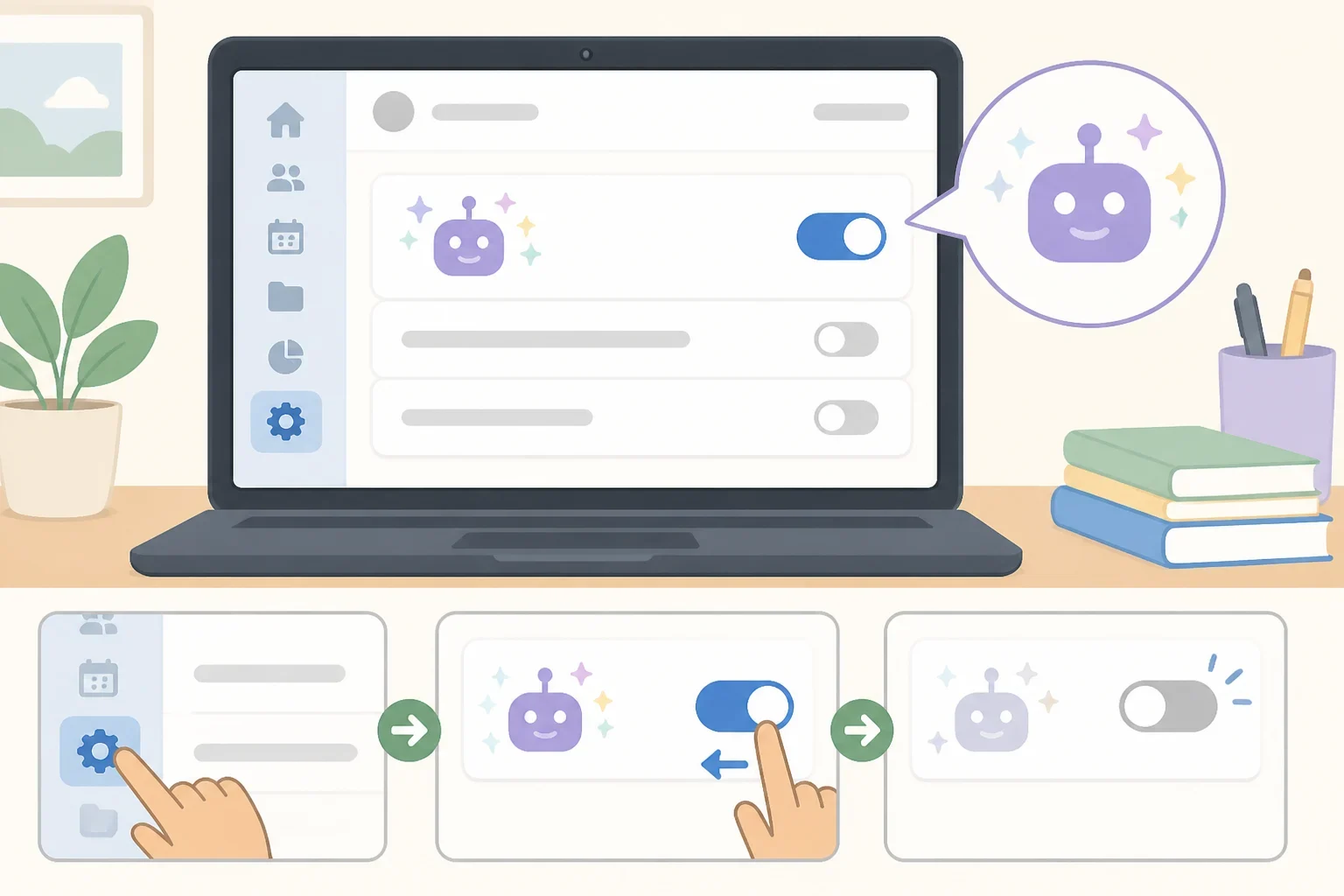
The moratorium applies to generative AI that students interact with directly, including features embedded in reading, tutoring, writing and other educational software. It does not prohibit every form of AI or classroom technology.
According to the September 2 announcement from Mayor Zohran Mamdani and Schools Chancellor Kamar Samuels, the restrictions extend beyond standalone chatbots. Educational platforms containing student-facing generative AI must comply, even when those features represent only one part of a larger product.
During the official press conference, city officials said they would disable or discontinue AI components in more than 38 previously permitted programs that failed to meet the new standards.
Officials identified Amira and HMH curriculum products as examples requiring changes. Where prohibited AI features cannot be disabled without affecting the rest of a product, schools may have to discontinue its use.
The policy governs AI use in schools, not children's access to public chatbots at home. Students who use generative AI outside school must still follow their teachers' assignment instructions and academic integrity rules.
Why NYC parents raised concerns about classroom AI
The moratorium followed months of discussions about how generative AI was entering classrooms and whether schools had established adequate safeguards.
Parents and education advocates questioned student privacy protections, the effects of AI on independent learning and whether families were adequately informed about classroom software. Some raised concerns that tools generating answers or written responses could interfere with children's development of foundational academic skills.
At the September announcement, City Council Member Lincoln Restler described receiving complaints from parents about AI reading programs used by their children. He said some families and educators objected to the technology's use in their schools.
The discussion also forms part of a broader debate over government oversight of artificial intelligence. In September 2026, NYC Public Advocate Jumaane Williams published Artificially Inevitable, a report examining AI governance, including transparency, accountability and protections against potential harms.
These concerns do not establish that every educational AI application undermines learning. Supporters of supervised classroom use point to opportunities for individualized practice, explanations of difficult concepts and preparation for technology-driven workplaces.
NYC's policy takes an age-based approach to those competing priorities. Younger students face stricter limits, while high school students receive structured opportunities to learn about AI and use approved tools under educator supervision.
AI rules for elementary, middle and high school students
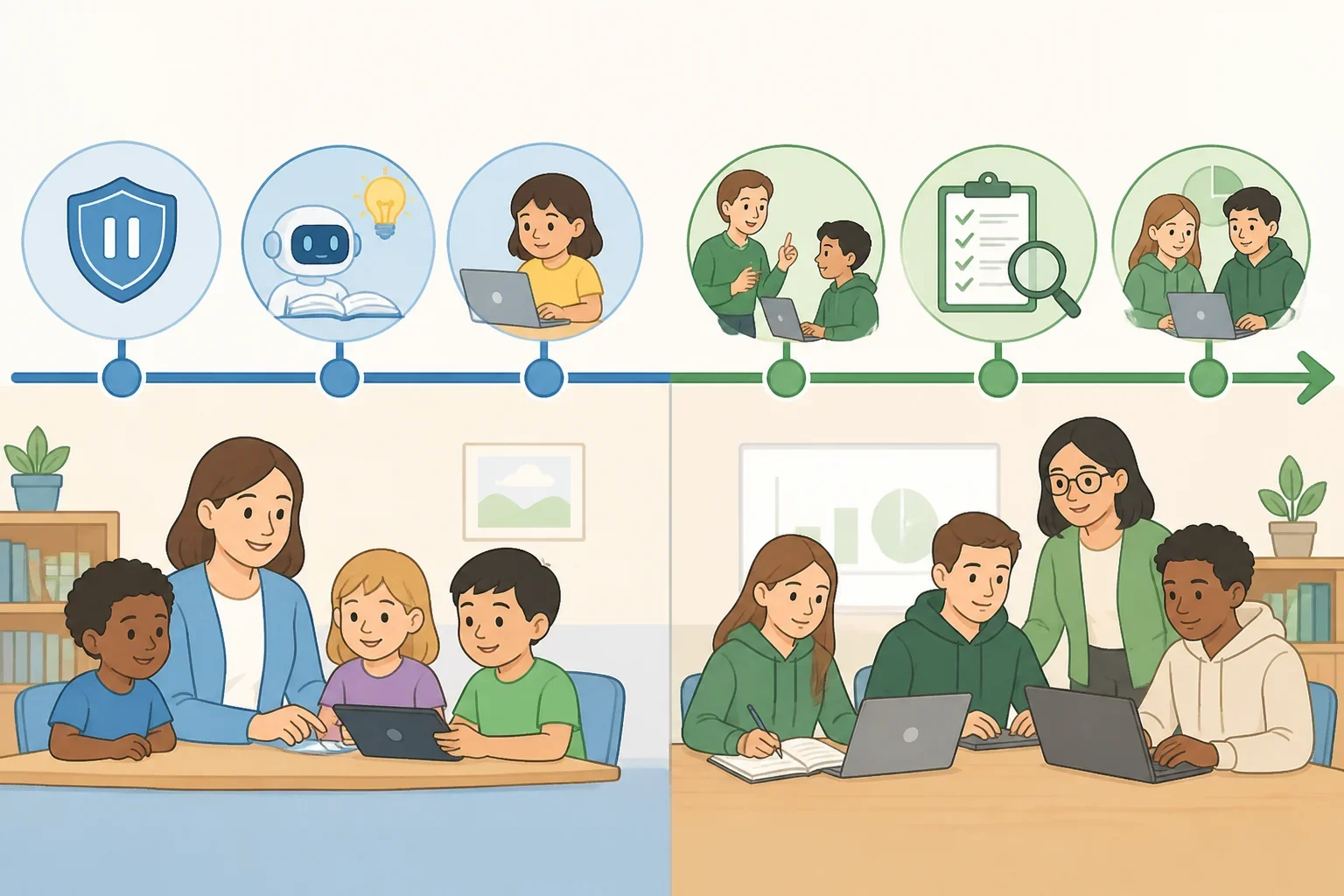
Students from 2-K through eighth grade cannot use student-facing generative AI during ordinary classroom instruction under the moratorium. High school students follow different rules.
Under the official NYC Public Schools AI and screen-time guidance, every high school student must complete two 45-minute AI literacy modules during the school year.
The lessons cover AI's capabilities and limitations, misinformation, bias, data privacy and responsible use. Students participating in approved AI pilots or eligible career-readiness programs must complete additional, more in-depth instruction.
Five AI pilot programs are approved for selected high schools:
- Quill: Supports reading comprehension, textual analysis and evidence-based writing.
- Edia: Provides mathematics coaching and prompts students to explain their reasoning.
- Brisk Teaching: Offers guided practice using teacher-selected instructional materials.
- Playlab: Helps students examine AI-generated responses through assignment-specific activities.
- Intel AI-Ready Schools: Introduces AI concepts through projects addressing community problems.
Participation is capped at 50,000 general education high school students, approximately 5% of the public school system. Each high school may offer the pilots in no more than five classes, and individual students may participate in only one pilot.
Schools must receive approval to participate, and students must work under the supervision of trained educators. Families will be informed when their children take part. The programs also have individual usage limits and defined instructional purposes.
The moratorium includes important exceptions. Students with disabilities can continue using necessary assistive technology provided through an Individualized Education Program (IEP) or Section 504 plan. English language learners retain access to necessary learning supports.
Eligible career-readiness programs, including Career and Technical Education (CTE), may also incorporate supervised AI instruction.
These exceptions preserve access to educational support and career preparation without permitting unrestricted generative AI use.
Screen-time limits and teacher AI restrictions
The policy also limits individual screen use in elementary and middle school classrooms.
For students from 2-K through second grade, routine one-on-one screen time is prohibited. For grades 3–5, the recommended maximum is 30 minutes daily, increasing to 45 minutes for grades 6–8.
Exceptions cover assistive technology, assessments, remote instruction and centrally approved learning activities, including coding and simulations. Teacher-led lessons using shared classroom displays remain permitted.
Teachers may also use approved AI tools for lesson planning and administrative responsibilities, provided the software meets NYC Public Schools' privacy, security and procurement requirements.
However, AI cannot be used to grade students, monitor their behavior or make decisions about placement, promotion or graduation. Those responsibilities remain with educators and school officials.
The city is reviewing educational technology for privacy, security, instructional effectiveness and vendor accountability. Products that fail to meet the standards or do not support essential learning activities may be removed, including tools without generative AI.
A Technology in Schools Coalition will evaluate the restrictions and approved pilots throughout the school year. The group, comprising educators, students, families, advocates and other stakeholders, is scheduled to submit recommendations in April 2027.
Those findings will help inform the city's classroom technology policies beyond the one-year moratorium. Officials have not announced whether the restrictions will be extended, revised or lifted for the following school year.
How parents can check their school's AI use
Families can contact their child's teacher or principal to confirm which AI-enabled tools remain available and how the restrictions apply to specific classes or learning needs.
Questions worth asking include:
- Which classroom tools contain generative AI, and which have been disabled or removed?
- Is my child participating in an approved high school AI pilot?
- How do the restrictions apply to my child's IEP, 504 plan or English language learning support?
- What screen-time limits apply to my child's grade?
- How does the school handle concerns about AI-generated assignments or classroom software?
Parents can also raise concerns through their School Leadership Team or Community Education Council.
For current requirements and exceptions, families should consult their school's administration and official district communications. The April 2027 coalition report will mark the next major step in determining how New York City balances student protections, classroom learning and AI education for the 2027–28 school year.