

- Arkansas Trade School Scholarships: Workforce Challenge 2026-27 Changes
- Confirmed eligibility for Arkansas vocational school scholarships
- How the award tiers work
- Applicant rules and deadlines that still need confirming
- How Workforce Challenge compares with other Arkansas aid
- Verification checklist before enrolling
Arkansas Trade School Scholarships: Workforce Challenge 2026-27 Changes
Arkansas's Workforce Challenge Scholarship is adding qualifying vocational-technical schools to the list of eligible providers, a change that reshapes Arkansas trade school scholarships starting with the 2026-27 academic year. The Arkansas Department of Higher Education confirms the new provider category along with updated fields, program lengths, and award tiers.
The change may affect Arkansas students pursuing professional-skills training or credit-bearing certificate programs in five high-demand fields. ADHE's current institutional guidance confirms the school, field, and program requirements, but its applicant-facing residency and graduation rules still appear on an older listing and should be verified before anyone assumes they're settled.
The scholarship began under Act 613 of 2017 and was amended by Act 341 of 2025, known as ACCESS, which created the vocational-technical provider category, ADHE says. The program-length rules, award tiers, and provider criteria on ADHE's current institutional page reflect that update.
What that current page doesn't cover is who counts as an eligible applicant. Those rules, tied to Arkansas residency and graduation history, still live only on an older Workforce Challenge listing dated to 2022, published before Act 341 existed, in ADHE's Scholarship Application Management System. ADHE's published materials reviewed for this article do not resolve whether that older applicant guidance still governs the category added in 2025.
Confirmed eligibility for Arkansas vocational school scholarships

Three requirements are confirmed on ADHE's current institutional page: provider status, field of study, and program length. A public or private vocational-technical school headquartered in Arkansas meets the provider test if it satisfies at least one of the following, per ADHE:
- Inclusion on the Workforce Innovation and Opportunity Act (WIOA) eligible training provider list
- Approval to offer veterans' education benefits from the U.S. Department of Veterans Affairs
- Inclusion on ADHE's Private Career Education list
The program itself has to fall into one of five designated high-demand fields, ADHE's guidance states: advanced manufacturing, health care, information technology, construction trades, or logistics, distribution, and transportation. A program outside those five doesn't qualify no matter how strong the school's provider status is.
Length is the third piece. Credit-bearing training must total at least six credit hours, meeting the state's Certificate of Proficiency threshold, while noncredit professional-skills training must run at least 80 clock hours, according to ADHE. Since many short technical certifications are measured in clock hours rather than credits, this line can decide eligibility on its own.
Meeting the provider test doesn't clear every program a school offers. Field and length requirements apply program by program, so a specific course of study, not the institution as a whole, has to satisfy all three conditions. Ask the school to confirm eligibility for the exact program name and hours, not just for the institution generally.
How the award tiers work
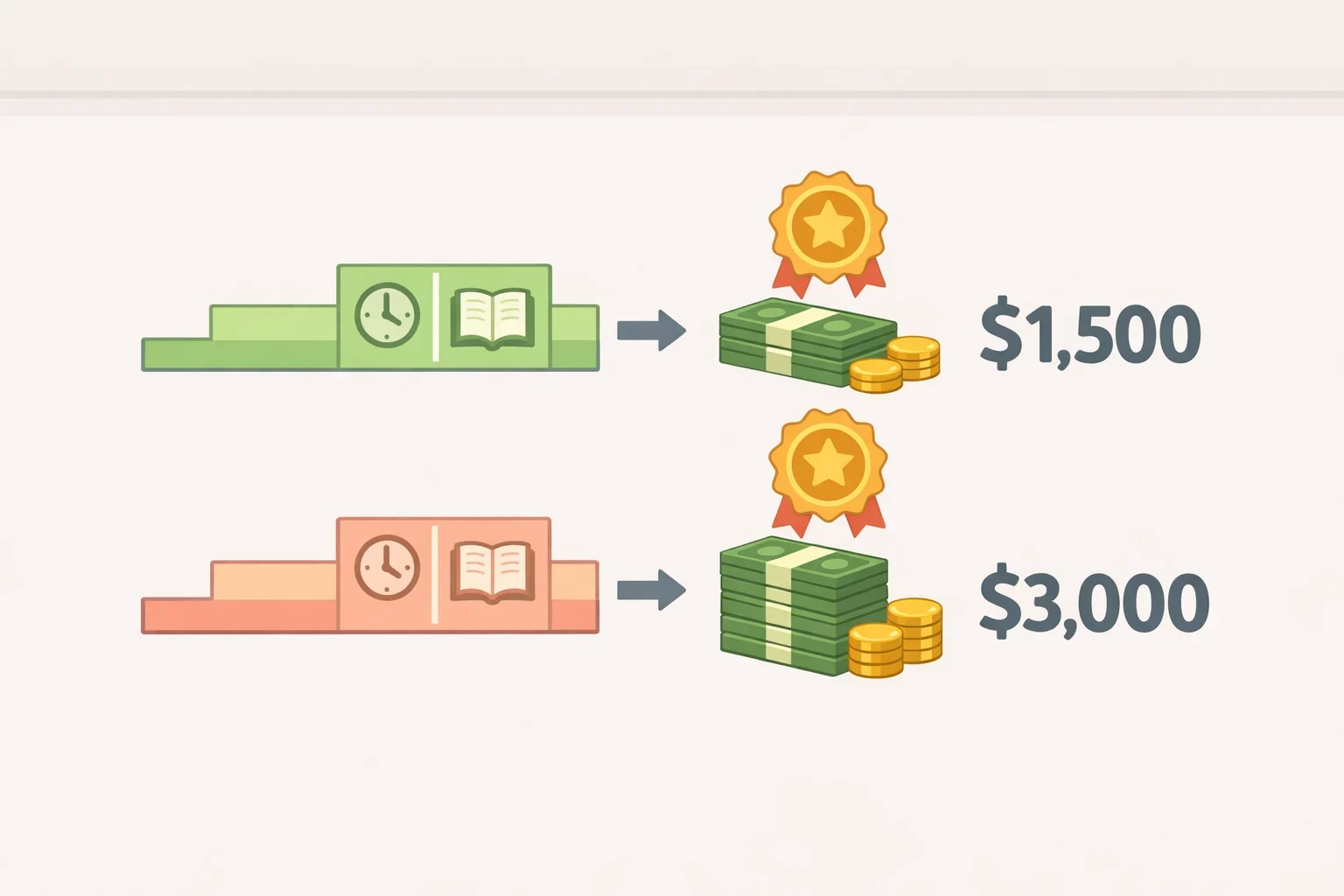
Award amounts depend on how a program is classified. For example, if an eligible noncredit program has 100 clock hours, it would fall within the up-to-$1,500 tier for programs of 80 to 179 clock hours, per ADHE's current page. An eligible 180-clock-hour program, or a credit-bearing certificate of at least six credit hours, would fall within the up-to-$3,000 tier.
Both figures are ceilings, not guarantees. The award can't exceed the school's standard tuition-and-fee rate, so a program with lower tuition than the award tier won't generate the full amount, according to ADHE. Ask the school what its actual tuition and fees run for the specific program before budgeting around the maximum.
ADHE's current page doesn't say whether the award extends to tools, equipment, or licensing-exam fees common in construction-trade and manufacturing programs. That question needs to go to the financial aid office directly.
Applicant rules and deadlines that still need confirming

Several details tied to the vocational-technical expansion remain open, and they all trace back to a Workforce Challenge listing published in 2022, before Act 341 existed. ADHE's published materials reviewed for this article do not resolve whether these older rules carry forward into 2026-27.
Who can apply is the biggest unknown. The 2022 listing describes eligible applicants as graduates of an Arkansas high school, homeschool, or GED program, or out-of-state graduates who lived in Arkansas the previous year, per ADHE's scholarship system. Whether that language still governs the new vocational-technical category isn't addressed anywhere in ADHE's current materials.
The application timeline is also unsettled. The 2022 listing instructs applicants to apply 30 days before their class start date, but nothing confirms that instruction still applies to the 2026-27 cycle.
One figure to discard entirely: the same 2022 listing caps Workforce Challenge at $800 per program, a number that predates the current $1,500 and $3,000 tiers. It shouldn't factor into any 2026-27 budgeting.
Finally, the 2022 listing states that students can't receive both Academic Challenge and Workforce Challenge in the same term. Whether that restriction still applies, especially now that Workforce Challenge covers a new category of schools, is something ADHE and the school's financial aid office should confirm before a student applies for both.
How Workforce Challenge compares with other Arkansas aid
Academic Challenge is a scholarship, not a workforce-training grant, and it works differently from Workforce Challenge. Funded largely by the Arkansas Scholarship Lottery, it's open to Arkansas residents regardless of academic status, including recent high school graduates, currently enrolled students, first-time enrollees, and adults returning after time away from school, per the state's official service page. An ADHE listing gives an annual application deadline of July 1, according to ADHE's scholarship system, though students should confirm the current 2026-27 deadline directly with ADHE rather than assume that date holds.
ArFuture is a grant, described by ADHE as the newest state grant program, aimed at increasing the education and skills of Arkansas's workforce affordably, per ADHE. It covers tuition and fees for qualifying certificate and associate-degree programs in STEM or regional high-demand fields at Arkansas's public institutions, awarded first-come, first-served, with a July 1 deadline for fall enrollment and a January 10 deadline for spring.
Students checking Arkansas Future grant eligibility for certificate programs should compare ArFuture's public-institution requirement with Workforce Challenge's vocational-technical provider criteria; the two programs draw the eligible-school line differently. Whether Workforce Challenge can be combined with ArFuture isn't addressed in the materials reviewed for this article, and neither is whether the older Academic Challenge overlap restriction still applies to the new vocational-technical category. Raise both questions with a financial aid office before assuming any two awards will stack.
Verification checklist before enrolling

ADHE's cited pages provide eligibility categories, not a school-by-school roster for 2026-27. Confirming eligibility means working through each requirement with the specific school, in writing. Bring these questions to a financial aid office:
- Exact program name and total length, in clock hours or credit hours
- Which of the five high-demand fields the program falls under
- Which provider-approval category the school meets: the WIOA list, VA approval, or ADHE's Private Career Education list
- Whether the current application deadline follows the older 30-day instruction or a different timeline for 2026-27
- How the award amount applies against the school's published tuition-and-fee rate, and whether tools or licensing fees are covered
- Whether applying for Workforce Challenge affects eligibility for Academic Challenge, ArFuture, or other aid being pursued
Get the name and title of whoever answers each question, and note the date. Before signing an enrollment agreement or paying a deposit, take that record to ADHE directly and ask whether the 2022 applicant-eligibility rules, the 30-day deadline, and the Academic Challenge overlap restriction still apply to the 2026-27 vocational-technical category.