

- NCAA Transfer Portal Deadline: Why It Varies by Sport
- What to check before entering the transfer portal
- Notification windows vary by sport and division
- Why submitting notice isn't the same as Transfer Portal entry
- NCAA transfer eligibility requirements still apply after entry
- What to confirm before you commit
NCAA Transfer Portal Deadline: Why It Varies by Sport
A student-athlete who hears "the NCAA transfer deadline is today" may be checking the wrong calendar entirely. There is no single NCAA transfer portal deadline that applies to every sport. Notification windows are set division by division and sport by sport, following the pattern shown in NCAA's current rules for specific sports, and confusing "submitting notice to your school" with "being entered into the Transfer Portal" can leave an athlete unsure which step actually applies to them.
The Transfer Portal is the NCAA's centralized database of athletes who intend to transfer. A player's current school enters the name after receiving notice, and that entry is what other schools see, according to NCAA.org. Being listed opens the door to contact from coaches, the same source notes.
This article covers the Division I and Division II rules identified in the NCAA sources cited below. It does not attempt to explain Division III, NAIA, junior-college, or international transfer procedures, which involve separate governing bodies and documentation not addressed here.
What to check before entering the transfer portal
For a college athlete, the transfer portal deadline that applies depends on sport and division, not one generic date circulating online. These checks help confirm which rule actually governs a specific situation:
- Confirm the governing division. NCAA Division I and Division II set notification rules separately, and the cited NCAA materials do not provide one universal calendar covering every sport (NCAA.org).
- Check whether the sport has a published notification window. Division I golf, softball, and Division II football currently have specific windows; the NCAA guidance reviewed for this article does not confirm a fixed window for every sport.
- Sort out whether the date in question governs submitting written notice to the current school, or the school completing Transfer Portal entry. Those are two different steps handled by two different people.
- Ask the current school's compliance office to confirm, in writing, which window applies, the exact date, and whether it governs notice or entry.
For questions specific to one athlete's situation, the NCAA directs students to the compliance office at their current school or the school under consideration (NCAA.org). For general questions, NCAA Legislative Customer Service is available Monday through Friday, 10 a.m. to 5 p.m. Eastern (NCAA.org).
Notification windows vary by sport and division

Division I golf and softball each use two 15-day notification windows: one starting the day after the sport's championship concludes, and a second running Dec. 1-15, according to an NCAA announcement from four months ago (NCAA.org).
Division II football works differently, and the rule is new this year. Since June 1, 2026, football players must initiate the notification-of-transfer process during a Jan. 2-16 window unless a Division I exception applies, a change from the previous rule that let athletes start the process at any time (NCAA.org). Under the rule now in effect, a football player who misses the window has to wait for the Division I football transfer window instead (NCAA.org).
Sandra Woodley, Division II Executive Board chair and president of the University of Texas Permian Basin, said the change gives "greater clarity, consistency and structure to the transfer process while aligning more closely with Division I timelines," according to NCAA.org.
That same announcement, made earlier this year, said the Division II Legislation Committee planned to review Transfer Portal data across all sports at a June 16-17 videoconference and decide whether windows made sense beyond football. The cited April announcement does not provide the committee's later decision. Athletes competing in Division II sports other than football should confirm the current status of any additional windows directly with their compliance office.
These specific windows apply to Division I golf, softball, and Division II football. The cited NCAA announcements list windows for those sports but do not provide a complete calendar for every Division I or Division II sport, so a given sport's rule may differ.
Why submitting notice isn't the same as Transfer Portal entry

Understanding how to enter the NCAA transfer portal starts with notifying the current school; an athlete does not add their own name to the Transfer Portal directly. The process begins when an athlete tells their current school they intend to transfer, and the school, not the athlete, enters the name into the Transfer Portal (NCAA.org).
For Division II football specifically, the school must complete that entry within two business days of receiving written notice, or of confirming the athlete finished a required transfer education module, whichever comes later (NCAA.org). That replaces the previous seven-calendar-day standard. The athlete's clock, which starts when notice is given inside the window, and the school's clock, which covers completing entry, run separately.
Division I schools now face tighter limits on what they can do before that entry happens. Earlier this year, the Division I Cabinet made it an automatic violation for a school to add a transfer to its roster, sign the athlete to a revenue-sharing agreement, or let them practice or compete before Transfer Portal entry is complete (NCAA.org). The rule targets so-called "ghost transfers" and applies to transfers on or after Feb. 25, 2026 (NCAA.org).
Penalties are automatic and expected to be self-applied: a 50% season suspension for the sport's head coach and a fine equal to 20% of that sport's annual budget (NCAA.org). A school has 15 days to notify the NCAA of its intent to self-apply those penalties; if it misses that window, NCAA enforcement staff send written notice of the potential violation along with a deadline for the school to provide evidence that no violation occurred (NCAA.org). Schools that fail to self-impose the required penalties face an additional 10% coach suspension and 5% fine on top of the original amounts (NCAA.org).
This rule restricts what a receiving school may do before entry is confirmed; it does not add new steps for the transferring athlete personally. As a practical precaution, an athlete can still get written confirmation of the date notice was submitted and ask the compliance office for an expected entry date, in case timing becomes a question later.
NCAA transfer eligibility requirements still apply after entry
Transfer Portal entry determines visibility and eligibility for contact from coaches; it does not by itself determine whether an athlete can compete or receive athletics aid right away. That distinction matters most in Division I, where academic standing keeps applying long after a name shows up in the Portal.
This section applies specifically to Division I; the academic standards below come from Division I sources and may not describe requirements at other divisions. Division I athletes must keep meeting NCAA academic requirements after they enroll to practice, compete, and keep athletics aid (NCAA.org).
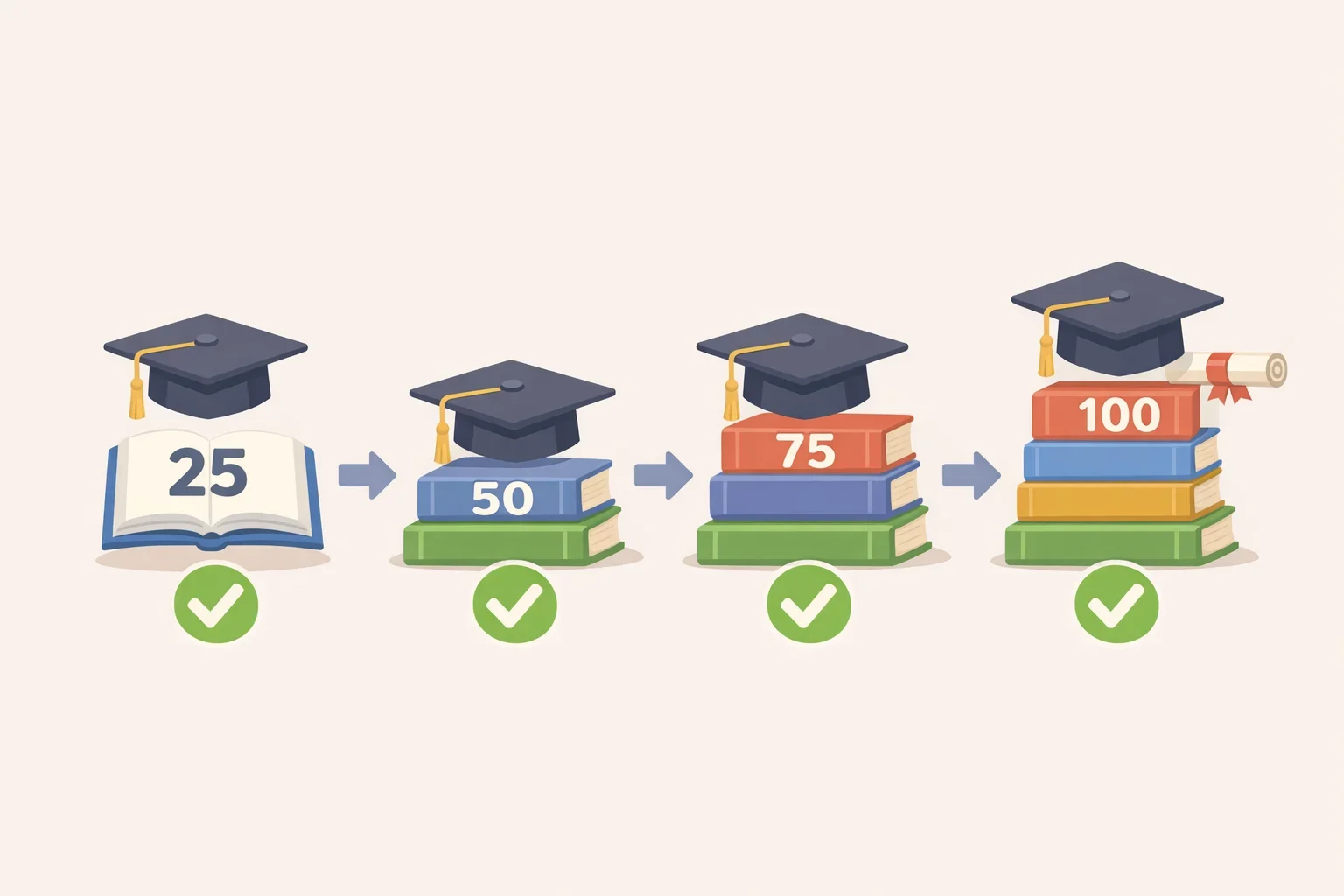
Both two-year and four-year transfers must meet progress-toward-degree benchmarks at the time of transfer, including at least six credit hours per term and 18 semester hours, or 27 quarter hours, across the year (NCAA.org). Four-year transfers specifically must have been academically eligible at their previous school to compete right away and receive athletically related aid at the new one (NCAA.org).
The benchmarks scale up as a student advances: 40% of required degree credit before the third year, 60% before the fourth, and 80% before the fifth, with grade-point requirements tied to each institution's own cumulative graduation standard rather than one NCAA-wide GPA figure (NCAA.org).
None of that gets settled by a Transfer Portal entry date. An athlete completing a transfer should ask the current and prospective schools' compliance offices to review credits, GPA, and eligibility before assuming they'll be eligible to compete or receive athletics aid immediately.
What to confirm before you commit

Before treating any date as final, bring these four questions to the current school's compliance office, then repeat them with the compliance office at any school under consideration:
- What is the exact notification window for my sport and division, and is a window even published for my sport?
- Does today's date govern submitting notice, or does it govern the school's Transfer Portal entry?
- What is my current progress-toward-degree standing, including credit hours and GPA?
- What date should I expect to see my name appear in the Transfer Portal?
For general questions beyond a specific case, NCAA Legislative Customer Service is available Monday through Friday, 10 a.m. to 5 p.m. Eastern (NCAA.org).