

- New Mexico universal child care impact on working mothers: access limits
- What New Mexico’s universal child care program actually changed
- Why universal eligibility does not mean universal access
- Staffing determines whether a slot stays open
- Funding is a separate long-term question
- What the evidence can and cannot show about working mothers
- What parents should verify before relying on the benefit
New Mexico universal child care impact on working mothers: access limits
Eligibility has expanded, but eligibility does not guarantee a nearby, staffed child care slot. That is the clearest answer about the New Mexico universal child care impact on working mothers roughly eleven months after the program launched.
New Mexico removed income eligibility requirements from its child care assistance program in November 2025. Families who are working or attending school and have children under age 13 were also promised waived copayments, making care effectively free under the program’s initial structure, according to the Urban Institute. Yet the available research does not show whether New Mexico mothers are working more hours, earning more, or staying in jobs at higher rates.
That distinction matters for working parents and student parents making decisions now. A family may qualify for assistance, but still need to find a provider that accepts the assistance, has an open place for the child’s age, offers workable hours, and can keep the classroom staffed.
What New Mexico’s universal child care program actually changed

New Mexico’s policy grew out of earlier eligibility expansions. The state first opened assistance to families earning up to 200% of the federal poverty level, then 350%, and later 400%. Before the November expansion, about four in five New Mexico families qualified for some assistance, though eligibility did not mean every family enrolled or received a placement, according to Searchlight New Mexico.
On November 1, 2025, New Mexico became the first state to establish universal child care, according to the Urban Institute. The initial design used two major changes: removing income eligibility requirements and waiving family copayments for families working or attending school with children under age 13.
That is why descriptions of free child care for New Mexico families can sound broader than the practical experience. The policy determines who may receive state assistance. It does not create an open seat in every community, guarantee a provider’s hours, or ensure that a classroom has enough employees to operate.
There is also an unresolved policy question about the income rules currently in effect. The program was codified in state law in March 2026, and The Hechinger Report described a change in requirements during that period. Its reporting says families earning up to 600% of the federal poverty level, or about $198,000 for a family of four, could receive care without copayments. It also says copays beyond that threshold are connected to whether oil prices decrease.
That account conflicts with the earlier description of no income limit. The available reporting describes a March 2026 change, but the current ECECD eligibility and copay rules should control. The New Mexico Early Childhood Education and Care Department is the appropriate place to verify the rule before a family relies on the benefit. The available ECECD material published last year describes no-cost care beginning November 1, 2025, but it does not settle how later changes should be interpreted today.
For parents, the practical questions are more specific than “Is child care universal?”
- Does the family meet the current eligibility and copay rules?
- What proof of work or school enrollment is required?
- Does the selected provider accept state child care assistance?
- Is there an opening for the child’s age?
- Do the provider’s hours cover the family’s work or class schedule?
- Can the provider keep that place open if staffing changes?
Those questions separate a policy promise from a usable child care arrangement.
Why universal eligibility does not mean universal access
The supply problem existed before the state expanded eligibility. From late July through mid-December 2025, statewide child care capacity increased by only 10 slots, even as the number of providers grew, according to Searchlight New Mexico. That measurement window overlaps the November launch and mostly covers conditions before or around the rollout. It cannot isolate the effect of universal child care from seasonal changes, staffing decisions, construction timelines, or other factors.
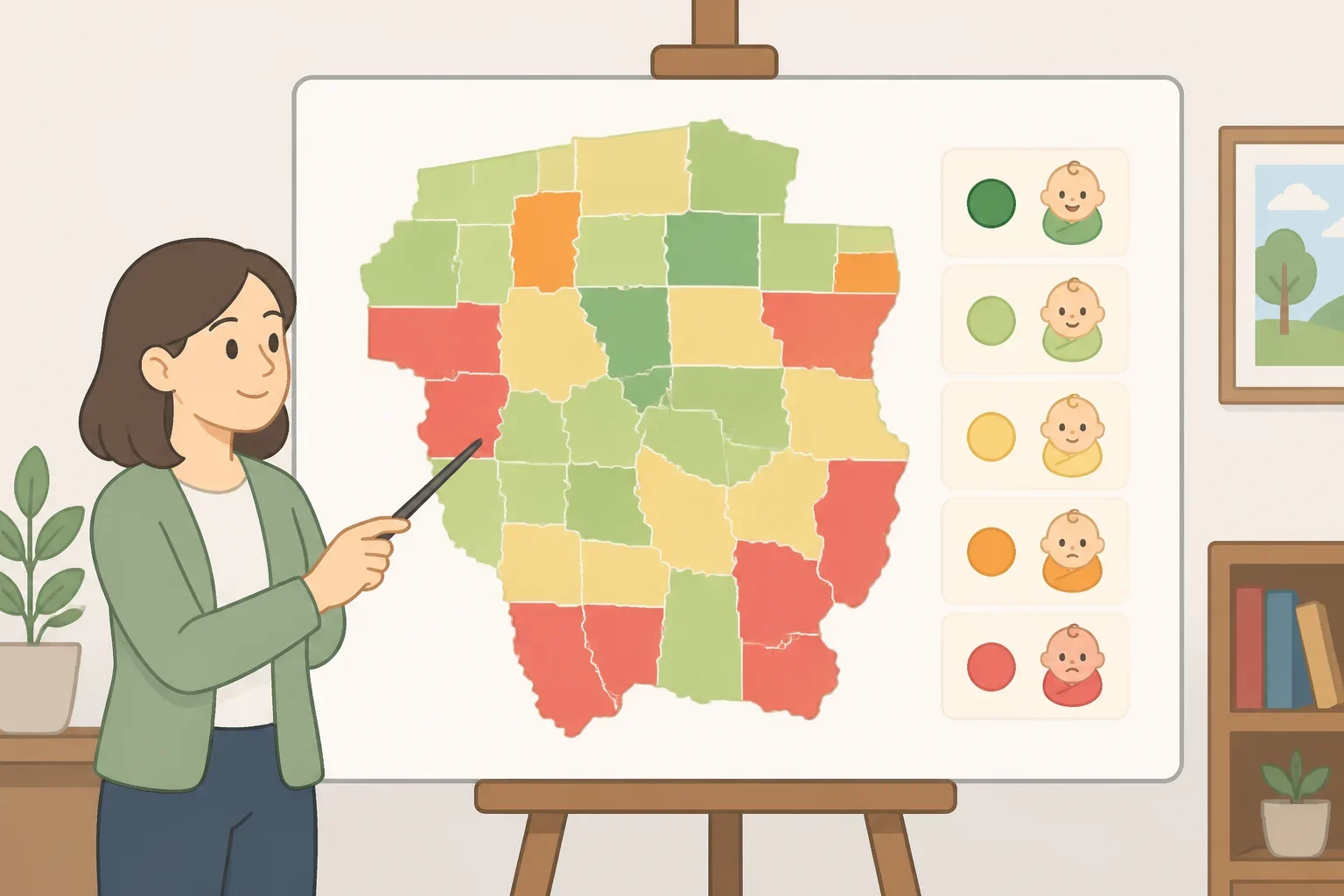
The same data shows why infant care deserves special attention. In 2025, New Mexico had 32 child care slots for every 100 children under age 2. Santa Fe County had 18 slots per 100 children under age 2, San Miguel County had five, and Union and Harding counties had none, according to the Searchlight New Mexico report, which cited Legislative Finance Committee data.
A parent with a preschooler may have different options from a parent seeking infant care. A family in a larger county may face a different search from one in a rural county. The benefit is statewide, but the available choices are not evenly distributed.
The state announced goals of 55 new licensed child care centers, 120 new licensed child care homes, and 1,000 new registered homes. From July through December 2025, the state added 31 facilities, including 19 registered homes, according to Searchlight New Mexico. The reported facility increase cannot be treated as an equivalent increase in usable slots. A new facility may still need staff, enrollment, operating hours, or additional work before it can meet a particular family’s needs.
ECECD has one tool aimed at expanding the physical supply: a $12.7 million low-interest loan fund for constructing, expanding, and renovating child care facilities, according to the New Mexico ECECD. That investment may help over time, but a facility loan does not immediately solve a parent’s need for care next semester or next month.
For a student parent, timing can be especially difficult. A class schedule may change each term. A required clinical placement or evening course may not fit a provider’s standard hours. A working parent may technically have a child care option but still be unable to accept a job if the commute, pickup deadline, or waitlist makes the arrangement unreliable.
Staffing determines whether a slot stays open
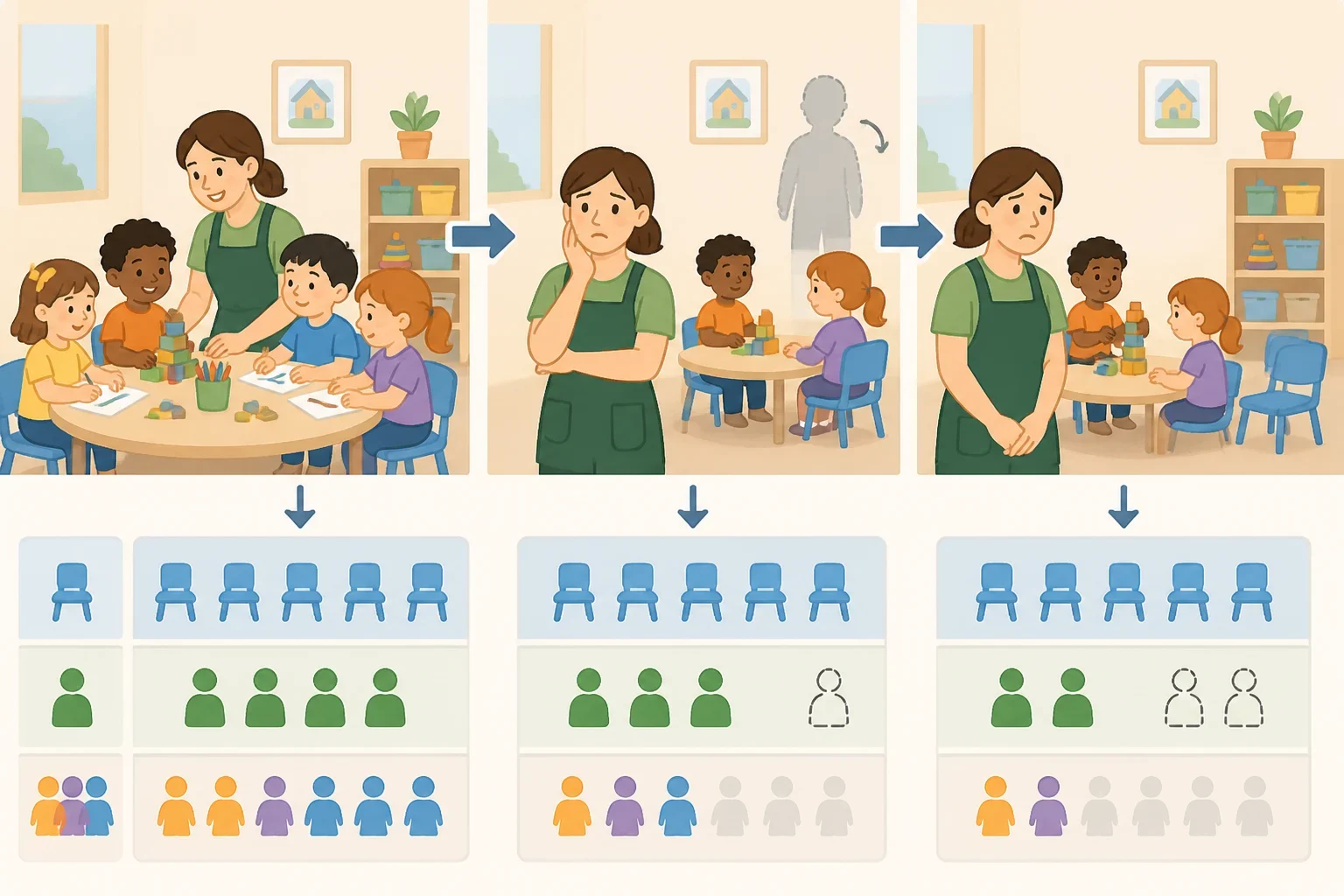
Child care capacity is not only a building question. It is also a workforce question.
New Mexico set aside $60 million for higher child care workforce wages and began developing a wage scale and career lattice intended to recognize experience and education, according to The Hechinger Report. ECECD also described an incentive rate for programs that pay entry-level staff at least $18 per hour and offer 10 hours of care per day, five days a week, according to the New Mexico ECECD.
Other reporting describes a lower $15-per-hour baseline connected to standard reimbursement, along with providers paying $16 or $17 per hour under different arrangements, according to Searchlight New Mexico and The Hechinger Report. The available material does not fully explain how those figures fit together. Parents should treat them as examples of different provider and reimbursement conditions, not as one universal wage rule.
The staffing risk is easy to understand from a family’s perspective. One provider told The Hechinger Report that any employee could leave for a center offering higher pay. If a provider cannot recruit or retain enough workers, a family may lose access to a classroom that was technically available.
This creates another important distinction:
- A licensed facility is not necessarily a facility with an opening.
- An open place is not necessarily an opening for an infant or toddler.
- An age-appropriate place is not necessarily available during the needed hours.
- A scheduled place is not necessarily stable if staffing problems force a classroom to reduce enrollment or hours.
Universal child care and maternal employment depend on all four conditions lining up. The policy can reduce the cost of care, but it cannot by itself guarantee that the care arrangement will be available and dependable.
Funding is a separate long-term question
The program’s financial structure creates another issue for families planning beyond the current term. The initiative was projected to cost more than $660 million annually, with funding tied in part to oil and gas revenue and withdrawals of about $500 million from the Early Childhood Trust Fund and about $250 million from the Land Grant Permanent Fund, according to Searchlight New Mexico.
Those figures describe a projected funding plan, not a guarantee that every future year will look the same. New Mexico’s projected new revenue for fiscal year 2027 fell from $484.8 million in an August 2025 forecast to $105.7 million in a January 2026 forecast, according to Searchlight New Mexico. These were forecasts, not actual revenue losses, but they show why lawmakers are debating sustainability while the program is expanding.
The political positions do not fall into one simple pro- or anti-child-care division. Sen. George Muñoz supported expanding access while warning about budget constraints. Rep. Rebecca Dow questioned whether free universal care was financially feasible. Sen. Michael Padilla, a longtime advocate for the state’s early childhood system, praised the progress but also expressed misgivings about directing more money to the department under a tighter budget, according to Searchlight New Mexico. The same reporting said Padilla argued at another point that the state should go all-in and adjust the budget later.
For parents, the significance is practical rather than partisan. Staffing investments and facility loans may expand access, while revenue pressure could complicate the program’s future funding. A student parent choosing a multi-year academic path should avoid treating today’s benefit as a permanent guarantee without checking current rules each year.
What the evidence can and cannot show about working mothers
National labor data explains why child care access is relevant to maternal employment, but it does not measure New Mexico’s results. In 2024, 68.3% of mothers with children under age 6 participated in the labor force, compared with 78.0% of mothers whose youngest child was 6 to 17, according to the U.S. Bureau of Labor Statistics. Fathers’ participation rates were 94.9% for those with children under age 6 and 92.5% when the youngest child was 6 to 17.
Those figures provide national context for how child care access may affect mothers’ employment. They do not show that New Mexico’s program was designed specifically for mothers, and they do not demonstrate a New Mexico change.
The Urban Institute launched its New Mexico project in March 2026, and research was still ongoing in July, according to the Urban Institute. Its two studies focus on early implementation, outreach, engagement, participation, provider enrollment, and changes in child care assistance and licensing data before and after the program began.
Those studies should provide early evidence about how the program is being implemented, which families take up the opportunity, which providers participate, and how access changes during the first year. The materials reviewed here do not report New Mexico-specific employment outcomes for mothers, including changes in hours, earnings, or job retention.
That limitation should shape the language used to describe the program. “Reshaping work for moms” remains a policy goal or possible effect, not a demonstrated result. The evidence is currently stronger on program design and early access conditions than on labor-market outcomes.
What parents should verify before relying on the benefit

Parents can use the current information to make a careful first check, but not to assume placement. Before changing a job, enrolling in a class, or planning a return to work, contact ECECD through its official program information and verify the rules currently in effect.
Then ask:
- What are the current income, copay, and work-or-school requirements?
- What documentation is required for a student parent to show enrollment or attendance?
- Which nearby providers accept the New Mexico Child Care Assistance Program?
- Is there an opening for the child’s specific age group?
- Are the provider’s hours compatible with work, class, commuting, and pickup?
- Is there a waitlist, and what estimate can the provider give?
- What happens if the provider loses staff or reduces classroom hours?
- Should the family recheck eligibility or copay rules after a change in income, work, school enrollment, or state policy?
The most reliable conclusion about New Mexico universal child care is also the most useful one: assistance may remove a major cost, but it does not remove the need to find a suitable and stable provider. Eligibility, provider participation, an open slot, schedule fit, and staffing are separate checkpoints. Parents should verify each one before treating the benefit as part of a job or class plan.