
- AI-proof hands-on jobs: What evidence says about automation
- What “AI-proof” can and cannot mean
- Are AI-proof hands-on jobs really resistant to automation?
- Why retraining is part of the conversation
- What a real retraining pathway can look like
- How to compare a trade pathway before enrolling
- A better decision rule for skilled trades
AI-proof hands-on jobs: What evidence says about automation
Welding, HVAC, trucking, construction, and other hands-on pathways can look like sensible alternatives to office-based work as AI changes entry-level jobs. But the available evidence does not show a documented youth migration into these programs, much less prove that fear of AI caused it.
The better question is not which jobs cannot be replaced by AI. No occupation comes with that guarantee. The useful question is which tasks and career pathways may be more resistant to automation, and whether a specific training program leads to a verified local opportunity.
That distinction matters for high school graduates, career changers, and anyone considering career retraining for AI job loss. A hands-on job may involve physical work, local service, judgment, and customer interaction, while also using software for scheduling, dispatch, training, or analysis. A short credential may open a door, but its value depends on the field, employer, location, cost, and next step.
What “AI-proof” can and cannot mean

“AI-proof” is a marketing phrase, not a reliable career category. It can suggest that a job is immune to automation, but the research does not support that level of certainty.
Three measures are easy to confuse:
- Projected job growth: whether employers expect more jobs in an occupation or sector.
- Task exposure: whether some duties may be automated, assisted, or reorganized with technology.
- Job quality: whether the work offers predictable scheduling, stable earnings, useful training, and a realistic path to advancement.
Those measures can point in different directions. A job may be projected to grow while some tasks within it become more technology-dependent. A role may be difficult to automate physically but still offer unpredictable schedules or limited advancement. A credential may improve employment outcomes on average without producing the same result for every student.
The World Economic Forum reported last year that changing technology, economic conditions, demographics, and the green transition could create 170 million jobs globally and displace 92 million by 2030. Those figures describe several forces acting together, not AI-caused job losses alone.
The same report projects strong absolute growth for selected frontline roles, including farmworkers, delivery drivers, and construction workers. It also projects growth in care and education roles. That is meaningful, but it does not establish that every skilled trade will grow or that a growing occupation will be safe from AI automation.
The report also identifies cashiers, administrative assistants, and graphic designers among the fastest-declining roles. This contrast can make hands-on work appear safer, but projected growth is still different from immunity. A student comparing career paths needs to examine the work itself, not just the label attached to it.
Are AI-proof hands-on jobs really resistant to automation?
Physical, location-dependent work can present barriers to full automation. A technician may need to work in a particular building. A construction worker may need to respond to changing conditions at a job site. A welder or mechanic may need to adjust to the materials and circumstances in front of them.
Those examples are analytical distinctions, not findings that the supplied research directly measures. They show why readers should examine the tasks inside a job rather than label the entire occupation “safe.”
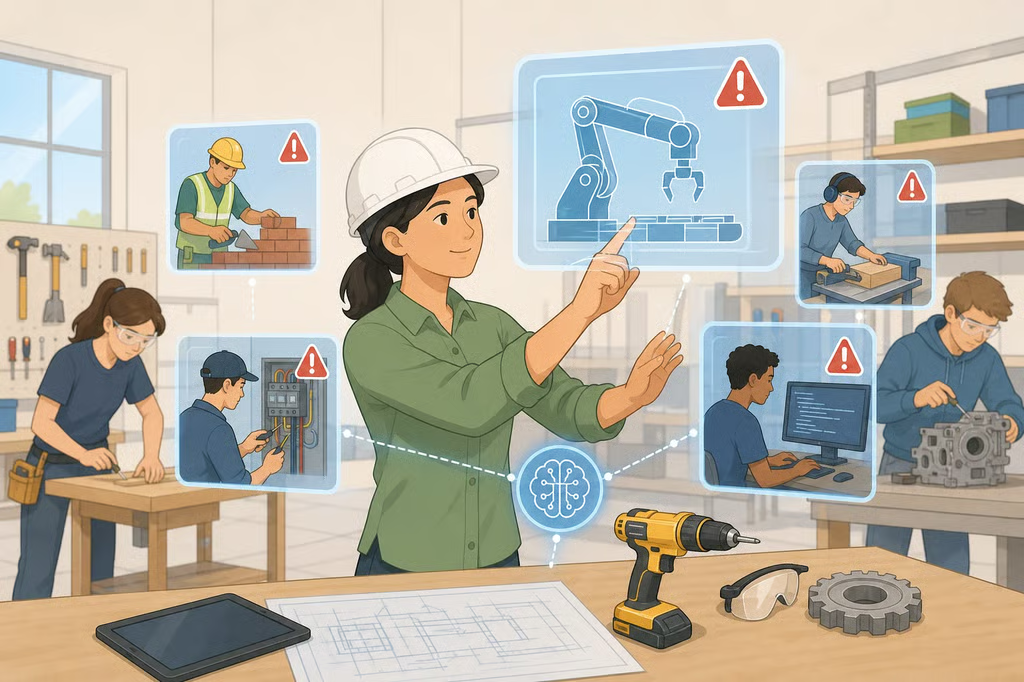
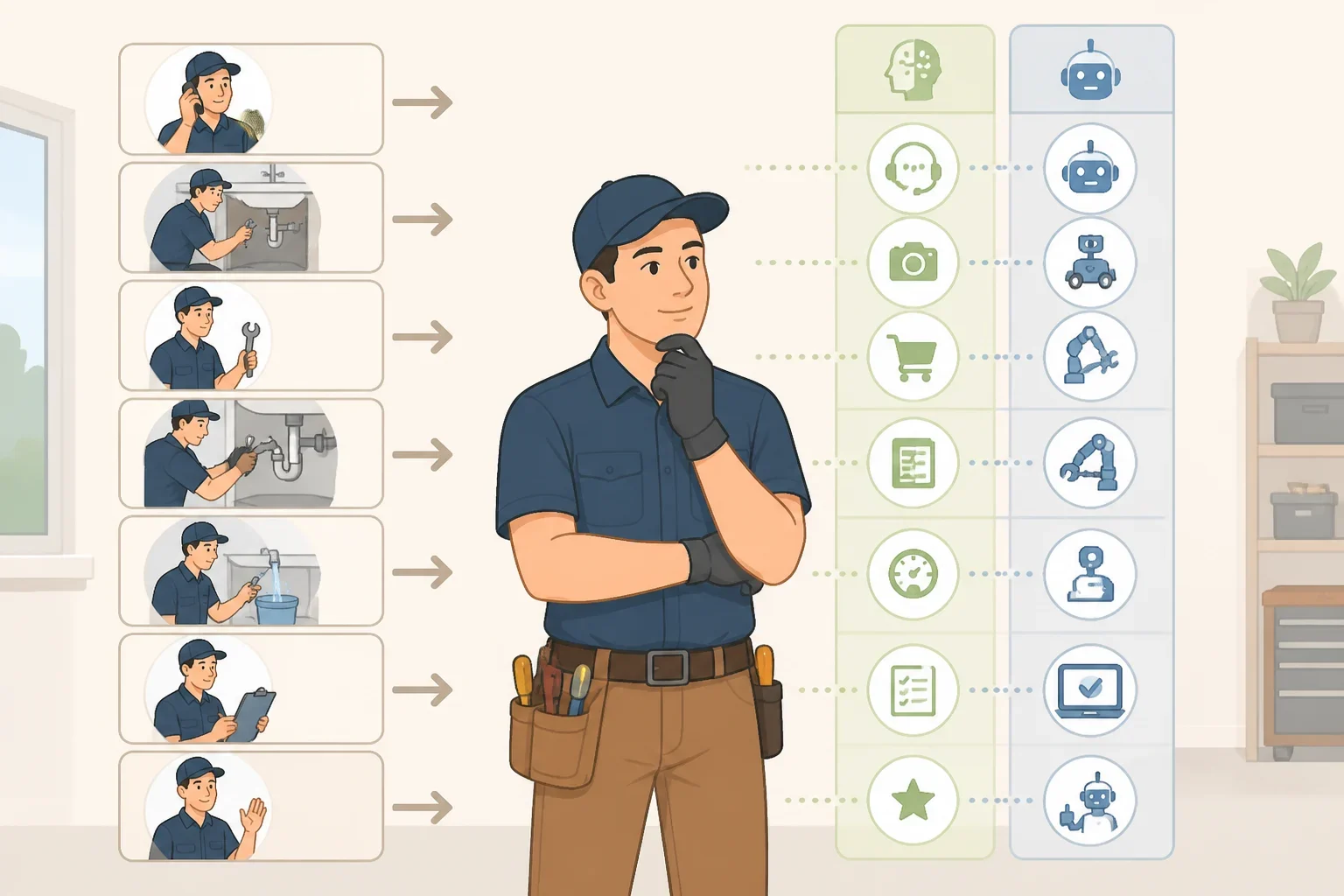
A trade can contain several types of work:
- physical installation, repair, or construction;
- planning, measurement, and documentation;
- customer communication and problem explanation;
- scheduling, dispatch, and inventory coordination;
- equipment monitoring or routine information processing.
Some of those duties may be easier to support with software than others. The World Economic Forum’s frontline analysis from last year describes emerging tools for intelligent scheduling, predictive analytics, conversational AI, hiring, and coaching. The source presents these tools as developments that could reshape frontline work. It does not establish that they are already widespread in welding shops, HVAC companies, or trucking firms.
That difference matters. A future employer may use AI to organize shifts or route jobs without eliminating the worker who performs the repair. In another setting, technology could change the number of people needed for certain tasks or alter the skills employers seek. The outcome depends on how employers adopt the tools, not simply on whether a job is hands-on.
Job quality belongs in the calculation, too. The WEF, citing the International Labour Organization’s 2024 outlook, reports persistent shortages of essential workers in manufacturing, retail, construction, and transport. It links those shortages not only to demographic pressures but also to poor job quality. For frontline workers broadly, volatility can mean unstable schedules, unpredictable earnings, and high turnover, according to the WEF.
AI might help employers coordinate schedules and give workers more information. It might also shift more monitoring and risk onto workers if systems are poorly designed. The WEF warns that responsible use requires safety, transparency, and human oversight, because AI systems can amplify bias, misuse sensitive data, or make working conditions less fair.
A hands-on job can therefore be more resistant to full replacement while still being a difficult job. Resistance to automation is not the same as stability, good pay, or a healthy workplace.
Why retraining is part of the conversation

Young workers’ concern about AI and employment may be real, but concern is not the same as enrollment. No research cited here shows that young adults are choosing welding, HVAC, CDL training, or construction because of AI fear.
Employer expectations help explain why retraining has become part of the conversation. The WEF reported last year that 77% of surveyed employers planned to upskill workers, while 41% planned to reduce their workforce as AI automated certain tasks. These are survey responses about expected actions, not a count of layoffs or completed training programs.
A study described by Northeastern last year surveyed 6,000 Americans and Canadians. Participants evaluated policy responses to economic shock scenarios involving AI adoption or offshoring. Worker retraining ranked as the top policy choice across party lines in that study.
That result supports public interest in retraining. It does not show that young adults are choosing skilled trades, and it does not compare welding, HVAC, trucking, construction, or office-based programs. Northeastern economist Alicia Modestino also pointed to apprenticeships, co-ops, and subsidized education as ways to preserve talent pipelines while AI changes entry-level work.
The study found different views about what AI will do. Some respondents saw AI as a complement that could improve workers’ skills and create new jobs. Others saw it as a substitute for human workers. That disagreement is useful for career planning: a student should not build a plan around either total optimism or total replacement.
What a real retraining pathway can look like
Virginia’s FastForward program offers a concrete example of a short, employment-focused pathway. The Institute of Education Sciences described the model two years ago as a noncredit career and technical education program tied to industry-recognized credentials in high-demand fields identified by the Virginia Workforce Board.
The program uses shared funding from the state, students, and training institutions. It also collects information about enrollment, completion, credential attainment, and labor-market performance. That data collection makes the program easier to evaluate than a course that advertises job preparation without publishing outcomes.
FastForward is not a promise that every short program will work. Its results are Virginia-specific and vary by field. More than 90% of students completed their program, and about two-thirds obtained an industry credential, according to IES. Students who earned an industry credential had average quarterly earnings approximately $1,000 higher and an average employment-probability increase of 2.4 percentage points. These are average program findings and associations, not guaranteed returns for an individual student.
The field made a difference. Transportation credentials, including a commercial driver’s license, and precision-production credentials, including gas metal arc welding, were associated with particularly pronounced earnings premiums. That does not mean every transportation or welding program will produce the same outcome. It does show why “skilled trades” should not be treated as one financial category.
FastForward also serves as a reminder that noncredit training can be a separate route rather than a short stop on the way to a degree. Sixty-one percent of participants had no credit-bearing college enrollment before or after the program, as IES reported. The average enrollment duration was 1.5 quarters, and 78% of students enrolled in only one FastForward program. Some participants were recent high school graduates or older career changers seeking a first job in a chosen field.
For a student comparing options, the lesson is practical: short does not automatically mean weak, and short does not automatically mean sufficient. The credential, employer recognition, hands-on practice, and next opportunity all need to be checked.
How to compare a trade pathway before enrolling

A program should be evaluated as a route into a particular occupation, not as a general escape from AI. Ask the provider and local employers questions such as:
- What exact job does this program prepare students to seek? “Hands-on career” is too broad. Ask for job titles and examples of employers.
- What credential is awarded? Confirm whether it is industry-recognized, workforce-board designated, or connected to a requirement that applies in the intended location.
- Does the field require a license, exam, background check, or other employer-specific condition? Requirements can vary by state, occupation, and employer.
- How long does completion take in practice? Compare scheduled length with the time students actually spend in class, labs, supervised practice, or other required settings.
- What does the work require physically and geographically? Consider lifting, heat, outdoor conditions, travel between sites, shift timing, and access to transportation.
- What happens after the first credential? Ask whether employers provide further training and whether the pathway leads to more advanced duties, credentials, or supervision.
- What are the program’s outcomes? Request completion, credential-attainment, employment, and earnings data for the specific program, not just the institution as a whole.
- What will the student pay? Clarify tuition, equipment, testing, transportation, and lost work time. Ask how funding is divided and whether assistance depends on completion.
- What do local employers actually recognize? A credential can be legitimate without being the credential preferred by employers in a particular area.
These questions apply to HVAC certificates, welding programs, CDL training, construction pathways, and other technical options. They also apply to office and STEM programs. Avoiding all technology-related careers is not automatically safer. The WEF reports growth in both technical roles and frontline work, while also identifying technological skills, cognitive skills, and collaboration as important skills for the coming years.
A better decision rule for skilled trades
The available evidence supports a measured conclusion. Employer expectations point to major skill changes, selected frontline roles are projected to grow, and short, noncredit credential programs can produce useful outcomes when they are tied to recognized credentials and supported by detailed state-level data.
The evidence does not support calling any occupation AI-proof. It also does not establish a nationwide youth shift from office-track education into skilled trades because of AI fear.
The WEF projected last year that 59 out of every 100 workers globally may need reskilling or upskilling by 2030, while 11 may be unlikely to receive it. Those figures concern projected training needs and access, not a count of workers who will lose jobs directly to AI.
Before enrolling, choose the pathway that meets four tests: it leads to a verified local occupation, teaches a credential employers recognize, fits the student’s practical constraints, and publishes outcomes specific enough to evaluate. A counselor, workforce-development office, community college adviser, or training provider can help verify the details.
A program is worth considering because its pathway holds up under those questions, not because its advertisement promises an AI-proof future.