

- New Jersey math standards and college readiness: Rutgers placement explained
- What New Jersey’s math requirements measure
- What Rutgers math placement shows about college readiness in New Jersey
- Why the placement result can affect a student’s path
- What students and families should verify before enrollment
New Jersey math standards and college readiness: Rutgers placement explained
A student may pass algebra, geometry, and another math class under New Jersey’s high school requirements and still be placed below calculus at Rutgers. That possibility captures the problem with treating a diploma, a course title, a high school grade, and a college placement result as interchangeable measures. New Jersey high school math graduation requirements do not measure exactly the same skills as a college placement test.
The question is not whether New Jersey “lowered standards” and caused Rutgers placement outcomes. The available evidence cannot establish that chain of cause and effect. It does show that several academic signals can point in different directions.
The 74 reported Wednesday that about 2,500 students were placed in Rutgers courses below calculus during the previous reporting period. The same report described students in an accelerated precalculus course who had already taken precalculus or calculus in high school, sometimes earning A’s and B’s. Those details raise a practical question for students and families: what does a New Jersey diploma actually certify, and how closely does that certification match the math sequence a particular college or major expects?
What New Jersey’s math requirements measure

New Jersey’s graduation system contains more than one math-related hurdle. Students must pass algebra, geometry, and at least one additional math class to earn a high school diploma, according to The 74. Separately, students must satisfy a graduation assessment requirement. Passing courses and meeting an assessment requirement are related, but they are not the same measurement.
The distinction matters because a course grade usually reflects a student’s work in a particular class, under a particular teacher, with a particular set of assignments and assessments. A statewide graduation assessment is designed for a broader purpose. The New Jersey Department of Education says its statewide assessment system measures progress toward the New Jersey Student Learning Standards, supports consistent reporting and accountability, and is intended to measure college and career readiness (NJ Department of Education).
That stated purpose does not mean the assessment predicts placement into a specific Rutgers course. The state system and a college placement process may ask different questions, cover different content, and apply different performance standards. A student can satisfy one requirement without receiving a result that a particular college uses to place the student into calculus.
The alternative pathways make the distinction sharper. The 74 reported that a student can satisfy New Jersey’s math graduation requirement with an ACT score of 17, while ACT sets a college-readiness benchmark of 22. The 22 is ACT’s benchmark for its own exam. It is not a universal definition of readiness, and it does not establish the standard Rutgers or another college uses for placement.
That point should not be turned into a simple claim that every student meeting the state requirement is unprepared. The evidence does not support that. It supports a narrower conclusion: New Jersey’s graduation pathways can certify that a student has met a state requirement without showing that the student has met every college’s preferred starting point in mathematics.
The same caution applies to two figures cited together in the reporting. New Jersey had a reported graduation rate of 91.8%, while 40% of that year’s graduates had not passed the state high school math exam the previous year, according to The 74. The available account does not make clear whether those figures use identical cohorts or the same testing window. They indicate a tension worth examining, not a precisely matched comparison.
The state’s assessment rules also deserve current verification. An October 2025 state filing proposed changes that included making approved curriculum pacing guides and citations for core instructional materials publicly available. It also proposed support for districts entering dual-enrollment agreements with public colleges (NJ Department of Education). That document describes proposals. It does not, by itself, establish which provisions were adopted after the filing. Families should check the current state or district position rather than assume the proposal is now a requirement.
What Rutgers math placement shows about college readiness in New Jersey
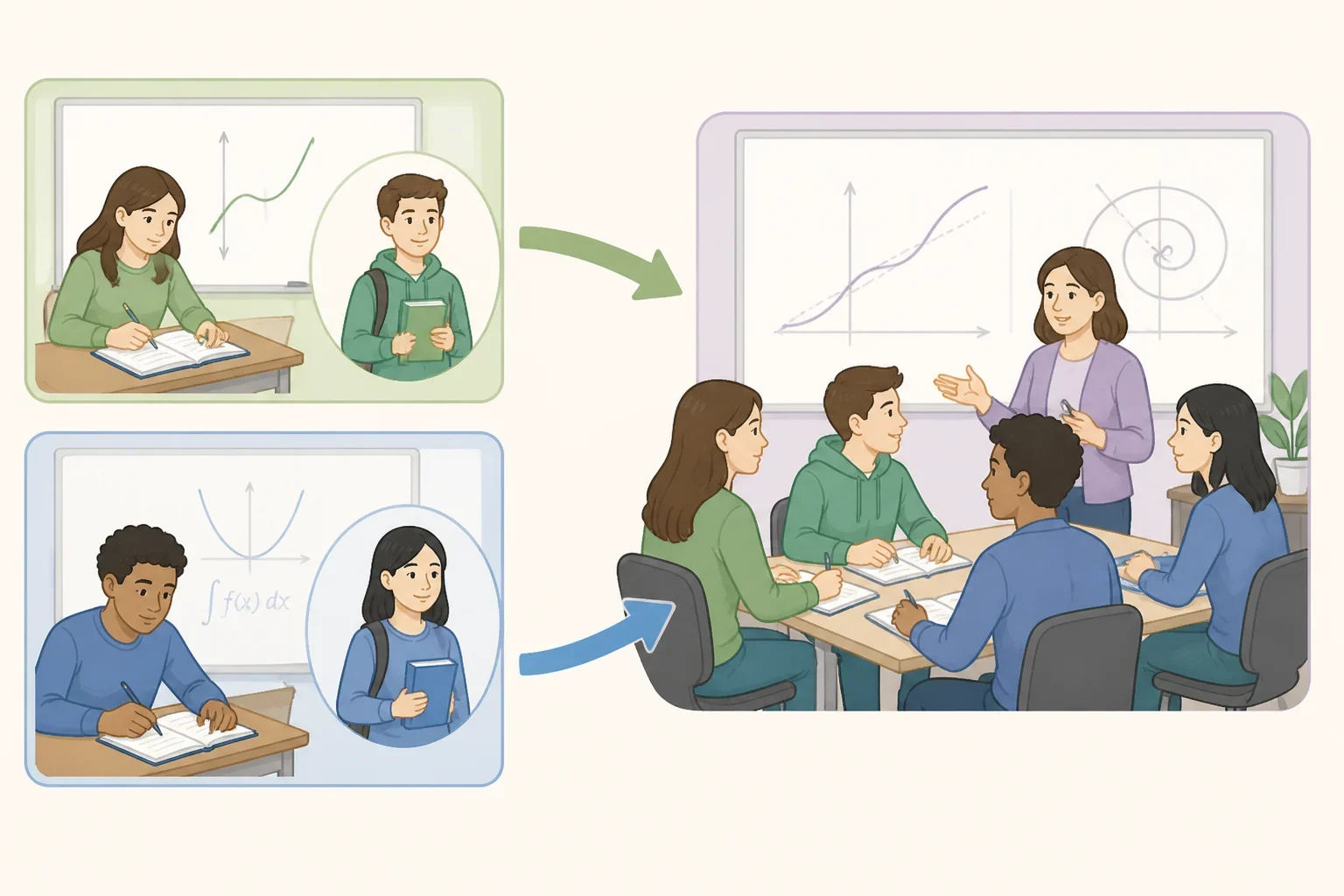
“Placed below calculus” is a broad description, not a complete academic diagnosis. It tells readers that students did not begin in a calculus course, but the available reporting does not identify every course involved, the students’ majors, or the placement process used for each student. A lower starting course may be appropriate for a student whose program does not require calculus. It may also signal a gap for a student whose intended major depends on a longer mathematics sequence.
The Rutgers figure therefore needs context. About 2,500 students were placed below calculus, The 74 reported Wednesday. The reporting does not establish what share of the entering population that represents, whether the number has increased or decreased, or how the students were distributed across majors. Without those details, the figure cannot prove a campus-wide trend or show that New Jersey’s graduation system caused the placements.
The more specific evidence comes from Rutgers math professor Steve Safran. He told The 74 that, on the first day of his accelerated precalculus course, most students said they had taken precalculus or calculus in high school. Many had earned A’s and B’s and were disappointed to be studying the material again.
That is a clearer mismatch than the raw placement count. It connects a high school course history and grades with a college placement outcome in one course. It still does not show that every student placed below calculus had strong grades, or that every high school course labeled precalculus covered the same material.
Another Rutgers instructor described a more basic problem. Some students, the instructor told The 74, arrived unable to add fractions without a calculator and became lost when a problem introduced a variable. Because the instructor was not named and the account does not quantify how many students were affected, it should be read as an instructor observation, not a description of Rutgers students as a whole.
These accounts point to several possible explanations for a placement result. A student may have passed a course but retained gaps in foundational skills. A course may have emphasized procedures without giving enough practice applying them in unfamiliar problems. A student may have earned a strong grade in one setting and then encountered a different test format, pace, or expectation in college. The supplied evidence does not identify which explanation is most common.
That uncertainty is useful. It keeps the discussion focused on alignment rather than blame. A placement test is not a verdict on a student’s ability, and a high school grade is not proof that a student will begin every college math sequence at the same point.
Why the placement result can affect a student’s path

For students whose majors require a particular math sequence, placement can change the order and timing of their coursework. The report says students may need additional semesters of prerequisites before reaching courses required for their majors. It also says some students switch majors or leave college, while others take more time and money to complete a degree (The 74).
Those are reported possible consequences, not measured outcomes for all 2,500 Rutgers students. A student placed below calculus may complete the sequence successfully, use a different course that satisfies the major, or discover that the original major does not require calculus after all. The effect depends on the institution, the program, the student’s schedule, and the support available.
Timing can still matter. New Jersey families typically wait until October for state assessment results, while Ohio requires districts to share results with parents by June 30 and Virginia says parents must wait no more than 45 days, according to The 74. A New Jersey superintendent described the delay as having “an eye patch over one eye” while flying a plane.
It is reasonable to infer that later information gives schools and families less time to respond before a student moves from high school into college. A school may have fewer opportunities to adjust a course plan, arrange additional instruction, or help a student investigate summer learning. That is an inference from the timeline, not a measured finding showing that delayed results caused Rutgers placements.
The cited reporting also leaves an equity question unanswered. It does not provide a detailed breakdown of the New Jersey assessment pathways or Rutgers placements by income, race, or district. Without that information, the evidence cannot show which students are most likely to experience a mismatch between their high school record and college placement result.
That missing detail matters for policy and for individual planning. A statewide average or a campus-wide count cannot tell a student whether a particular course sequence is a good fit. Students need information tied to their own intended program and institution.
What students and families should verify before enrollment

A completed course and a passing grade are useful evidence of preparation, but they should be treated as part of a larger check. Before enrollment, students should ask the college that they are considering for its current mathematics placement policy and course sequence. The question should be specific: What result places a student into the first math course required for the intended major?
The major itself should be part of the conversation. A student considering a math-intensive program should ask whether the degree requires calculus, statistics, or another sequence. The student should also ask what happens if placement falls below that course and whether the lower course counts toward the degree or functions as preparation for a later requirement.
Useful questions include:
- Which mathematics course is the first requirement for the intended major?
- What placement result allows a student to enroll in that course?
- Does a high school precalculus or calculus course affect placement, or is placement determined separately?
- If a student places below the expected course, what sequence follows?
- Are there refresher, corequisite, summer, or other support options, and do they apply to the student’s program?
- Can the college provide a sample first-year schedule showing how a lower placement affects later courses?
The answers may differ by campus, college, major, and academic year. A student should ask the mathematics department, advising office, or admissions office rather than rely on a general statement about Rutgers or another university.
High school families can also ask a counselor for more detail than a transcript course title provides. What topics does the course cover? How much time is devoted to algebraic manipulation, fractions, equations, functions, and problem solving? Does the student’s recent work show understanding without a calculator? These questions do not replace a college’s placement process, but they can reveal where review would be useful.
District transparency is another item to verify rather than assume. The October 2025 New Jersey filing proposed public access to pacing guides and core instructional-material citations, along with support for dual-enrollment agreements (NJ Department of Education). Families can ask whether their district currently posts those materials and what college-course opportunities are available. They should confirm the answer through the district or state, since the filing alone does not establish the current rule.
New Jersey’s math standards and college readiness debate is ultimately about signals. A diploma shows that a student has met a state pathway. A course grade reflects performance in a particular class. A college placement result estimates where the student should begin in one institution’s sequence. Those signals can agree, but they do not have to.
Before assuming that a course title or grade guarantees placement into credit-bearing calculus, compare the intended major’s math sequence with the college’s current placement policy. That single check can turn an unexpected result into a plan made before enrollment, rather than a problem discovered after the first semester begins.