
- Automatic speech recognition for reading assessment: why it should support specialists, not replace them
- The staffing problem is real, but its scope matters
- How speech recognition for student reading works
- Task-level results matter more than one accuracy claim
- Automatic speech recognition bias in education is a validity issue
- What districts should ask before adoption
Automatic speech recognition for reading assessment: why it should support specialists, not replace them
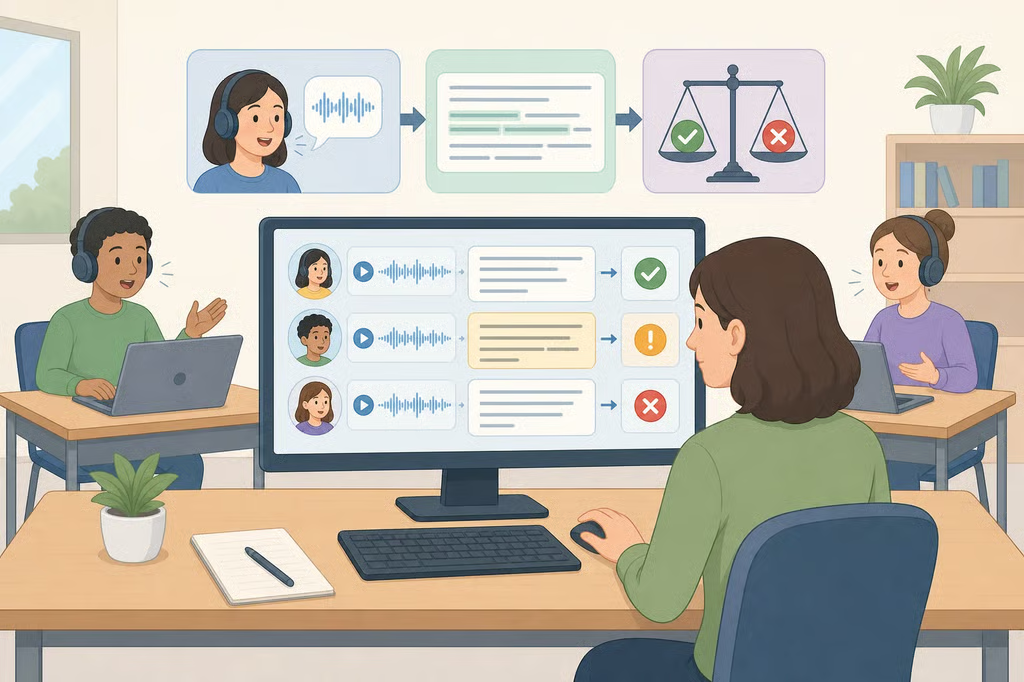
Schools need practical ways to identify reading difficulties when trained staff are stretched thin. Automatic speech recognition for reading assessment may help, but it should remain decision support, not a replacement for a reading specialist, speech-language pathologist, or other qualified school professional.
That position applies to district administrators, literacy coaches, reading specialists, speech-language pathologists, and parents reviewing AI reading assessment tools. A system can capture a child’s spoken response and compare it with a target. It cannot reliably determine why the response occurred, whether it reflects a reading difficulty or a language variation, or what support the student needs without professional review.
The staffing problem is real, but its scope matters
Special-education personnel shortages create pressure to find tools that save time. Last year, OSEP reported that 45 percent of schools had vacancies in special-education roles and 78 percent had difficulty hiring special-education staff. The agency also said shortages had worsened since the COVID-19 pandemic.
Those figures need careful use. They describe special-education personnel broadly, not reading specialists or speech-language pathologists specifically. A district should not present them as direct proof of a shortage in every literacy-related role. They do show why schools may consider automated literacy assessment, meaning software that uses spoken student responses and related algorithms to help organize or score literacy information.
Federal investment also shows that staffing remains a workforce issue, not a problem technology can simply erase. In fiscal year 2024, OSEP awarded more than $80 million under the Individuals with Disabilities Education Act, including more than $17 million for 78 new personnel-preparation and professional-development grants, according to OSEP. Tools may extend professional capacity, but they do not replace the need to prepare and retain qualified staff.
Last year, ASHA described clinical AI as something to evaluate within an evidence-based practice model that combines client perspectives, professional expertise, and research evidence. That standard is useful for schools, too. An AI score can be one piece of information, but it should not become the decision-maker.
How speech recognition for student reading works
The research examined a speech-verification system, a form of automatic speech recognition, in early-literacy screening. The system captured audio, extracted acoustic information, and produced a confidence or target score for a child’s response. In plain terms, it compared what a child said with the response expected for a particular task, as Frontiers in Education reported seven months ago.
That is narrower than saying the system “understands” a child’s reading. The study evaluated the SoapBox Labs speech-verification pipeline across phoneme blending, expressive vocabulary, and word reading. It compared system classifications with human-rater scores, rather than testing every kind of ASR or every form of reading assessment.
The analysis included 429 kindergarten students recruited from 20 schools across three states and followed through the end of the academic year, according to Frontiers in Education. The setting gives the findings practical relevance, but it also limits how broadly they should be applied. A kindergarten screening study cannot establish how the same tool will perform with older students, in another district, or for a different decision.
Most importantly, the study measured agreement with human raters. Agreement provides evidence about scoring consistency. It does not prove diagnostic validity, show that the tool improves reading outcomes, or demonstrate that students receive better interventions.
Task-level results matter more than one accuracy claim
The study found that agreement varied by task. Human raters and the system showed lower consistency on phoneme blending, a phonologically complex task that asks children to combine individual sounds into a word, than on expressive vocabulary and word reading. Frontiers in Education reported poor overall agreement across the tested confidence thresholds, with mean Cohen’s kappa values ranging from 0.15 at Target 50 to 0.09 at Target 90.
The figures should not be treated as one broad measure of tool accuracy. At the Target 50 threshold, mean human-rater accuracy for expressive vocabulary was 78.94 percent, compared with 73.54 percent for the system. For word reading, the corresponding figures were 62.38 percent and 60.32 percent, according to Frontiers in Education.
Those closer results on two tasks do not automatically establish validity. They do show why districts should request task-by-task results instead of accepting a vendor’s overall accuracy claim. A tool might be more consistent for one type of response and much less consistent for another. A single dashboard score can hide that difference.
Before adopting a tool, educators should ask:
- Which reading or language tasks were tested?
- How closely did the system agree with trained human raters on each task?
- What happened when the confidence threshold changed?
- Were results examined at the item, task, and student levels?
- What evidence supports using the score for screening rather than diagnosis or placement?
Screening can flag students who may need a closer look. Diagnosis and placement require a broader interpretation of a student’s skills and needs.
Automatic speech recognition bias in education is a validity issue
A diverse sample is a genuine strength, but it does not settle every fairness question. The kindergarten study included Black, White, multiracial, Hispanic, Asian, and Pacific Islander students, along with students identified as English learners. Its task-level analyses included the full sample, Black participants, and White participants, according to Frontiers in Education.
The relevant question is not only who participated. It is whether system scores remain consistent with human judgments for the students and speech varieties represented in the intended setting. The researchers called for continued study of scoring consistency across groups and more diverse speech-sample collection. The study did not report documented over-referral or under-identification outcomes, so those effects should not be claimed.
A study listed in the NSF Public Access Repository frames this issue as one of testing fairness and validity. It describes how training data can underrepresent varieties of English other than General American English and notes that ASR has been more problematic for African American English speakers in adult studies because of differences in prosody, pronunciation, word usage, and grammar. The repository indicates that the content will become publicly available next year, so it should not be presented as a fully accessible 2026 study.
This is why bias in AI reading assessment is more than a public-relations concern. If a system treats an unfamiliar pronunciation or speech pattern as an incorrect reading response, its score may not measure the skill the school intends to measure. Sample diversity is necessary. Subgroup agreement rates are what help determine whether scoring is equitable.
The NSF-listed work also describes efforts to use child speech and text corpora to improve scoring algorithms for African American English speakers and, in some experiments, children with oral-language and reading difficulties. NSF data reports favorable early results, which offer possible directions for more inclusive assessment. They do not eliminate the need for independent validation with the students a district serves.
What districts should ask before adoption
ASHA’s framework is not a reading-assessment validation study, and its discussion of computerized speech-sound learning systems does not prove that every ASR reading tool is ineffective. Its value is practical. It gives schools a disciplined way to examine validity, reliability, generalization, and ethical use.
A district evaluating an AI reading tool should ask:
- What was validated? Does the evidence concern the exact task, age group, language context, and intended use? A tool studied for speech-sound therapy is not automatically validated for early-literacy screening.
- Who was tested? Does the evidence include the populations the district serves, including relevant language and speech varieties? Overall results are not enough.
- How was the system tested on new students? ASHA guidance explains that overfitting occurs when a system performs well on training data but fails to generalize to data it has not seen before.
- What does the score mean? A confidence score, classification, screening flag, diagnosis, and placement recommendation are different things.
- What happens when the system is uncertain? The process should preserve relevant response information for qualified review rather than forcing every result into a final correct-or-incorrect category.
- What evidence supports the intended decision? Validity is the primary technical concern for standardized tests, while reliability concerns consistency across measurements, contexts, or raters, according to ASHA guidance.
The governance line should be clear. Results may flag a student for review, but the vendor, dashboard, or classroom teacher acting alone should not make the final decision. A qualified school professional should review the result alongside other evidence and follow district procedures and applicable education rules.
Parents can ask which professional examines an AI-assisted result, whether the tool is being used for low-stakes screening or a higher-stakes decision, and how the school handles disagreement between the system and a human reviewer.
Automatic speech recognition may help organize early-literacy information for some tasks. The evidence does not support handing it the final say. Before purchase, districts should request task-level and subgroup validity data, confirm the intended use, and require a written process for qualified human review. Use the technology to focus a specialist’s attention, then let trained professionals interpret the student’s response in context.