
- Do students still need to learn calculus? Check your major first
- What California's graduation minimum actually requires
- The completion gap: calculus-ready students starting below calculus in California
- Who starts behind in California, and why the pattern matters
- Is calculus important for college and careers? How to check your own requirement
- What to check before you finalize your math schedule
Do students still need to learn calculus? Check your major first
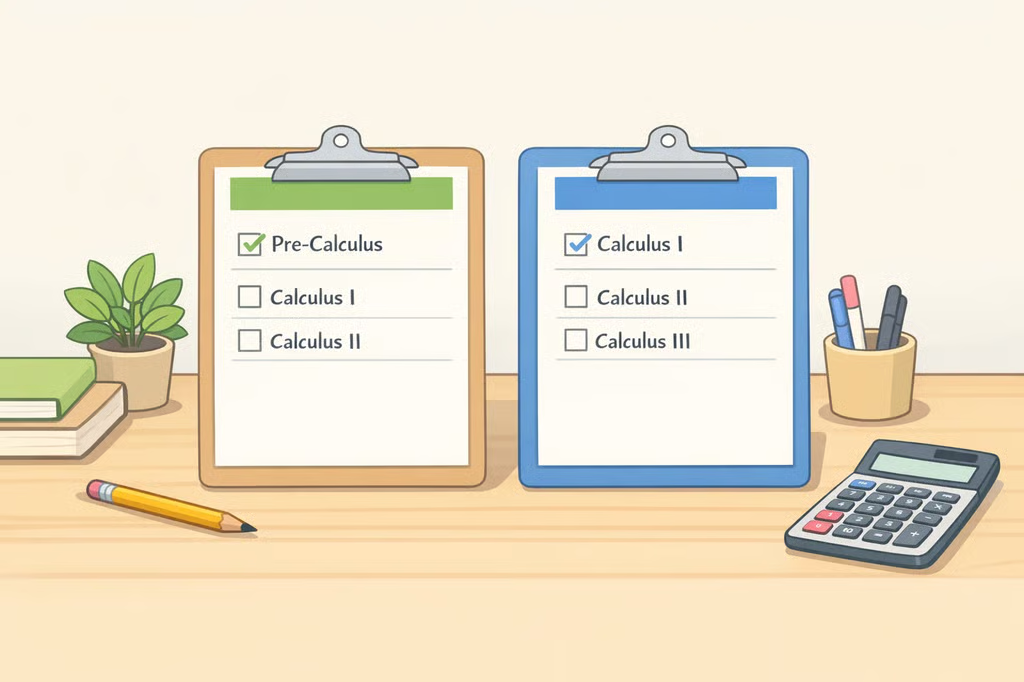
Do students still need to learn calculus? That question is too broad to answer usefully without knowing the student's program. The sharper version is narrower: does the major or program you're actually aiming for list calculus as a requirement, and will your school's course sequence get you there without unnecessary detours?
The California graduation minimum reviewed here doesn't require calculus at all (California Department of Education), and nothing in the research behind this article shows calculus as a universal requirement for a math career, either. But for students heading into specific STEM majors, calculus still functions as a real gatekeeper course. The best-documented problem in the research reviewed here isn't whether calculus should exist. It's that students who already proved they were calculus-ready in high school are often placed into extra prerequisite courses first, a pattern tied to lower two-year completion rates in one large California cohort (MMAP/ERIC).
This article separates two layers of math requirements that the cited policy documents actually address: what your state or district requires for a diploma, and what your intended major or transfer program requires once you get there. A third layer, each college's own freshman admission course requirements, varies by institution and isn't covered by the research here. Check that separately with each school on your list.
AP Calculus AB test-taking rose from 251,639 students in 2021 to 285,891 in 2025, per College Board exam data. That's a rise in participation, not proof of universal demand, since diploma and admission policies vary by state and school.
The rest of this guide uses California's community college system as a case study of what happens when calculus-ready students get placed below calculus, then walks through how to check your own major's requirement.
What California's graduation minimum actually requires
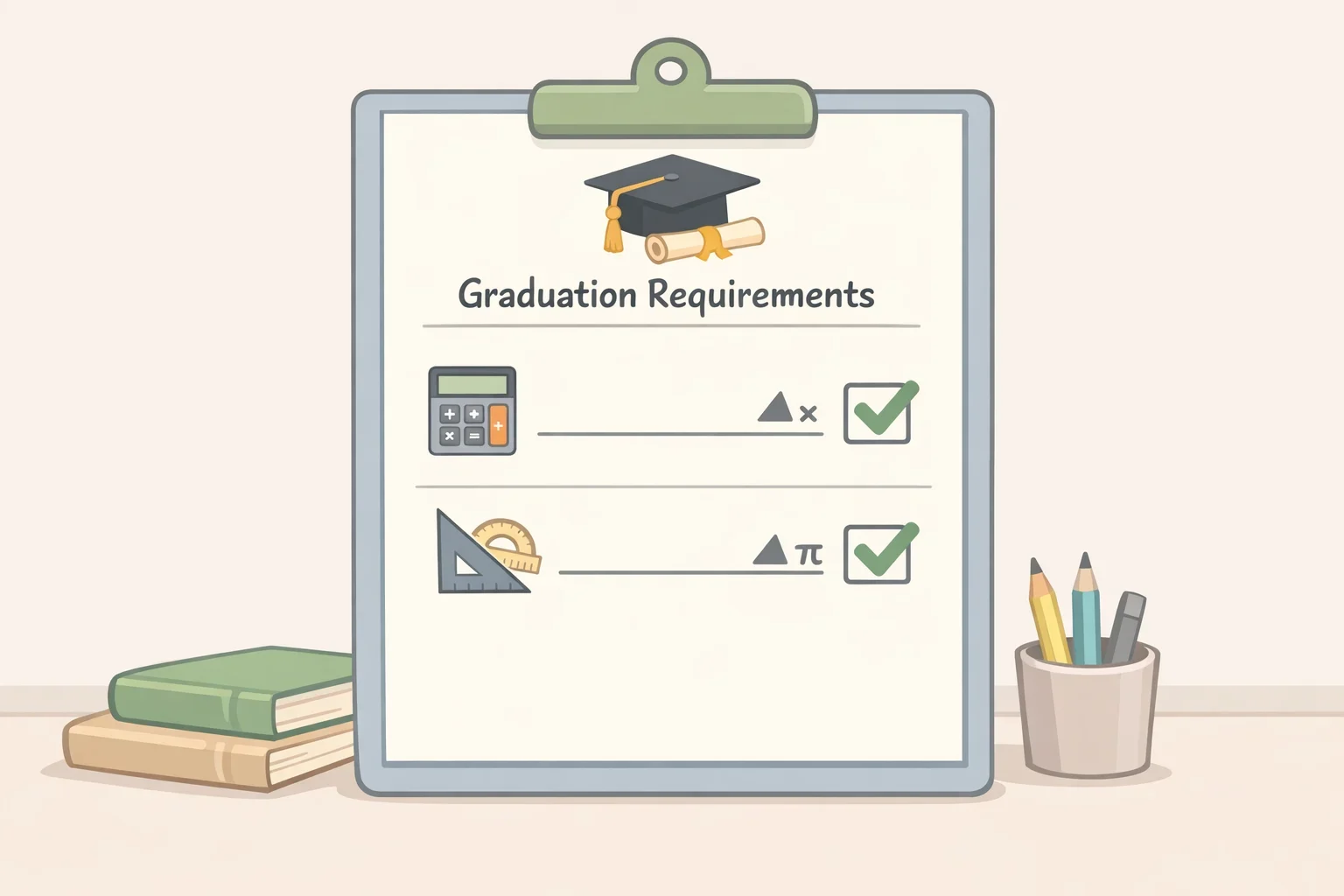
California's graduation code is a clear example of how low that floor can sit, and it applies only within California, not nationally. Under Education Code Section 51225.3, the state requires just two math courses, one of which must be Algebra I. Calculus, precalculus, and even Algebra II aren't part of the statewide minimum (CDE). That's a floor, not a ceiling; local districts may add requirements on top, though the state doesn't require them to.
A major or transfer program tells a different story. California's Assembly Bill 1705 was written specifically to strengthen completion of the first STEM calculus course for students in STEM programs, which shows calculus operating as a formal program-level checkpoint in California's community college system, separate from any diploma rule (MMAP/ERIC).
Don't assume a major requires calculus just because it sounds technical, and don't assume it doesn't just because your diploma never did. Pull up the official prerequisite list on the intended major's degree page at each college you're considering, not a general catalog description, and note whether calculus is listed as required, recommended, or not mentioned at all.
The completion gap: calculus-ready students starting below calculus in California
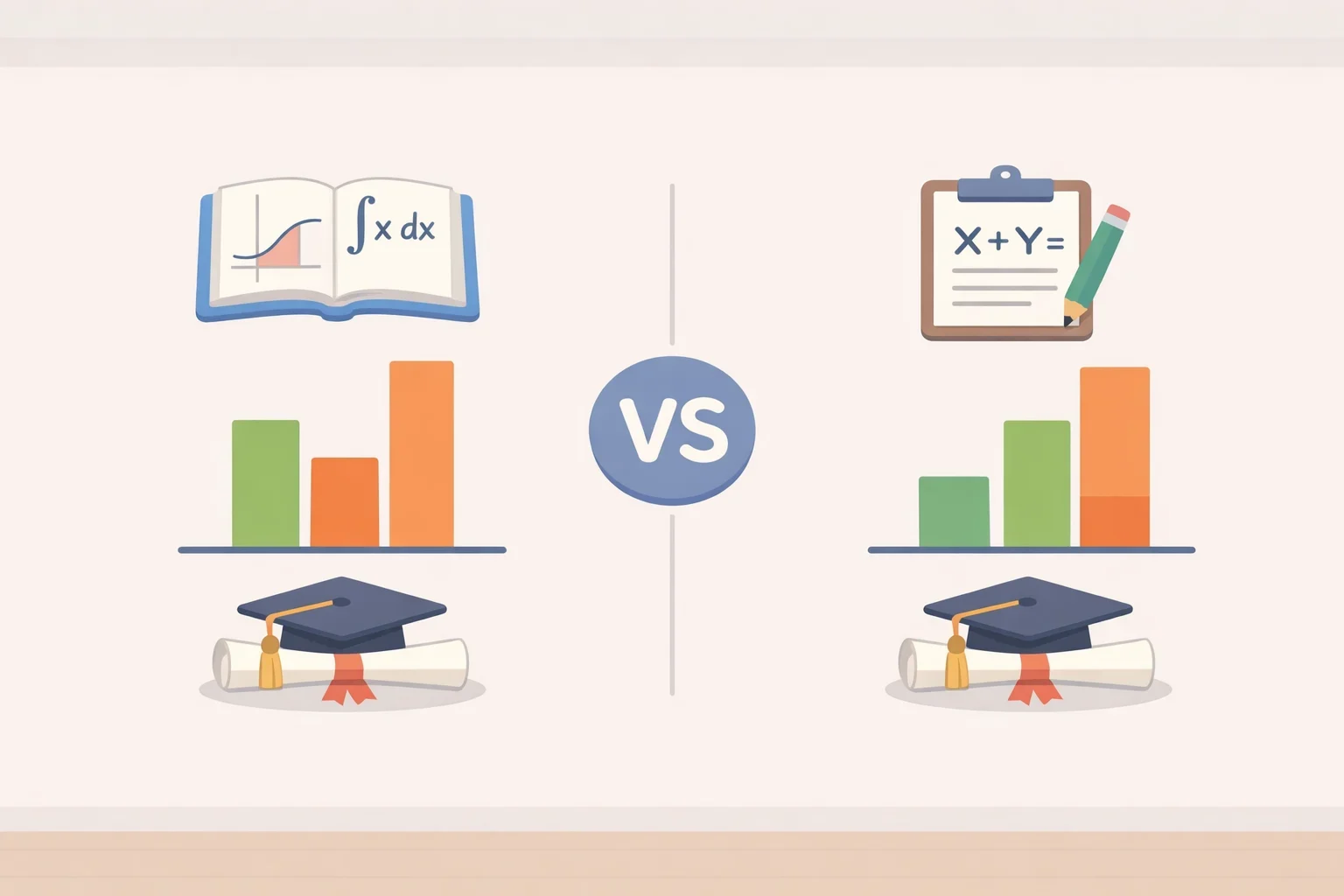
The clearest evidence in the research reviewed here on what happens next comes from a 2024 analysis of California's community college system, not from a national dataset. Researchers tracked more than 37,000 STEM majors who enrolled in math between 2012-13 and 2019-20 and found 69% started in a preparatory course below Calculus I rather than enrolling directly (MMAP/ERIC).
Students placed below Calculus I had lower two-year completion rates in this cohort. Students who had already completed calculus in high school but were placed into a lower college course finished Calculus I within two years at a 46% rate, compared with 86% for students who started directly in Calculus I. Students who repeated trigonometry or precalculus in college despite finishing it in high school completed at 37%, versus 73% for direct enrollment (MMAP/ERIC).
The report's own conclusion is direct: based on its analyses, no group defined by level of high school math preparation was considered highly unlikely to succeed with direct enrollment in calculus.
The comparison has an important limitation, though. A secondary analysis in the report excluded roughly 14,585 students who started in a prep course but hadn't reached calculus within the two-year window it studied. That's a limitation of that specific comparison, not evidence that college policy shut those students out of calculus entirely.
This data is bounded to California community colleges, and it's observational, meaning it shows an association, not proof that prep courses caused lower completion. Even with that caveat, it's the clearest pattern in the research reviewed here suggesting extended readiness sequences can work against students who already demonstrated calculus readiness in high school. If a college you're considering places students below calculus by default, ask the math department what share of students in that starting course go on to complete Calculus I within two years, and ask whether the placement policy allows direct enrollment based on prior coursework.
Who starts behind in California, and why the pattern matters
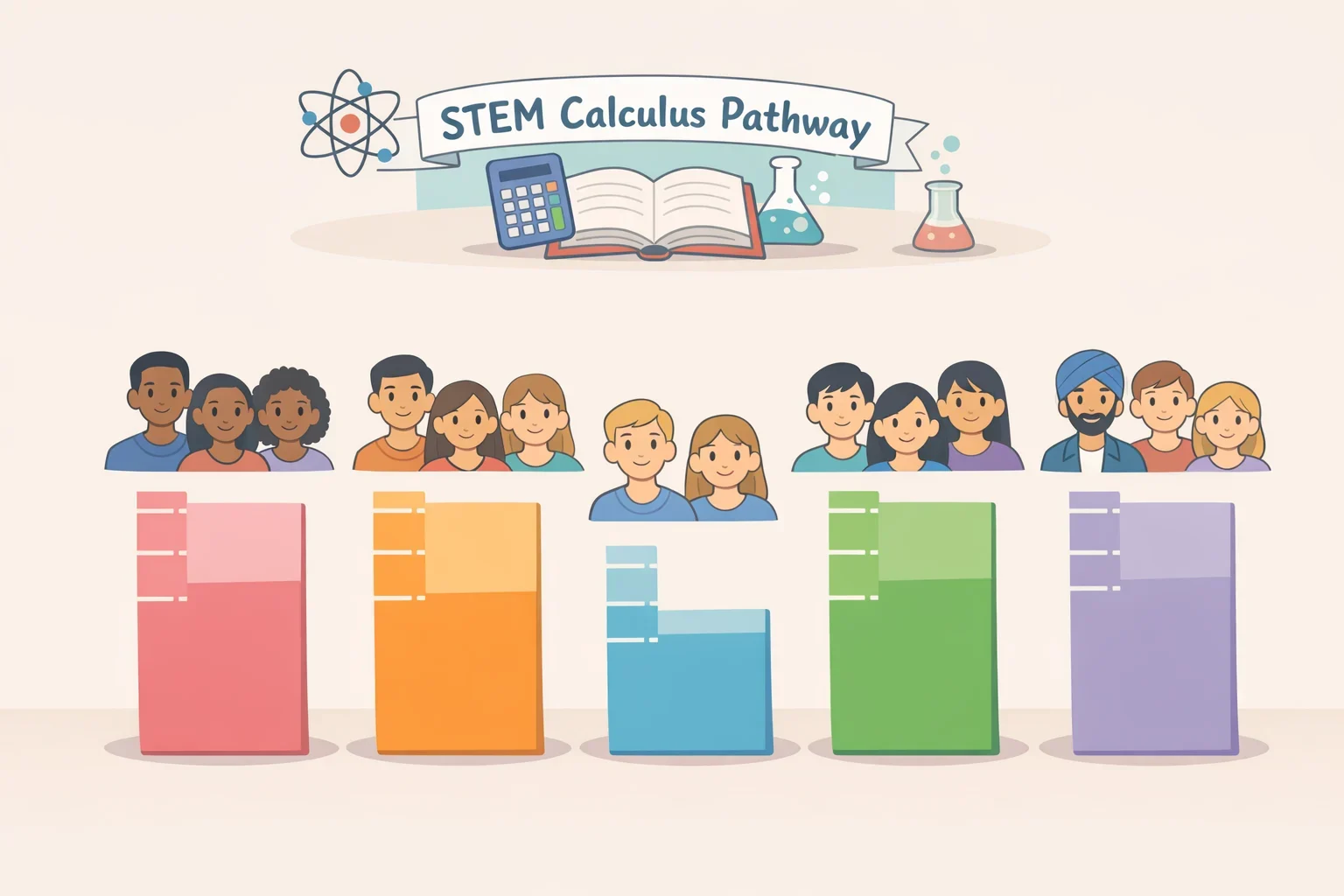
Placement patterns aren't distributed evenly, and the same report documents where the gaps show up. Between 2012-13 and 2019-20, 75% of Black students and 75% of Hispanic students in California's STEM calculus pathway began in a preparatory course, compared with 58% of Asian students and 66% of White students (MMAP/ERIC).
The completion gap tied to that placement was wide. Among students placed below Calculus I, 32% completed it within two years, versus 78% of students placed directly into it, a gap the report says persisted even after disaggregating by high school math preparation and GPA (MMAP/ERIC).
Be precise about what this data does and doesn't show. The report identifies an unequal placement pattern; it doesn't establish why the pattern exists. The gap could reflect differences in high school course access, counseling, or placement practices, and the report doesn't isolate a single cause. The report places AB 1705 within a broader effort to improve equitable completion outcomes and economic mobility across the California community college system (MMAP/ERIC).
If you're evaluating a community college's placement approach, ask whether it uses multiple measures, such as high school GPA and completed coursework, rather than relying on a single placement test. That's a specific, answerable question for an advising or math department office. The research here doesn't show that multiple-measure placement alone produces better outcomes, only that it's a policy choice tied to where students in this cohort started in the pathway.
Is calculus important for college and careers? How to check your own requirement
Some argue that most careers never use calculus, so schools should shift emphasis toward statistics and data literacy instead. There's real evidence behind part of that argument, though it's more modest than it might sound.
Student Achievement Partners examined six states that revised their high school math standards since 2020 and found every one increased emphasis on inverse functions beyond Common Core levels, with matrices and probability content also gaining broader adoption, a pattern the authors interpret as a response to data-driven college and career needs (Student Achievement Partners, published earlier this year). The same six states pulled back on radians, periodic trigonometry, and completing the square.
SAP is careful about what this shows. The organization describes the memo as a starting point, not a conclusion, and notes it covers only six states. It documents a curriculum shift, not outcomes, admissions results, or whether a statistics course actually substitutes for calculus in practice. The standards evidence adds context, not a substitute for checking requirements.
Separate three situations, then verify each directly rather than assuming a pattern based on your field of interest.
- If a major's official prerequisite page lists calculus by name, it's required. Verify this on the program's own page rather than a general description.
- If a program's page lists calculus as recommended, or doesn't mention it, don't assume a pattern based on the subject area alone. The MMAP analysis includes biology, engineering, computer science, and math majors in its STEM calculus pathway, but you still need to verify the exact requirement for your program, since prerequisites for business, health-science, and social-science programs vary widely between schools.
- If you're undecided between a STEM and non-STEM path, taking calculus is one way to keep more doors open as a planning consideration, since it satisfies prerequisites for majors that require it later, while a statistics or quantitative-reasoning course may satisfy a different set of programs. Course acceptance and prerequisites vary by institution, so confirm the specific requirement instead of guessing from the subject label.
What to check before you finalize your math schedule

None of the evidence above replaces checking your own situation directly. Before finalizing a math course sequence, gather four documents:
- Your state or district's graduation requirements page
- The official prerequisite list on your intended major's degree page at each college you're considering
- Each target college's freshman admission course requirements page, checked separately since this varies by institution and isn't addressed by the research above
- If you're community-college bound, the math department's placement policy, including whether it uses multiple measures or a single test
One point from the California data is worth keeping in mind while you compare these documents. When researchers tested whether restricting direct calculus access helped less-prepared students, the comparison found small to modest conditional gains for that group, but it excluded students who hadn't reached calculus within the study's two-year window, which limits how broadly that result can be interpreted (MMAP/ERIC).
Compare what each document actually says, required, recommended, or not mentioned, instead of relying on one course description or general advice. Confirm the current version of each document directly with the school's counseling, admissions, or advising office before you register for next term's math course.