

- LinkedIn Ghostwriting with AI: LinkedIn's AI Slop Crackdown
- What LinkedIn is actually flagging
- How professional LinkedIn ghostwriting works
- How LinkedIn ghostwriting with AI still requires human approval
- Weighing self-writing, AI assistance, and paid help
- What students and early-career users may need to verify
- What to do next
LinkedIn Ghostwriting with AI: LinkedIn's AI Slop Crackdown
LinkedIn said in May that it was expanding systems designed to identify generic or repetitive content, including what it calls "AI slop," according to a company post by Laura Lorenzetti (LinkedIn). In an initial test, the company said those systems correctly identified generic content 94% of the time, and said it was also targeting comments posted at scale by automation tools with little or no human involvement (LinkedIn).
That announcement lands on a practice that combines two existing activities: LinkedIn ghostwriting and AI-assisted drafting, together often described as LinkedIn ghostwriting with AI. Whether someone drafts their own posts with a model's help or pays a ghostwriter who uses AI in the process, the change affects anyone posting under their own name. If you're a college student building a presence for a job search, a career changer establishing a new professional identity, or an early-career professional posting for the first time, this affects how anything AI helps write should be treated before it goes out under your byline.
What LinkedIn is actually flagging

LinkedIn's own language matters here. The company says its systems are trained to recognize signals of AI slop and flag content that "feels generic or repetitive, even if it appears polished on the surface," not to confirm that it can detect AI involvement itself (LinkedIn). Using AI to help write a post isn't the stated target. Posting something with no real perspective behind it is.
Taplio, a company that builds LinkedIn writing tools, notes there is no public confirmation that LinkedIn detects or demotes posts specifically for being AI-assisted (Taplio). The documented platform concern is generic or repetitive content, not confirmed AI authorship detection.
How professional LinkedIn ghostwriting works
Ghostwriting is an established practice, and LinkedIn providers now apply it to posts, profile copy, and other content (The Digital Writing Firm). On LinkedIn, it typically means a writer produces posts that publish under someone else's name and voice, while the account holder supplies the ideas, the expertise, and final approval (The Digital Writing Firm).
Agencies describe the process as a repeating cycle: strategy and voice discovery, content planning, drafting, review and approval, publishing, and performance tracking (Windmill Growth).
Windmill Growth, an agency selling this service, describes a 60 to 90 minute kickoff interview as the starting point. Voice discovery can continue well beyond that call: the agency says full calibration typically takes two to four weeks before drafts need only minor edits (Windmill Growth). A separate agency, The Digital Writing Firm, reports a similar setup: a 45 to 60 minute recorded interview, followed by roughly one to two hours of client time per month for review and approval (The Digital Writing Firm).
In the provider descriptions reviewed here, the client supplies source material, topics, and reactions to proposed drafts. The writer or agency turns those inputs into a content plan, prepares posts for approval, publishes or schedules them, and reviews metrics such as impressions, profile views, connection requests, and inbound messages (Windmill Growth). Those metrics describe an agency-reported workflow, not evidence that ghostwriting produces any particular career result.
Both time estimates above come from agencies selling the service, so they read as vendor-reported examples rather than a guarantee of how any individual engagement will run.
How LinkedIn ghostwriting with AI still requires human approval

Taplio describes the workflow as three inputs, regardless of who or what does the actual typing: past posts, which teach a model how a person sounds; notes or voice memos, which supply what they actually want to say; and an edit, which removes what the model guessed at (Taplio). Skip the first input, that source says, and the result reads like generic AI writing. Skip the edit, and a person ends up publishing AI writing with their own name attached to it.
AI runs into a hard limit on anything that requires having actually been somewhere. Taplio says that asked for an anecdote it doesn't have, a model may produce a plausible invention rather than admit it has nothing to offer, which the same source calls the most common way AI-assisted posts damage someone's credibility (Taplio).
Numbers carry a similar warning, per that source: a model tends to default toward an agreeable middle that nobody argues with, and any statistic it offers unprompted should be treated as unverified until it's checked against a real source (Taplio). Taken together, the sources reviewed here describe AI as changing the drafting step while leaving approval and source material with the account holder.
The line practitioners draw isn't about which tool did the drafting. It's about ownership. Taplio and The Digital Writing Firm both describe writing assistance as defensible when the ideas and experiences are genuinely the publisher's own and every line gets read and approved before it posts. Both sources describe it as impersonation when a draft invents an experience, cites an unverified number, or states an opinion the person doesn't actually hold (The Digital Writing Firm; Taplio).
Taplio frames a simple test for anything AI-assisted before it publishes: if someone commented asking for more detail on a specific sentence, could the person publishing it actually supply it? (Taplio)
Weighing self-writing, AI assistance, and paid help
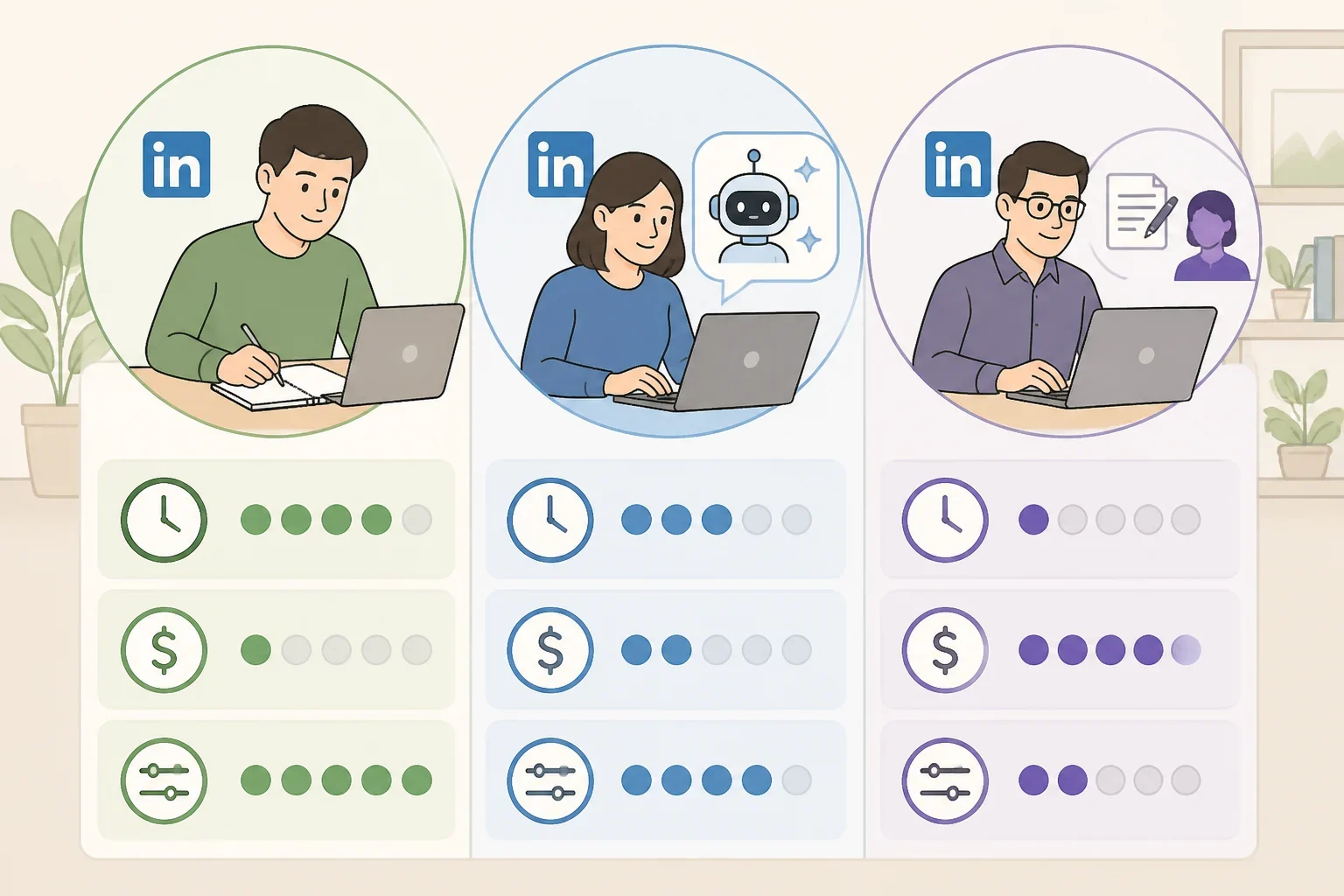
Three basic paths exist, and each trades time, money, or control differently. The figures behind them come primarily from companies that sell ghostwriting, content, or related tools. They illustrate how providers describe the work, not an independent survey of LinkedIn users or a market-wide pricing study.
- Write every post yourself. No financial cost, but ongoing time. The Digital Writing Firm estimates three to five hours a week, indefinitely, and says consistent, decent posting can outperform a skilled ghostwriter hired for just a month (The Digital Writing Firm).
- Use AI to help write your own posts. This shifts the time cost from drafting toward gathering input and editing. Taplio says feeding a model 10 to 20 of a person's own past posts, plus notes or voice memos for someone newer to posting, shapes the output more than how a prompt is worded (Taplio). Skipping the edit step, per that source, is what turns AI assistance into publishing AI writing under someone's name rather than AI writing in their own voice.
- Hire a ghostwriter or agency. This trades money for time. The Digital Writing Firm reports mid-tier retainers of $1,500 to $3,500 a month, with per-post rates between $300 and $800, by its own account rather than an independent market survey (The Digital Writing Firm). That source frames the fit narrowly: it works, in its telling, when someone already knows what they'd say and simply lacks time to say it, not when someone hopes a writer will generate expertise they don't have.
Across the wider ghostwriting field, which covers books and speeches as well as social posts, a 2025 industry survey found 61% of writers rely on AI for some kind of support, while only 7% use it to generate content outright (Association of Ghostwriters). That survey describes a similar split between support use and outright generation, though it measures book ghostwriters rather than LinkedIn work.
What students and early-career users may need to verify
General ghostwriting guidance doesn't address everything a student, intern, or employee needs to check before posting under their own name. As a limited editorial note here, not a reported policy: it's worth confirming whether a school, internship program, or employer has a stance on AI-assisted public writing, since such rules vary by institution and none of the sources above cover them.
Sharing internal information or coursework details with an AI tool can raise its own confidentiality questions, depending on a program's or workplace's rules.
For anyone evaluating a paid ghostwriter, Windmill Growth's process description points to useful questions: what source material the writer needs, how factual claims in a draft get verified, who holds final approval, and whether the writer would ever draft comment replies (Windmill Growth).
Taplio is direct about that last point: delegating replies, in that source's view, is where writing assistance stops being help and becomes misrepresentation, since relationships and opportunities form in the back-and-forth of comments rather than in the post itself (Taplio). The Digital Writing Firm adds that whoever drafts a post, the account holder remains responsible for reviewing claims published under their own name (The Digital Writing Firm).
What to do next
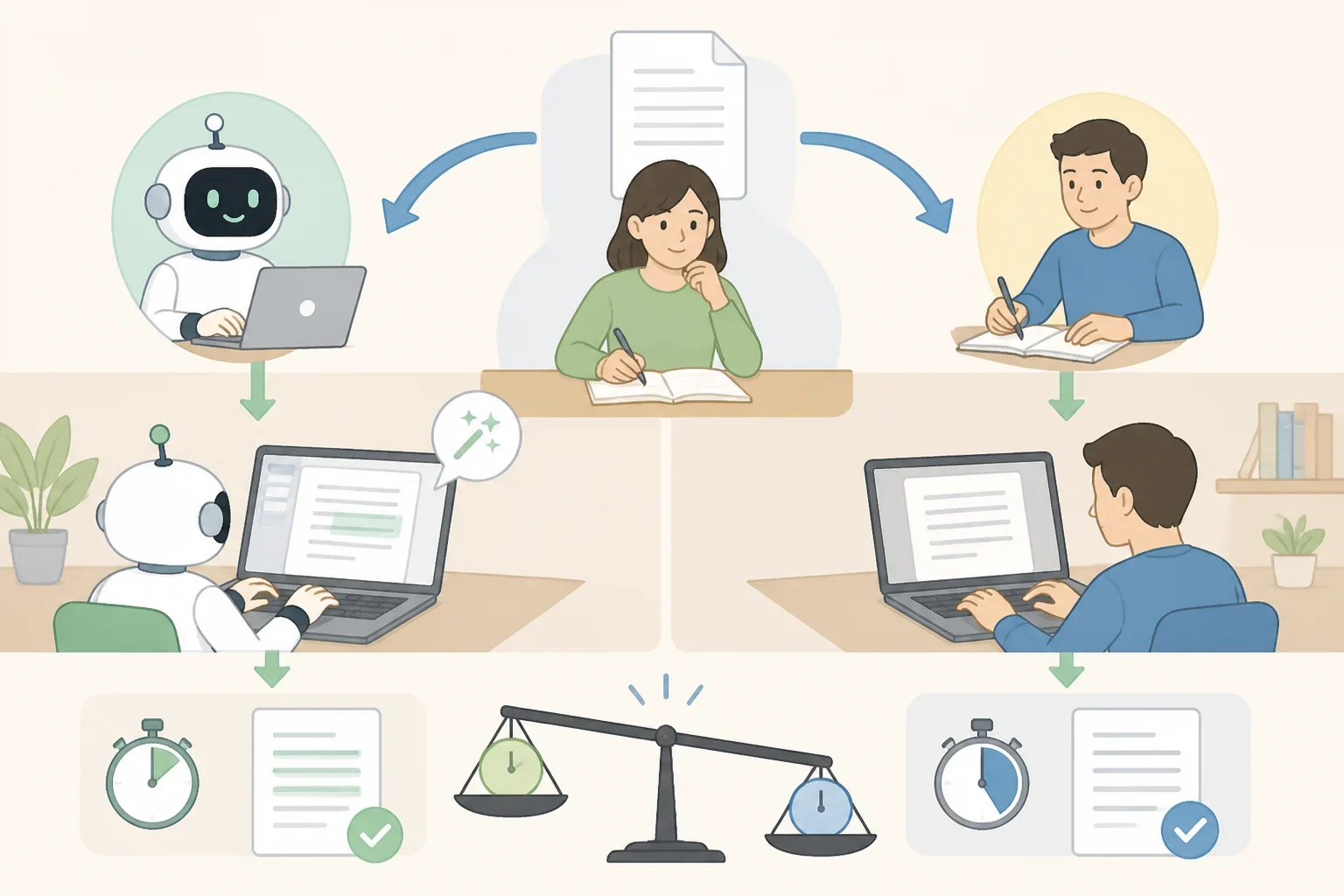
Taplio recommends testing the input-edit process before relying on it: gathering 10 to 20 past posts, notes, or voice memos, then comparing how long it takes to edit an AI draft against writing from scratch, as a practical way to see whether AI is actually saving time or just moving it around (Taplio). The same source's expansion test, applied to any AI-assisted sentence before it publishes, asks whether the person posting it could personally defend or elaborate on it if a comment demanded it. Checking a school's or employer's policy on AI-assisted public writing, and confirming whether the real constraint is time rather than expertise, are reasonable steps before publishing under your own name or paying anyone to help.