
- How to use AI for college essays without losing your voice
- Check each college's essay AI guidelines before you draft
- How to use AI for college essays without crossing into ghostwriting
- A step-by-step workflow for AI college essay brainstorming
- How to repair a draft that AI shaped too heavily
- Privacy, disclosure, and a final checklist for responsible AI use in college applications
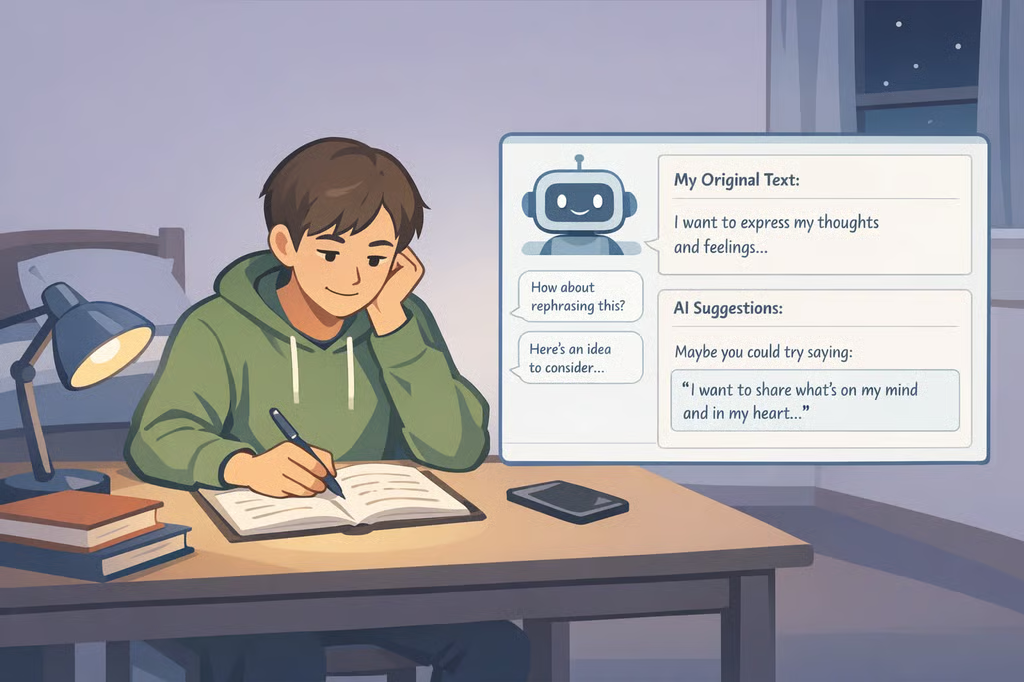
How to use AI for college essays without losing your voice
Figuring out how to use AI for college essays responsibly starts with a number worth sitting with. In a study of 81,663 applications submitted to one selective university between 2020 and 2024, essay language began converging in surface-level linguistic features after 2023, and that convergence was largest among lower-SES applicants, identified in the study by fee-waiver status, and among rejected applicants (The Digital Divide in Generative AI, about 6 weeks ago).
The same research found that estimated AI use in essays climbed sharply in 2024 across every applicant group, with the steepest increases among lower-SES students. Heavier estimated AI use was linked to larger declines in predicted admission probability for that group specifically, even after the researchers controlled for academic credentials and writing style (The Digital Divide in Generative AI, about 6 weeks ago).
None of that proves AI use lowers any one student's real chances. It's an association inside one university's modeled outcomes, not a causal finding, and it covers one applicant pool over one window of years. But paired with the language convergence, it points to something specific and avoidable: an essay that reads like the same AI-smoothed draft everyone else submitted, instead of like the person who wrote it.
This guide walks through what to check on each college's application page, where AI help ends and ghostwriting begins, a full brainstorming workflow, and what to review before hitting submit. It's built for the student doing the writing. If a parent is reading along to support that process, the useful role is asking questions and encouraging revision, not running the prompts, editing sentences, or supplying the story.
Check each college's essay AI guidelines before you draft
Washington and Lee University's published applicant guidance permits AI for brainstorming, organizing thoughts, and exploring different phrasing, but says clearly it is not for writing the essay itself (W&L Admissions, about 1 year ago). That's one school's policy, not a sector-wide rule, and other colleges may say less, more, or nothing at all.
NACAC, the professional association for college admission counselors, has been building out its own guidance for members on this subject. A webinar the group offered to counselors last year on developing college essays includes a specific segment on teaching students to use AI with integrity (NACAC, about a year ago). One webinar isn't proof of a sector-wide consensus, but it's a sign the field is still working out shared norms rather than operating from one settled standard.
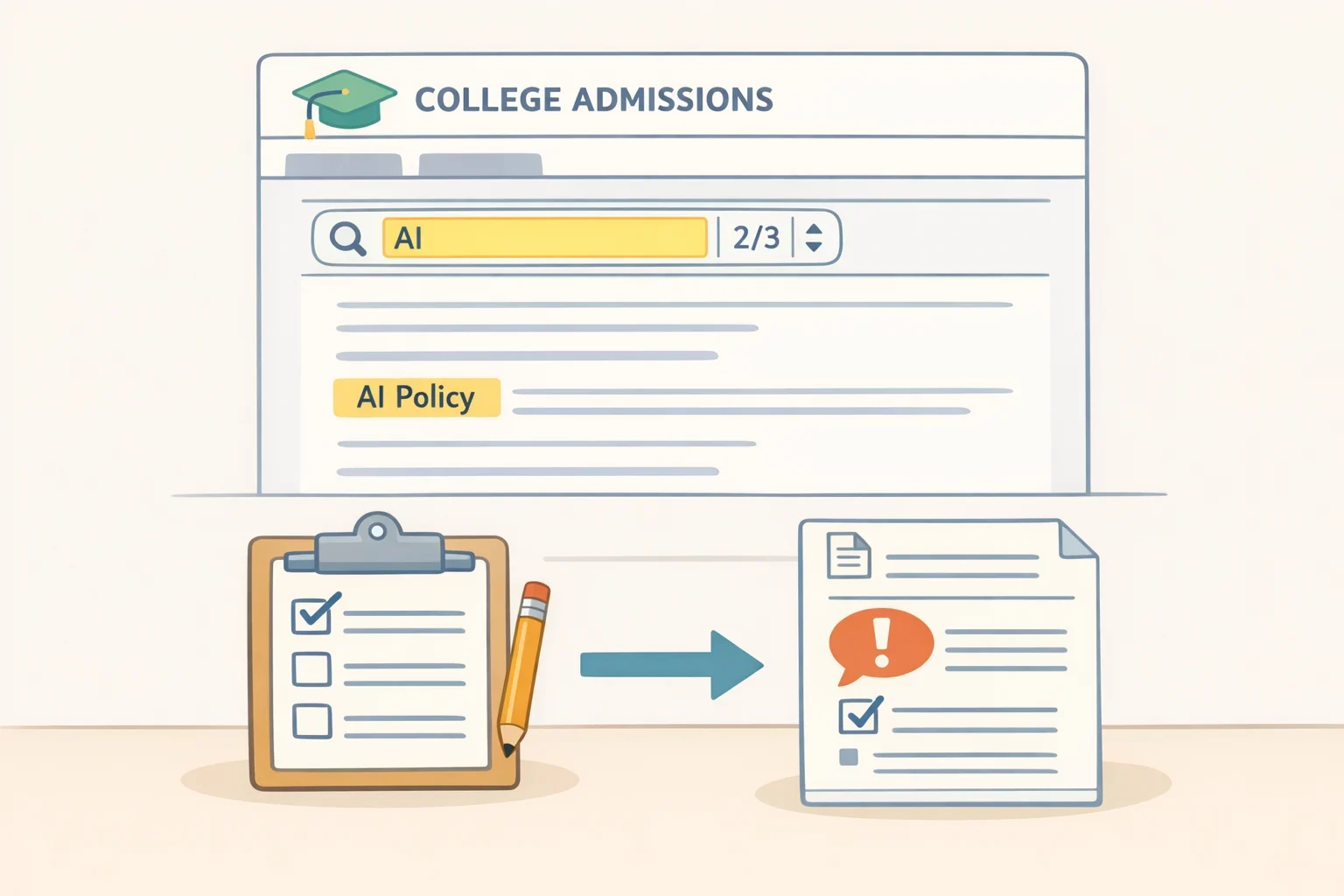
Before drafting anything, search each college's "Apply" or "First-Year Applicants" page for the word "AI." If nothing turns up, email the admissions office directly: "Does your essay policy address AI-assisted brainstorming, editing, or grammar checking? Is disclosure required, and if so, how?"
If a college does require disclosure, follow its stated method exactly. Some schools may ask for it through a checkbox, a short written statement, or a separate field on the form, though the specific method belongs to each college, not to any universal standard. Disclose only the specific, permitted forms of assistance actually used, something like "used AI to generate reflection questions during brainstorming." Saved drafts and notes are not a substitute for disclosure; they're a separate, optional habit covered further down.
If a parent is helping with this step, the useful contribution is reading the policy aloud and confirming the student understood it, not deciding how to answer a disclosure question on the student's behalf.
How to use AI for college essays without crossing into ghostwriting
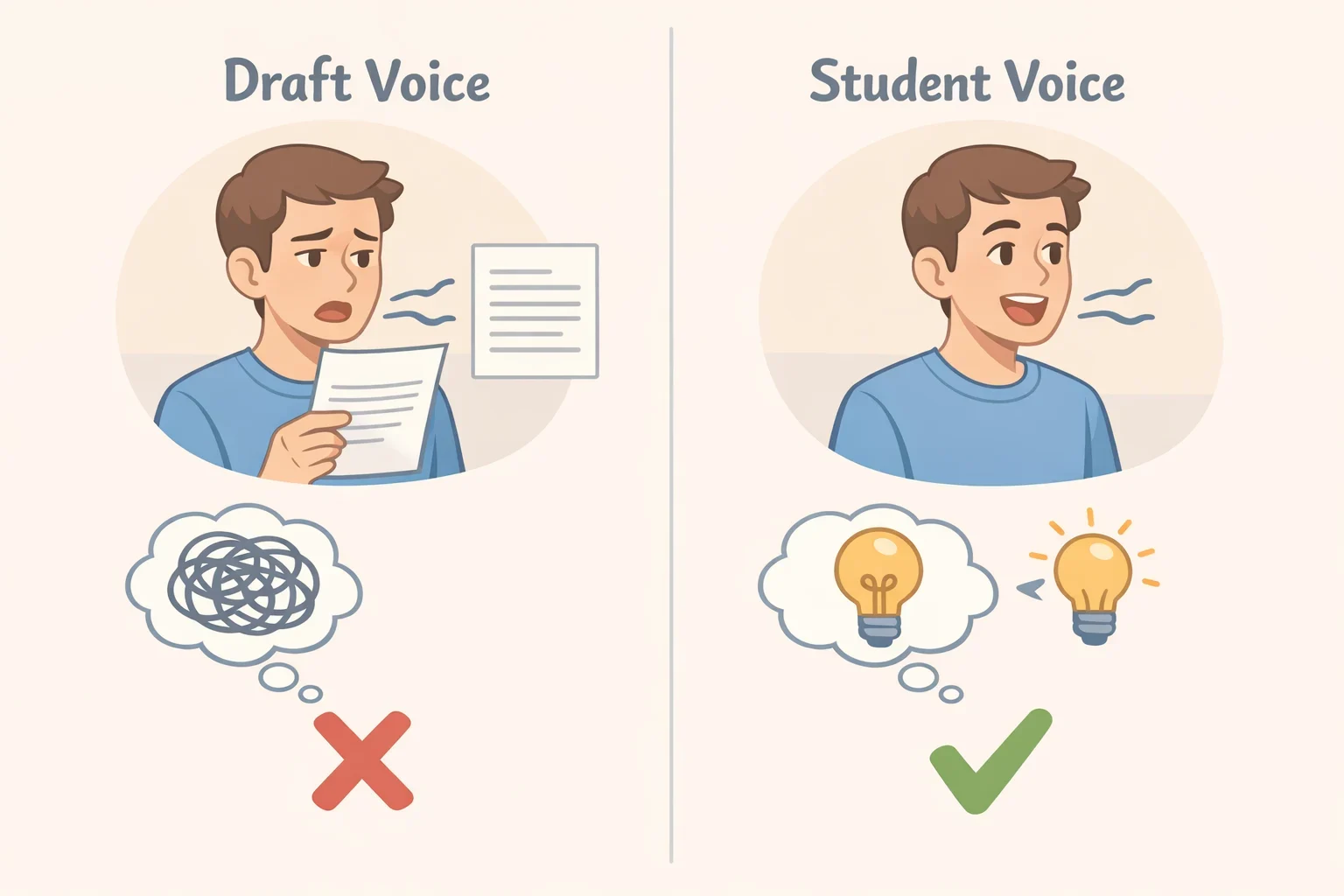
Washington and Lee's guidance draws the line directly: AI stops being a tool and becomes a substitute the moment it chooses the student's words, builds the argument, or changes the message (W&L Admissions, about 1 year ago). The same guidance offers a workable self-test. If the essay doesn't sound like the applicant, or isn't something they could explain out loud in conversation, it isn't theirs and shouldn't go in (W&L Admissions, about 1 year ago).
Use a conservative boundary when a college's policy is unclear or silent. The convergence findings from the 81,663-application study are a reasonable warning sign here: essays that lean on AI more heavily trended toward more standardized language, which may work against the individual voice essay readers are actually trying to evaluate. That's the article's interpretation of the data, not something the study itself claims about how readers perceive AI-shaped writing.
The tiers below aren't published by Washington and Lee at this level of detail. They're a conservative reading of where that guidance points, useful for weighing AI-assisted college essay writing decisions even at colleges whose own policies say less.
- Lower risk: AI-generated reflection questions that prompt the student's own thinking, organizing notes the student already wrote, or a grammar and clarity pass on a finished draft. Grammar checks aren't named specifically in Washington and Lee's policy, but they fit comfortably within the "refining" work the guidance does allow.
- Gray area: asking AI to identify which anecdote in a set of notes reads as most specific, or to flag a paragraph that feels vague. The rule here isn't "revise and adapt AI's rewrite." AI can point to a problem, something like "this paragraph doesn't explain why this mattered to you," but the student writes the replacement sentence independently, from scratch.
- Avoid unless a school explicitly says otherwise: having AI draft the essay, invent an anecdote, supply the insight or lesson learned, propose the essay's structure, or rewrite a paragraph for the student to adapt.
A sentence that sounds like it could belong to any applicant's essay is a signal to revise it, not automatic proof that AI wrote it. Run every AI-touched sentence through the same question at each drafting stage: can this be said out loud, right now, in the student's own words?
A step-by-step workflow for AI college essay brainstorming
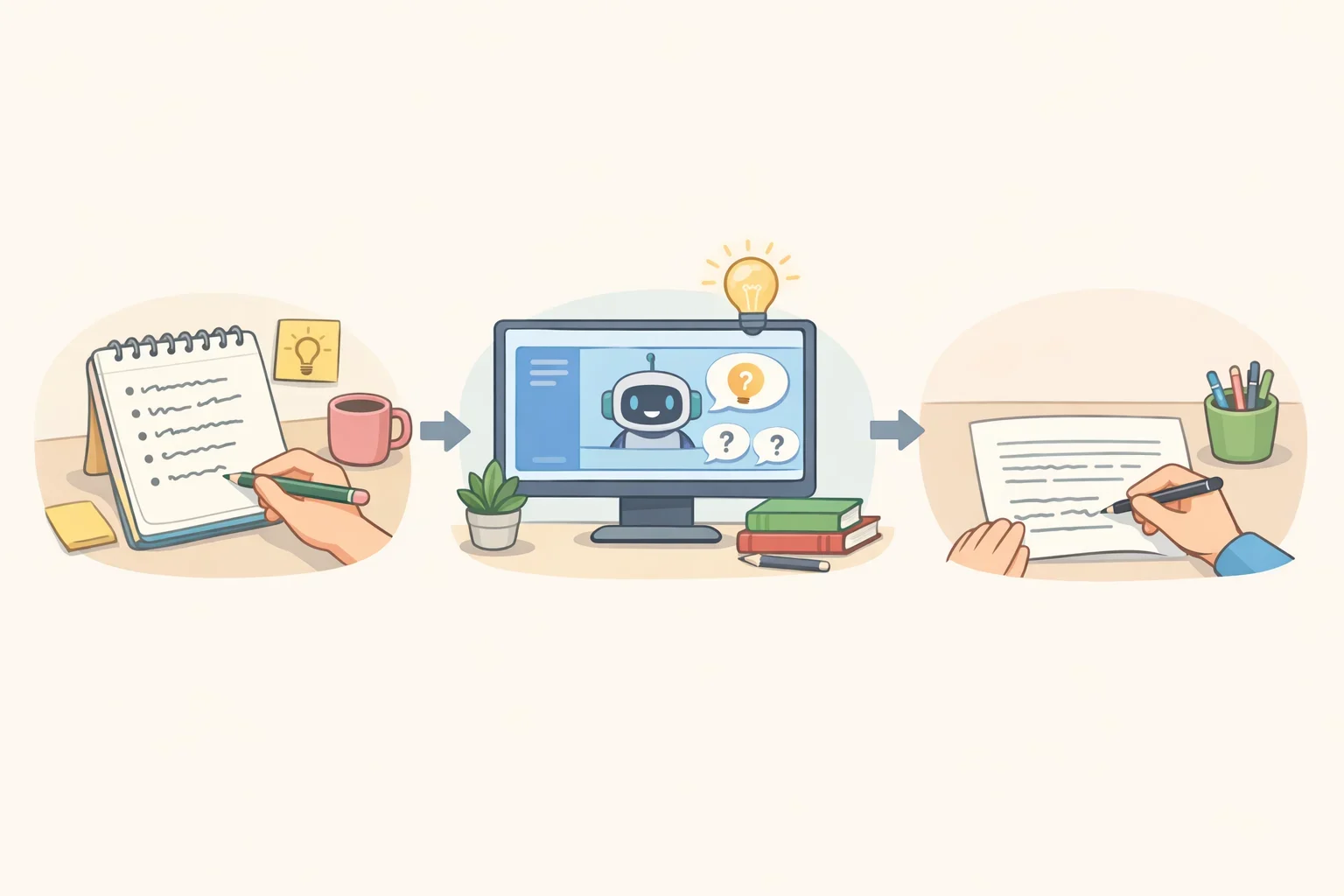
1. Write rough, messy notes first, without AI. Say a student jots fifteen bullet points about failing to make the school soccer team: "cried in the car," "coach said work on my left foot," "practiced alone for six months," "made the team as a walk-on the next year." Keeping this raw material in the student's own words matches the starting point Washington and Lee's guidance assumes when it describes AI helping with "ideas," not content (W&L Admissions, about 1 year ago).
2. Ask AI for reflection questions, not content. A prompt like "Ask me five questions that would help me think about what this experience taught me" might return something like "What did you tell yourself during the six months of solo practice?" The student answers that offline, in their own words: "I told myself the coach's feedback wasn't personal. It was information I could use."
3. Paste only the student's own bullet points and ask AI to group related ones. A prompt such as "Group these fifteen bullet points by theme" will return a rough sort. The student reviews it and keeps only groupings that make sense, rejecting or reshuffling the rest. This kind of feedback loop is close to the "meaningful, constructive feedback" NACAC's essay-development webinar covers, without letting AI decide what the essay is actually about (NACAC, about a year ago).
4. Pick the actual focus, alone. Looking at the grouped notes and the offline answer from step 2, the student decides the essay isn't really about making the team. It's about learning to treat criticism as useful information instead of an insult, something the notes and the reflection answer point toward but don't spell out. That decision, the actual thesis of the essay, has to be the student's, made without asking AI what the essay should be about.
5. Draft the essay independently, using the grouped notes and the chosen focus as a map, not a script. Nobody but the student writes this paragraph.
6. Get a human feedback pass before an AI one, if possible. Ask a teacher, tutor, or trusted adult to read the finished draft and answer three questions: "Where do you want more detail? What part sounds most like me? What sentence feels unclear?" That script works without a paid editor or a school counselor and gives the reader something concrete to respond to.
7. If no one is available for a human read, use AI only to flag, not fix, vague or generic passages. The student rewrites those sections independently afterward. Whether the process involves using ChatGPT for college essays or another tool, the rewriting step stays with the student.
8. Run grammar and clarity checks last. This lines up with the "refining" work Washington and Lee's policy allows, distinct from generating sentences from scratch (W&L Admissions, about 1 year ago).
How to repair a draft that AI shaped too heavily
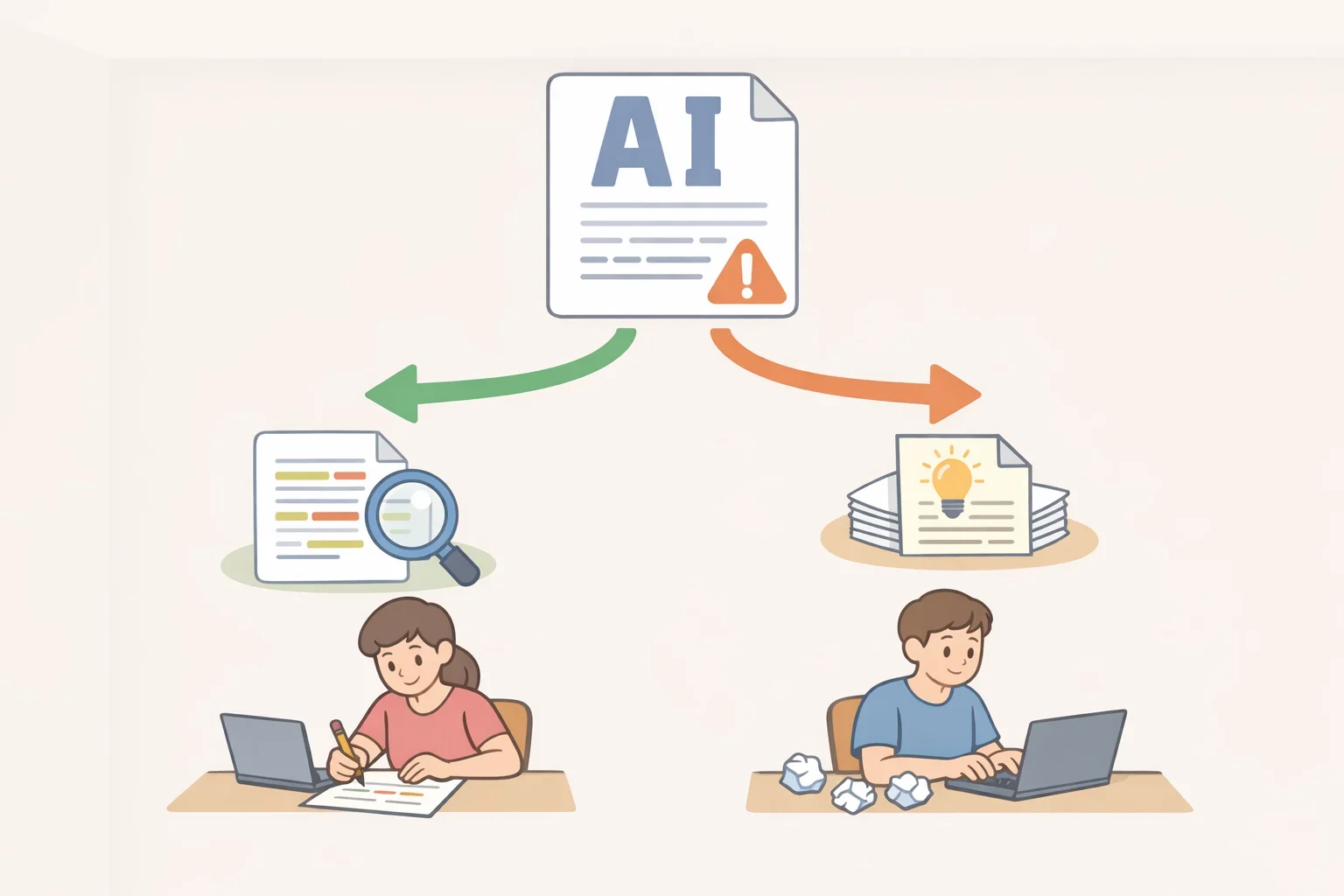
The fix depends on how far AI actually went. If the story, structure, and argument are still the student's and only specific wording drifted, revise the flagged sentences, run the self-test on them, and move on.
If AI supplied the structure, the interpretation, or the narrative arc itself, don't patch it. Go back to the original notes, or rebuild them from memory, and redraft the essay from scratch in the student's own words. Discard the AI-influenced version entirely rather than trying to save parts of it.
Keeping drafts and notes along the way can help a student explain their own writing process later if a college ever asks. Washington and Lee's own policy models this kind of transparency, disclosing that the university used ChatGPT to test phrasing and clarify ideas while writing its guidance (W&L Admissions, about 1 year ago). Treat this as a good habit, not proof of compliance with a college's required disclosure process.
Privacy, disclosure, and a final checklist for responsible AI use in college applications
Avoid pasting highly sensitive personal details, family conflict, medical history, disciplinary records, financial information, into any consumer AI tool, and check that tool's own privacy terms before using it. Federal guidance under FERPA and PPRA addresses how schools, districts, and other recipients of Education Department funds handle student education records (U.S. Department of Education, guidance dating to 2023). That guidance is aimed at institutions, so treat caution around consumer AI tools as ordinary common sense rather than something backed by that specific rule.
A separate 2025 research project is asking whether widespread AI co-authorship changes how evaluators rate essays and whether it narrows the range of ways applicants present themselves. So far it has published its research questions, without reported findings, so treat it as a project to watch rather than evidence of an outcome (Generative AI and Competitive Self-Presentation).
Before submitting, run through this checklist:
- Confirm the target college's application page addresses AI use, and if not, save the admissions office's written answer to a direct email question.
- Check whether disclosure is required, and if so, follow the school's exact method.
- Reread the essay and ask whether every sentence could be explained out loud, in the student's own words, right now.
- Confirm the story, structure, and final wording came from the student, not from an AI-suggested outline or rewrite.
- Delete any sensitive personal details that were pasted into an AI tool during brainstorming, and review that tool's data retention settings if the option exists.
The most useful next step is a small one: pull up the admissions page for every college on the list today and search for "AI." Note which schools address it, which stay silent, and which require disclosure. For any that leave it unclear, send the specific question from the first section and keep the reply on file before the next draft goes out.