
- The effects of AI chatbots on children's cognitive development: What “cognitive stunting” research actually shows
- What “cognitive stunting” means, and what it does not mean
- How AI cognitive offloading can affect students
- What research says about ChatGPT and children's critical thinking
- How parents and schools can reduce over-reliance
- What to check before a child uses a chatbot
The effects of AI chatbots on children's cognitive development: What “cognitive stunting” research actually shows
Do AI chatbots stunt cognitive development, or does the effect depend on how children use them? The current evidence does not support a simple yes-or-no answer. It raises a credible concern about children outsourcing effortful thinking, but it does not establish that ordinary chatbot use causes lasting cognitive harm.
A Brookings analysis from four months ago calls this concern “cognitive stunting”: children may shortcut the development of writing, reasoning, analysis, and other skills if AI routinely performs those tasks before they have practiced them independently. A systematic review of generative AI research among university students found over-reliance in 33.7% of the studies it examined, followed by reduced analytical autonomy in 20.2% and cognitive offloading in 18.0% of studies. These figures describe coded findings across studies, not percentages of students or measured declines in intelligence. (Frontiers in Psychology, three months ago)
The same review found positive cognitive outcomes in 40.4% of studies and mixed or conditional effects in 23.6%. That difference matters. The research question is not simply whether children use AI chatbot tools. It is whether the tool replaces thinking or gives learners something to question, test, and build on.
What “cognitive stunting” means, and what it does not mean
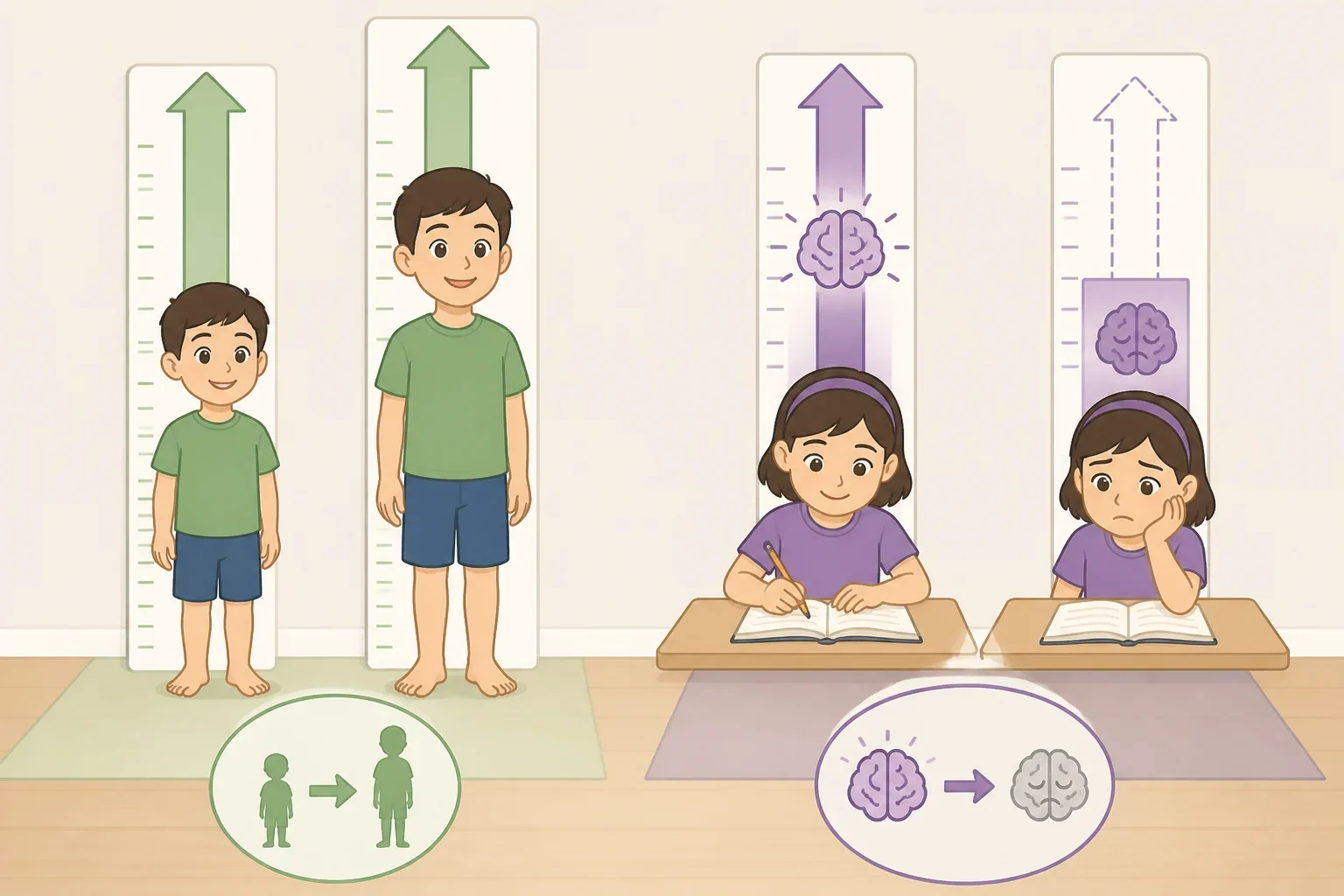
The phrase comes from an analogy with physical growth stunting. When children do not receive sufficient nutrition, stimulation, or caregiving, physical development can be impaired. Pediatricians in the United States have long tracked physical development against age-based norms, a comparison Brookings uses to explain why researchers are asking whether cognitive development can be measured in a similar way. (Brookings, four months ago)
The proposed AI analogy is narrower than a claim that chatbots directly damage the brain. It describes a possible loss of practice. If a child asks a chatbot to write the explanation, solve the problem, summarize the reading, or generate the first argument every time, the child may have fewer chances to struggle productively with those tasks.
Cognitive development includes the growth of processes such as perceiving, remembering, forming concepts, solving problems, imagining, and reasoning, according to the APA Dictionary, cited by Brookings four months ago. Those abilities are not built merely by viewing a polished answer. They develop through attempting, making mistakes, comparing possibilities, revising, and explaining why one answer is stronger than another.
That does not make “cognitive stunting” an established diagnosis. Brookings does not identify a validated diagnostic measure or agreed threshold for AI-related cognitive stunting. The term is a proposed framework for asking whether certain patterns of AI use reduce opportunities for cognitive development, not a clinical finding that can currently be assigned to a child. (Brookings, four months ago)
This distinction protects against two opposite mistakes. A parent should not assume that one chatbot conversation has harmed a child’s development. A teacher should also not dismiss repeated dependence as harmless simply because the child’s final work looks correct.
How AI cognitive offloading can affect students
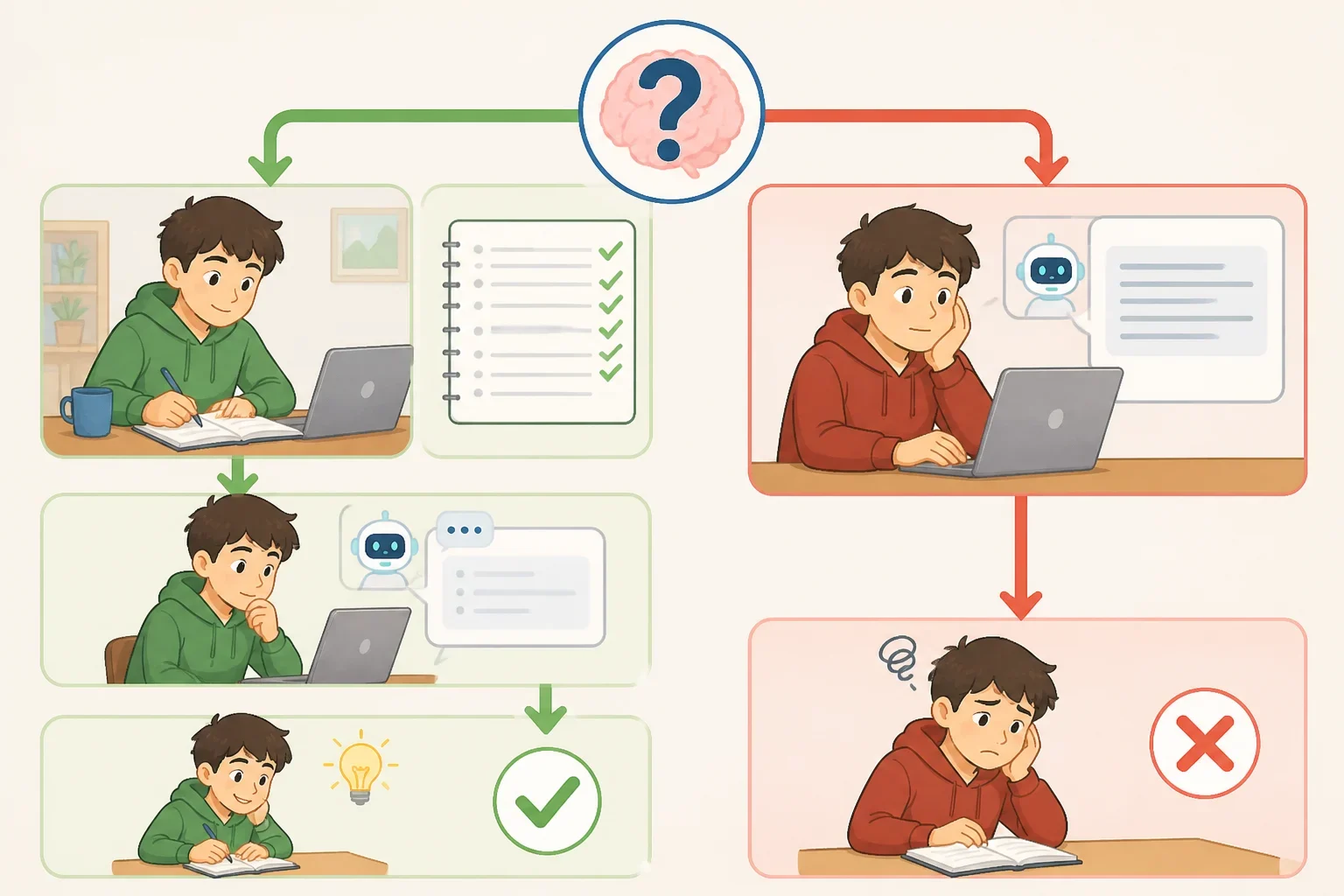
Cognitive offloading means using an external tool to handle part of the mental work. People do this in ordinary ways, such as using a calculator for arithmetic or a calendar to remember an appointment. The educational concern begins when the tool takes over a task the learner needs to practice.
A student who first writes a rough explanation and then asks a chatbot to identify gaps is still doing some independent thinking. A student who asks for a complete explanation before trying to understand the topic may be using the chatbot as a substitute for that thinking. The visible product can look similar, but the learning process is different.
The university-student review found over-reliance to be the leading reported cognitive risk, followed by reduced analytical autonomy and cognitive offloading. It also found that 55.1% of the studies used no specified pedagogical strategy, while explicit theoretical frameworks appeared in only 25.8% of the research corpus. Those findings do not prove that unguided AI use causes cognitive decline. They do show that many studies examined AI use without a clearly defined teaching structure, making it harder to treat “AI use” as one consistent educational experience. (Frontiers in Psychology, three months ago)
Brookings also describes a feedback loop: students may save time or receive better-looking work, then use AI for more tasks, which can increase dependence and cognitive offloading. That is a plausible pathway, not proof that every student follows it. (Brookings, four months ago)
Other evidence points to problems with recall and engagement. Educators have reported “digital amnesia,” meaning that some students struggle to remember information from assignments they completed with AI, even shortly after submitting them. This is a reported classroom observation, not a validated diagnosis or a population-level estimate. It still gives teachers a useful question to ask: Can the student explain the work without reopening the chatbot? (Brookings, linked through Brookings, four months ago)
A separate study monitoring brain activity during writing tasks found lower neural engagement among participants who used ChatGPT than among those who wrote without it. The resulting work was also described as lower quality, with diminished critical inquiry and greater vulnerability to shallow or biased perspectives. This was a short-term finding from a writing task, not proof that all chatbot use produces the same neurological or academic result. (neural-engagement study, linked through Brookings, four months ago)
Taken together, these findings describe a plausible risk pathway. A learner may save time, receive a satisfactory product, and then have less reason to practice the underlying skill. The pathway deserves attention, but evidence from university students, adult participants, educator observations, and short writing experiments should not be presented as direct proof of long-term developmental harm in children.
What research says about ChatGPT and children's critical thinking
The most directly relevant evidence in the available research comes from an eight-week quasi-experimental study of 85 sixth-grade students. Forty-two students received metacognitive scaffolds while working with generative AI, while 43 students used the tool without those scaffolds. The scaffolded group significantly outperformed the control group in overall critical thinking and in questioning and verification, logical reasoning, and reflection and regulation. (Mitigating cognitive offloading in GenAI-supported collaboration, two months ago)
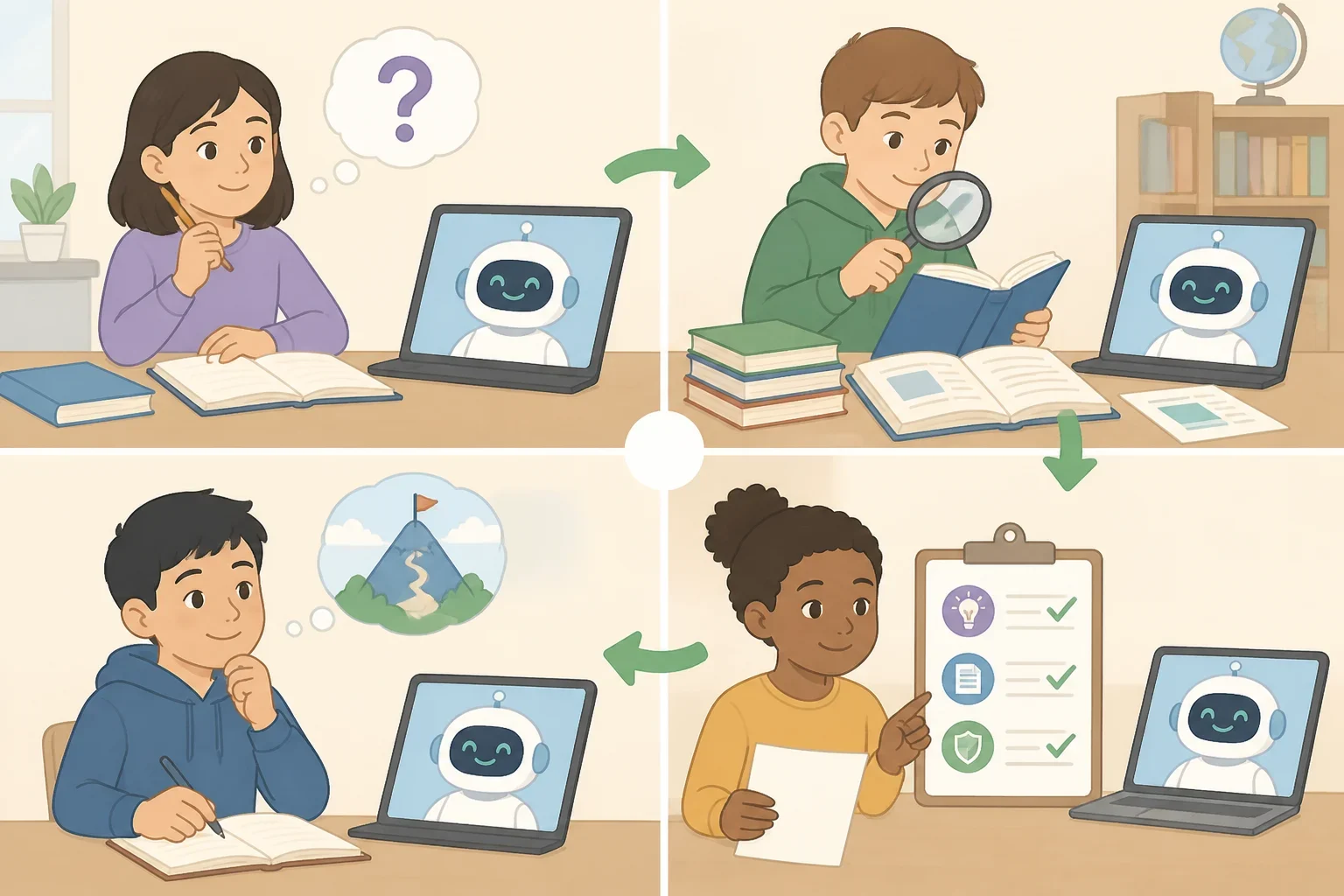
“Metacognitive” means thinking about one’s own thinking. In practice, the scaffolds prompted students to question an AI response, retrieve supporting evidence, analyze that evidence logically, and reflect on the result. The goal was not to make students reject every AI answer. It was to keep them responsible for deciding whether an answer deserved trust.
The study’s discourse analysis helps explain the outcome. High-order cognitive structures accounted for 49.7% of the experimental group’s discussion. The researchers identified a recurring sequence of questioning the AI, retrieving evidence, and analyzing that evidence logically. The unscaffolded group showed more surface-level exchanges and passive agreement with AI answers. (Mitigating cognitive offloading in GenAI-supported collaboration, two months ago)
That result offers a practical distinction. A chatbot can become a conversation partner that supplies a counterargument or a possible explanation. It can also become an answer dispenser. The sixth-grade study suggests that structured use may reduce offloading and support critical thinking, but it does not establish that structure determines outcomes in every setting.
The limits are important. The study lasted eight weeks and included 85 students, so it cannot answer whether the benefits continue over years, whether the same routine works with younger children, or whether the results transfer to every subject and chatbot. It was also a quasi-experimental intervention, not a random-assignment study that can settle causation by itself. (Mitigating cognitive offloading in GenAI-supported collaboration, two months ago)
The university review points in a similar conditional direction, but its participants were university students, not children. Its Dual-Mechanism Model describes generative AI as a cognitive amplifier under structured teaching conditions and a cognitive substitute when use is unguided. That model is relevant context for schools, not direct evidence about elementary or middle-school development. (Frontiers in Psychology, three months ago)
Age should shape the level of independence expected. For elementary students, adult supervision and short, clearly bounded activities may be more appropriate than open-ended chatbot access. For middle-school students, teachers can emphasize questioning, evidence checks, and explanation. High-school students may be ready for more independent comparison of AI responses, provided assignment rules permit the tool and students still produce and defend their own reasoning. These are cautious applications of the evidence, not age-based research conclusions.
How parents and schools can reduce over-reliance
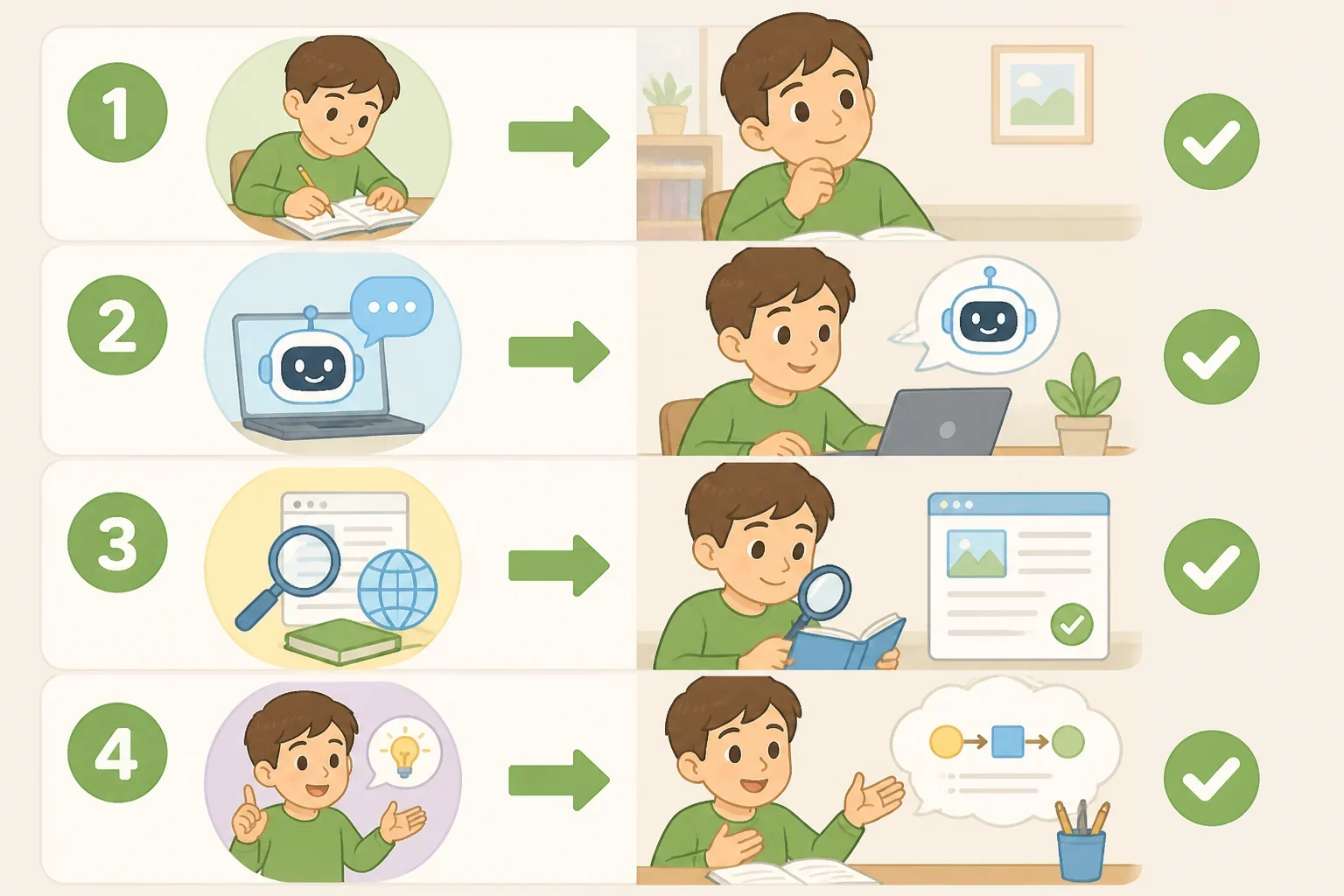
A useful routine can be simple enough to use at home or in class:
- The child answers, outlines, or attempts the problem independently first.
- The chatbot offers a possible explanation, counterargument, example, or question.
- The child checks the response against a textbook, class notes, teacher-provided material, or another credible source.
- The child explains what changed, what was rejected, and why.
That sequence keeps the learner in the role of thinker and decision-maker. It also creates something a teacher or parent can inspect. A finished answer alone may conceal whether learning occurred, while a short explanation of the checking process makes the child’s reasoning more visible.
Teachers can build similar expectations into assignments by asking students to submit an initial attempt, identify one AI claim they verified, and explain how the evidence affected the final response. Parents can ask:
- What did you try before opening the chatbot?
- Which part of its answer did you check?
- What source supported or contradicted it?
- Can you explain the idea without looking at the AI response?
- Which part of the final work is your own reasoning?
These questions are not universal classroom requirements. They are practical ways to apply the sixth-grade study’s questioning, verification, reasoning, and reflection pattern.
Schools also need to check the tool itself, not only the student. Brookings reports that there is currently no systematic way to assess which AI products or usage patterns may pose developmental risks for children. It points to existing measurement resources, including the NIH Toolbox, which provides age-normed cognitive assessments for people ages 7 to 85 and older, along with companion tools for children ages 3 to 6. It also discusses the longitudinal ABCD Study, which tracks more than 10,000 adolescents. These resources are possible foundations for measurement, not current tests for AI-related cognitive stunting. (Brookings, four months ago)
UNESCO guidance from three years ago called for government regulation of generative AI in education, including privacy protections, validation of AI systems before classroom use, and consideration of an age limit of 13 for classroom use. The age figure is guidance to consider, not a universal legal requirement or a rule every school follows. (UN News, three years ago)
What to check before a child uses a chatbot
Before allowing AI chatbot use for schoolwork, parents and students should check the school, district, teacher, and assignment rules. Policies can differ, and a tool permitted for brainstorming may not be permitted for drafting or completing an answer.
The most useful questions are specific:
- Is the chatbot allowed for this assignment and this age group?
- Must the student disclose or cite AI assistance?
- Does the assignment require independent work?
- Must the student verify AI-generated claims?
- Can the student explain the work without the chatbot?
- What information should never be entered into the tool?
The evidence does not justify treating chatbots as automatically harmful or automatically educational. It supports a narrower conclusion: risks increase when children rely on generative AI to perform the thinking they are meant to learn, while structured activities that require questioning, checking, and explanation may preserve learner agency.
“Cognitive stunting” is therefore best used as a warning question, not a diagnosis. Parents and educators can apply that question by requiring an independent first attempt, a source check, and a brief explanation of what the child learned or changed. Children should learn to think before they learn to prompt, a principle Brookings raises as guidance rather than a settled scientific finding. (Brookings, four months ago)