
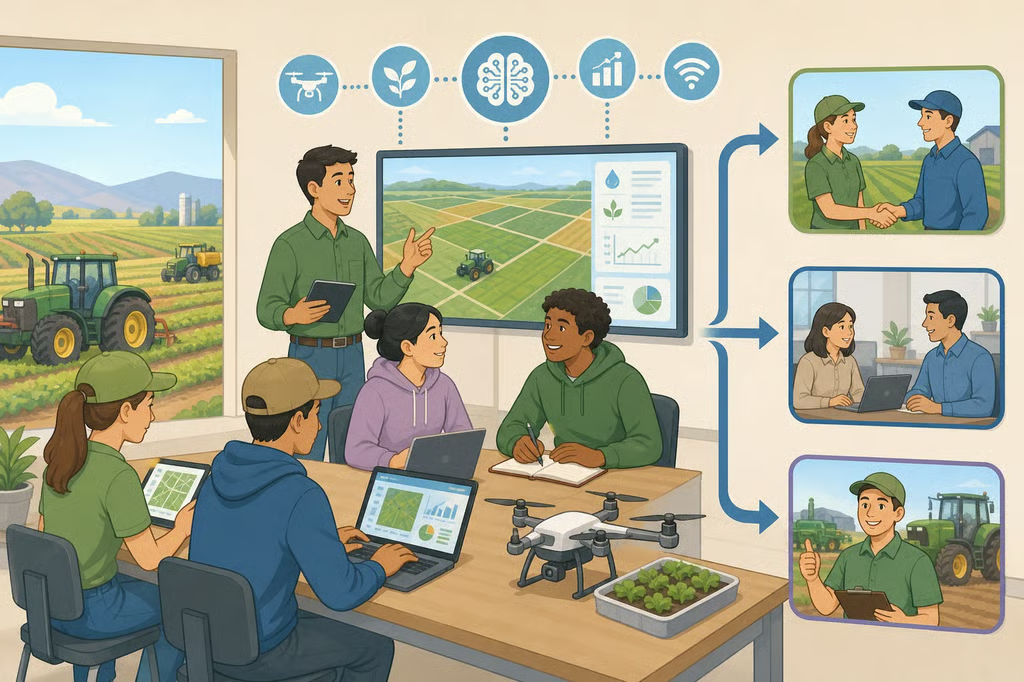
- AI workforce development in rural California: People-first plan
- What rural California AI workforce training should prepare learners to do
- Agriculture shows why AI and automation should not be lumped together
- Merced is a promising test, not verified proof
- Why automation still matters
- How to check a training pathway before enrolling
AI workforce development in rural California: People-first plan
On September 2, 2025, Merced received a $9.2 million California Jobs First award, described as the state’s largest agtech award to date. The Merced AgTech Alliance projected more than 3,000 jobs, over 100 agtech startups, and 250 internships for underserved populations. The announcement also said regional unemployment was nearly double the state average. (Merced College, last year)
For students, workers, and educators, the practical lesson is not that this award guarantees a new career. It is that AI workforce development in rural California needs a people-first plan. Training, paid work-based learning, and clear employer commitments deserve as much attention as equipment, research facilities, and startup funding.
The distinction between AI and agricultural automation matters here. The Merced initiative is an agtech and advanced-technology investment. Its public materials mention agriculture, artificial intelligence, and advanced technology, but they do not establish that every planned job will be AI-specific. The available agricultural research also describes automation in general, not necessarily AI-powered systems.
That uncertainty is not a reason to wait. It is a reason to build training carefully and judge the results by what learners and workers can actually do next.
What rural California AI workforce training should prepare learners to do
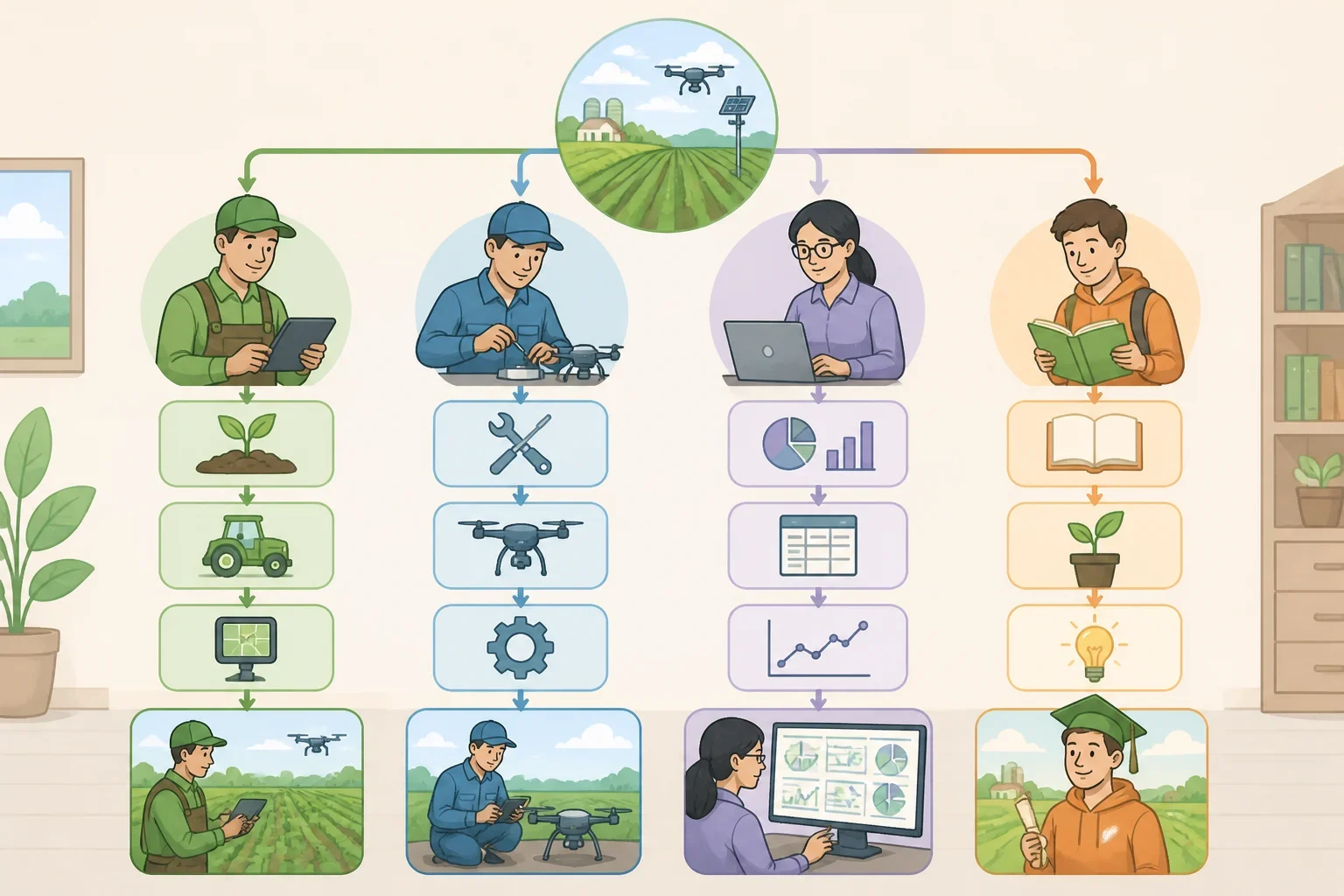
AI workforce development is broader than teaching students to use a chatbot or write computer code. Depending on the job, rural California AI workforce training might introduce learners to digital records, agricultural data, GIS tools, sensor systems, automated equipment, troubleshooting, or workplace procedures for new technology. These are examples of possible preparation, not a confirmed list of jobs created by the Merced award.
Different learners may need different routes:
- A farmworker or equipment operator may need practical instruction in using and troubleshooting digital or automated systems.
- A technician may need deeper preparation in equipment systems, sensors, robotics, or data collection.
- An analyst may need GIS, data interpretation, or basic coding.
- A high school or community college student may benefit from introductory coursework, career exploration, or an internship.
- An adult learner may need short-term digital skills training that fits around work and family responsibilities.
Those pathways should not be treated as interchangeable. An introductory data course may help a student explore agtech, but it may not qualify that student for a technician position. A certificate may demonstrate useful preparation, while an employer may still require equipment experience or additional training.
A credible program should identify the job family it supports, the skills students will practice, and the next requirement after completion. “AI skills” is too broad to guide a learner’s decision.
Stanford researchers wrote last year that the overall effect of AI on employment is likely small right now, but surrounded by “enormous uncertainty.” They also noted that researchers still have limited evidence about how AI is changing workers’ tasks, matching job seekers with employers, and reshaping retraining and education. (Stanford Digital Economy Lab, last year)
That is why technology investment alone is not a workforce strategy. It is a bet.
Agriculture shows why AI and automation should not be lumped together
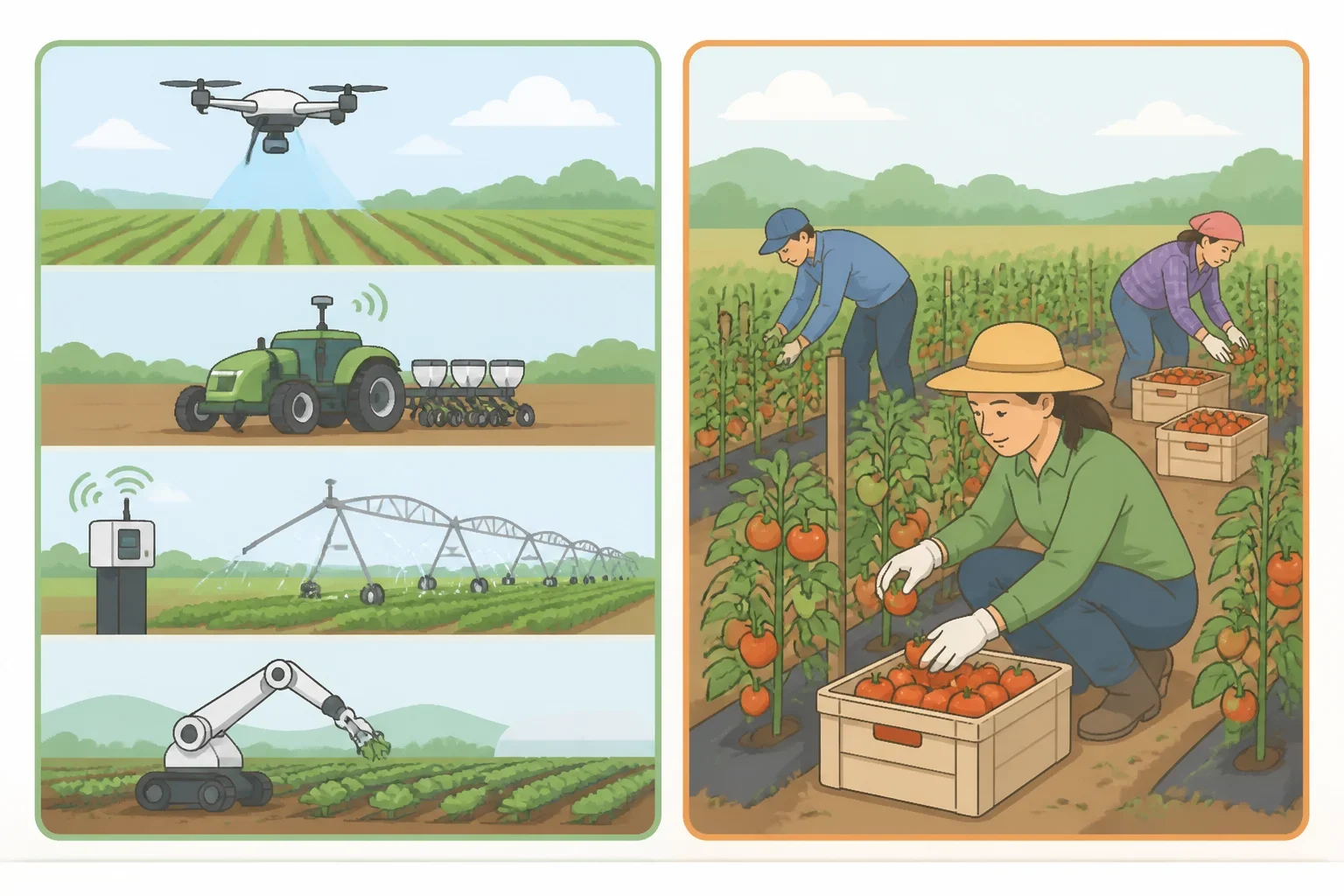
Agriculture provides a useful test because labor-saving automation is advancing unevenly. Nearly one-third of total U.S. agricultural labor expenses occur in California, a state dominated by fruit, vegetable, and horticultural crops. (Cal Poly Digital Commons, last year)
Fresh-fruit and vegetable producers still rely extensively on hired manual labor for several tasks, particularly harvesting. Producers have adopted systems for automated irrigation, weeding, and crop protection, but progress in harvesting has remained slow. (Cal Poly Digital Commons, last year)
Those findings support a claim about agricultural automation. They do not prove that AI is replacing farmworkers or that automated equipment will create a particular set of AI jobs. Some workers may interact with digital or automated systems while continuing to perform physical or judgment-based work. Other roles may shift toward monitoring, maintenance, data collection, or equipment operation. The research does not establish how many jobs will move into any one category.
Economic pressure is also coming from outside AI. The Cal Poly research identifies rising labor costs, driven primarily by reduced worker availability, as a major challenge for labor-intensive western agriculture. It also describes rising imports of fresh fruits and vegetables in response to production costs, consumer demand, and seasonal differences. (Cal Poly Digital Commons, last year)
For learners, the better question is not simply, “Will this technology grow?” Ask instead:
- Which local agricultural tasks does the program address?
- Does the training prepare students to operate, maintain, analyze, or design a system?
- Which employers helped shape the curriculum?
- What equipment or software will students actually use?
- Is the credential useful beyond one employer or one grant cycle?
Merced is a promising test, not verified proof

The Merced AgTech Alliance includes workforce development in its public-private model. It was created by the Community Foundation of Merced County, Merced College, UC Merced, and the Reservoir. Its partnership includes more than 40 local and regional companies, including John Deere, Blue Diamond Almonds, Gallo, Western Growers, and Merced County Farm Bureau. (Merced College, last year)
That arrangement could give Merced College a way to connect instruction with regional employers. UC Merced could contribute research and technical expertise, while community and industry partners could help identify workplace needs. The planned internships could create a bridge between classroom learning and employment.
Could and could. Those are the accurate terms at this stage.
The announcement provides projected targets, not evidence that more than 3,000 jobs or 250 internships have already materialized. The available research does not show which Merced College programs are currently operating under the alliance, how many learners have enrolled, whether internships have converted into jobs, or whether internships include wages and transportation support. Students should request those details before treating the investment as a career pathway.
A separate California example shows what a clearer training-to-work model can look like. Last year, the California Employment Development Department committed $2 million to expand allied-health training, connecting the investment to documented demand in an industry that had grown by nearly 220,000 jobs since 2020. (California EDD, last year)
Healthcare and agriculture do not require the same curriculum. The useful comparison is the structure: training dollars should be connected to identifiable occupations, job-ready skills, and a realistic path into work. Merced’s agtech initiative should be evaluated by that standard, even though its occupations will differ.
Why automation still matters
Labor shortages and rising costs give agricultural businesses real reasons to pursue automation. Dismissing those pressures would not help workers or students. Research describes ongoing investment in automated irrigation, weeding, and crop protection, while also showing that harvesting remains difficult to automate. (Cal Poly Digital Commons, last year)
The stronger argument for worker investment is that technology does not produce one predictable labor-market result. Stanford’s review found that, within firms, entry-level hiring in AI-exposed jobs declined 13% relative to less-exposed jobs. That is a relative change within firms, not a 13% decline across the entire economy. A Denmark study released in late September 2025 found no difference in entry-level hiring between firms that adopted AI and those that did not. (Stanford Digital Economy Lab, last year)
The evidence supports preparation without panic. Effects may differ by occupation, employer, and region, so rural colleges and workforce organizations should not assume that either mass displacement or automatic job creation is around the corner. They should build ways for learners to gain relevant skills before workers are expected to adapt without support.
That recommendation is especially important because the current evidence does not tell rural institutions exactly which occupations will grow. Programs need local feedback, employer participation, and regular review rather than a one-time technology purchase.
How to check a training pathway before enrolling

Students, workers, and educators should identify the local community college or workforce board that serves their area, then request the program’s written details. Useful questions include:
- What job or job family is the training designed to support?
- Which skills will be practiced, and on what equipment or software?
- Are employers involved in curriculum design or work-based learning?
- Is the internship paid, and what costs must the student cover?
- How will the program measure completion, local hiring, wages, or continued employment?
- What additional education, license, or experience might employers require?
- Does the credential apply beyond one employer or grant cycle?
EDD’s California Agriculture: Primary Worker Research Dashboard can add local context. The tool combines GIS visualizations with current labor-market information about California’s agricultural workforce. Readers can find it through California EDD’s workforce data report, published last year. A student can review the dashboard with a counselor, instructor, or workforce adviser and compare its information with the occupations named in a program’s materials.
No dashboard can guarantee employment. It can help reveal whether a training plan is connected to a documented local need or built mainly around an attractive technology story.
Rural California should welcome agtech investment, but the success measure cannot be equipment installed or job targets announced. It should be training completion, local hiring, job quality, and internship-to-job conversion. Before enrolling, identify the community college or workforce board, request employer and internship details, and compare those details with EDD labor-market information. That is how investing in people for the AI economy becomes a pathway learners can actually evaluate.