

TikTok College Admissions Advice: How to Verify Claims
Something is shifting in how high schoolers say they find out about college admissions. Admissions coach Hollee Becker told Town & Country this week that when she asks students where they get their admissions information, the answer used to be "last year's graduating class." Now, she says, students tell her it's TikTok and Reddit.
That's one creator's observation, not a measured trend. No source tracked here puts a number on how many applicants actually rely on TikTok college admissions advice, or whether that reliance is growing compared with counselors, Google, or official college sites. What research does support is that TikTok increasingly functions as a search engine for Gen Z users, who type keyword queries to find guidance and peer experiences rather than only scroll for entertainment, according to research hosted on PubMed Central.
TikTok and Instagram carry content covering nearly every stage of the college process: essay-writing tips, campus-tour walkthroughs, scholarship roundups, dorm-shopping hauls, according to a report from the nonprofit College Access: Research & Action, covered by The 74 about two months ago. This article looks at why that content is spreading, what the research does and doesn't support, and how to check a specific claim before it factors into where a student applies or enrolls.
Why students are turning to creators alongside official sources

Creator content has an obvious pull: it's personal, searchable, and available at 11 p.m. when a school counselor's office is closed. Becker started posting because her own kids told her that's where students spend their time, first on TikTok and later on Instagram, Town & Country reported this week.
Fellow admissions creator Audrey Wisch described the emotional pull bluntly: "Social media is fears and dreams. And college epitomizes the intersection of that," she told Town & Country this week. TikTok isn't only a place to look up requirements. It's a place to seek reassurance and find people who confirm a worry or a hope a student already has.
A video like that feels compelling because it's personal and immediate. That doesn't make it accurate for a specific student, and any claim it makes needs to be checked against a source tied to the actual college in question.
What the research shows, and what it doesn't
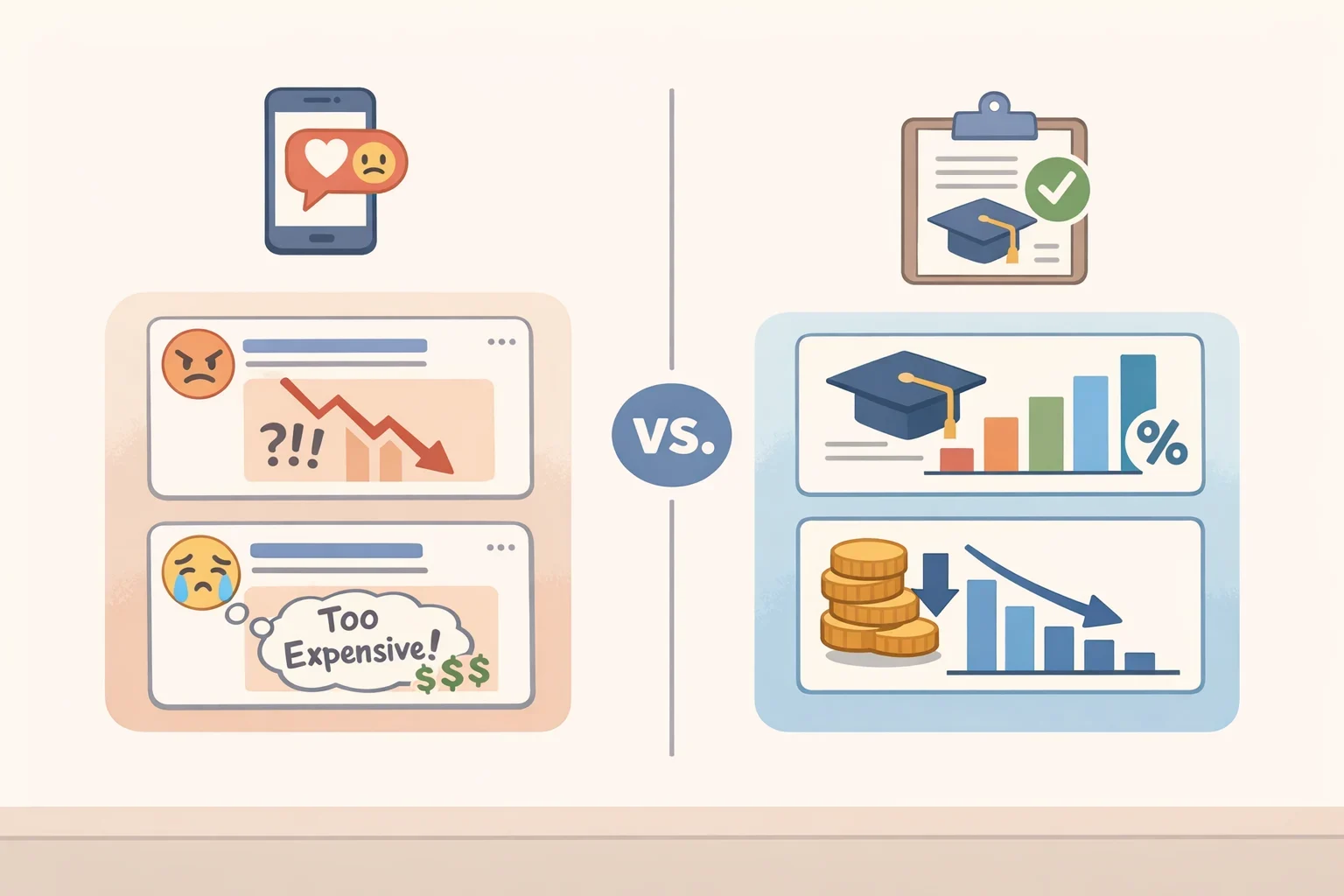
Some of the data circulating about "college content" on social media describes sentiment, not accuracy, and the two get conflated easily. A 2024 Campus Sonar study found only 7% of college-related social content was positive, with negative posts outnumbering positive ones five to one, as The 74 reported two months ago. That figure measures overall tone about college as a topic. It says nothing about whether admissions-specific claims, like acceptance odds or scholarship eligibility, hold up.
That negative skew doesn't match how most young adults say they feel about college's value. Nearly two in three, 65%, still say a degree is worth its cost, according to a 2023 NACAC/Harris Poll of 1,010 respondents ages 16 to 22. That poll is now three years old and remains the most current data available on the question, so treat it as a snapshot rather than a real-time read on 2026 attitudes.
There's a real access story here too. College Access: Research & Action found that an entire "algorithm" of useful college information exists for teenagers, but it mostly surfaces for students who already know which topics to search, The 74 reported. First-generation students exploring college, who had less family knowledge of the process, told researchers this content meaningfully contributed to their search even when it wasn't fully accurate.
That's a real benefit, but it doesn't remove the need to check individual claims. Nearly seven in 10 young adults, 68%, say it's hard to find unbiased information about colleges, and separately, 62% equate a college's selectivity with its quality, per the same NACAC poll. Neither figure shows TikTok caused the belief. Both help explain why an oversimplified "top school" video could reinforce a misconception a student already holds instead of correcting it, which raises the cost of trusting a claim that turns out to be wrong for a specific school.
Some students described videos about the "catastrophic consequences" of student loans, which left an impression that all higher education is unaffordable, The 74 reported. The report also says larger loans are often associated with graduate school or elite private institutions, so a worst-case borrowing story may not describe every undergraduate applicant's situation.
Checking TikTok college admissions advice against official sources
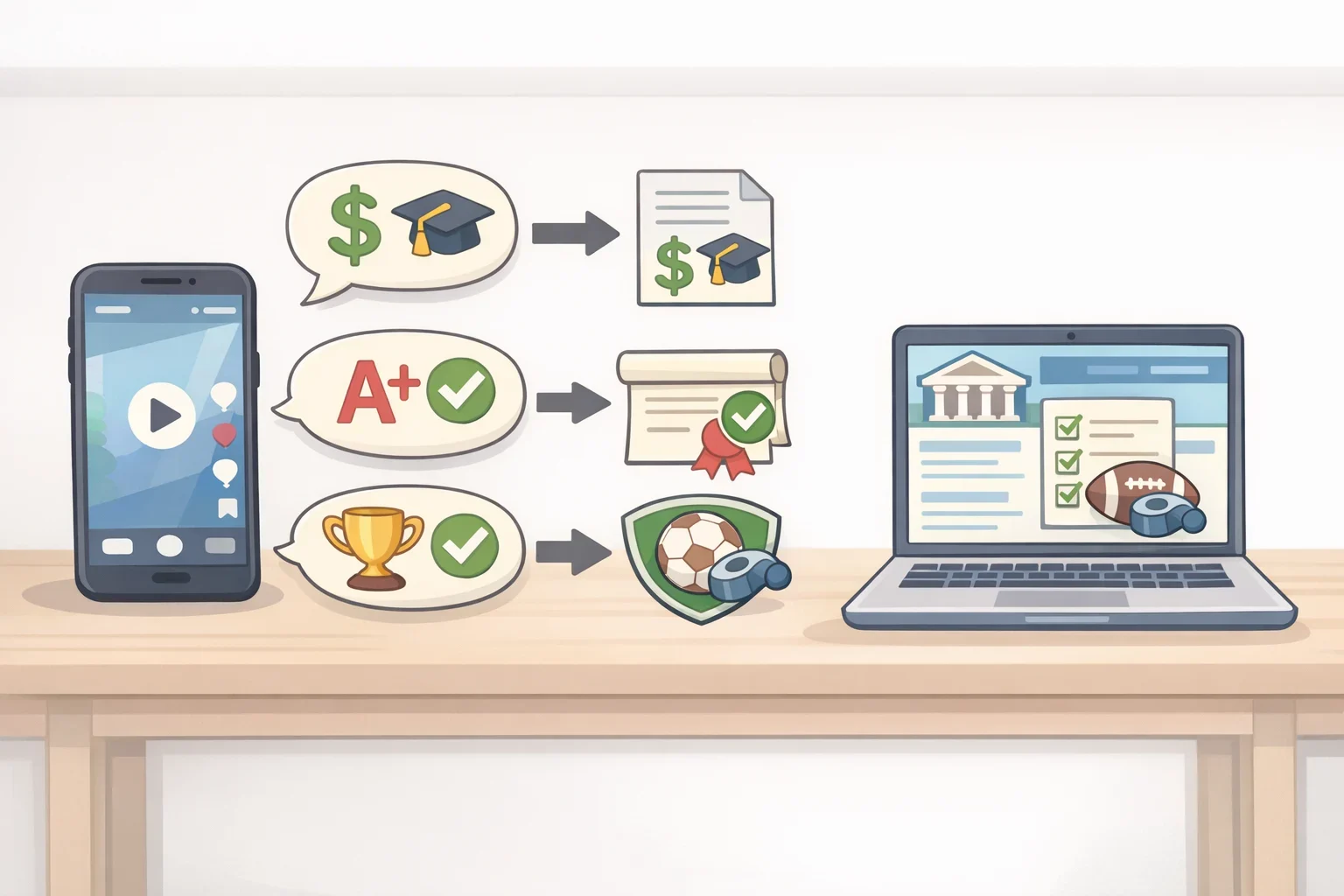
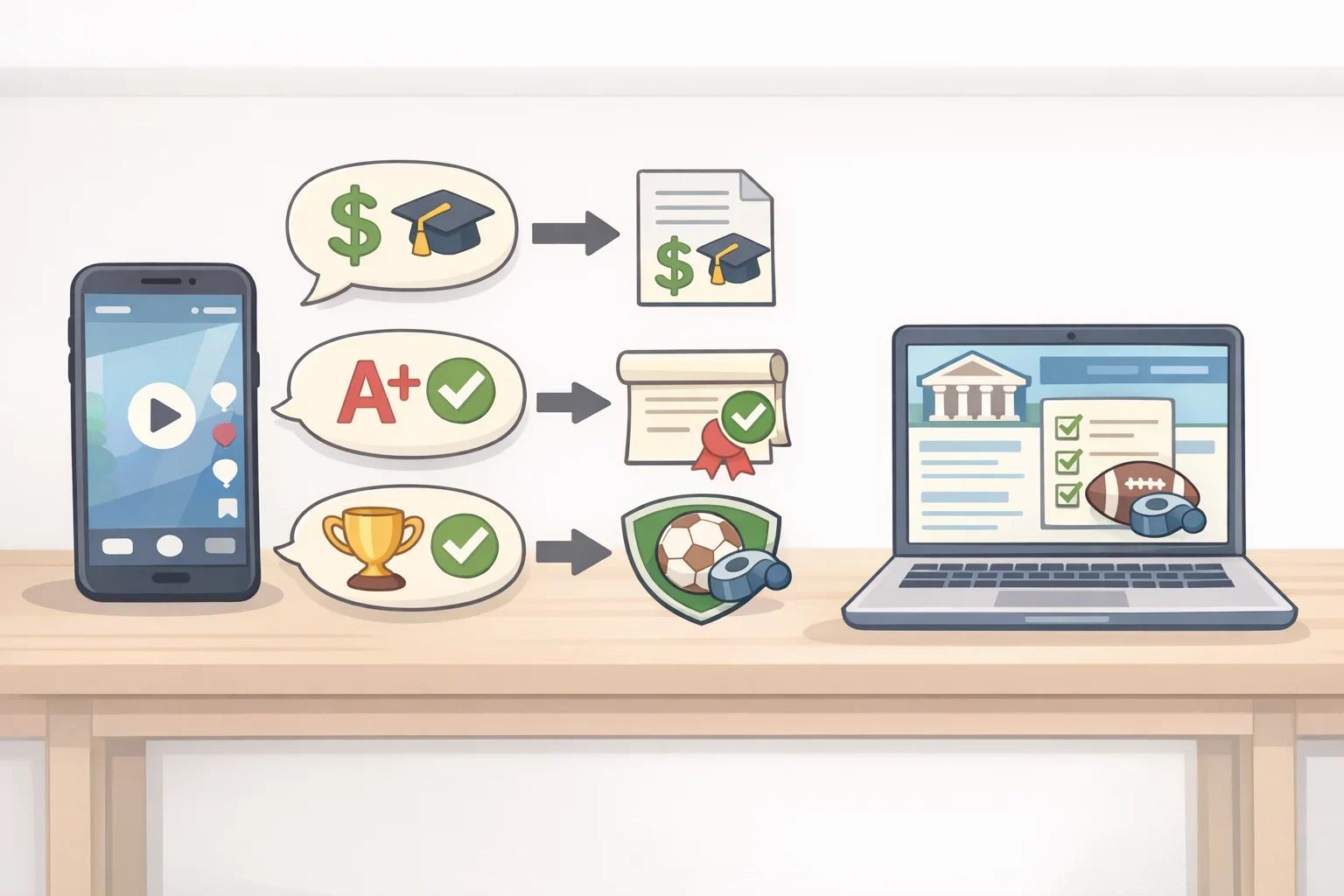
Different types of claims call for different official sources, and a general video rarely matches a specific application decision without checking. Sorting a claim by category, and by what confirms it, makes that check faster.
1. Admissions-chances claims ("this GPA gets you in," "test-optional isn't really optional")
- Confirm with the college's own admitted-student profile and current testing policy on its admissions website, checked for the correct application cycle.
- Typical score ranges and testing policies vary by institution and can change year to year.
A worked example makes the gap clear. Say a video claims a 1350 SAT score "guarantees" admission to a specific university. Pulling up that university's admitted-student profile might show a middle 50% range of 1280 to 1420, which tells a different story: a 1350 sits inside a common range, not above a guaranteed threshold. The profile also won't say what else factored into any individual decision, since GPA, coursework, and essays count too. That's the difference between a typical range and a guarantee, and it only shows up by checking the school's own page.
2. Application requirements and deadlines (essay prompts, supplemental materials, early-decision dates)
- Confirm with the specific college's admissions page or that school's dashboard inside its application portal.
- Requirements published for one school don't transfer to another, even in the same state or applicant pool, and not every college offers early decision, early action, and regular decision, so check which options actually apply.
3. Scholarship and financial-aid claims ("hidden" scholarships, specific award amounts)
- Confirm with the scholarship provider's or college's official financial-aid page, and use the college's net-price calculator for a personalized estimate.
- Eligibility rules, deadlines, and award amounts differ by provider and by student circumstances, so a dollar figure from a video shouldn't stand in for that calculation.
4. Loan and cost claims (videos portraying all student debt as catastrophic)
- Confirm with the college's published cost-of-attendance and borrowing data where available, since not every school publishes an average-debt figure for every program.
- The most alarming examples in a video often describe graduate-school borrowing or costs at high-priced private institutions, not typical undergraduate borrowing at the school being considered.
A school counselor can walk through this same claim-by-claim process with a student instead of dismissing the platform outright. It's a practical approach for using the content, not a substitute for the college's own numbers, and it matters because research participants said this kind of content still filled real information gaps for first-generation students exploring college with less access to family or school-based knowledge, The 74 reported.
What this means for applicants
No source reviewed here measures what share of applicants rely on TikTok for admissions information or whether that share is growing. What the evidence does show is narrower: College Access: Research & Action found this content fills real gaps for some students, particularly first-generation students exploring college, while NACAC's 2023 poll found most young adults already struggle to judge bias and selectivity in college information generally, before any single video enters the picture.
Applicants can reduce that risk by recording one specific claim from a recent video, an acceptance statistic, a scholarship deadline, or a net-cost estimate, and checking it against the college's admissions or financial-aid office, its net-price calculator, or a school counselor before the week is out.