

- Student Tuition and Transparency System Rule vs. Compact
- What the Student Tuition and Transparency System rule requires, and what it doesn't decide yet
- The Compact for Excellence: circulated, but the record stops there
- Cornell's institutional-voice recommendations: guidance for one university
- How to read a policy document like this one
- What to check next
Student Tuition and Transparency System Rule vs. Compact
The Student Tuition and Transparency System rule, known as STATS, ties federal student loan eligibility to how much a program's graduates earn after they finish. The Department of Education announced the final rule on June 29, 2026, and said it would be posted for public inspection in the Federal Register the next day, with formal publication on July 1, 2026 (ED, 5 weeks ago). It carries a defined penalty: fail the earnings test, and a program can lose access to federal loans.
Two other higher-education items are sometimes discussed in the same breath: a draft "Compact for Excellence in Higher Education" that the administration circulated to several universities nine months ago, and Cornell University's Presidential Task Force on Institutional Voice, which released recommendations on university speech six months ago (ED, nine months ago; Cornell, six months ago). All three come from official Department or university documents. This article compares what those documents themselves establish, not outside reporting on them.
The three differ in legal status. STATS is a final regulation with a documented eligibility consequence. The Compact is a circulated request; the release describing it does not document a compliance process. Cornell's task force produced guidance for how one university handles its own public statements. The table below summarizes what each document establishes, based on the releases cited above and below.
Development Issuer Status Scope Consequence STATS and Earnings Accountability rule U.S. Department of Education Final rule announced June 29, 2026; publication and implementation details should be checked in the Federal Register Nearly all programs and sectors, regardless of tax status or credential level Direct Loan eligibility lost after failing an earnings test two of three years; discretionary loss of Title IV/Pell eligibility possible after three straight failures Compact for Excellence in Higher Education U.S. Department of Education Draft circulated to several universities, October 2025 Universities that received the draft Not specified in the November 19 Department release reviewed here Institutional-voice recommendations Cornell University Presidential Task Force Final task-force recommendations, endorsed by university leadership Cornell University only None stated; guides Cornell's own future public statements
What the Student Tuition and Transparency System rule requires, and what it doesn't decide yet
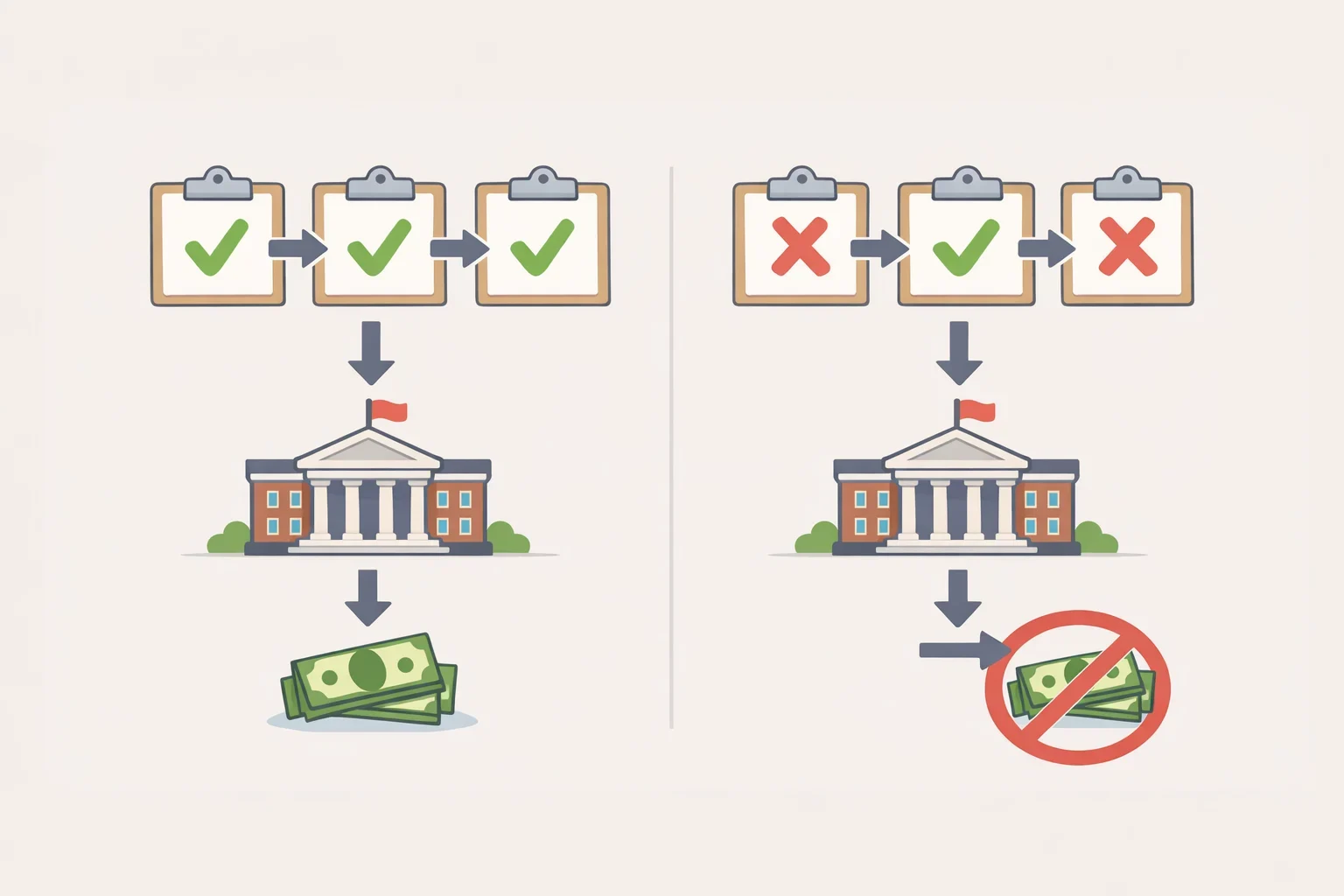
Under the rule, undergraduate programs must show their graduates out-earn the typical high school diploma holder, and graduate programs must show their graduates out-earn the typical bachelor's degree holder (ED, 5 weeks ago). The Department announced STATS as a final rule after negotiated rulemaking and public comment, and it combines earnings accountability with a broader "transparency and earnings accountability framework," in the Department's own phrase (ED, 5 weeks ago). In practice, the rule adds federal higher education transparency requirements tied to earnings outcomes, on top of the cost and tuition figures schools already report.
The two federal aid programs at stake are not the same, and they don't kick in on the same schedule:
- Direct Loan eligibility. A program that fails the earnings test in two of three consecutive award years loses eligibility for the federal Direct Loan program. That's a program-level consequence, not an institution-wide one (ED, 5 weeks ago).
- Title IV and Pell Grant eligibility. After three straight years of failing, the Department could terminate Title IV eligibility, including Pell Grants, for all of that institution's low-earning programs (ED, 5 weeks ago). The release uses "could," not "will," so this third-year consequence is discretionary rather than automatic.
A few delays and exemptions affect who actually feels these consequences and when:
- Programs preparing students for occupations where most workers earn tipped income get their eligibility consequences delayed at least one year, so earnings data can reflect the "No Tax on Tips" policy starting with the 2026 tax year.
- Institutions that haven't participated in the Direct Loan program for the past five award years are exempt from automatic loss of Title IV eligibility.
- A program not yet flagged as low-earning can avoid automatic termination if the institution and the Department agree to amend the program participation agreement to block Direct Loan borrowing for that program for at least five years.
- Institutions that exclusively serve students with documented disabilities are exempt from these eligibility consequences.
(ED, 5 weeks ago)
The rule harmonizes the earnings standard created by the Working Families Tax Cuts Act with the Department's existing Financial Value Transparency and Gainful Employment regulations, and it's the third and final rulemaking package tied to that Act, which the president signed into law on July 4, 2025 (ED, 5 weeks ago).
Students weighing a specific program should ask the financial aid office two direct questions: has this program been evaluated under the earnings test yet, and does any delay or exemption, tipped-income occupations, disability-serving status, or an existing program participation agreement, apply here. Asking for the Department's published guidance directly is more reliable than relying on a secondhand summary.
The Compact for Excellence: circulated, but the record stops there

The administration circulated a draft Compact to several universities in October 2025, describing it as a set of commitments to "aggressively contain costs, improve return on investment, and reduce administrative bloat" (ED, nine months ago).
At a White House roundtable a month later, Secretary Linda McMahon tied those themes to what she called "dwindling faith" in higher education, criticizing spending on "administrators and DEI programs." That's the administration's stated rationale in a Department press release, not independently verified spending data (ED, nine months ago).
The November 19 release reviewed for this article does not describe a signing process, a deadline, an enforcement mechanism, or a list of which universities received or responded to the Compact. It documents that the draft was circulated and what it said, not what compliance would require. A separate agreement or response could exist elsewhere; the absence of that detail in this particular release doesn't rule it out.
A related item from the same period shows what a more documented process looks like, even short of a final rule. Department negotiators reached consensus on a proposed accreditation overhaul on May 21, 2026, covering transfer-credit acceptance, completion-rate measures, and protections for academic freedom among faculty (ED, 11 weeks ago). As of that release, the proposal had reached negotiated-rulemaking consensus, not a completed public-comment period or a final rule. The research reviewed for this article doesn't indicate whether the proposal has since advanced to a Notice of Proposed Rulemaking or further; readers citing it as settled policy should check the Federal Register for anything more recent.
Cornell's institutional-voice recommendations: guidance for one university

Cornell's Presidential Task Force on Institutional Voice released its final recommendations six months ago, following what the university describes as months of review with faculty, staff, students, and shared governance bodies (Cornell, six months ago). The announcement, signed by President Michael Kotlikoff and Provosts Kavita Bala and Robert Harrington, presents these as recommendations that "will guide the administration's responses to external events," not as a federal requirement.
The central recommendation is institutional restraint. Cornell should issue public statements on social or political issues only when necessary to "directly preserve and enhance its core mission, values, and functions" (Cornell, six months ago). The recommendations also spell out who is authorized to speak for the university, giving deans, department chairs, and faculty groups a way to keep personal or scholarly opinions from being mistaken for Cornell's official position (Cornell, six months ago).
Neither the Cornell announcement nor the Department releases reviewed here mention any connection between Cornell's process and the Compact, the STATS rule, or the accreditation proposal. The Cornell announcement also doesn't identify a federal aid or institutional funding consequence tied to these recommendations; what it describes is a communications framework, not an eligibility or accreditation standard.
How to read a policy document like this one

The three documents above differ on five points: who issued them, what type of document each is, what it covers, whether it has been formally adopted, and whether it names an enforcement mechanism. STATS was issued by a federal agency, went through negotiated rulemaking and public comment, applies to nearly all programs and sectors regardless of tax status or credential level, and names a specific loan-eligibility consequence. The Compact was circulated by the same agency but has no documented adoption status or enforcement mechanism in the record reviewed here. Cornell's recommendations were adopted internally by university leadership and apply only to Cornell's own communications, with no eligibility or funding mechanism attached.
The same five points can sort any other document described loosely as a "reform statement": issuer, document type, scope, adoption status, and named consequence.
What to check next
To confirm whether a specific college signed the Compact or adopted a comparable communications framework, start with that institution's official policy library, board minutes, or signed public announcements rather than secondhand summaries. Cornell publishes its statements at statements.cornell.edu; other schools may keep a similar page through the provost's or president's office.
If federal loan eligibility for a specific program is the real concern, that's a separate question from either the Compact or Cornell's framework. Contact the financial aid office, name the exact program, and ask whether it has been evaluated under the STATS earnings test, whether any of the rule's delays apply, and where to find the Department's published guidance for that program. Save a direct call to a president's or provost's office for confirming a status the public record doesn't already answer, such as whether a particular university actually responded to the Compact.