
- FAFSA identity verification: what documents you need
- Why the Department added this step
- How the screening and identity-confirmation process works
- What documents are needed to verify FAFSA identity
- What happens if the FAFSA identity check fails
- Getting a rejected FAFSA resolved
- Who else this affects
- What to check before submitting the FAFSA
FAFSA identity verification: what documents you need
Since April 26, 2026, every FAFSA applicant has passed through a real-time fraud-risk screening built directly into the application. Only a small share of applicants who register as elevated risk get asked to go further: presenting a photo ID and completing a live photo check as part of FAFSA identity verification, according to guidance Federal Student Aid updated two months ago (FSA).
That real-time confirmation step isn't the same thing as ordinary FAFSA verification, and mixing the two up is the easiest way to misread a rejected application. Every applicant gets screened for fraud risk. Some high-risk applicants complete the online identity-confirmation step. And a FAFSA can separately get flagged for standard verification, the "V4/V5" review schools have handled for years. FSA's FAQ, published three weeks ago, treats the two processes as distinct (FSA FAQ). The distinction matters most for students at schools outside the U.S.: they're exempt from standard verification but still have to complete identity confirmation if the fraud-detection system flags them (FSA FAQ).
This article covers who actually goes through the identity-confirmation step, what documents a flagged student might need, and what to do if the check fails, gets skipped, or can't be finished before a deadline.
Why the Department added this step
Federal Student Aid says the identity-confirmation system followed a one-time review of every 2026-27 FAFSA form submitted before real-time screening went live. That review selected about 300,000 applications for Verification Tracking Group V5, based on indicators tied to suspected fraud risk (FSA).
The Department of Education points to a broader pattern behind the change. In an announcement three months ago, it said the screening tool responds to "significant evidence of fraud" and estimated its fraud-detection efforts would save taxpayers more than $1 billion during the current FAFSA cycle, a Department projection rather than an independently audited figure, Department of Education said.
That followed earlier action. Last year, the Department said additional fraud-detection work had identified almost 150,000 suspect identities among FAFSA forms submitted at the time (Department of Education).
How the screening and identity-confirmation process works
Every applicant's information runs through a risk-based screening model built into the FAFSA form itself. Only applicants rated at elevated risk are asked for the extra identity-confirmation step, Department of Education says.
That evaluation happens near the end of the student's section of the form, after the student has invited any required contributors such as a parent or spouse, and it draws on data entered throughout the application (FSA FAQ).
Only the student applicant goes through this check. A parent, spouse, or other contributor filling out their own section of the form isn't screened and won't be asked for identification (FSA FAQ).
What documents are needed to verify FAFSA identity
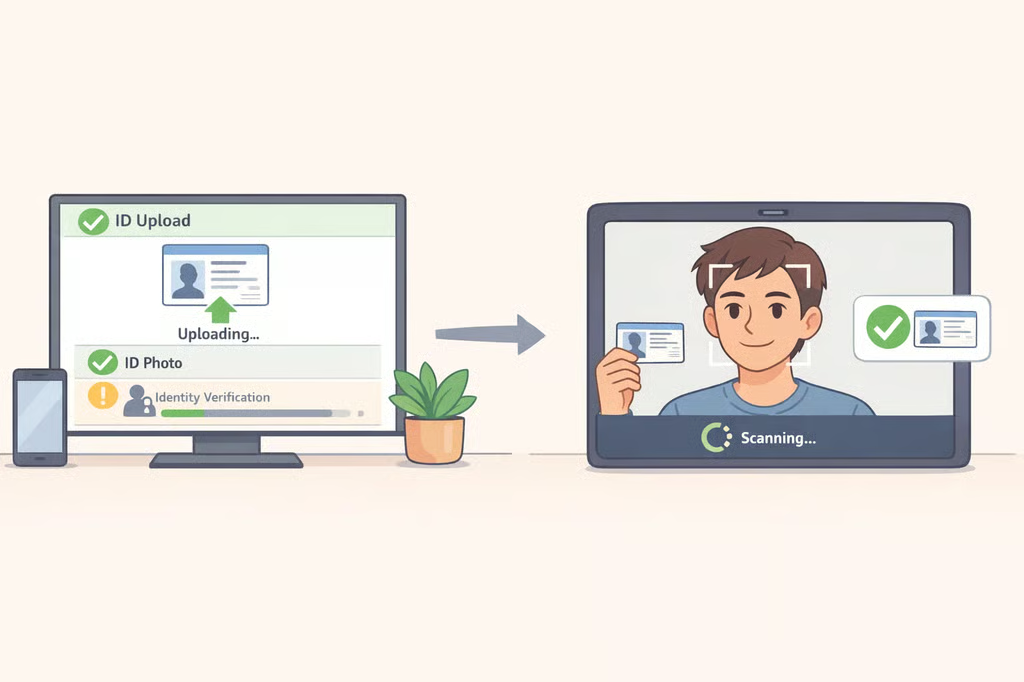
Students placed in the high-risk category are asked to present a valid government-issued photo ID and complete a brief live photo check during the online FAFSA session (FSA).
Accepted documents include a driver's license, passport, tribal identification card, or permanent resident card (FSA).
The photo check has to happen on a mobile phone or tablet. Students who start the FAFSA on a desktop get a QR code that moves the session to a mobile device (FSA). The device doesn't have to belong to the student; FSA's FAQ specifically allows a parent's phone or a school counselor's tablet (FSA FAQ).
Skipping the check doesn't block the FAFSA from being submitted, but the application comes back rejected until the issue gets resolved (FSA).
FSA says the online session is designed to finish in one sitting and can't be paused or resumed later. A student who arrives without a required document gets a short window to retrieve it if it's nearby, but running past that window counts as an incomplete check (FSA). Because of that one-sitting design, students selected for the check should have a valid photo ID and a camera-equipped mobile device ready before starting the final submission, especially close to an aid deadline.
What happens if the FAFSA identity check fails
The check itself is automated and gives real-time feedback if a photo or ID image doesn't come through clearly, so a student can retry before the session ends (FSA).
Not every result looks the same. FSA's guidance describes several statuses a student might see on the FAFSA submission summary:
- Moderate risk: the form processes normally, with a message telling the student no action is needed unless their college or career school follows up directly (FSA).
- High risk, document verification not finished: the form is rejected, and the message tells the student they were selected for identity verification but the process couldn't be completed, and to contact their college's or career school's financial aid office to finish it (FSA).
- Highest risk: the form is rejected outright, and the message tells the student that fraudulent activity was detected on their form and directs them to contact the financial aid office for assistance (FSA).
- Technical issue: if FSA's system can't run the screening at all, the form isn't blocked. It's marked with Comment Code 360, and the school isn't required to take extra action on it (FSA FAQ).
In processing terms, a check that's attempted but unsuccessful gets Reject Code 74 with Comment Code 354. A check the student never attempts gets the same Reject Code 74, paired with Comment Code 355 instead (FSA).
Getting a rejected FAFSA resolved
A rejected status shifts the remaining work to the school. FSA's guidance directs financial aid administrators to resolve identity issues using the in-person or video-call options described in its V4/V5 identity-verification guidance (FSA FAQ).
Once a financial aid administrator confirms a student's identity, the administrator enters an "FAA Fraud Override" in the FAFSA Partner Portal. That override is a separate step from V4/V5 resolution, entered after the school is satisfied the student's identity checks out (FSA).
Submitting the override generates a new transaction. Assuming nothing else on the form needs correcting, the resulting record includes a valid Student Aid Index and Pell Grant eligibility (FSA). Schools must keep processing a student's aid once they're satisfied the student's identity has been confirmed (FSA FAQ).
That obligation has a limit, though. A school has no duty to perform identity verification, or even respond, for a prospective student who is neither admitted nor enrolled there (FSA FAQ). A rejected FAFSA gets resolved through the college or career school where the student already has an admission offer or is currently enrolled: that school confirms identity and submits the override, and the corrected record follows from there. The Department itself doesn't handle individual cases.
Who else this affects
There's no exemption based on where a student is located or attending school. Students at foreign institutions and incarcerated applicants can both be flagged for identity confirmation like anyone else, even though students at foreign schools are exempt from standard verification (FSA FAQ).
Incarcerated applicants without a mobile device or an acceptable ID can still submit a FAFSA, but it comes back rejected until their institution steps in, using separate flexibilities FSA has built for incarcerated students (FSA FAQ).
The FSA materials cited here don't spell out the specific criteria behind the moderate-, high-, and highest-risk ratings, how often legitimate students get flagged in error, or a standard timeline for schools to resolve a rejected application. Students who get flagged should ask their financial aid office directly what to expect and roughly how long resolution takes at that particular school.
What to check before submitting the FAFSA
The 2026-27 FAFSA opened October 1, 2025, and the Department must receive it no later than June 30, 2027, though filing earlier is recommended since school and state deadlines often fall much sooner (2026-27 FAFSA form).
Before starting a submission, especially near a deadline:
- Confirm access to one accepted photo ID: driver's license, passport, tribal ID, or permanent resident card (FSA).
- Line up a phone or tablet with a working camera, even one borrowed from a parent or counselor (FSA FAQ).
- Plan to finish the FAFSA session in one sitting, since the identity step can't be paused and resumed (FSA).
- Check the FAFSA submission summary and any messages from a college or career school rather than assuming silence means everything is fine.
If a submitted FAFSA comes back rejected for identity reasons, contact the financial aid office at the college or career school where the student is admitted or enrolled, not the Department of Education. That office confirms identity and submits the FAA Fraud Override needed to generate a valid Student Aid Index and Pell Grant eligibility (FSA). Since FSA hasn't published a standard timeline for that resolution, ask the office directly what to expect and how soon it plans to act.