
- F-1 OPT Duration of Status Changes: 2026 Filing Guide
- Key terms before you file
- OPT filing paths under the duration of status rule
- How travel timing can change the filing requirement
- Key dates to track for OPT and STEM OPT filings
- What DHS guidance allows while a filing is pending
- Grace periods and the F-1 fixed admission period
- What students should verify with their DSO
F-1 OPT Duration of Status Changes: 2026 Filing Guide
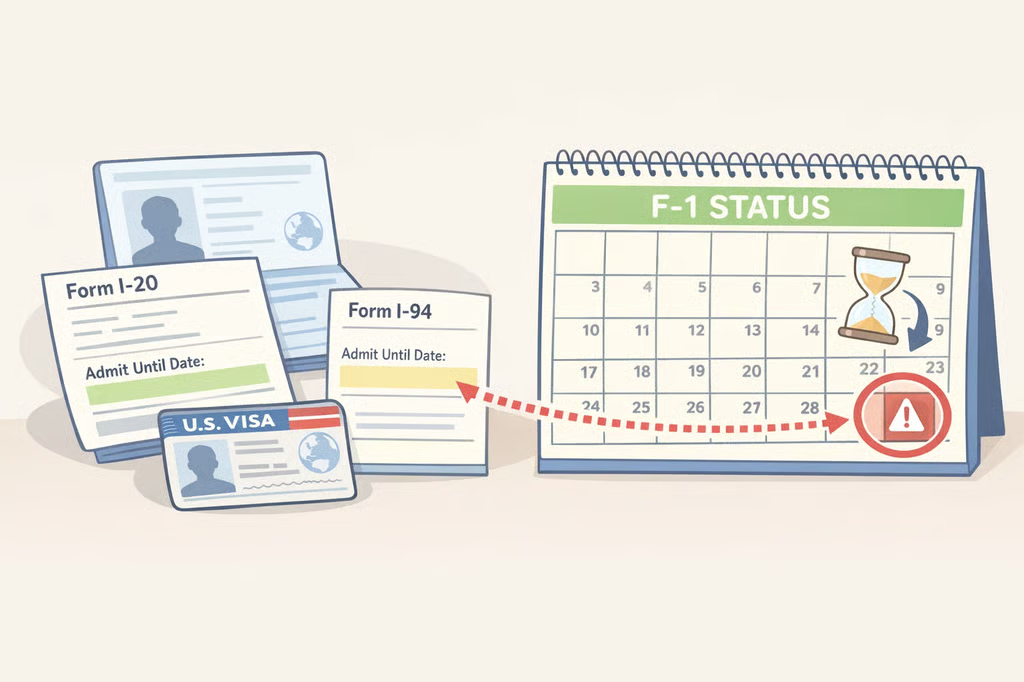
F-1 students working on Optional Practical Training or preparing a STEM OPT extension are facing a new, date-driven filing track under a DHS final rule ending duration of status for F, J, and I nonimmigrants. The rule is scheduled to take effect September 15, 2026, and would replace the current open-ended stay tied to program enrollment with a fixed expiration date on Form I-94, called an Admit Until Date (AUD). DHS finalized the rule on July 17, 2026, with that effective date subject to Congressional Review Act procedures, according to the Federal Register.
The guidance below applies to F-1 students pursuing post-completion OPT or a STEM OPT extension. It does not cover degree extensions, school transfers, moves between academic levels, J-1 cases, or I-status cases, which the final rule also addresses separately (DHS Study in the States).
DHS published the rule for F, J, and I nonimmigrants in the Federal Register on July 17, 2026. Fiscal year 2024 alone saw more than 1.8 million admissions in F status, a figure that counts entries rather than individual students but still shows how widely this classification is used (Federal Register).
Whether a student needs one form or two depends on three things: whether the student was in the U.S. in D/S status when the rule took effect, whether the student has traveled internationally since, and whether the student is entering the country for the first time on or after September 15, 2026.
Key terms before you file
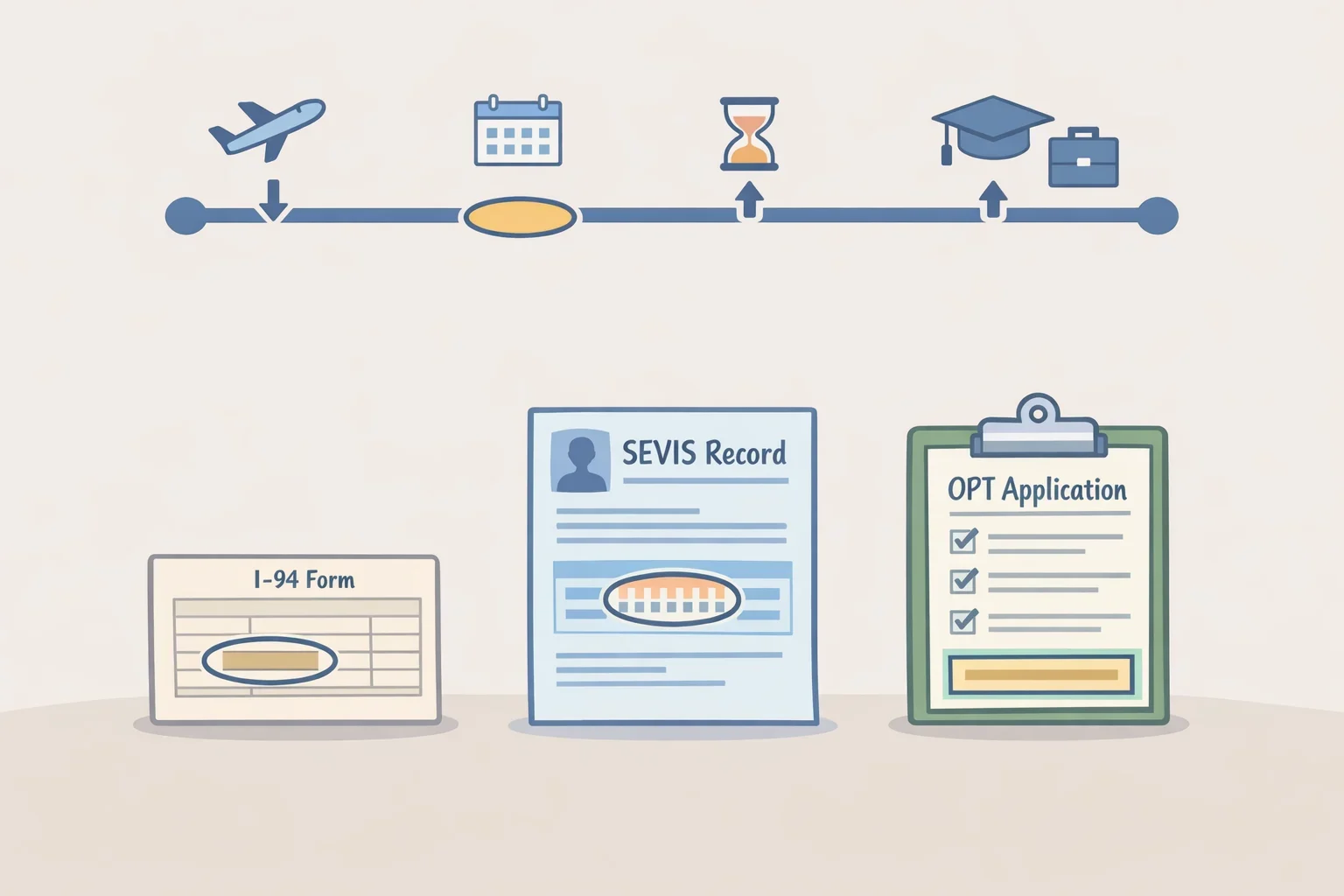
- D/S (duration of status): the admission framework that let F-1 and J-1 students remain in the U.S. as long as they maintained their program, with no fixed end date on the I-94 (Yale OISS).
- AUD (Admit Until Date): the specific date DHS will print on Form I-94 in place of the "D/S" notation once the rule takes effect (Yale OISS).
- EOS (Extension of Stay): a request filed with USCIS for more time in the U.S. before a current admission period expires (Yale OISS).
- Form I-94: the DHS arrival record showing a student's immigration classification and authorized period of admission.
- Form I-765: the Application for Employment Authorization, used to request an OPT or STEM OPT work permit.
- Form I-539: the Application to Extend/Change Nonimmigrant Status, used to request an EOS.
OPT filing paths under the duration of status rule

Until September 15, 2026, F-1 students continue to be admitted for duration of status, per the rule in the Federal Register. After that date, the filing path depends on the situation below.
Situation Status on Sept. 15, 2026 Travel after Sept. 15, 2026? Form I-539 generally required? Departure grace period Transition group, stays put Admitted for D/S, still in U.S. No No, if Form I-765 for OPT or STEM OPT reaches USCIS by March 18, 2027 60 days Transition group, then travels Admitted for D/S before departure Yes, readmitted with a fixed AUD Yes, both Form I-765 and Form I-539 required 30 days First admission on/after Sept. 15, 2026 Enters after the effective date Not applicable Required if the student needs more time beyond the AUD to finish the program or pursue OPT/STEM OPT 30 days
A DSO and USCIS, not this table, make the final call on any individual case. The table shows the general framework DHS has published so far (DHS Study in the States; Yale OISS).
Two exceptions worth flagging: F-1 students who are beneficiaries of a timely filed, cap-subject H-1B petition may qualify for a "cap-gap" extension and skip the separate EOS application, remaining in F-1 status until the petition is decided or April 1 of the relevant fiscal year, whichever comes first (DHS Study in the States). F-2 dependents, J-1 exchange visitors, and students not pursuing OPT or STEM OPT follow related but separate steps in the final rule.
How travel timing can change the filing requirement
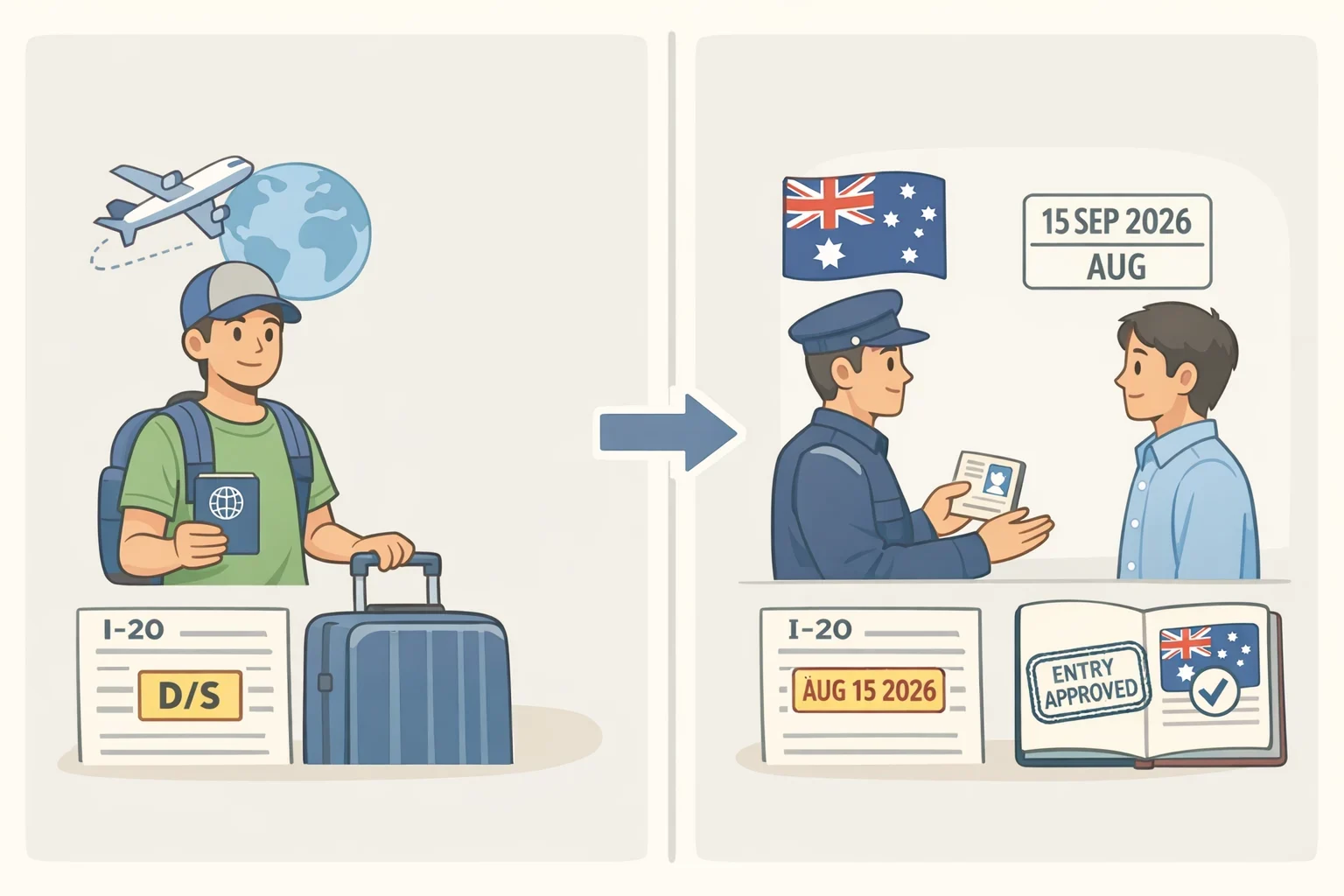
Consider two students with the same F-1 program end date of December 15, 2026, both currently admitted for D/S and both planning to file for post-completion OPT this fall.
If one of them travels internationally before filing anything and is readmitted after September 15, 2026, that re-entry converts the D/S admission into a fixed AUD tied to the December 15 program end date, plus a 30-day departure period (MIT ISO). DHS guidance is direct on this point: a student who travels before filing for OPT or STEM OPT and is readmitted with a fixed admission period must file both Form I-765 and Form I-539 (DHS Study in the States).
What happens if a student files Form I-765 first and travels afterward is less settled in the published guidance. Students weighing travel around an OPT or STEM OPT filing should raise the specific timing with their DSO and check current DHS guidance before booking anything, since the order of filing, travel, and readmission can change which forms a case requires.
Key dates to track for OPT and STEM OPT filings
- July 17, 2026: DHS published the final rule in the Federal Register.
- September 15, 2026: scheduled effective date, subject to Congressional Review Act review (Federal Register).
- March 18, 2027: the date DHS and Yale cite for filing Form I-765 for post-completion OPT or a STEM OPT extension without a separate EOS application, for eligible transition-group students (DHS Study in the States; Yale OISS). MIT's summary describes a related six-month provision covering pending Form I-539 applications using the date "before March 17, 2027." The one-day gap reflects how each source calculated the same six-month window from the effective date, not a separate rule (MIT ISO).
- A student's own dates: program end date on Form I-20, the OPT filing window (up to 90 days before or 60 days after the program end date, and within 30 days of a DSO's SEVIS recommendation), the STEM OPT filing window (up to 90 days before current OPT expires), current EAD expiration, and AUD expiration all determine what's due and when (USCIS).
What DHS guidance allows while a filing is pending
Filing Form I-539 does not, on its own, authorize a student to begin or continue post-completion OPT employment. That authorization comes only from an approved EAD under standard OPT rules (Yale OISS).
Separately, under existing STEM OPT rules that this new rule does not change, a student with a timely filed STEM OPT extension application may keep working for up to 180 days past the current EAD's expiration, provided program requirements are met (Yale OISS).
A narrower 240-day provision covers on-campus employment, Curricular Practical Training, or severe economic hardship employment (or, for J status, program participation and status-related employment) while a Form I-539 is pending. Yale describes that provision as distinct from OPT or STEM OPT work authorization: it does not create a new 240-day extension of an OPT or STEM OPT EAD (Yale OISS). MIT's summary adds that DHS had not yet issued additional guidance clarifying how the 240-day provision works in every case as of its late-July analysis, so this detail is worth confirming with a DSO before relying on it (MIT ISO).
Grace periods and the F-1 fixed admission period
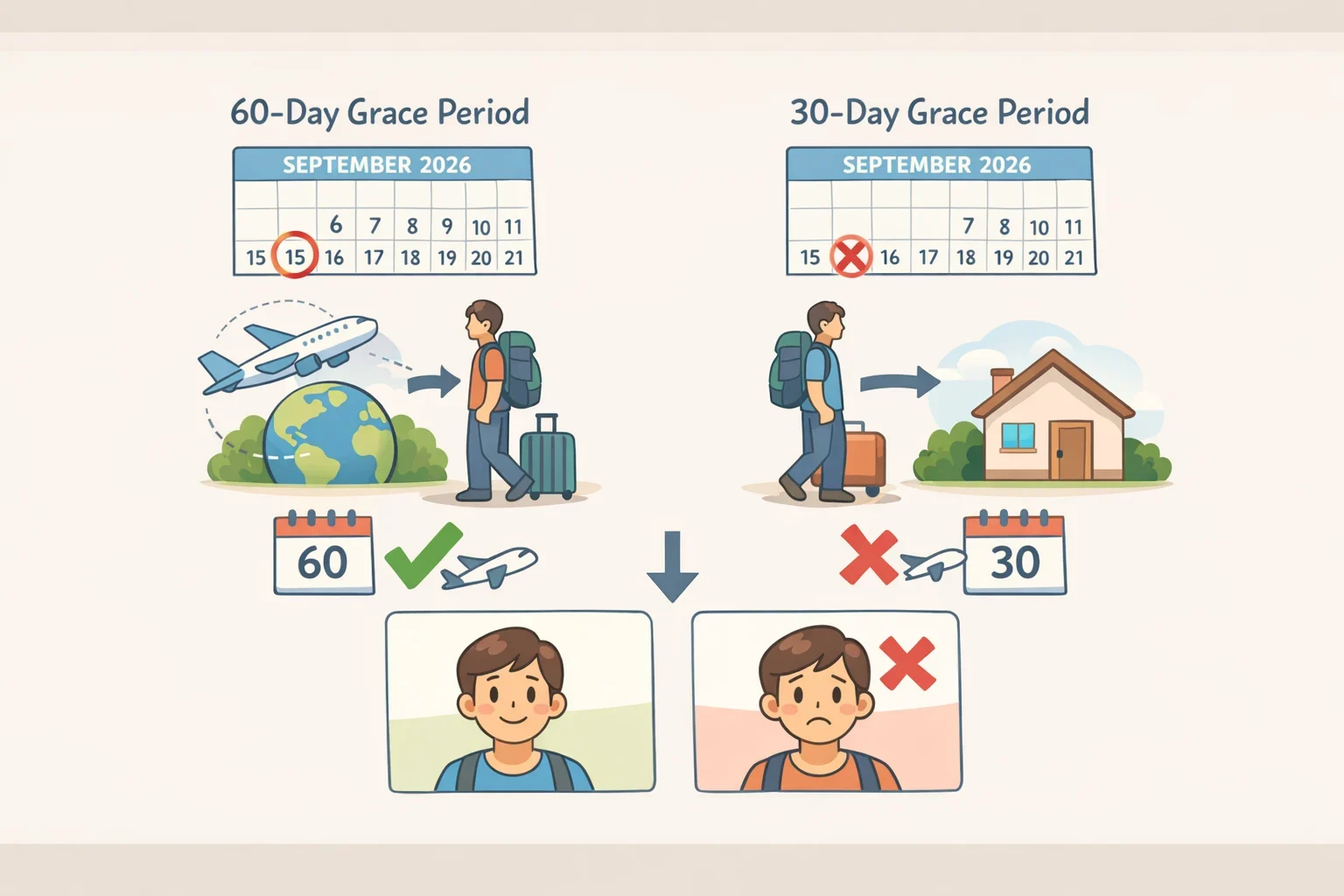
The post-completion grace period tracks a student's travel history, not just which row of the table applies. Students in the transition group who stay in the U.S. without traveling keep the existing 60-day grace period; anyone who departs and re-enters after September 15, 2026, including transition-group students, gets the new 30-day departure period instead (MIT ISO).
All new fixed-date admissions after September 15, 2026, come with a 30-day period to prepare for departure once a program or post-completion OPT or STEM OPT ends, down from the previous 60-day standard (Federal Register).
A Form I-539 carries logistical requirements beyond the paperwork itself. It has to reach USCIS before the I-94 or AUD expires, and it requires the correct fee, biometrics, and, where necessary, a DSO's help updating SEVIS records. A DSO can generally extend a program's end date in SEVIS without USCIS approval, but that update does not extend a student's federal admission period or substitute for an EOS. USCIS makes the final decision on any extension of stay application (Yale OISS).
Students who fall out of status matter here too. Yale's guidance warns that remaining past an I-94 expiration date without an approved extension or another lawful status may cause a student to fall out of status and begin accruing unlawful presence immediately, without waiting for a formal determination from USCIS or an immigration judge. More than 180 days of unlawful presence may trigger a three-year reentry bar, and one year or more may trigger a ten-year bar (Yale OISS).
What students should verify with their DSO
A DSO can review a SEVIS record and explain a school's filing process, but that office's authority has limits: extending a program end date in SEVIS is not the same as USCIS approving an EOS. This article explains the rule in general terms. For questions about individual legal risk, such as specific travel timing, a denied application, or unlawful presence, students should consult their DSO alongside a qualified immigration attorney.
Before booking travel or filing anything, pull the most recent Form I-94 and check whether it shows "D/S" or a specific date. Compare that date against the I-20 program end date and, if applicable, the current EAD expiration. Then bring all three documents to the DSO office and ask which filing path applies to that specific case, along with the exact fee and deadline that case requires.