
- Pearl Harbor Remembrance Day Classroom Activities: 3 Lessons
- Choosing the right activity for your class
- Pearl Harbor primary source activities: corroborating the attack
- Teaching Pearl Harbor with primary sources: film versus documentation
- December 7 classroom activities: tracing unequal consequences
- Before you teach: verify your sources
- What to do next
Pearl Harbor Remembrance Day Classroom Activities: 3 Lessons
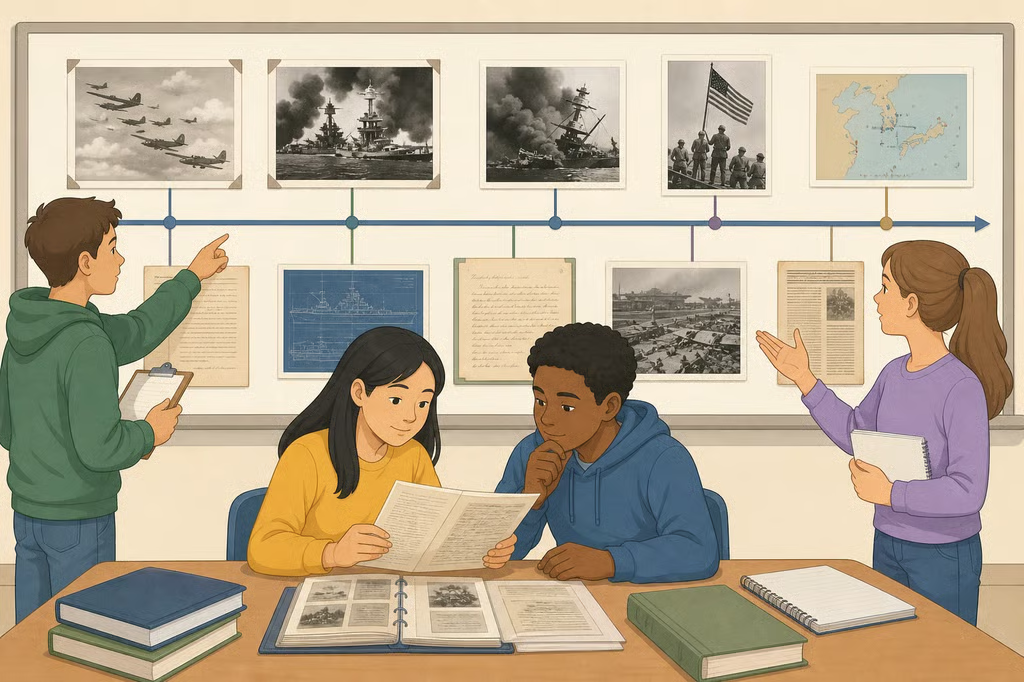
Teachers looking for Pearl Harbor Remembrance Day classroom activities that go beyond a single textbook paragraph now have more raw material to work with than most lesson plans use. Last year, the National Archives confirmed it recovered a handwritten Navy logbook covering March 1941 through June 1942, spanning the December 7 attack itself, after a California couple turned it over to the government. The logbook now resides in the National Archives and is available to the public.
That discovery joins a larger existing collection. The Archives already hold ship logbooks, a December 7 radiogram warning "this is no drill," maps, and salvage photographs, according to a National Archives program on the attack's history. The attack killed 2,341 people, including 1,177 aboard the USS Arizona, according to Archives records.
This guide turns those records, plus a teaching resource from the National WWII Museum, into three classroom activities built around one question: how do different kinds of evidence, official records, film, and everyday objects like a school yearbook, help students understand both the attack and its uneven aftermath? Each activity below lists a suggested grade range, a time estimate, source material, and a way to check what students learned. The grade and time estimates come from this article, not an official curriculum, so adjust them to fit your students and your schedule.
Choosing the right activity for your class
Pick based on the period length available and how ready students are for sensitive material, not just where you are on the calendar.
- Evidence of the attack: grades 6 through 12, one class period. Builds corroboration skills by cross-checking firsthand textual records.
- Evaluating representation: grades 9 through 12, one to two periods. Builds media-literacy skills by comparing how film represents an event versus how documents record it.
- Tracing consequences: grades 8 through 12, two periods or a homework extension. Builds skill in analyzing civil liberties and uneven wartime experience, drawing on a teaching resource from the National WWII Museum.
Each activity targets a different historical-thinking skill instead of repeating the same "what happened" content. The third one touches on incarceration and civil liberties directly, so younger students may need extra framing time before you start.
Pearl Harbor primary source activities: corroborating the attack
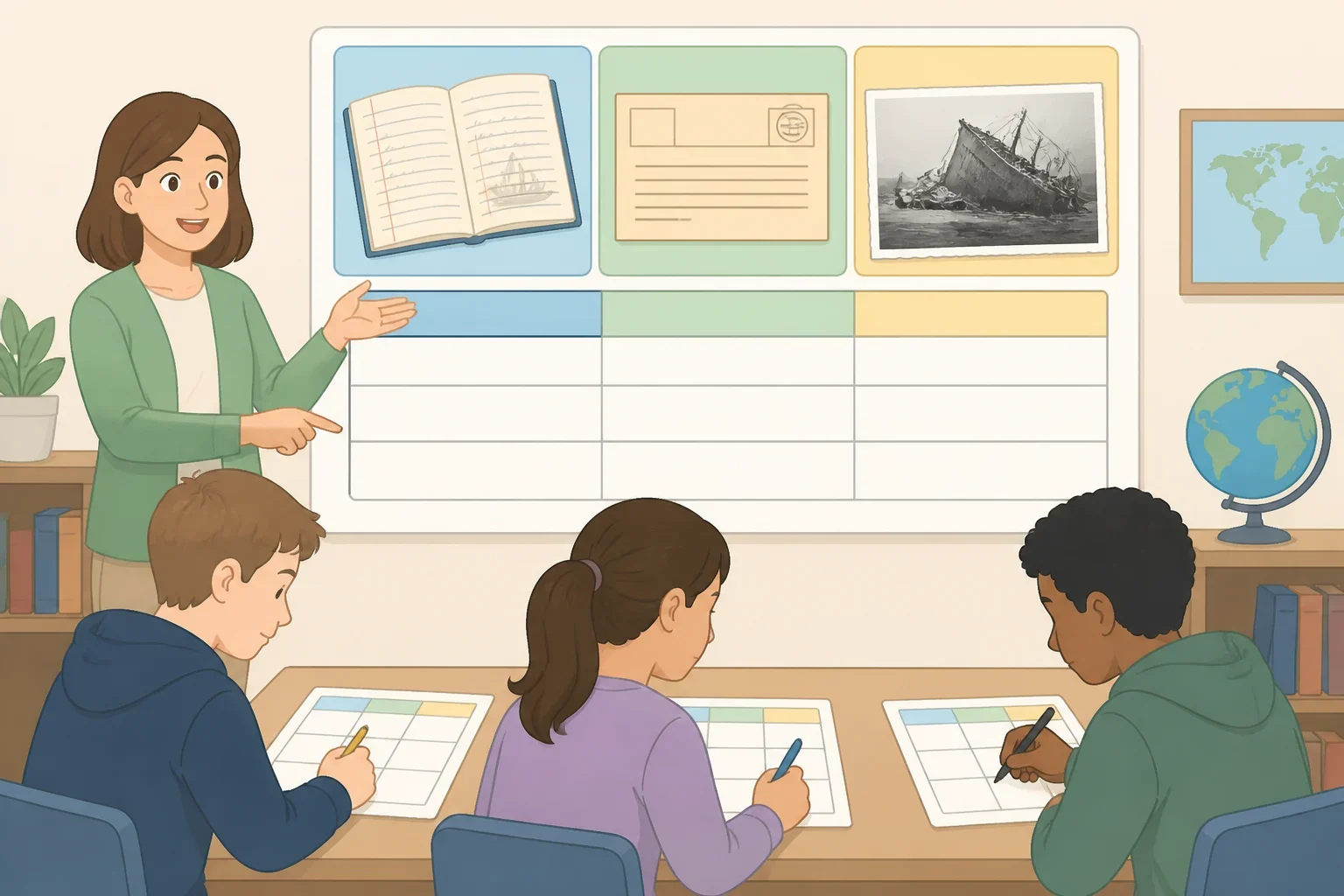
This activity treats Pearl Harbor as a puzzle assembled from multiple accounts rather than one clean narrative. Pull a logbook excerpt, the December 7 radiogram declaring "this is no drill," and a Navy dispatch that announced the attack to the mainland, all part of the Archives' holdings described in its program on the attack's history. Pair one of these with a digitized salvage photograph, such as an October 24, 1942 image of a sailor emerging from the USS Arizona's after magazines, catalogued under National Archives Identifier 296945 and available through the Archives.
Give each student two or three sources and a short evidence log with three columns: source, creator and date, and one fact it confirms. Push students past simple restating with a model like this: the radiogram confirms that commanders recognized an attack was underway in real time, while the salvage photograph can't corroborate that warning because it was made nearly a year later. Instead, it documents the physical aftermath. That distinction, between a source that confirms a claim and one that simply repeats or extends it, is the actual skill this activity builds.
Have students answer three questions for each entry: Who created this record, and when? What does it confirm that a textbook summary can't show directly? What's missing if this is the only source available? For an exit ticket, ask students to write one sentence naming a claim about Pearl Harbor that only becomes verifiable once two sources agree.
Teaching Pearl Harbor with primary sources: film versus documentation
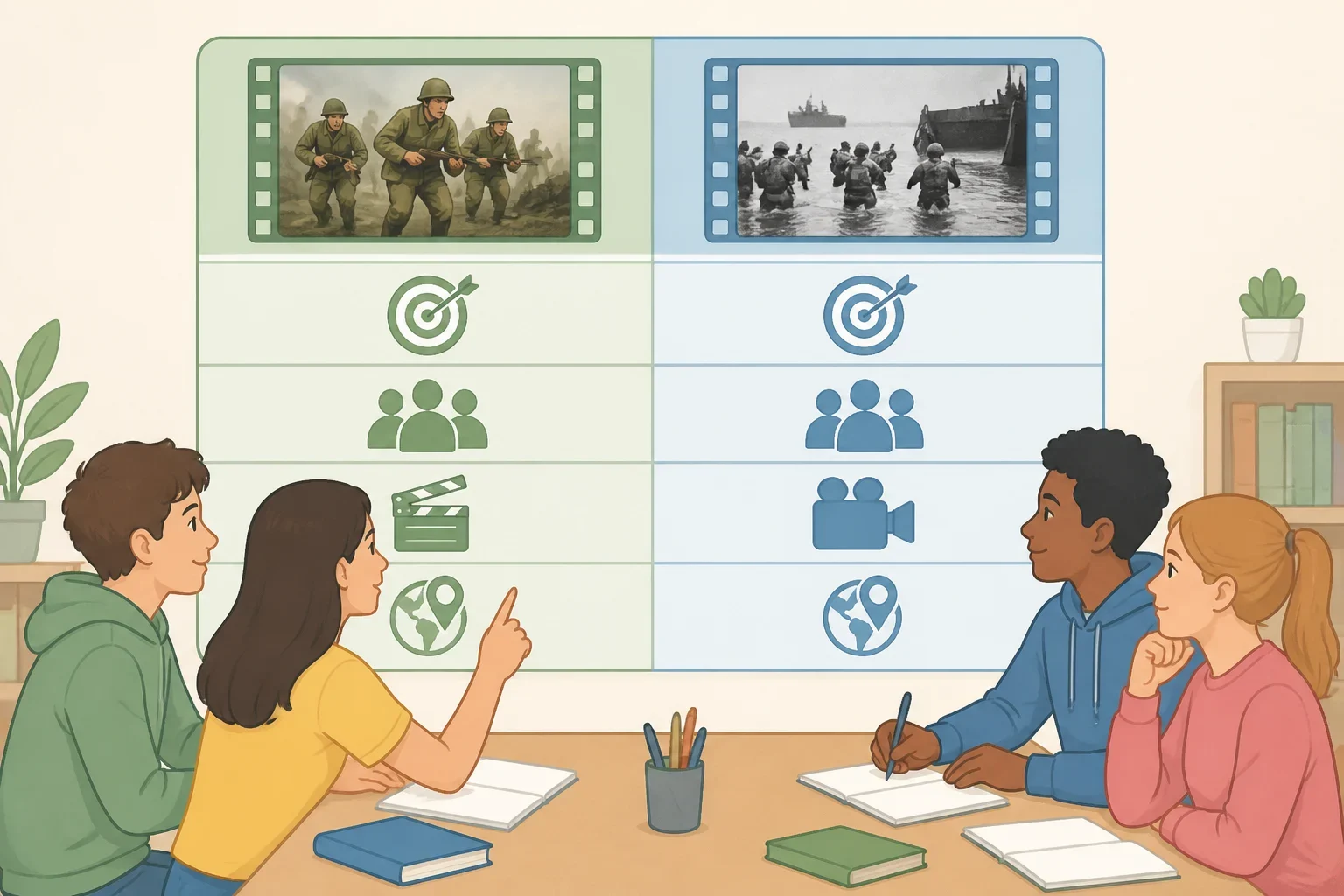
Because Pearl Harbor was a surprise attack, almost no American motion-picture footage exists from the moment itself, according to the National Archives. Name that gap for students before showing any clip; it explains why the footage they're about to see wasn't filmed live.
Introduce December 7th, a film the Navy released in 1943 that won the 1944 Academy Award for Best Documentary Short Subject. Despite the award, the vast majority of its footage was recreated after the attack rather than filmed during it, according to the Archives. Pair it with Dia Toa News, a captured Japanese newsreel the Archives describe as chronicling the attack "from their perspective." The source material doesn't characterize the newsreel beyond that description, so avoid labeling it propaganda without further evidence.
Both titles come from a description of a National Archives screening program, not a confirmed public streaming link. Whatever version of either film students see, make clear which scenes were recreated after the war so no one mistakes staged footage for a direct recording of the attack.
Have students build a two-column chart, but skip a single reliability score for each film. Instead, ask them to separate four criteria: purpose (why was this made), audience (who was it made for), production circumstances (recreated footage versus live filming), and proximity (how close in time and place is this source to the actual event). A recreated Navy documentary and a captured newsreel can both be useful sources; they just answer different questions when measured against those four criteria. Ask students who made each film and for whom, what "recreated" means here and why an award-winning documentary might still include staged scenes, and how a wartime newsreel differs in purpose from a Navy logbook. As an assessment, have them write a short paragraph naming which source they'd cite if asked what happened at Pearl Harbor on December 7, and which they'd cite if asked how the attack was portrayed to the public afterward.
December 7 classroom activities: tracing unequal consequences
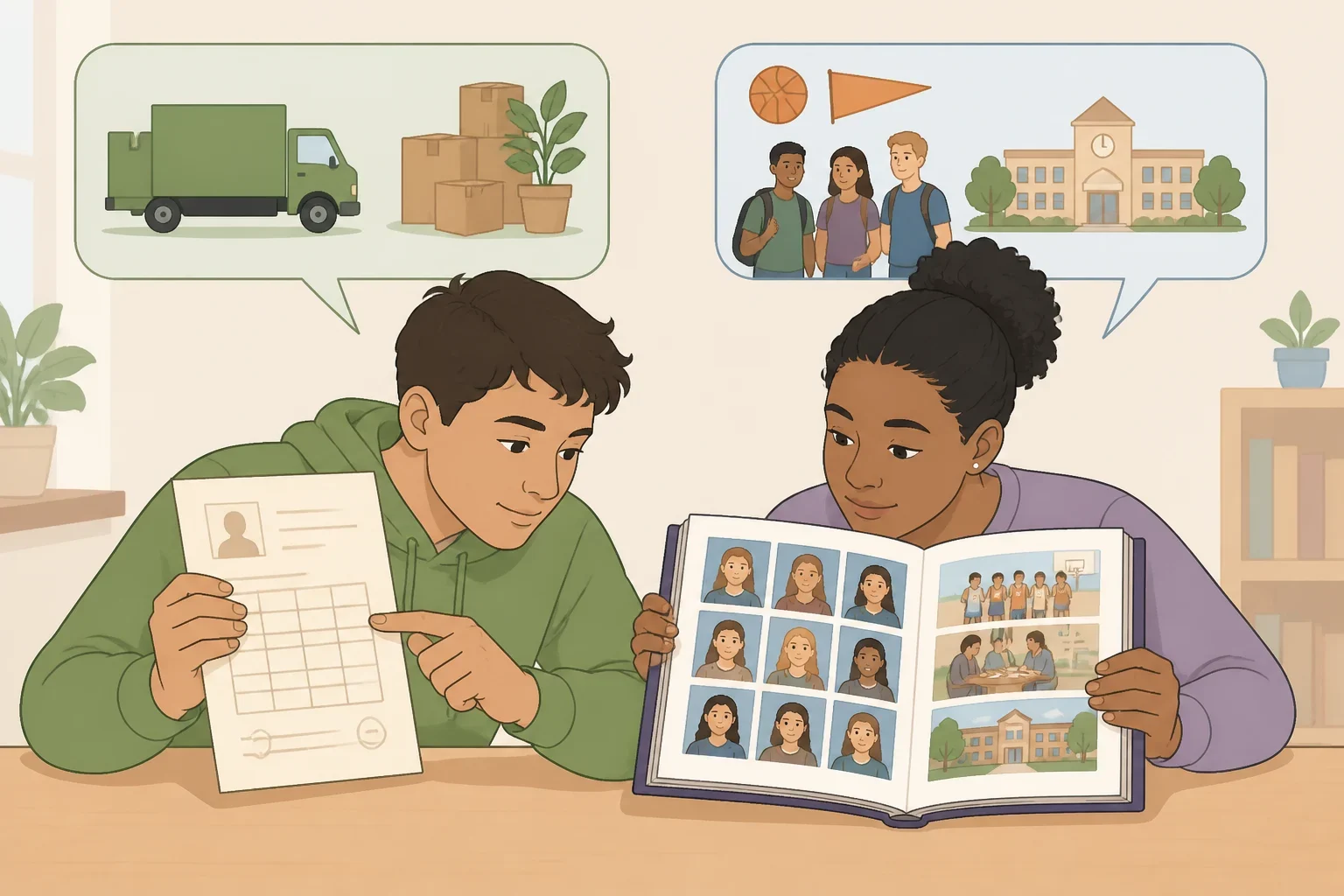
This activity narrows to one central comparison instead of surveying all Asian American and Pacific Islander wartime history. It pairs artifacts to show how a single event produced different outcomes across communities, which is the lesson's analytical purpose rather than a settled historical verdict, drawing on a National WWII Museum resource published earlier this year.
Show students the Museum's "Relocation Instructions" artifact alongside the digitized 1944 Rohwer Center High School yearbook. At first glance, the yearbook resembles any other Home Front high school yearbook, according to the Museum. Its students, though, lived behind barbed wire after Executive Order 9066 forced Japanese American families from their homes. Almost 80,000 of those forced into camps were Nisei, children born in the United States to Japanese immigrant parents, who were citizens by birth.
Make clear to students that AAPI wartime experience wasn't one story. Many Chinese, Filipino, and Korean communities had already lived through Japanese occupation or invasion before December 7; the Philippines, Korea, and parts of mainland China were occupied earlier, and some 2,700 Korean men who had been forced laborers for Japan were later captured by U.S. forces and held as prisoners of war in Hawaii for the rest of the war, the Museum notes. About 20% of Chinese Americans and thousands of Filipino nationals enlisted; the Museum describes enlistment as offering a unique path to full citizenship at a time when that path was otherwise mostly out of reach. That contrast, incarceration for one community alongside a path to citizenship through service for another, is what students should compare.
On December 18, 1944, the Supreme Court decided two cases the same day with opposite outcomes: Korematsu v. United States upheld the government's exclusion order, while Ex parte Endo ruled the government could not detain a citizen it conceded was loyal, according to the Museum. Reparations for incarcerated Japanese Americans followed decades later, in 1988. Frame this material around civil liberties and lived experience rather than a debate over whether incarceration was justified.
Have students plot four points, the yearbook-and-instructions pairing, the enlistment figures, and the two court rulings, on the OER Project's Continuity and Change Over Time chart, a classroom setup proposed here rather than a sourced requirement. The x-axis marks whether an event represents continuity or change; the y-axis marks whether its impact was positive or negative, per the Museum's description of the tool. Require a written justification for each point instead of letting students treat "positive" and "negative" as self-evident; a policy that looks purely negative for one community can sit alongside a policy that opened a narrow path to citizenship for another. Then ask why two people affected by the same war might land in very different spots on that chart.
Before you teach: verify your sources

Check each Archives catalog link and confirm its digitization status before assigning it, since online access can change. Confirm current availability for December 7th and Dia Toa News through the National Archives Catalog rather than relying on the screening-program description alone, and keep stills, transcripts, or captioned summaries on hand in case the full films aren't accessible.
Review school or district guidance on teaching incarceration history and wartime casualty figures before the third activity, especially for younger grades, and preview any film clips or stills for age-appropriateness ahead of class.
What to do next
Pick one activity based on the class time available and where students are in the unit. Select one source pair from that activity, write down the single claim you want students to corroborate or evaluate, and decide what evidence they'll submit to show their thinking, an evidence log, a comparison chart, or a CCOT plot with written justification. If incarceration history is new territory for your class, check in with a department colleague or curriculum coordinator on scope and framing before you teach it, not after.