
- Evidence-Based Writing Instruction in Elementary School
- Why writing instruction needed a rethink
- What evidence-based writing instruction in elementary school looks like
- Which writing strategies have the strongest evidence?
- A four-step writing lesson for grades 2-4
- How middle and high school fit the same picture
- What to check next
Evidence-Based Writing Instruction in Elementary School
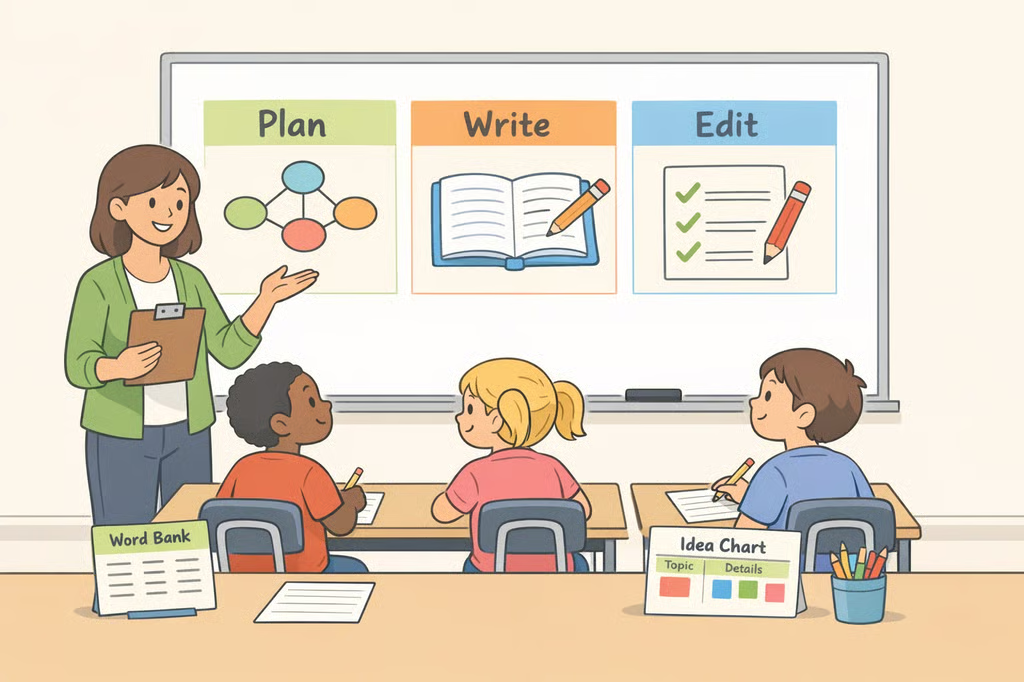
A student staring at a blank page during "writing time" is a familiar classroom problem. It's also part of why the Institute of Education Sciences (IES) built a new resource aimed at addressing it directly. Last fall, IES released the first of 10 planned toolkits designed to help teachers deliver evidence-based writing instruction in elementary school, specifically in grades 2 through 4, treating writing as a skill that needs deliberate teaching rather than more independent writing time and the hope that students figure it out on their own (IES's toolkit overview).
A federal agency building a structured resource matters for teachers looking for guidance. It's not the same as proof that classrooms nationwide have already changed how they teach writing, and it's worth being precise about that distinction before going further. This article breaks down what the toolkit contains, what research actually supports when it comes to writing strategies for elementary students, a practical lesson structure teachers can adapt now, and what to check locally instead of assuming a national resource describes any one classroom.
Why writing instruction needed a rethink

Writing is genuinely hard to teach well, and the research explains why. A meta-analysis focused on primary-grade students describes writing as one of the most demanding academic skills because it requires coordinating multiple language and cognitive processes at once: spelling, sentence construction, organizing ideas, and generating content (the primary-grade meta-analysis).
That difficulty shows up in long-standing assessment data. National assessments from 2003 and 2012 found that roughly three in four school-age students did not reach proficient writing levels, according to the same meta-analysis, which cites those figures to explain why researchers have spent years studying writing instruction, not as a measurement of how students are writing today (the primary-grade meta-analysis).
IES frames the new toolkit's goal in specific terms: helping students build fluency, confidence, and stamina, and eventually see writing as a tool for thinking (IES's toolkit overview). That's a narrower, more useful aim than a generic call to write more, and the research supports why the distinction matters. In the meta-analysis, variation in total instructional dosage did not explain differences in outcomes across studies. That's a specific finding about dosage, not a general claim that method always outweighs time, but it does suggest that adding minutes to the schedule isn't the lever most likely to help (the primary-grade meta-analysis).
What evidence-based writing instruction in elementary school looks like
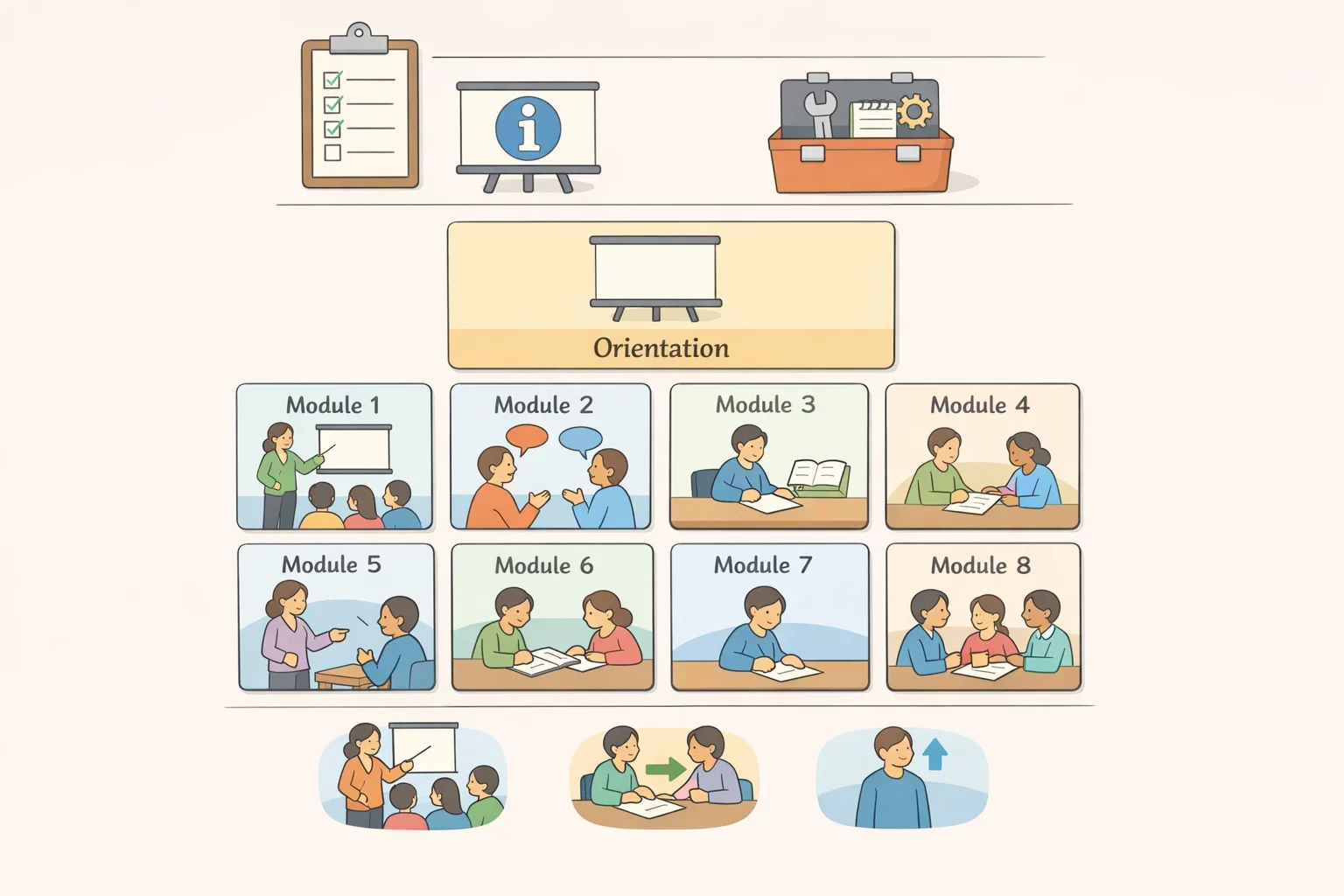
So what does "evidence-based" mean here, beyond a label on a government resource? The IES toolkit is built on the What Works Clearinghouse's "Teaching Elementary School Students to Be Effective Writers" practice guide, and IES described it as the first of 10 toolkits planned for release during the 2025-26 school year (IES's toolkit overview). Whether the remaining nine have since gone out isn't confirmed in the sources reviewed for this article, so teachers curious about additional toolkits should check IES's site directly.
The toolkit is designed around professional learning communities (PLCs), small teams of teachers who meet regularly to study and apply a shared instructional practice. It includes an orientation plus three modules delivered across eight one-hour sessions, with an option for individual use if a school doesn't have PLC time set aside (IES's toolkit overview).
Teachers begin with a self-reflection tool that assesses their own current instructional practices, highlighting strengths and gaps before any new strategy gets introduced. From there, the modules move into establishing daily writing routines, building a classroom culture where writing feels supported, and delivering explicit instruction using gradual release of responsibility, a sequence where a teacher models a skill and then gradually hands more responsibility to students as they practice independently (IES's toolkit overview).
The final module focuses on sustaining whatever practices a PLC has built. IES separately describes peer feedback, publishing student work, and letting students choose their own topics as strategies that help students see themselves as real writers with something worth saying, though the source doesn't specify that all three sit inside that closing module (IES's toolkit overview).
Before assuming this is easy to slot into an existing schedule, a few implementation questions are worth asking. Eight one-hour sessions require someone to enable them, whether that's an instructional coach, a literacy specialist, or a teacher taking on that role for a grade-level team. A school considering this toolkit needs to figure out where that time comes from, not just whether the content is useful.
For teachers, the toolkit's name and structure are specific enough to check directly. Ask a curriculum coordinator whether the school has scheduled PLC time around this particular resource, or whether "writing PD" this year refers to something else entirely.
Which writing strategies have the strongest evidence?
The strongest quantitative evidence discussed here comes from a meta-analysis of 24 studies involving 5,589 students in kindergarten through third grade (the primary-grade meta-analysis). That's an important scope note: this evidence base is directly relevant to grades 2 and 3, but it doesn't establish effects specifically for grade 4, since fourth graders weren't part of the sample. Anyone applying these findings to a grade 4 classroom is extending the evidence, not reading a direct result.
Within that K-3 sample, writing instruction overall produced a moderate, positive effect, with students in the instruction group scoring roughly a third of a standard deviation higher than students without it (the primary-grade meta-analysis). That's a real but modest average effect, not a guarantee for any individual student.
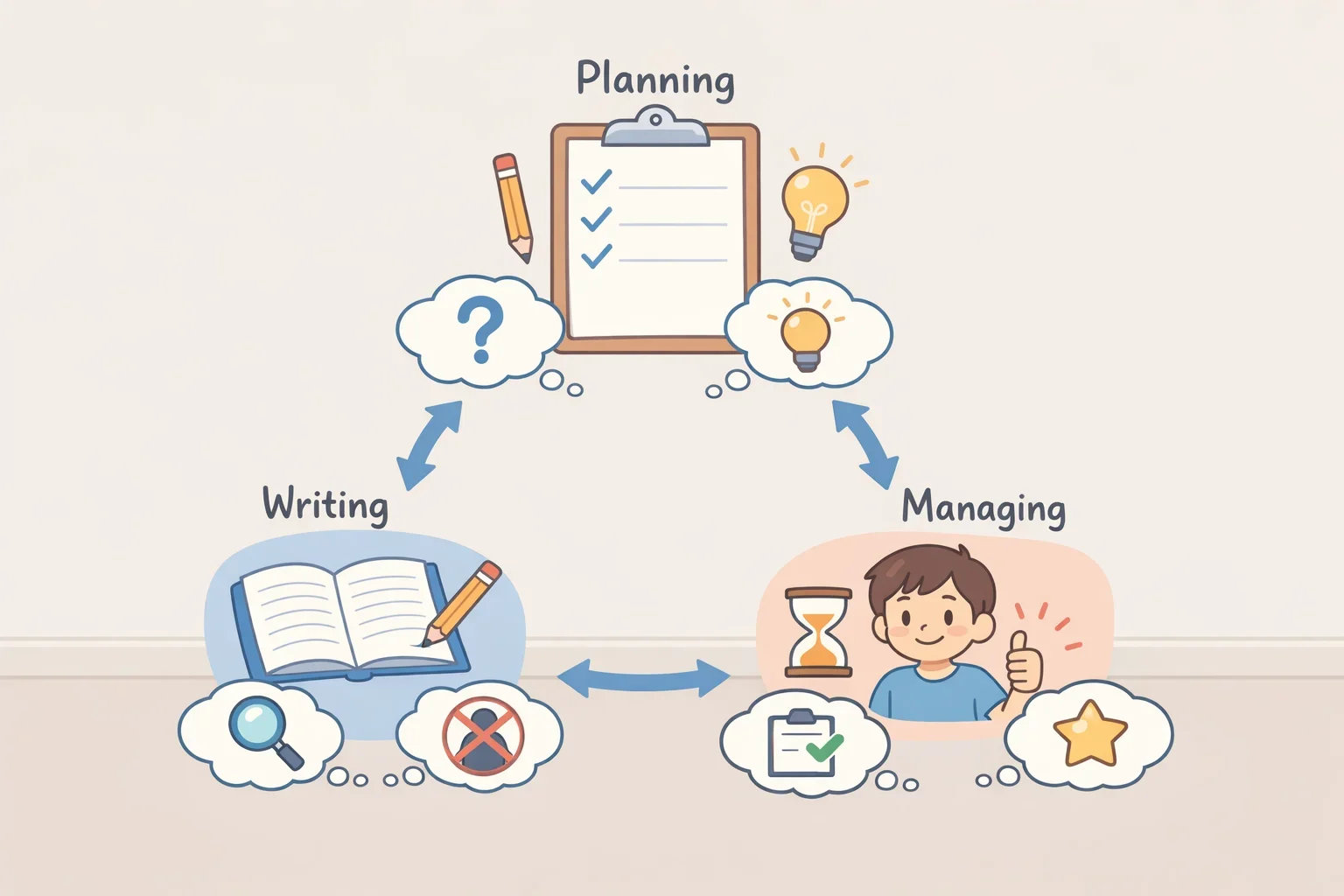
One specific approach inside that broader research stands out: Self-Regulated Strategy Development, or SRSD, a method that teaches students to plan, monitor, and manage their own writing process. Across the studies reviewed, SRSD produced effects of 1.04 for writing quality, how well the writing communicates its ideas, 0.72 for text-structure elements, meaning how consistently a piece includes the parts readers expect from that genre, and 0.59 for productivity, or how much writing a student produces (the primary-grade meta-analysis). Those effects were substantially larger than the overall average of 0.31 reported across the full meta-analysis. Worth being clear: SRSD is an approach studied broadly across primary-grade research. It's an example of what works, not a confirmed feature listed inside the new IES toolkit itself.
By contrast, instruction that focused only on transcription, meaning handwriting and spelling, didn't produce statistically significant effects on any dimension of composition the researchers measured (the primary-grade meta-analysis). That doesn't mean handwriting and spelling don't matter. For classroom planning, it suggests those foundational skills likely need to be paired with strategy instruction rather than mastered separately before students write anything meaningful.
A four-step writing lesson for grades 2-4
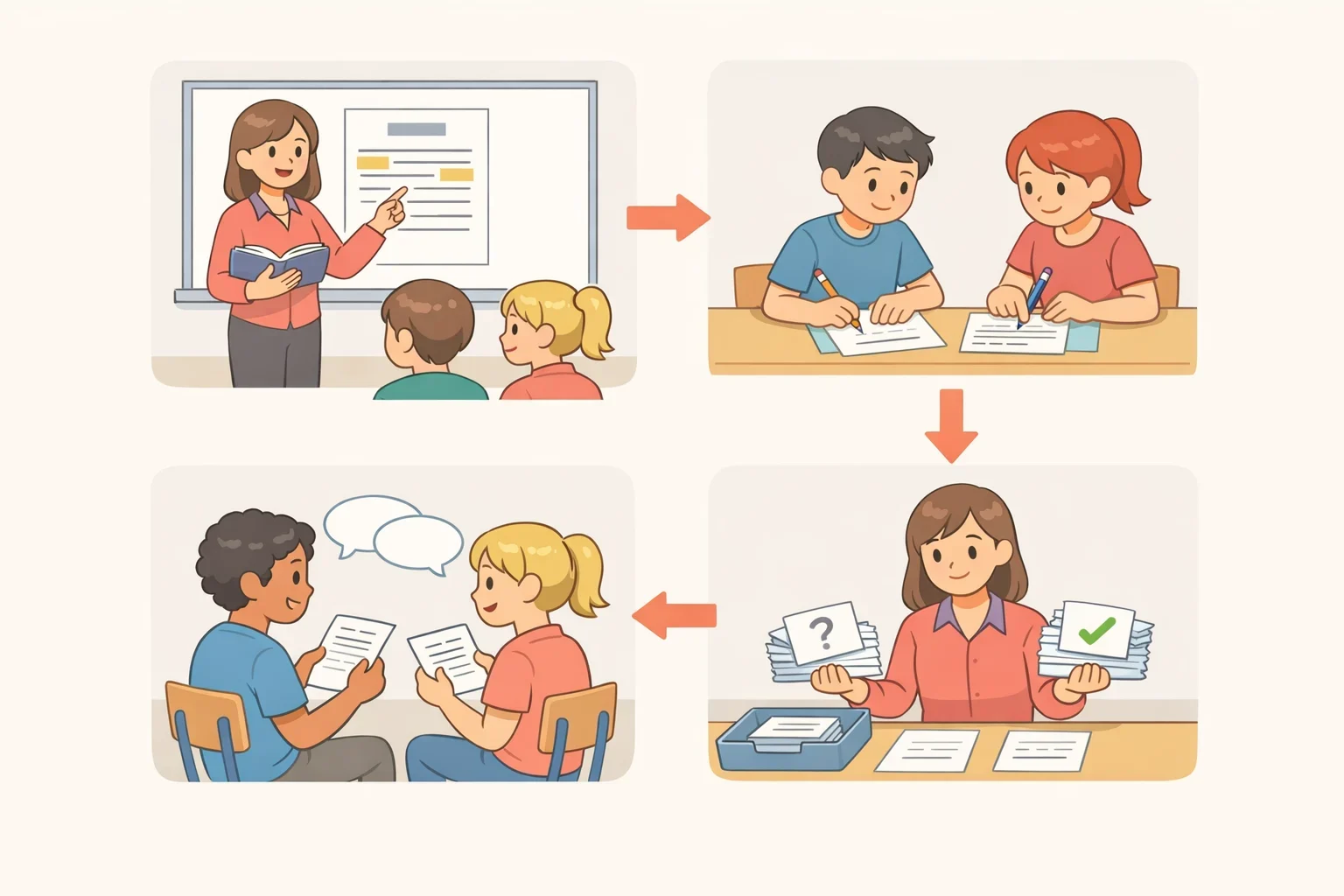
Here's how a teacher might turn those research findings into a single lesson, built around the same idea that shows up in both the SRSD studies and the IES toolkit's gradual-release approach: model first, then hand over responsibility gradually.
- Model the process out loud. Before students write a word, the teacher thinks aloud through planning a short piece, for example a science explanation, narrating what to say first and why.
- Guide planning together. Students work through a simple planning step as a group or with a partner, using a checklist or graphic organizer rather than starting cold.
- Draft independently, then trade for feedback. Students write their own version, then exchange papers and give each other feedback focused on one specific feature, such as whether the writing includes a clear main idea.
- Review samples to plan reteaching. The teacher reads the resulting work and sorts it by what needs more instruction: some students may need help organizing ideas in order, others may need practice supporting a claim with a detail.
This sequence is an illustration of how a teacher might apply the research discussed above. It isn't a tested protocol lifted directly from either study, and it isn't a required format inside the IES toolkit. Teachers can adapt it to writing tasks in science and social studies, too, where writing also supports learning rather than just demonstrating it.
How middle and high school fit the same picture
The same instructional philosophy extends upward. A companion practice guide for grades 6-12 rests on similar reasoning, that writing supports critical thinking and happens in every subject, and it recommends a "Model-Practice-Reflect" cycle where teachers demonstrate a strategy before students practice it and evaluate their own work (IES/REL Pacific's practice guide).
One real difference is worth flagging: the secondary guide recommends assessing students' own writing before teaching a new strategy, then targeting feedback based on that assessment. The elementary toolkit's self-reflection tool, by comparison, has teachers assess their own instructional practices, not their students' writing directly, so the two resources aren't identical in design even though both lean on evidence (IES/REL Pacific's practice guide). As of that January 2025 update, IES described the secondary toolkit as still in its evaluation phase, with publication expected sometime that year. That window has since passed, and nothing in the sources reviewed here confirms whether it has been finalized, so middle and high school teachers should check IES's Regional Educational Laboratory pages directly for current status.
What to check next
None of the sources reviewed here report how many schools have adopted either toolkit, how much instructional time schools are devoting to writing as a result, or how the training affects teacher workload. A federal resource existing isn't the same as a confirmed shift in what happens in a specific classroom, which is exactly why the next steps below point toward local verification rather than another national summary.
If you're a teacher, ask a curriculum coordinator three things: whether the school has scheduled PLC time around this specific IES toolkit, whether current writing instruction includes explicit modeling and gradual release rather than mostly independent writing time, and whether student writing samples are actually used to decide what gets retaught. If no structured resource is in place yet, the four-step sequence above is a reasonable starting point for a single lesson in any subject.
If you're a parent, two questions at a conference cover most of what matters: "Does my child's class use a structured writing routine, with planning and revising steps taught explicitly?" and "How is my child's writing assessed to decide what to work on next?" At home, support drafting by asking your child to explain their plan out loud before they start writing, rather than editing or rewriting the work yourself.
Either way, the concrete next step is the same: ask to see the specific resource by name, whether that's this IES toolkit or the grades 6-12 practice guide, and confirm with the school's curriculum office which one, if any, is actually in use before assuming a federal report describes your child's classroom.