

- AI readiness survey 2026: Skills and data gaps
- What the AI readiness survey 2026 shows about skills
- Data readiness for AI: Why governance and data quality matter
- AI ROI measurement: Expected results are not demonstrated impact
- What to check before choosing AI-related training
- Choose demonstrated practice over a promising title
AI readiness survey 2026: Skills and data gaps
Enterprise leaders often describe their organizations as ready for artificial intelligence while naming the same capabilities as major obstacles. That contradiction sits at the center of the AI readiness survey 2026, a report based on 505 data and analytics leaders at major global enterprises. The survey was conducted in the second half of 2025 and published nine months ago, so it offers a recent view of enterprise planning, not a universal measure of the labor market. (Drexel LeBow)
That distinction matters for anyone comparing an AI course, certificate, bootcamp, or degree. The findings do not prove that a particular credential leads to a job or higher pay. They do show which capabilities surveyed leaders say are difficult to build: reliable data, responsible oversight, business translation, practical measurement, and the ability to move beyond isolated experiments.
For students and career changers, the useful question is not simply, “Does this program teach AI?” It is, “Will this program help me check data, explain decisions, manage risks, connect a tool to a real goal, and evaluate the result?”
What the AI readiness survey 2026 shows about skills
The survey’s confidence gap begins with a difference between having a capability and being prepared to use it consistently.

Most respondents said their organizations had the infrastructure, skills, data readiness, strategy, and governance needed for AI. At the same time, those categories appeared among the leading obstacles to AI progress. Infrastructure was cited by 42% of respondents, skills by 41%, and data readiness by 43%. (Drexel LeBow)
Those answers are not necessarily impossible to reconcile. A company may have a data platform, employees who have used AI tools, and a written strategy while still lacking the people and processes needed to use those resources reliably across departments. A successful pilot does not show that an organization can maintain, monitor, explain, and expand the same work.
The difference appears in the survey’s more specific skills questions. Although 86% of respondents said their organizations had the necessary AI skills overall, only 38% felt very prepared with the appropriate staff skills and training. More than half, 51%, identified skills as a top need for AI readiness. (Drexel LeBow)
The most commonly reported missing capabilities were broader than model building:
- 30% cited the ability to deploy AI at scale in a business environment.
- 29% cited responsible AI and compliance expertise.
- 28% cited the ability to translate business needs into AI solutions.
- 27% cited AI model development and basic AI literacy. (Drexel LeBow)
“Deploy AI at scale” means more than creating a working demonstration. It can involve connecting a system to existing processes, assigning responsibility, monitoring performance, and making sure people know when to review or question its output. “Translate business needs” means starting with a problem, such as reducing delays or improving a service, rather than starting with a favorite tool.
That distinction can help a student choose coursework. A program focused only on prompts or model construction may provide useful practice, but it may not cover documentation, compliance, data review, or communication with people who are not technical specialists. Those topics do not replace technical learning. They show how technical learning is used in an organization.
The survey identifies capability gaps among surveyed enterprise leaders. It does not establish hiring demand for every related job, guarantee that a certificate will be valuable, or show that one academic pathway is better than another. A career decision still requires checking the requirements of a specific employer, program, or role.
Data readiness for AI: Why governance and data quality matter
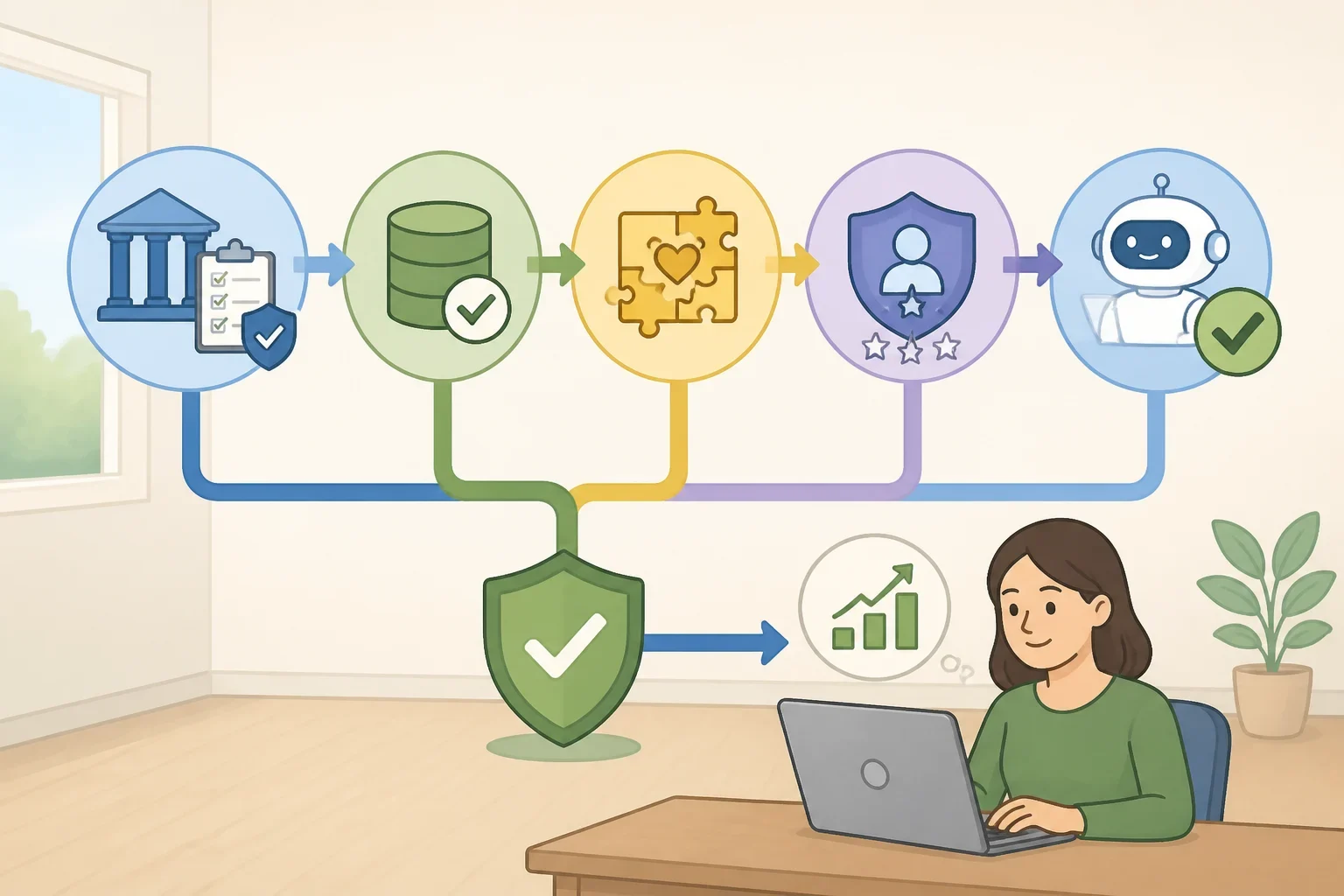
Data readiness for AI is easier to understand when separated into a few related ideas.
Data quality is a diagnostic discipline used to assess and monitor data health. A student might check whether a dataset contains missing, duplicated, outdated, or inconsistent records before using it for analysis. Data integrity is the combination of accuracy, consistency, and context that makes data dependable for decisions and outcomes. Trust is the confidence that stakeholders have that data will produce reliable insights and sound decisions. (Drexel LeBow)
Data governance sets expectations for how data is managed, including who is responsible for it, how it is documented, and how quality problems are addressed. AI governance applies related oversight to AI systems and their use. It can include questions about privacy, security, compliance, human review, and whether an AI application is appropriate for a particular purpose.
These concepts overlap, but they are not interchangeable. A dataset can be accurate in one narrow sense and still lack the context needed to interpret it. An organization can have a general AI governance program while lacking a separate program for the data used to train or operate its AI systems.
The survey captures that difference. Sixty-three percent of organizations had established some form of AI governance, either by expanding existing data governance or creating a separate initiative. Separately, 48% had not implemented programs specifically to govern data used for AI. One figure concerns AI governance broadly; the other concerns governance of AI data. They should not be treated as competing answers to the same question. (Drexel LeBow)
The reported trust levels offer a useful association, but not proof of cause. Seventy-one percent of organizations with governance programs reported high or very high trust in their data, compared with 50% of organizations without governance programs. The survey does not show that governance alone produced the difference. It does suggest that oversight and data trust tend to appear together. (Drexel LeBow)
Data work also becomes difficult when older systems are involved. Twenty-five percent of leaders reported a lack of skills needed to integrate complex legacy data, and 23% reported a lack of skills or staff to deliver high-quality data. Data quality was the most common data integrity priority, cited by 51% of leaders. (Drexel LeBow)
For a learner, the practical lesson is straightforward: data preparation is not a minor step before the “real” AI work begins. Models trained on flawed data can produce outputs that reflect those same deficiencies. (Drexel LeBow)
A data-related course should therefore include exercises in profiling data, identifying quality problems, documenting sources, and explaining what the data cannot support. Those are concrete forms of AI data governance and data quality practice, not abstract add-ons.
AI ROI measurement: Expected results are not demonstrated impact

A key performance indicator, or KPI, is a measure connected to a stated goal. Revenue, cost, customer satisfaction, time saved, and error rates are examples of business outcomes that an organization might track. KPI measurement asks whether an AI project changed a meaningful result, not simply whether the tool operated successfully.
The enterprise survey found that 71% of respondents said AI aligned with their business goals, but only 31% had well-established metrics tied to KPIs. Sixty-nine percent struggled to connect AI performance with business outcomes. (Drexel LeBow)
That gap makes forecasts about return on investment harder to interpret. Thirty-two percent expected positive AI ROI within six to 11 months, and 16% expected positive ROI within six months. Those are expectations, not confirmed results. (Drexel LeBow)
The distinction matters when reading an AI investment ROI survey or evaluating a training program. A confident projection may reflect a business case, a target, or an early estimate. It does not necessarily show that an organization has measured the result or isolated AI’s contribution from other changes.
MIT CISR provides a related but distinct perspective. Its 2025 Real-Time Business Survey included 152 respondents and reported the greatest measured financial impact in the move from stage 2, where enterprises build pilots and capabilities, to stage 3, where enterprises develop scaled AI ways of working. The research also drew on interviews with executives in 11 enterprises conducted from 2024 to 2025. (MIT CISR)
The point is not that every organization must follow one fixed sequence. Rather, the findings distinguish experimentation from repeatable use. At stage 2, an organization may test business cases, simplify processes, and encourage employee experimentation. At stage 3, it works to embed AI across the business. That transition requires strategy, interoperable systems and data, redesigned roles, and compliant, transparent practices. (MIT CISR)
A Guardian Life example in the MIT CISR research illustrates the measurement process. Its team developed a framework with three phases: forming hypotheses with business leaders, testing solutions and building business cases, and creating plans to scale. In one project, an employee-benefits request-for-proposal and quoting process that originally produced a proposal in five to seven days took 24 hours. The source describes the process and result; it does not establish that the framework alone caused every improvement. (MIT CISR)
This is a useful model for coursework. Students should practice stating the goal before selecting a tool, choosing a measure that matches the goal, recording a baseline when possible, and explaining limitations. A portfolio project becomes more informative when it shows not only the output, but also the data used, the evaluation method, and the reason the result matters.
What to check before choosing AI-related training

A course title can hide large differences in content. “AI certificate” might describe programming, workplace use, data analysis, compliance, or a mixture of topics. Before enrolling, ask for evidence of what learners will actually practice.
A useful program checklist includes:
- Data-quality assessment: Does the course teach learners to find missing, inconsistent, outdated, or poorly documented data?
- Data governance and privacy: Does it explain responsibility, access, documentation, privacy, security, and appropriate data use?
- Responsible AI: Does it address compliance, human review, transparency, and limits on AI use?
- Business translation: Do learners practice turning a real organizational or community problem into a clearly defined AI-related task?
- Outcome measurement: Does the program teach KPIs, evaluation criteria, baselines, or other ways to compare results with a stated goal?
- Applied projects: Does the student produce something that shows decisions, revisions, documentation, and evaluation rather than only a finished demonstration?
- Instructor expertise: Can the program explain who teaches the material and what experience or qualifications those instructors bring?
- Prerequisites: Are required math, programming, statistics, data, or writing skills clearly stated?
- Assessment criteria: Can a prospective student see how projects and assignments are judged?
- Current policy documentation: If the course is offered through a school or college, can students review the current rules for AI use in coursework?
The evidence does not need to be elaborate. A syllabus, sample project, grading rubric, instructor profile, prerequisite list, and current academic-technology or AI policy can answer many questions. If a provider will not explain what students do, how their work is assessed, or what support is available, the course title should not carry the decision.
Students should also separate access from readiness. Having access to an AI tool may make it easier to experiment, but it does not show that a school, employer, or training provider has clear rules, reliable support, or formal instruction. The same principle applies in the workplace: a company may encourage AI use while still struggling with data governance, staff training, and outcome measurement.
Before using AI for an assignment, check the instructor’s directions and the school’s current policy. Before recommending a program, verify that the curriculum covers responsible use and applied evaluation, not only access to software.
Choose demonstrated practice over a promising title
The 2026 State of Data Integrity and AI Readiness points to a narrower and more useful definition of enterprise AI readiness. It is not simply familiarity with an AI tool. For the surveyed large organizations, readiness also involves dependable data, clear oversight, staff training, business translation, scalable processes, and measures that connect work to results. (Drexel LeBow)
MIT CISR’s research adds a second caution: meaningful financial impact is associated with moving from AI pilots to scaled ways of working, not merely collecting more demonstrations. That does not make scaling automatic, but it explains why organizations need people who can connect strategy, systems, roles, stewardship, and measurement. (MIT CISR)
The evidence does not predict every employer’s needs, and it cannot determine the right course for every learner. It can improve the questions asked before committing time or money.
Compare programs by what students are expected to do. Look for practice checking data, documenting governance decisions, evaluating responsible use, translating a problem into a workable project, and measuring the result. Then verify prerequisites, instructor expertise, assessment standards, access requirements, and the current AI policy at the school or organization involved. A course title may promise readiness, but demonstrated practice is stronger evidence.