
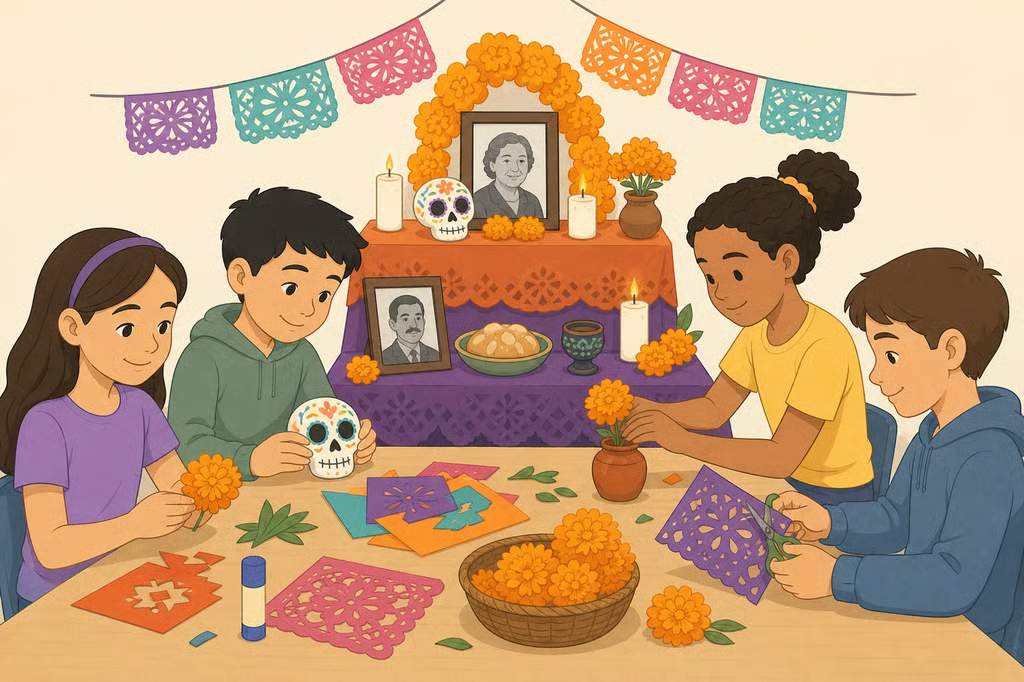
- Día de los Muertos classroom activities: what to teach
- What Día de los Muertos actually honors
- Who these Día de los Muertos lesson plans fit
- Teach Día de los Muertos symbols: what ofrendas, calaveras, and La Catrina mean
- Day of the Dead classroom activities that start with context
- Why a single ofrenda template doesn't fit every classroom
- What to check before teaching this lesson
Día de los Muertos classroom activities: what to teach
Most Día de los Muertos classroom activities start with sugar-skull coloring sheets, treating the holiday as a seasonal craft project. Educators and cultural institutions describe something different: a remembrance tradition centered on ancestors and the cycle of life, not a Mexican stand-in for Halloween, according to a Library of Congress feature on the holiday's layered history (Library of Congress, 2024).
That distinction should shape how teachers plan Día de los Muertos lesson plans this fall. Teachers, homeschool educators, and Spanish, art, and social studies instructors building lessons around the November 1 and 2 observance need to know which symbols require explaining before students pick up scissors and glue, and which activities fit which classroom.
What Día de los Muertos actually honors
Día de los Muertos marks the cycle of life and the recently departed. Many cultures treat death mainly as a cause for sadness, but the communities that observe this holiday tend to see death as part of life rather than only an occasion for grief, according to the Smithsonian's Day of the Dead Learning Kit, a resource the National Museum of the American Latino built for classroom and home use and posted to the Smithsonian's online Learning Lab last month.
The rituals are estimated to be roughly 3,000 years old, rooted in Aztec and other Mesoamerican traditions that treated death as a natural stage in life's cycle rather than an ending (Smithsonian American Art Museum, 2022).
The museum's account also traces how the holiday took its current shape. When Spanish colonizers arrived in Latin America, they shifted an existing Indigenous summer observance to align with the Catholic All Saints' Day and All Souls' Day in early November, blending Indigenous and European traditions into what's now called Día de los Muertos (Smithsonian American Art Museum, 2022).
Stephen Winick, a folklife specialist at the Library of Congress's American Folklife Center, draws a comparison to Halloween's own layered history. "Just as Halloween's pre-Christian roots are Celtic, the Día de los Muertos has roots in Indigenous Mexican and Central American cultures," he said (Library of Congress, 2024). Winick describes the holiday as "generally a more solemn and reflective holiday, with a greater focus on remembrance of ancestors and deceased loved ones," while noting that modern observances also include social gatherings, music festivals, parades, and costume contests (Library of Congress, 2024).
Who these Día de los Muertos lesson plans fit
The National Museum of the American Latino's kit pairs general history with Smithsonian collections, video, music, and hands-on activities built for in-school or at-home learning. It reads more like a flexible starting point than a scripted lesson, meant to be adapted by whoever is teaching it.
A separate Spanish-language lesson plan from the K20 Center scales its "Painting a Picture" activity by proficiency level: about 20 minutes for Spanish 1, 30 minutes for Spanish 2, and 40 minutes for Spanish 3 (K20 Center, 2024).
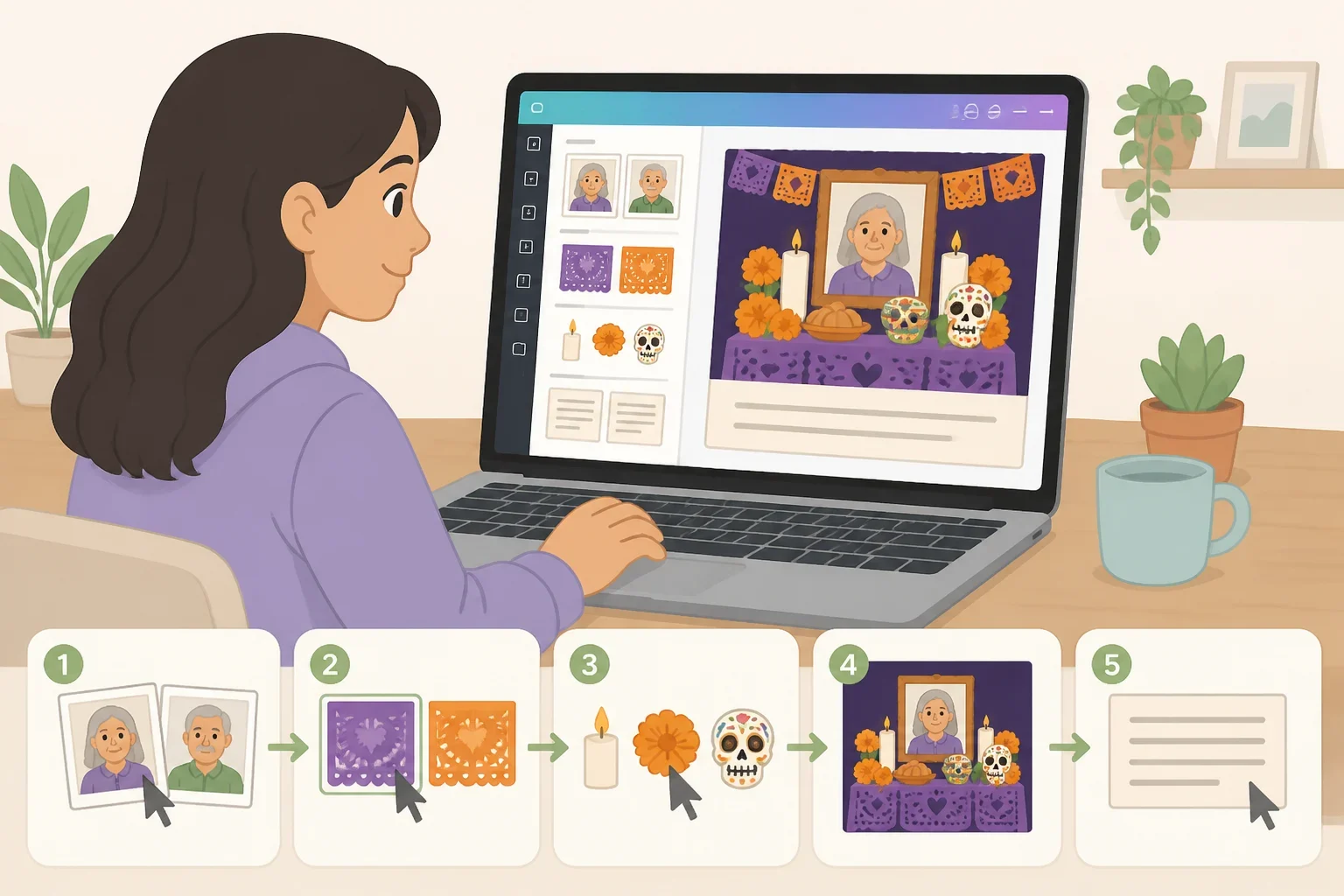
That activity has students build a digital ofrenda in Canva: a photo of a loved one, a background image of a place that person enjoyed, at least two items they liked, and a written explanation of each choice (K20 Center, 2024).
The published instructions focus on honoring a personal loved one. Teachers could prepare a non-personal alternative, such as a historical figure, literary character, or community member, for students navigating recent loss or family circumstances the exercise doesn't anticipate.
Teach Día de los Muertos symbols: what ofrendas, calaveras, and La Catrina mean
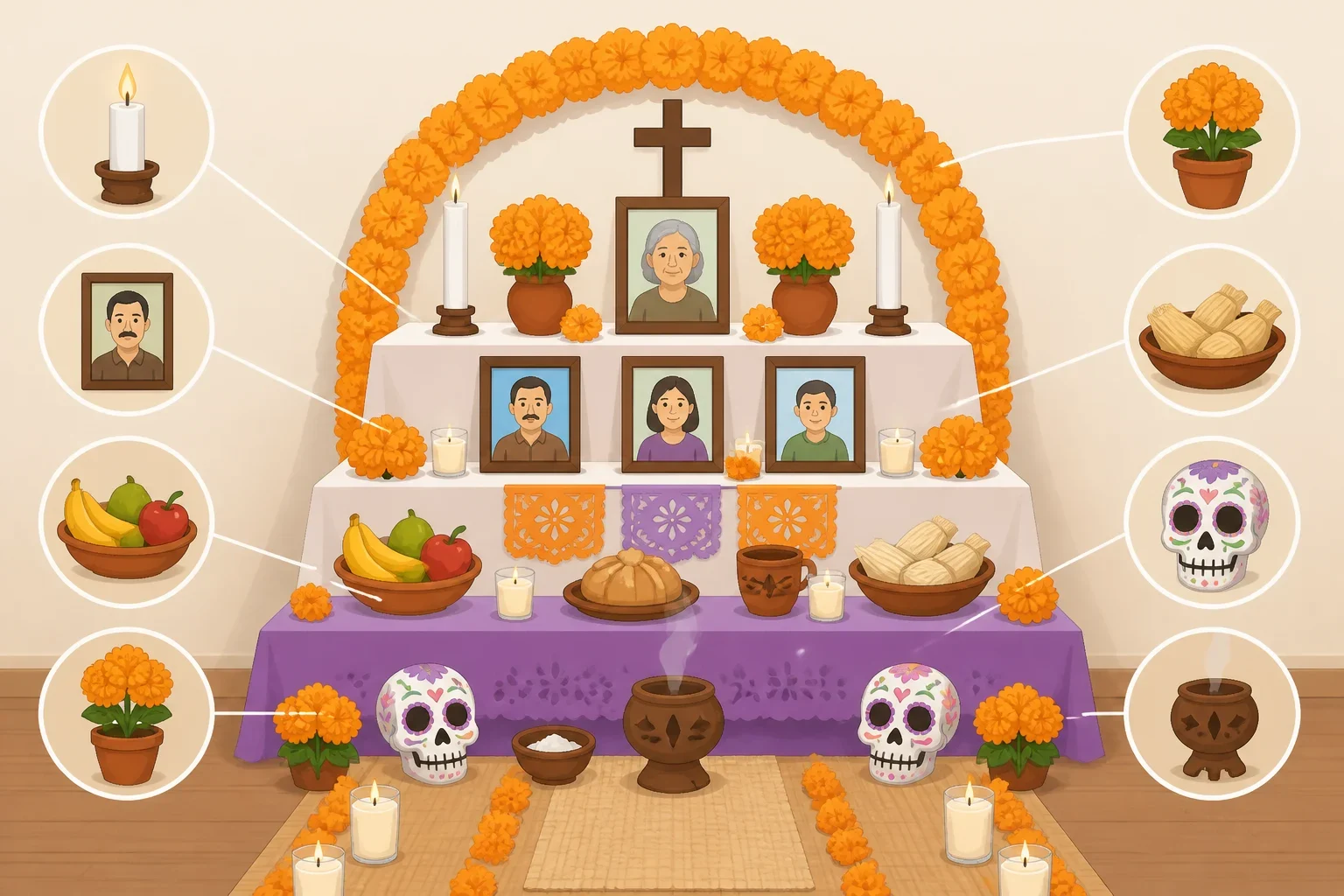
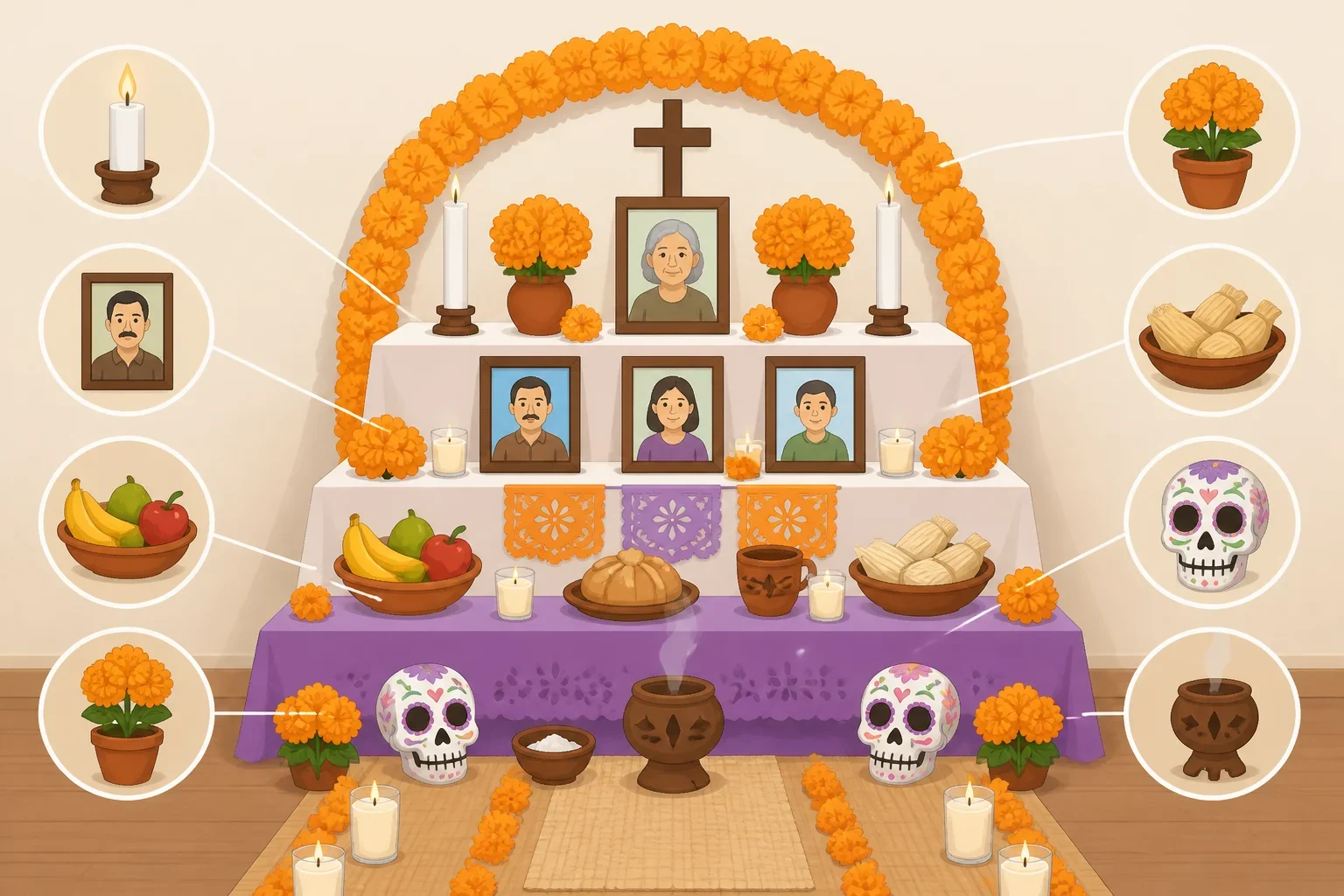
Family altars, or ofrendas, typically include marigolds (cempasúchil), candles, photographs, and favorite foods and drinks. The flower's color and fragrance are said to guide spirits home, and the offerings are meant to nourish the spirit on its journey rather than simply decorate a table (Library of Congress, 2024; Smithsonian American Art Museum, 2022).
Mexican printmaker José Guadalupe Posada helped popularize the calavera imagery now tied to the holiday, using skeleton figures as satire, often paired with rhyming ballads that reached Mexican audiences regardless of literacy (Library of Congress, 2023). Posada used his calaveras to mock the upper class and political corruption. His most enduring figure, La Catrina, specifically satirized wealthy Mexican women who adopted European fashions before the Mexican Revolution, an elegant skeleton suggesting death treats everyone the same (Smithsonian American Art Museum, 2022).
Papel picado, perforated paper banners, appear alongside sugar skulls and calavera imagery to illustrate the holiday's broader symbolism (Library of Congress, 2024).
Day of the Dead classroom activities that start with context
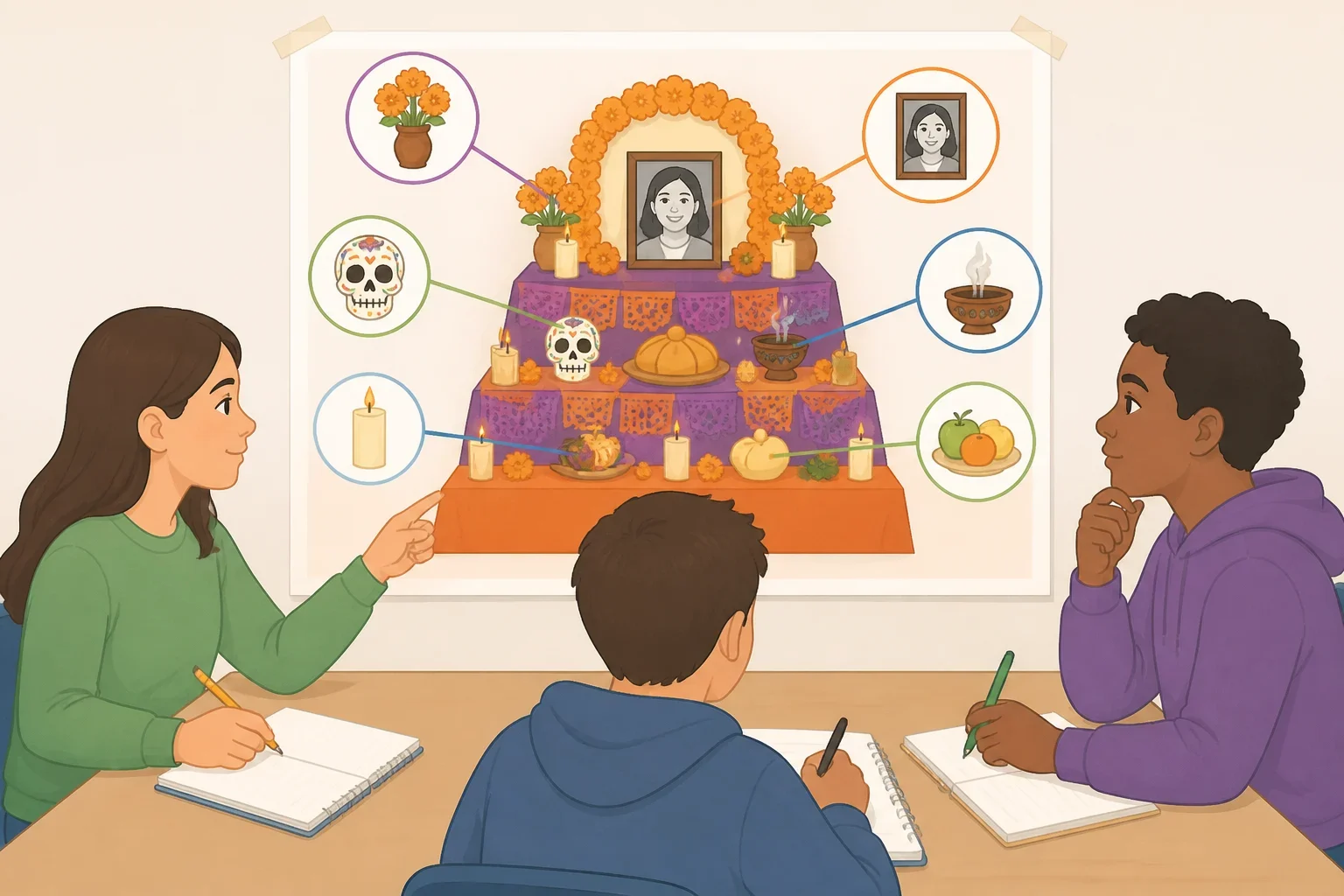
Teaching these symbols alongside their history gives students something to analyze instead of just coloring in. A few options build on the materials described above:
- Reading an ofrenda as a primary source. The National Museum of the American Latino's kit includes collection images and hands-on materials related to altars. Pairing those images with a discussion of what each object might communicate about the person being honored extends the kit; it isn't an exercise the kit spells out on its own.
- Building a tribute with a written rationale. The K20 lesson's Canva-based ofrenda activity already asks students to explain their symbolic choices in writing, which turns the craft into an analysis piece rather than just a decoration exercise (K20 Center, 2024).
- Studying Posada's calaveras as political art. Posada's broadsides mocked Mexico's elite through skeleton imagery and rhyming verse that reached readers regardless of literacy (Library of Congress, 2023). Asking students which elites or institutions a given broadside satirizes treats the image as social commentary rather than seasonal decor.
- Closing with structured reflection. The K20 lesson's "Mirror, Microscope, Binoculars" protocol asks students how the activity changed their thinking, how they can apply what they learned, and what actions help people respect others' cultural traditions (K20 Center, 2024).
Why a single ofrenda template doesn't fit every classroom
The Smithsonian American Art Museum traces the growth of public Día de los Muertos events in the United States, including parades and large community altars, to Chicano artists and activists who began organizing them in the 1970s to build a new political and cultural identity rooted in Indigenous heritage (Smithsonian American Art Museum, 2022). One of the earliest events resembling today's public celebrations took place in East Los Angeles in 1973, organized by Self Help Graphics & Art, a printmaking collective the museum describes as the oldest Chicanx art center still in existence (Smithsonian American Art Museum, 2022).
Private family traditions can look quite different from that public template. Artist Carmen Lomas Garza, who grew up in south Texas in the late 1950s and early 1960s, recalled cemetery visits built around flowers and candles rather than skeleton imagery. "I didn't see any skeletons or skulls or anything like that at the cemetery," she said. "It was mostly flowers and candles. I don't remember people using copal incense, either" (Smithsonian American Art Museum, 2022).
Her account suggests why presenting one altar diagram, built around marigolds, candles, and sugar skulls, as the single accurate version of the holiday misses something. Ofrendas, calavera imagery, and simpler graveside offerings of flowers and candles are all documented practices, not interchangeable pieces of one fixed symbol set.
What to check before teaching this lesson
The K20 timings apply to the "Painting a Picture" activity specifically and are built around Spanish proficiency levels, not grade bands, so pacing for other parts of the same lesson, or for a non-language classroom, would need adjusting.
Whether an activity asks students to name or describe a personal loss is a separate checkpoint, particularly for classes that include students facing recent grief. Before assigning any version of this lesson, check school or district policy on cultural-holiday content, confirm which students might need the non-personal alternative described above, and where possible, ask a colleague or family with Mexican or Mexican American background to review the material for accuracy.
From there, pick a starting point: the National Museum of the American Latino's kit for background and collections, or the K20 Center's activity for a Spanish class. Choose one symbol, an ofrenda, a calavera broadside, or papel picado, and build toward it through its documented history before handing out the craft supplies.