

How to Start a Study Group That Actually Gets Work Done
Learning how to start a study group is easier than getting that group to actually study. A study group works when it has a clear purpose, a set meeting time, and a plan for what happens once everyone shows up, not just a running group chat. Oregon State University's Academic Success Center notes that figuring out a group's purpose early can help shape its size, meeting space, and how often it meets, though settling on a purpose isn't required before the group forms (OSU, 5 months ago).
A group chat is useful for logistics and quick questions, but it isn't the same as a working session. Duke University's Academic Resource Center calls session structure, not communication, the "KEY" ingredient of a successful study group (Duke ARC, about 20 months ago).
This guide is for middle school through college students, tutors, and parents supporting a learner. It covers what it takes to create an effective study group: recruiting the right people, deciding how many people should be in a study group, setting rules everyone actually follows, and structuring meetings so the group produces real learning instead of scattered messages.
How to start a study group with classmates

The easiest way in is to ask directly. OSU points out that asking a classmate in lecture, lab, or recitation whether they're already in a study group, or simply mentioning an interest in starting one, is often all it takes (OSU, 5 months ago). Posting an invite through the course's learning management system works too, and OSU notes that most classmates are relieved someone else made the first move.
If there isn't an obvious opening in class, there are other entry points. Harvard's Academic Resource Center suggests asking an instructor or teaching fellow to send a class-wide email, posting on the course's discussion board, or using a "Student Groups" tool if the learning platform has one (Harvard ARC, 3 years ago). Office hours and student organizations tied to a course are additional places worth checking, since Harvard notes these are settings where study-group connections often form.
A first message doesn't need to be elaborate: "A few of us are starting a weekly study group for this class to go over problem sets before the exam. Want to join? Thinking Tuesdays at 5." That gives classmates enough to say yes without a long back-and-forth.
Before finalizing size or location, it helps to decide why the group exists. OSU notes this isn't a required step, but working out whether the goal is weekly review, exam prep, or getting through problem sets together can make it easier to settle everything else, from group size to meeting space to frequency (OSU, 5 months ago).
How many people should be in a study group?

How many classmates join shapes how the group actually runs. OSU recommends capping groups at five to six people, splitting into smaller groups if more students want to join (OSU, 5 months ago). A study "group" can technically be as small as two people, so there's flexibility depending on the class and the goal.
Arizona State University's engineering program runs a peer-led study group model built around four to five students per group (ASU Learning and Teaching Hub, nearly 2 years ago). Separately, ASU cites research showing that groups of four or fewer help engineering students stay more productive and learn course material more effectively (ASU, nearly 2 years ago). That research is specific to engineering courses using a peer-led format, not study groups in general, so it's better read as one data point than a universal rule.
Taken together, these sources suggest a cautious starting point, not a fixed formula: five or six people is a workable ceiling, and a smaller group may make it easier for everyone to speak up, which is a reasonable inference from ASU's productivity findings rather than a direct research conclusion. Subject matter and the type of task also matter, but the clearest evidence concerns something else entirely: how evenly matched the group's preparation is.
Preparation gaps matter as much as headcount. ASU warns that when group members' preparation levels are too far apart, more prepared students tend to dominate the discussion while less-prepared students disengage (ASU, nearly 2 years ago). A group of five students at roughly the same point in the material will likely work better than a group of three with a wide gap in preparation.
Study group rules and expectations that keep meetings productive
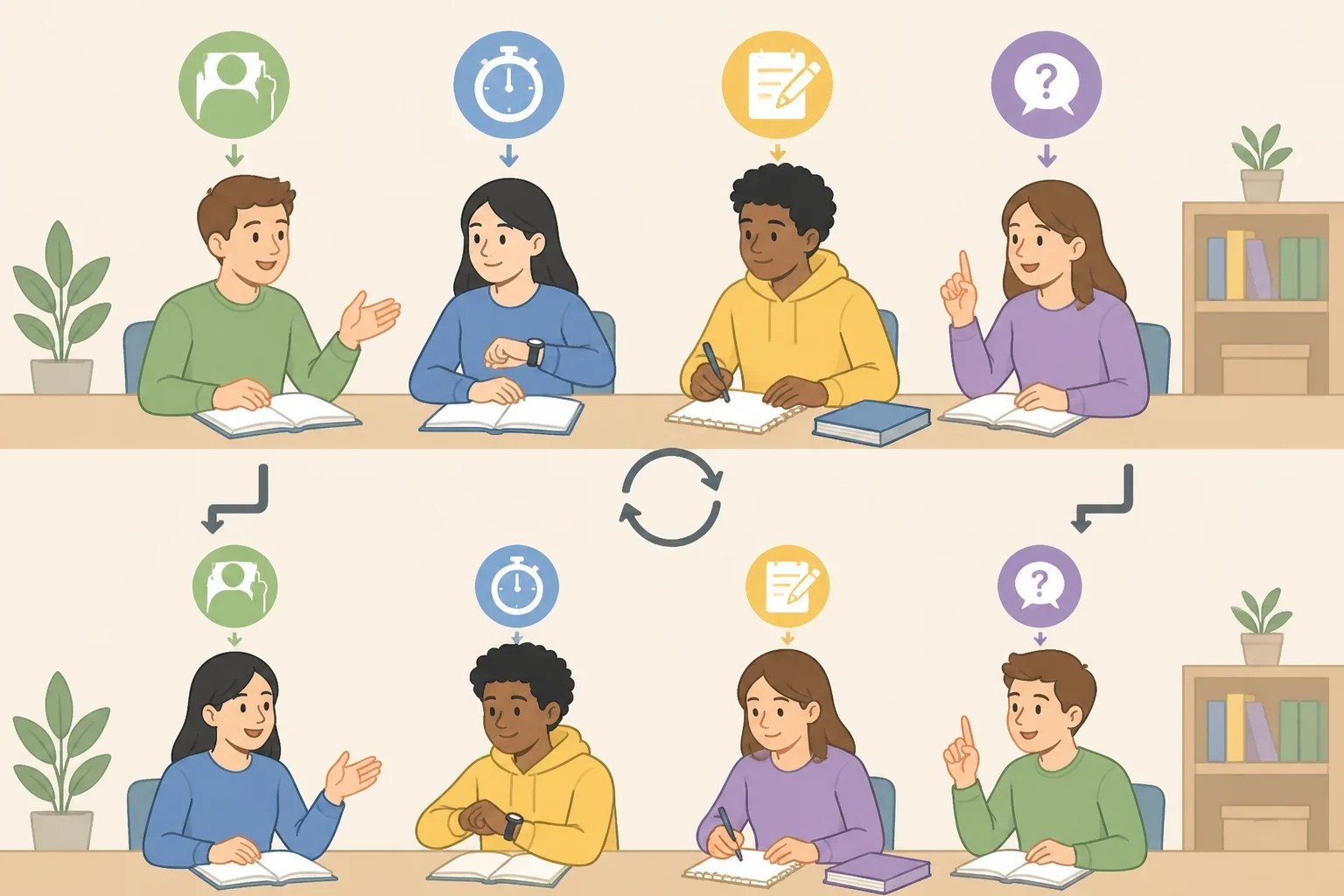
Use the first meeting to establish whether the group will run with real structure or drift into casual conversation. OSU recommends spending five to ten minutes early on agreeing how members will prepare beforehand, what the group will do if it gets off track, and whether to appoint a rotating scheduler or facilitator (OSU, 5 months ago).
Assigning specific roles distributes the work of keeping a session on track. UNC Charlotte's University Center for Academic Excellence recommends roles such as facilitator, timekeeper, note-taker, question-asker, and researcher, so no single person carries the whole session (UNC Charlotte, 2 years ago). Harvard adds that rotating those roles, or using a timer, helps keep any one person from dominating the conversation week after week (Harvard ARC, 3 years ago).
Before setting group goals, check the instructor's collaboration policy. Duke's Academic Resource Center and OSU both recommend confirming what kinds of work can be done together, since some instructors encourage group exam prep but expect individual assignments like lab reports to be completed alone (Duke ARC; OSU). This varies by course and instructor, so it's worth a quick email rather than an assumption.
Studying together also requires a certain amount of vulnerability. Harvard notes that if members can't admit when they don't understand something, the group can't serve its main purpose of increasing understanding for everyone (Harvard ARC, 3 years ago). Treating every question seriously, and respecting that people arrive with different levels of familiarity with the material, belongs in a group's ground rules just as much as its meeting schedule does.
How to organize a study group meeting

Duke's Academic Resource Center outlines a repeatable structure: start by reviewing the prior week's concepts, divide the lecture material among members, work through problems together, then close with a summary and a list of tasks for the next session (Duke ARC, about 20 months ago). Adapted for a single midterm-prep session, that sequence might look something like this:
- 5 minutes: agree on the day's goal and review outstanding questions
- 15 minutes: compare notes or take turns explaining key concepts
- 20 minutes: work through practice problems together
- 10 minutes: quiz one another on the material
- 5 minutes: assign preparation tasks and confirm the next meeting
That's one way to adapt Duke's sequence, not a fixed script. Groups can shorten or stretch any segment depending on how much material there is to cover and how many people show up.
Coming prepared is what makes that structure worth showing up for. UNC Charlotte recommends each member arrive with specific questions, topics to discuss, or concepts they struggled with during individual study time, since more preparation up front tends to make the session more effective (UNC Charlotte, 2 years ago). In practice, that can mean bringing lecture notes, finished readings, and two or three specific questions rather than showing up to see what everyone else has.
For middle school students, meeting somewhere supervised, such as a classroom after school, a library study room, or a parent's home, is often a practical requirement rather than just a preference, and a parent, teacher, or tutor may need to help arrange it.
Session length varies depending on the material and the goal. ASU reports that 40 to 60 minute sessions support active involvement in its peer-led engineering groups (ASU, nearly 2 years ago), while OSU notes that longer two to three hour meetings should include scheduled breaks (OSU, 5 months ago). There isn't one correct length. As a matter of practical advice, choosing a length before the session starts, rather than deciding in the moment, gives everyone a shared expectation to work toward.
Group chat has a real job in this process, just not as the place where the studying happens. OSU distinguishes live meetings, whether over Zoom, Teams, or in person, from the asynchronous tools groups use between sessions (OSU, 5 months ago). Group texts, Discord, and Instagram chats work well for quick questions and coordination; tools like Quizlet or Google Docs can support actual study work, such as compiling a shared study guide or drafting practice questions.
When a meeting drifts into unrelated conversation anyway, OSU suggests naming it directly rather than letting it slide: "I notice we keep talking about weekend plans. Let's get through this much, and then we can take a break and chat." (OSU, 5 months ago). If distraction keeps happening after that, OSU recommends revisiting the group's original agreements about pacing and participation.
What to check and do before the next meeting
UNC Charlotte recommends checking in after a few sessions to ask whether the group's goals are actually being met, then adjusting the format if they aren't (UNC Charlotte, 2 years ago). A group that started as loose review sessions might need firmer roles once exams get closer, and that's a normal shift rather than a sign anything went wrong.
If distraction or a mismatched pace continues even after revisiting group agreements, OSU suggests looking for a group whose approach is a better fit (OSU, 5 months ago).
Before the next meeting:
- Confirm the course's collaboration policy with the instructor
- Aim for a total group size of four to six people, including the organizer, and split into smaller groups if more classmates want in
- Agree on one clear goal for the session
- Choose a meeting location or platform that works for everyone involved
- Assign at least one role, such as a rotating facilitator or note-taker
Send the invitation, include the first session's goal and meeting time, and ask each person to bring one question.