
How to Help Students Identify What They Don’t Know: A Step-by-Step
A student finishes studying and says, “I know this.” Then the quiz reveals several missed concepts. The problem may not be effort. Students need a way to compare their sense of understanding with actual evidence.
That is the purpose of learning how to help students identify what they don’t know. This guide gives teachers, tutors, parents, and students a repeatable process: predict performance, gather evidence, use feedback, and write a brief diagnosis. The method can support a quiz, homework session, writing assignment, or independent study plan.
Why students may not recognize learning gaps
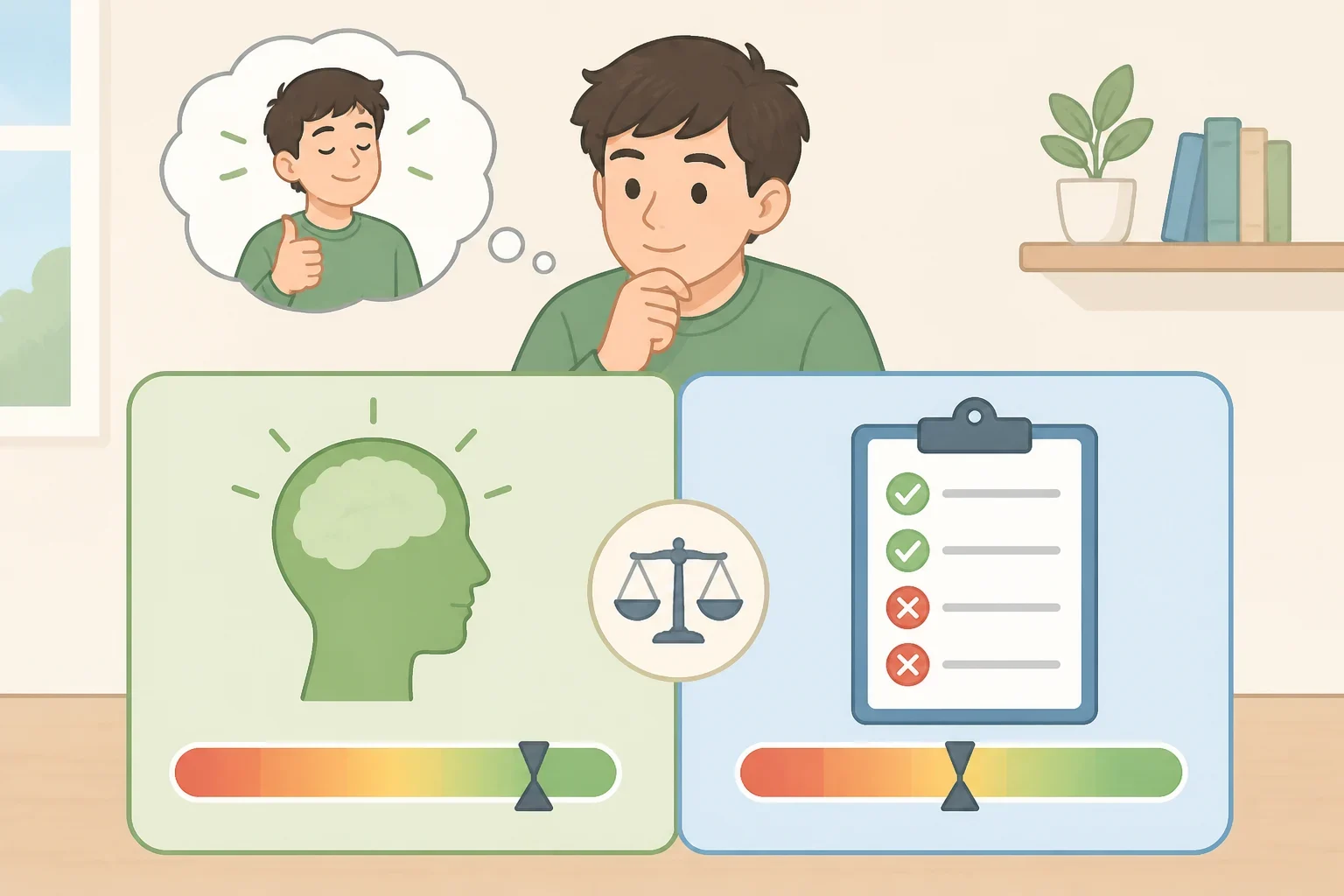
Metacognition is the ability to monitor current learning, compare it with a standard, and make a plan to improve. It includes both knowledge about learning and skills such as monitoring and controlling a study process, according to Frontiers in Education, citing Tobias and Everson.
That means confidence is not the same as demonstrated understanding. A student may recognize a familiar term, follow a worked example, or remember seeing a topic in class without being able to retrieve the idea or use it independently.
A study of students in three different physics courses compared predictions made immediately before exams with post-exam predictions and actual exam scores. About 303 students made predictions for the first exam, 299 for the second, and 283 for the third. Frontiers reported that lower-performing students were more overconfident and less accurate than higher-performing students across the exams, with large differences in absolute bias between ability groups.
The finding needs careful interpretation. It does not explain why any particular student was overconfident, and it does not show that lower-performing students are unable to recognize a mistake. Across the exams, between half and three-fourths of students made a correct adjustment after taking the test. Lower-performing students made correct adjustments as frequently as higher-performing students, although only about one-fourth to one-third of lower-performing students consistently made what the study defined as efficient adjustments. Frontiers defined an efficient adjustment as moving within five percentage points of the actual score or reducing the absolute prediction error by at least half.
The practical lesson is modest but useful: do not ask students to rely only on the feeling that they understand. Give them regular chances to make a judgment, test it, and revise it.
How to help students identify what they don’t know
Use the following four-step cycle. A teacher can apply it to a scheduled quiz. A tutor or parent can use a shorter version during homework. A student can record the process independently.
1. Ask for a prediction before gathering evidence
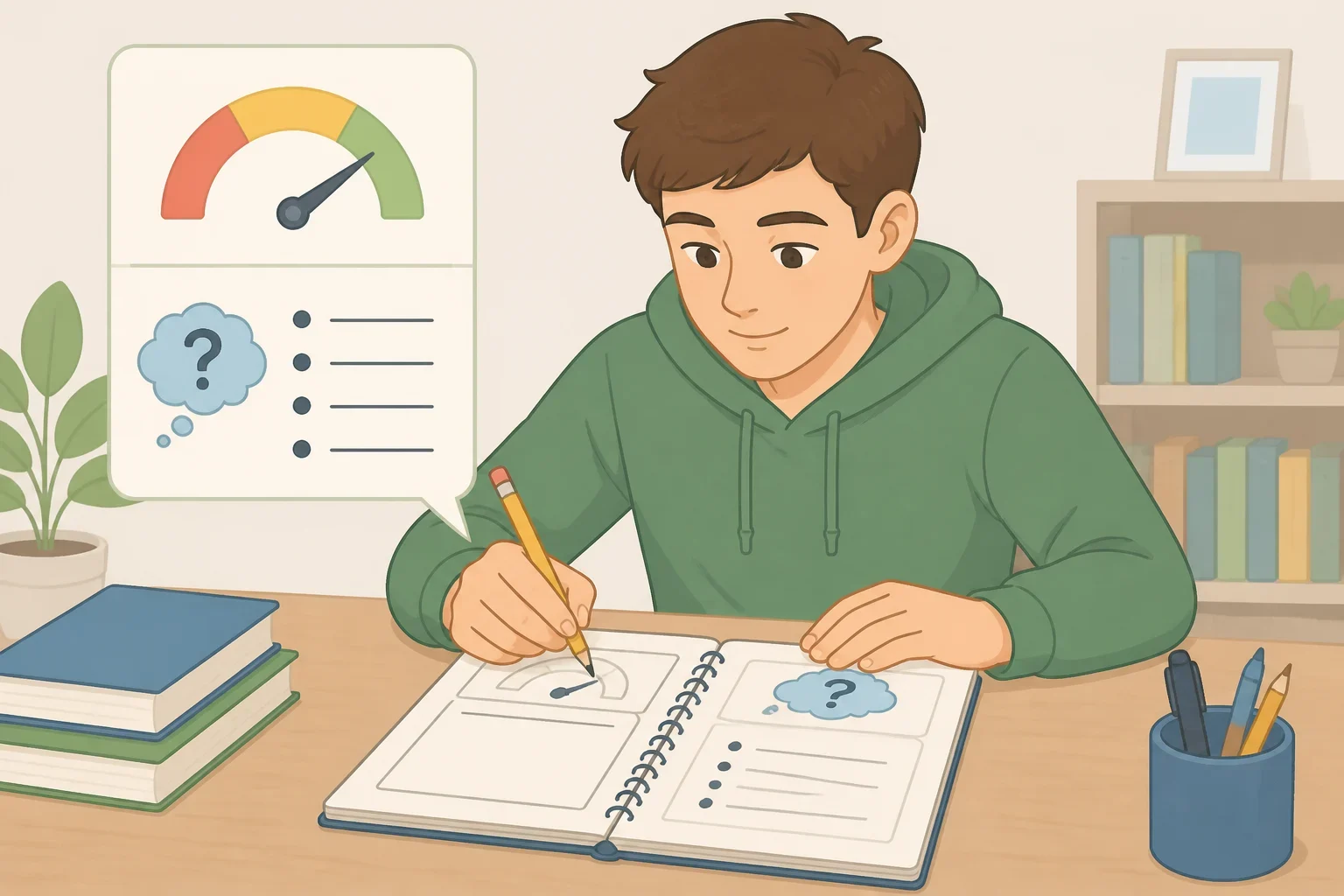
Have the student make a private prediction before beginning the quiz, practice set, or review task. Record the prediction so it can be compared with evidence later.
For an exam, use a percentage or score range. The physics study used this prompt: “Before you begin the exam, please take a second to think about what grade you anticipate getting on this exam (0–100%). Try to be as accurate as you can with your prediction.” Frontiers
A teacher does not need to display predictions publicly. Private recording reduces the pressure to sound confident and gives students something specific to revisit. A student might write:
- Predicted score: 82%
- Topics I feel least certain about: balancing chemical equations and limiting reactants
Applying predictions to assignments, homework, or individual skills is a reasonable classroom adaptation. The cited physics study measured predictions around exams, so those broader uses should be treated as a recommended practice rather than as a directly tested finding.
For a tutor, the prompt might be: “Before we start, how many of these four problem types do you think you can solve without looking at an example?” For a parent, it could be: “Which part feels solid, and which part feels shaky?” The goal is not to catch the student being wrong. It is to create a judgment that can later be checked.
2. Collect evidence instead of relying on familiarity

Next, ask the student to retrieve, explain, or apply the material without depending on notes. Rereading can make material feel easier in the moment, and students often report choosing rereading instead of retrieval when left to their own devices, according to The Learning Scientists. That immediate ease is not enough evidence of independent understanding.
Use a task that matches the learning goal:
- Math: Give a problem with the same underlying concept but different numbers. Ask the student to solve it and explain why the first step is appropriate.
- Reading: Ask the student to state the central claim, identify the evidence supporting it, and explain what a specific passage contributes.
- Writing: Ask the student to identify the purpose of a paragraph, explain how its evidence supports the claim, and revise one unclear sentence.
- Science: Ask the student to predict what would happen in a changed scenario, draw or label a process, and explain the cause rather than naming a term.
These tasks do not need to be long. One carefully chosen problem may reveal more than several minutes of looking over notes.
For teachers designing classroom questions, the IES summary of “Using Technology for Classroom Feedback” describes a What Works Clearinghouse recommendation to use response questions that reveal common errors and misconceptions. It also describes “why,” “how,” and opinion questions as ways to encourage discussion and reasoning. This is instructional guidance, not evidence that every multiple-choice question hides a gap. A practical mix is often more informative than memory-only questions.
3. Give feedback, then require a retry
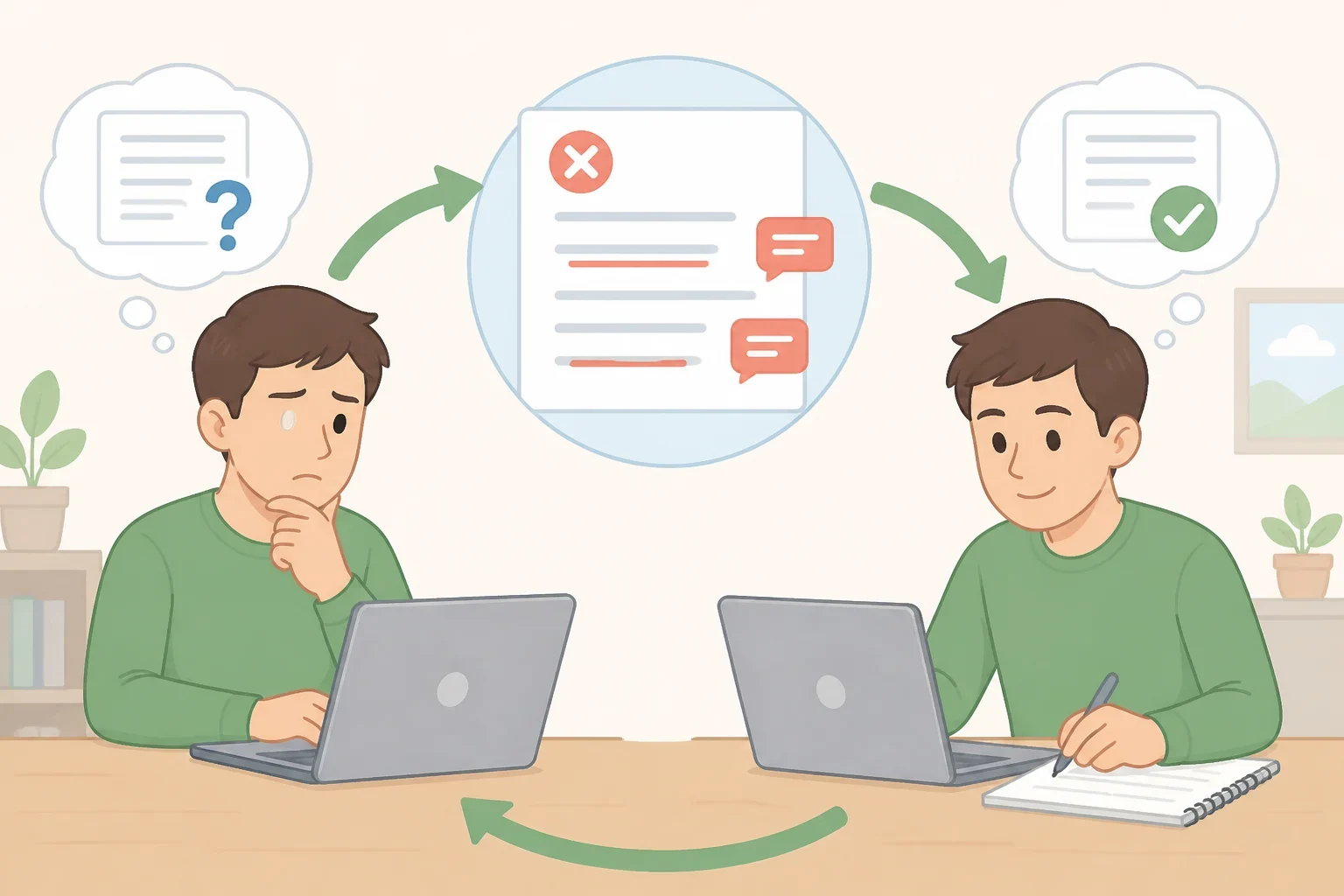
Feedback is most useful when it gives the student a chance to do something with the information. If a student selects a common wrong answer in a classroom response activity, the teacher can identify the misconception, discuss the reasoning behind the answer, and ask for a revised response. The IES summary explains that response systems can help instructors identify lingering misconceptions and provide immediate, targeted feedback.
The feedback does not have to be digital. A teacher can use mini-whiteboards, hand signals, paper response cards, or a short written response. The IES source describes paper cards scanned through Plickers as an option that does not require student devices or accounts, although the instructor still uses the app to scan responses.
Use corrective feedback when time is short: identify the correct answer and the key idea. Use explanatory feedback when the error reflects a common misunderstanding: explain why the tempting answer does not work and what clue would point toward the correct approach. IES notes that explanatory feedback can help with common errors but takes more time.
Then add a retry:
- “Solve the next problem using the corrected rule.”
- “Explain the passage again, this time connecting the evidence to the claim.”
- “Rewrite the sentence so the relationship between the ideas is clear.”
- “Draw the process and label the step that caused the original confusion.”
A student who only reads the correct answer may recognize it without being able to produce it. The retry supplies a second piece of evidence.
4. Write a short diagnosis
Do not end with a score review. Ask the student to describe what the evidence showed, what caused the error, and what practice should happen next.
An exam wrapper is one useful model. As The Learning Scientists explains, exam wrappers generally ask students to reflect on performance, content they handled well or poorly, and the strategies they used or might change. In a college introductory biology course, students who completed exam wrappers reported less rereading and more use of forced recall, summarizing in their own words, group work, and drawing later in the course. Those were self-reported behavior changes from one course, not a guaranteed grade increase.
Use this short template:
My prediction was __.
The evidence showed __.
I missed __ because __.
The strategy I used was __.
My next practice task is __.
I will check my understanding by __.
The last two lines matter. “Study more” is too vague. “Complete two fraction comparison problems without notes, then explain why the denominators matter” gives the student a task and a way to check it.
Make student self-assessment strategies part of regular learning
The four steps work better as a routine than as a one-time conversation. The aim is to give students repeated practice comparing judgments with evidence, without presenting the process as a guarantee of improved scores.
Model the thinking process
Students cannot always see how an experienced learner checks understanding. Model it aloud:
- “I recognize this vocabulary, but I cannot explain it yet.”
- “My first answer used the correct formula, but I cannot explain why it applies.”
- “The paragraph sounds clear to me. I am going to test that by stating its claim in one sentence.”
- “I changed my prediction because the practice problem exposed a misconception.”
In writing instruction, think-alouds are used to make planning and evaluation visible. The IES discussion of supporting strategic writers describes explicit strategy instruction and think-alouds as ways to show processes that are otherwise invisible. Teachers can adapt the same modeling principle to math, science, reading, or studying.
Teach a replacement for rereading
Reflection identifies a problem, but students also need a next strategy. If a student reports rereading notes for an hour and still missing application questions, offer a specific alternative:
- close the notes and explain the idea aloud;
- answer a question from memory;
- solve a new problem;
- draw the process;
- summarize the material in the student’s own words.
The biology-course summary from The Learning Scientists is useful here because the exam wrappers included attention to alternative study strategies. Students may not know what to try instead of a familiar but limited habit.
Adjust the process for the setting
Teachers: Before the next quiz, add a private predicted score and one topic-confidence question. After grading, return the quiz with a short diagnosis prompt and reserve time for one corrected response or retry.
Tutors: Before helping, ask the student to attempt one problem without notes. When an error appears, ask, “What did you expect this step to do?” After explaining, give a similar problem and let the student solve it.
Parents: Ask for a prediction and a topic that feels uncertain. Have the student explain one idea or complete one problem. Avoid taking over the pencil. A useful prompt is, “What part of the question tells you what to try next?”
Students: Keep a simple learning log with the prediction, evidence, error, and next practice task. Bring one specific question to the teacher, such as “I can identify the formula, but I do not know when to use it,” rather than “How did I do?”
Self-Regulated Strategy Development, or SRSD, offers a related example of explicit strategy teaching and self-monitoring. IES reports that SRSD is used in as many as 10,000 classrooms across the United States and in 12 other countries, and that the What Works Clearinghouse has recognized it as an evidence-based practice with consistently positive effects on writing outcomes. Its strongest evidence base is in writing, although SRSD research also exists in reading, math, and science. More work is needed on integrating the approach across content areas, so it is best treated here as an example of explicit instruction, not a universal solution.
Use the next quiz or study session as the starting point
A teacher can begin with three additions to the next assessment:
- A private prediction before the quiz.
- One retrieval or explanation question that targets a likely misconception.
- A short post-quiz diagnosis using the reflection template.
A student or parent can use a smaller home version:
- What did I predict?
- What did the evidence show?
- What will I practice next?
The process is simple, but it asks for honest evidence rather than a feeling of familiarity. That shift can help students recognize learning gaps, choose a more precise next step, and take greater ownership of checking their own understanding.