
- How to fix a disorganized essay with a reverse outline
- Who this helps
- Why strong evidence doesn't guarantee flow
- How to build a reverse outline
- Telling a missing transition from missing reasoning
- Testing a thesis against the outline
- Reading the outline for other problems
- What to check before revising
- What to do next
How to fix a disorganized essay with a reverse outline
A paper can have strong evidence, properly cited sources, and a clear topic sentence in every paragraph, and still come back marked "hard to follow" or "unclear organization." That note stings when each paragraph looks fine on its own. The problem usually isn't the evidence; it's how the paragraphs connect to each other.
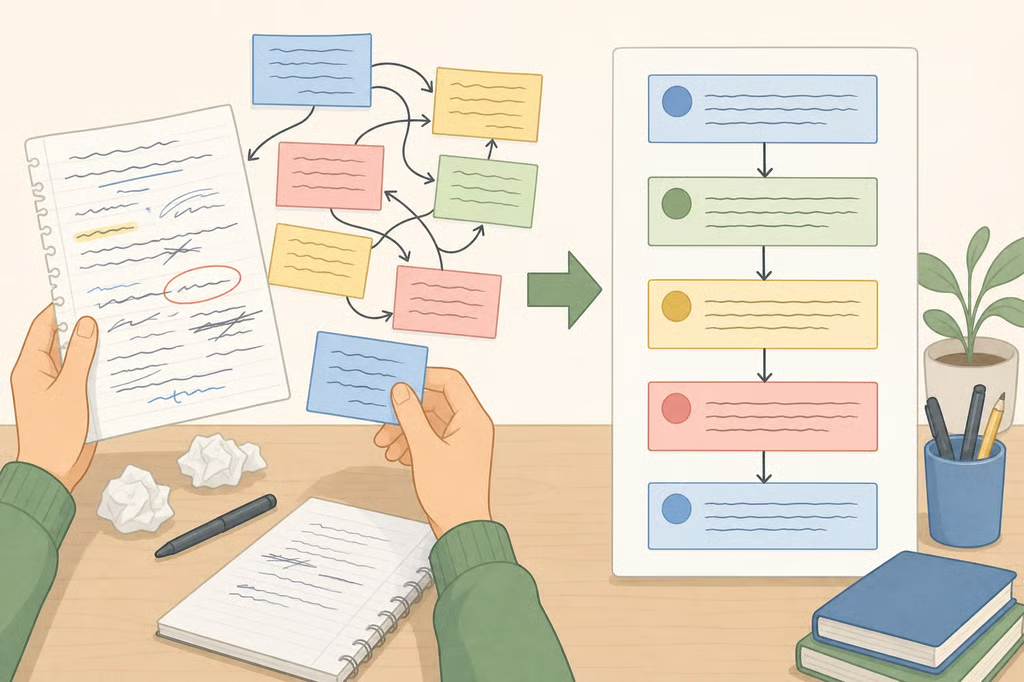
Reverse outlining is a revision technique built for that exact gap. Instead of outlining before writing, the writer outlines a draft that already exists, paragraph by paragraph, to see the structure the essay actually has instead of the one it was meant to have.
Purdue OWL covers reverse outlining as part of its guidance on revision, framing it as a technique for outlining a draft after it's finished rather than before it's written. The idea is to look at the paper's actual shape once the words are already on the page, not the shape a writer intended when planning the draft.
This guide walks through what a reverse outline is, who it helps, how to build one, how to read what it reveals, and what to do with that diagnosis once revision starts.
Who this helps
This approach can be useful for any writer revising an essay, research paper, or other piece of argumentative writing with several distinct sections, including high school students, college students, and adult learners working through their own drafts. The basic steps stay similar across levels, but what counts as a well-organized paragraph, how many sources a paper needs, and what structure a teacher or program expects can vary by class, discipline, and assignment. The prompt or rubric still matters on top of this process.
A short assignment, like a one-page response, has fewer paragraphs to work through, but it can still benefit if those paragraphs repeat a point, skip a step, or drift from the prompt.
Why strong evidence doesn't guarantee flow
Flow is the reader's experience of following an argument from paragraph to paragraph without getting lost, and that depends on how paragraphs connect to each other, not on how much evidence sits inside any single one. A paragraph can open with a sharp quote or a solid statistic and still fail to link clearly to what comes before or after it.
Picture two paragraphs that both support the same thesis but restate each other's point in different words, or arrive in an order that skips a step a reader needs to follow. Each one can still read cleanly sentence by sentence, which is why this kind of gap is hard to catch while rereading at that level. Turning paragraphs into a short list of one-line summaries, instead of leaving them as blocks of prose, makes some of those gaps easier to see.
How to build a reverse outline
Building a reverse outline takes four steps, and none of them require rewriting anything yet.
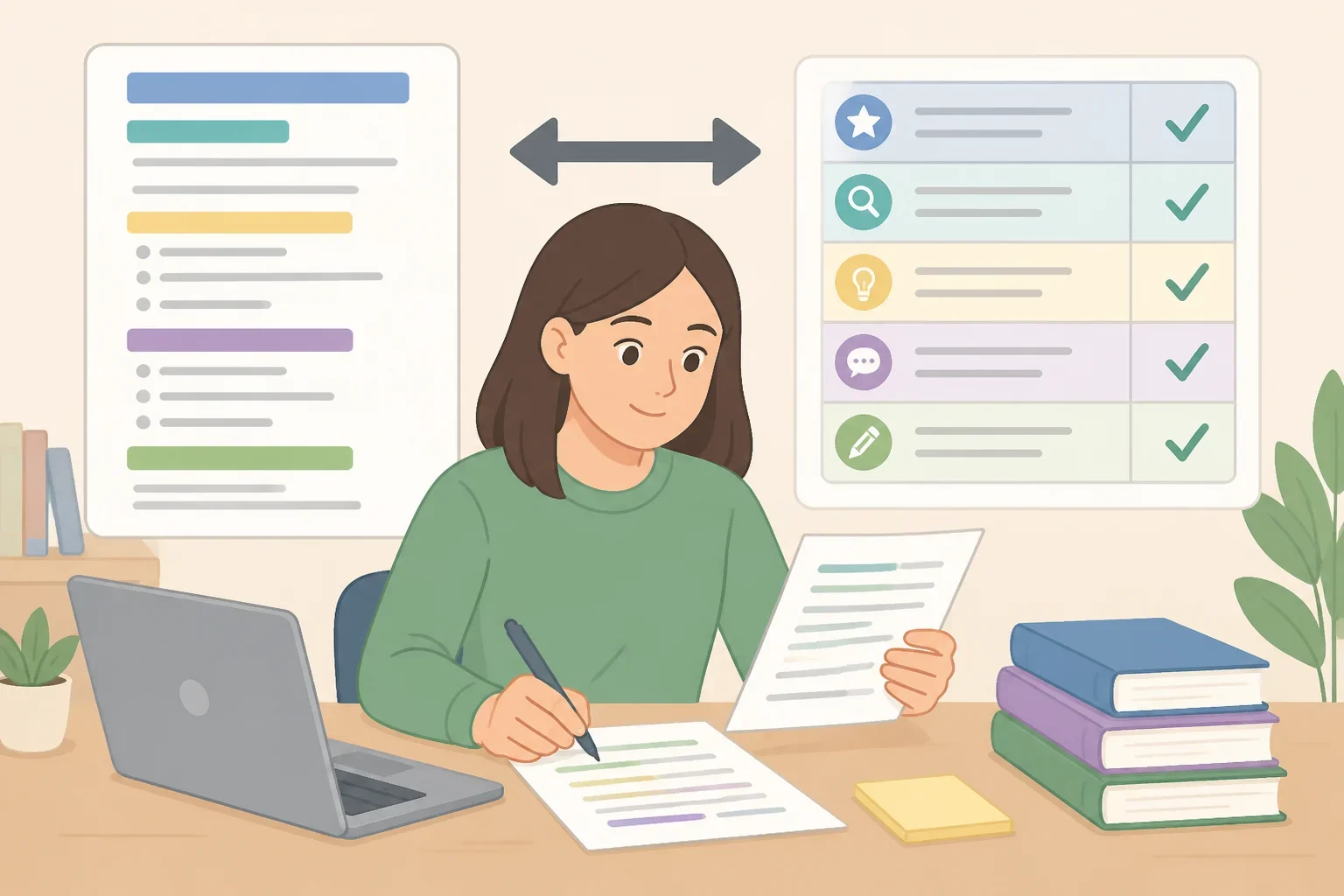
- Summarize each paragraph in one sentence. Read the draft and write a single sentence capturing the core claim or job of each paragraph, in the margin or in a separate document. Skip the supporting quotes and details; just name what the paragraph is doing. This lines up with the approach Purdue OWL describes for reverse outlining.
- List the summaries in order. Once every paragraph has a one-sentence stand-in, line those sentences up the way they appear in the draft. That list becomes a skeleton of what the essay actually argues, which can differ from what the writer meant to argue.
- Add a relationship label between each neighboring pair. This guide adds a relationship-label step on top of the summary list: for every two summaries that sit next to each other, write a short word describing the connection, such as supports, explains, contrasts with, provides evidence for, or responds to. If no label fits naturally, that pairing is worth a second look. It might point to a logic gap, a summary that's too vague to capture what the paragraph does, or a thesis that needs sharpening, not automatic proof something is broken.
- Check the full sequence against the thesis. Read the list of one-sentence summaries on its own, without flipping back to the full paragraphs, and judge whether it holds together as a standalone sequence. One way to apply that: compare the sequence against a pattern that fits the thesis, such as problem, evidence, proposed response, objection, and reply, or claim, evidence, interpretation. Those specific patterns are this guide's way of applying that test, not a method pulled from one source.
Reverse outlining works on paper, in a word processor, or in an outline view if the writing program has one. Longer papers have more paragraphs to work through, so plan for a longer session than a one-page draft would need.
Telling a missing transition from missing reasoning
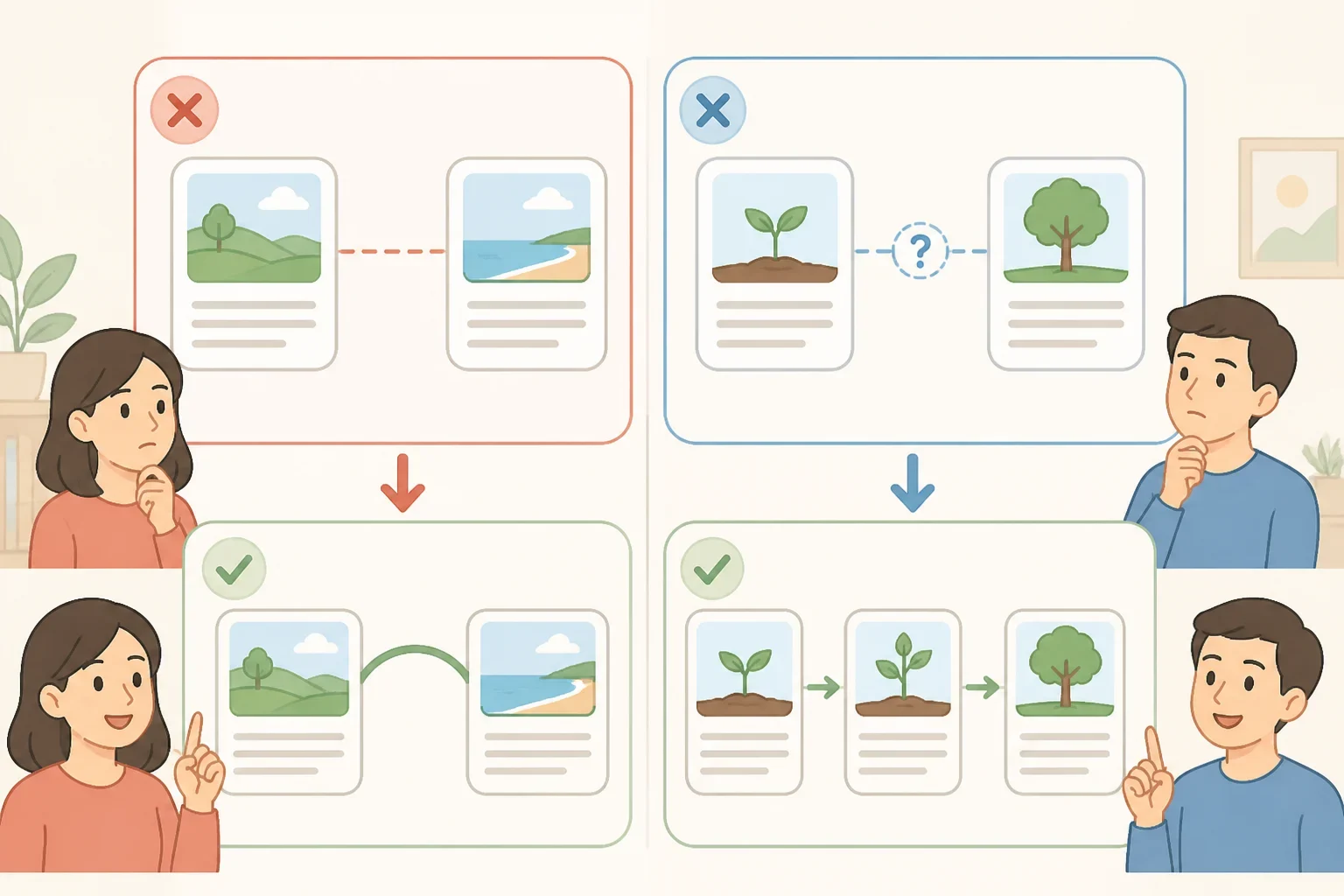
Once a gap shows up between two summaries, the fix depends on what kind of gap it is, and the difference matters more than just noticing something feels off.
Picture a paragraph summary that says a study found online learners spend more independent study time than classroom learners, followed by a summary arguing that online courses should add more structured check-ins. The connection already exists in the reasoning, even if no sentence says it outright: more independent time without built-in accountability is exactly why check-ins would help. A reader just needs the sentence that says so, something like "Because that time isn't structured, courses may need to build in check-ins to keep students on track." That's a missing transition.
Now picture the same first summary followed by one arguing the course should switch to pass/fail grading instead. No transition sentence repairs that gap, because nothing about independent study time actually supports a grading change. The essay needs a new paragraph connecting study time to grading before any transition could make sense. That's missing reasoning, and no amount of smoother wording fixes it.
Testing a thesis against the outline
Here's a hypothetical example showing both problems inside the same outline: an essay arguing that a school should start a campus recycling program because current waste habits overload the landfill and ignore cheaper options. A first-draft skeleton might look like this:
- Explains current waste disposal practices on campus.
- References a statistic meant to show the scale of recyclable waste being thrown out, without yet connecting it to the program being proposed.
- Re-explains the same waste-practice point from paragraph one, mostly in different words.
- Raises a cost objection about buying and placing collection bins, with nothing after it to answer that objection.
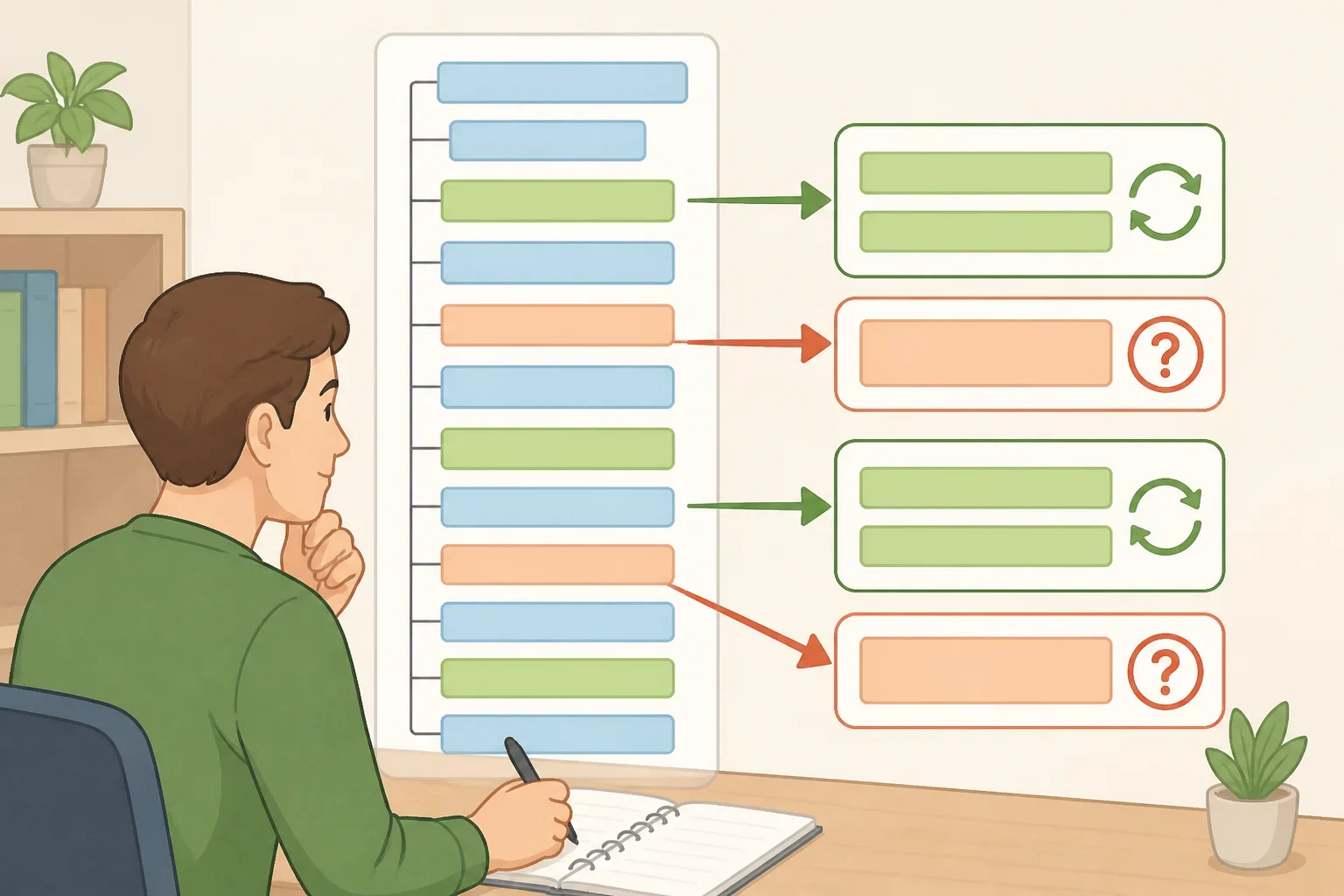
Reading this list top to bottom shows two problems right away: paragraph three repeats paragraph one instead of adding anything new, and paragraph four raises an objection that nothing in the essay answers, the same kind of missing-reasoning gap described above. Labeling paragraph three "repeats" and paragraph four "needs reply" makes both problems visible without rereading the full paragraphs. A revised skeleton might run like this instead:
- Explain current waste practices, setting up the problem.
- Establish the scale of the problem with the statistic, providing evidence of scale.
- Connect that scale to the case for a recycling program, proposing a response.
- Present the cost objection, testing the proposal.
- Answer the cost objection, replying to it directly.
Paragraph three now needs genuinely new content instead of a repeat, and paragraph five is an addition the original draft never had. That new paragraph would need evidence comparing the program's upfront cost with the current disposal cost, not a specific dollar figure invented for the sake of the outline. The waste statistics, cost claims, and program described here are hypothetical, built to illustrate the method, not findings about any real school.
Reading the outline for other problems
Repetition and a missing logical step are two of the more common issues a reverse outline turns up, but two others are easy to miss unless a writer is looking for them.
One summary doing two jobs at once usually signals an overloaded paragraph trying to introduce a point and argue it in the same block of text. Splitting it into two paragraphs, each with its own job and its own relationship to its neighbor, is one way to handle it.
The other risk runs the opposite direction: a tidy one-line summary can make a paragraph look connected when the actual paragraph is still vague or tangled. A summary like "explains the benefit of the program" might sound clean on the outline even if the real paragraph buries that point after three sentences of throat-clearing. Checking the actual topic sentences against what the summaries claim keeps the outline honest.
Reverse outlining diagnoses structure and the logic connecting paragraphs. Grammar, citation formatting, and sentence-level clarity are separate work that still needs its own editing pass once the structural work is settled. Rubrics weigh organization against clarity differently from class to class, so checking the actual rubric is the clearest way to confirm how those categories are scored.
What to check before revising
Before rearranging anything, check the assignment prompt against a short list:
- Does it require a specific number of body paragraphs or sections?
- Does it require a counterargument or an objection-and-reply structure?
- Does it require a minimum number of sources, or sources used in a particular order?
- Does it require a set genre sequence, such as a five-paragraph essay or something like IMRaD (introduction, methods, results, discussion), a structure some science and lab-report assignments use? Checking the syllabus or asking the instructor is the surest way to confirm, since this varies by course and discipline.
- Does the thesis itself promise an order, such as causes before effects, or problem before solution?
Any of these can limit how freely paragraphs move, regardless of what the reverse outline suggests. Reverse outlining still helps inside those limits; it just means testing the order against the required format instead of against open-ended logic alone.
What to do next
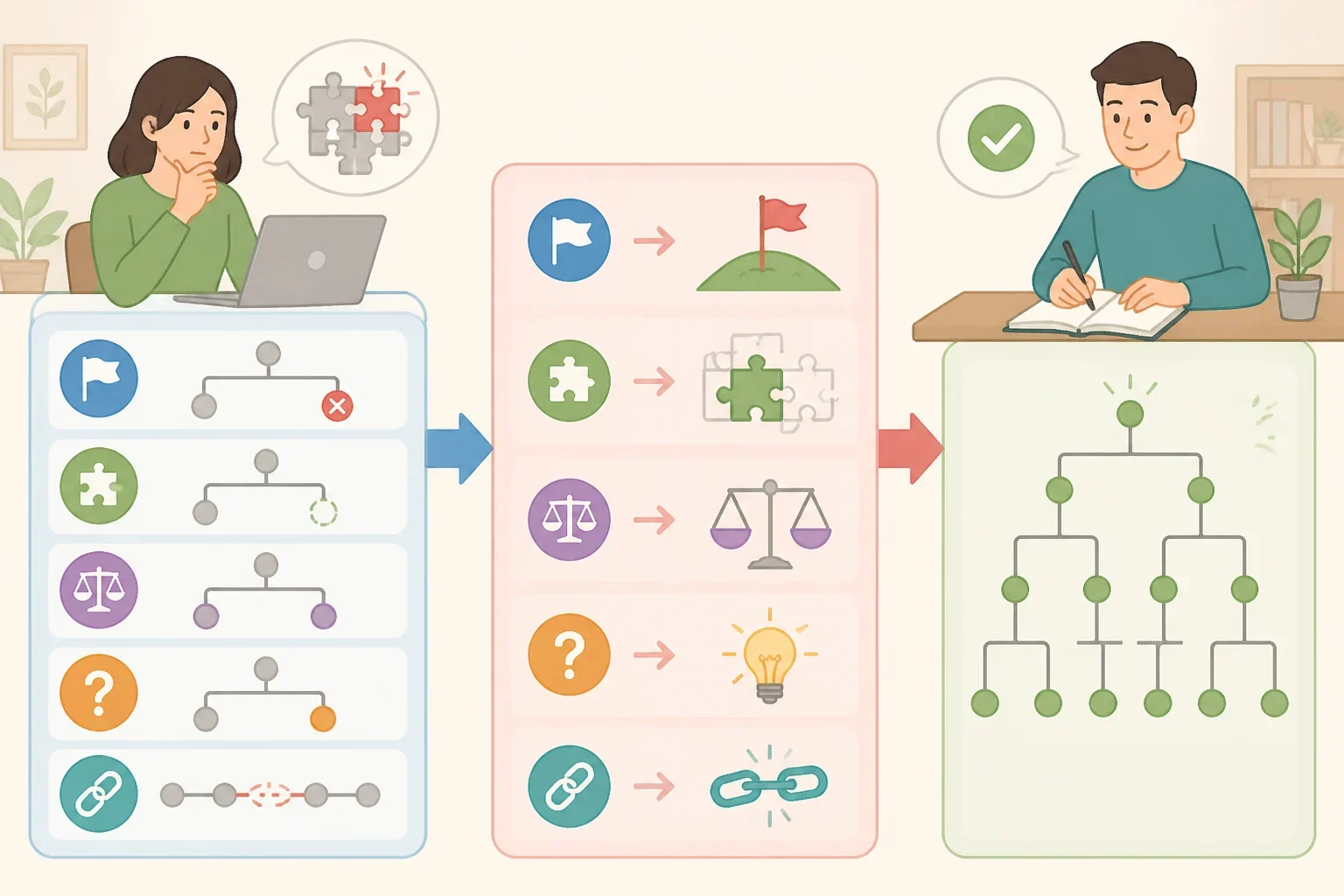
Once the prompt's limits are clear, finish the full outline before touching any sentences: every summary, every relationship label, every repeat, gap, and order problem flagged along the way. Fix the issue that touches the most paragraphs or blocks the thesis most directly first, rather than whatever weak spot caught attention first.
Match each fix to the problem it addresses: reorder paragraphs that are sound but out of sequence, merge or cut paragraphs that repeat each other, add evidence where a claim has none, add explanation where evidence exists but its relevance isn't clear, and add a transition only where the connection already exists and just needs to be said out loud. Once the essay is revised, reread just the topic sentences in order and compare that short list against the thesis; a paragraph can still drift from the thesis even when its topic sentence reads fine next to its neighbors.
For one current draft, summarize every paragraph, label each connection between neighbors, and mark the first place where the thesis, the evidence, and the paragraph order stop lining up. That's often the clearest place to start revising.